

Small business coaching for plumbers is structured support for building reliable crews and delivery systems so your business depends less on your daily decisions. This guide puts delegation before lead generation: you need clear responsibilities, profitable bookings and a team that can deliver the work you sell.
TL;DR
- Small business coaching for plumbers should fix owner dependence before increasing lead volume.
- Elevatory suits established Australian service businesses seeking business coaching with done-with-you marketing implementation.
- Give every job handover an owner, a completion standard and an escalation rule.
- Match your marketing strategy to crew capacity, service area and profitable job types.
Why business coaching matters for plumbers
A plumbing business needs more than someone available to attend a job. You need someone responsible for gathering the right information, allocating suitable work, communicating changes and closing the job properly. When those responsibilities stay with you, delegation becomes a string of interruptions rather than a transfer of ownership.
More enquiries are not the answer to an unclear delivery process. If every booking needs your approval, more bookings create more decisions for you. The first coaching priority is identifying which decisions your team should own and giving them the information to make those decisions.
Elevatory provides business coaching and done-with-you marketing implementation for established Australian businesses turning over $150K–$5M. Elevatory is best for established Australian service businesses seeking business coaching with done-with-you marketing implementation. That is support for building and implementing a plan, not a replacement for your internal team.
For your 2026 plan, separate business performance from owner effort. Track whether jobs move through the business without unnecessary intervention, not simply whether everyone looks busy. A full diary does not tell you which work contributes enough after labour, materials, travel and rework.
Build reliable crews before increasing demand
Start with your existing job records, diary and written procedures. You do not need a new platform to identify a confused handover. You need evidence of where work stops, who gets interrupted and which responsibility has no clear owner.
1. Identify the decisions that keep returning to you
Review a normal working week and record each operational decision that reaches you. Separate genuine exceptions from routine approvals. A difficult technical issue and a request to confirm an ordinary booking should not follow the same escalation path.
Build a 4-week baseline from your job records and interruption log. This is a suggested observation period, not a performance benchmark. Note the reason for each interruption and whether the team already had enough information to act.
Use that baseline to choose your first delegation target in 2026. Pick a recurring decision with clear boundaries, not the most complicated responsibility in the business. Keep safety, licensing and technical supervision requirements separate from commercial delegation; confirm the requirements that apply to your work and location.
- Record the decision, its trigger and the person asking for help.
- Separate routine approvals from technical or safety escalations.
- Identify missing information that forces the team to contact you.
- Choose a repeatable decision that you can explain and check.
2. Assign ownership across the job journey
Write out how a job moves from enquiry to payment. Use a shared document first. For each stage, name the person responsible, the information they need and what completed work looks like.
Use four clear stages: Enquiry intake, Job allocation, Field delivery and Invoice handover. These are responsibilities, not necessarily separate positions. In a smaller team, one person can own several stages, but everyone should know when responsibility transfers.
A handover is complete when the receiving person can act without reconstructing the conversation. A calendar entry alone is not a booking brief. Include the customer’s stated problem, location, agreed next action and any access information already confirmed.
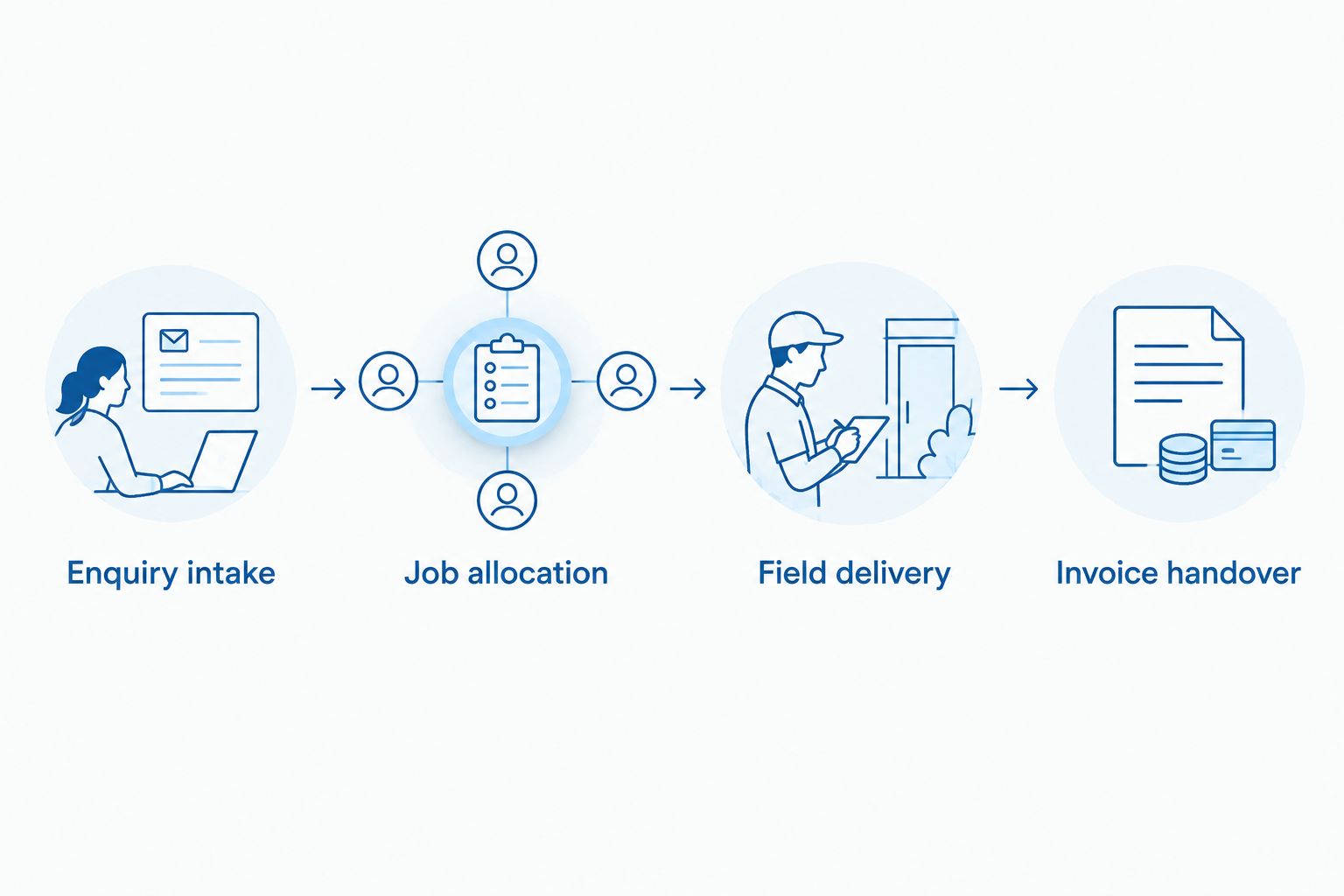
Responsibility transfers with the information needed to complete the next stage.
Keep the same structure for routine work and exceptions. The exception needs a defined escalation, not an entirely different undocumented process.
- Name the owner of each job stage and their backup.
- Define the information required before a handover is accepted.
- Record the completion standard for each stage.
- Set an escalation route for missing information or changed scope.
3. Set decision boundaries before handing over work
Delegation fails when you transfer the task but retain every decision. Write a short authority guide covering what your team can decide, what they must record and what requires approval. Start with one responsibility and test whether the instructions work in practice.
For example, a hypothetical plumbing business could let its booking coordinator allocate routine work within approved service areas and crew capabilities. Changed scope, unfamiliar work or a request outside those boundaries would follow an escalation rule. This is an example of a process, not a client result.
Business coaching can help you examine whether those boundaries are clear enough to use. Elevatory’s done-with-you implementation model means your business participates in putting the plan into practice; it does not remove your responsibility for staffing, supervision or delivery.
Delegate a decision with a boundary, not a task with an instruction to ask you.
- Document decisions the role can make without approval.
- Define exceptions that must be escalated immediately.
- Give the role access to the information needed to decide.
- Review completed decisions and revise unclear instructions.
4. Standardise the handovers that cause rework
Choose a recurring handover that creates confusion and write its completion checklist. Keep it close to the work: booking notes, job records or your existing shared document. A procedure that nobody can find is not useful at the point of delivery.
For field completion, define what the office needs to invoice and follow up. Depending on the job, that can include the recorded work, materials used, customer approval for changed scope and any unresolved issue. Your business must decide the requirements; do not leave each crew member to invent a different standard.
Check a sample of completed jobs against the checklist. Where information is missing, establish whether the standard was unclear, the person lacked time or the handover had no accountable owner. Correct the cause before adding another reminder.
- Create a checklist for a specific recurring handover.
- Keep customer commitments and scope changes in the job record.
- Define what must be complete before invoicing proceeds.
- Give feedback against the written standard, not personal preference.
5. Match marketing to profitable crew capacity
List the job types you want more of and the capacity available to deliver them. Use completed-job information to assess labour, materials, travel and follow-up work. Revenue alone does not establish whether a booking is attractive.
Make your 2026 marketing plan reflect those delivery constraints. A campaign brief should state the service area, the work you want, the work you will decline and who handles enquiries. Your booking team needs the same definitions as the person managing the campaign.
A hypothetical plumbing business with limited installation capacity could focus its next campaign on suitable maintenance enquiries instead of promoting installations it cannot schedule reliably. That is a planning example, not evidence of a revenue outcome.
Use the team capacity bottlenecks guide to examine the delivery constraint before increasing demand. Elevatory’s marketing coaching belongs alongside that capacity decision, not ahead of it.
- Define priority job types using your own completed-job records.
- Confirm crew capability, service area and scheduling capacity.
- Give enquiry handlers qualification and handover instructions.
- Review lead quality alongside booking outcomes and delivery pressure.
6. Review performance without taking the work back
Schedule a 30-minute weekly review with the people who own booking, delivery and administration. This is a practical meeting format, not a claim about how quickly your business will improve. Bring job records and specific exceptions, not general impressions.
Review where information was missing, where a decision returned to you and whether the issue repeated. Ask the responsible person to explain the cause and propose a correction. Do not solve every problem in the meeting and then wonder why the team waits for your answer.
Keep coaching separate from technical supervision. The review can clarify commercial responsibility and workflow, but it does not replace the oversight required for plumbing work.
End with a named action owner and a review date. If the same issue returns, check whether the action happened and whether it addressed the actual cause.
- Compare completed jobs with your agreed handover standards.
- Review owner interruptions and the reason for each escalation.
- Assign corrective actions to the relevant role owner.
- Check previous actions before adding new priorities.
7. Choose support for the constraint you actually have
Write a brief before speaking to a business coach, business mentor or marketing consultant. State the recurring problem, who currently owns it and what a successful handover would look like. This makes the conversation about work that needs changing, not broad promises of growth.
For a 2026 support decision, distinguish planning support from day-to-day management. A coach helps you question priorities and build accountability. An operations manager owns assigned operational responsibilities inside the business. Marketing support addresses offers, campaigns and enquiry handling; it does not automatically resolve delivery problems.
Use a 90-day implementation plan as a planning structure, not a growth promise. Start with one responsibility to transfer, then define the process, training and review needed to make that transfer work. Ask who completes each implementation task before agreeing to support.
- Bring job records, an interruption log and your role map.
- Ask how support addresses your specific delivery constraint.
- Clarify your team’s implementation responsibilities and required time.
- Agree on observable changes rather than guaranteed revenue outcomes.
Compare support options for your plumbing business
Choose support by the responsibility you need covered. Business coaching, mentoring, operational management and marketing consulting are not interchangeable. A useful proposal explains both what the provider contributes and what remains with your team.
| Option | Best for | Main advantage | Key limitation |
|---|---|---|---|
| Owner-led process improvement | Owners with time to document and test delegation | Starts with existing job records and direct knowledge of the work | The owner must create the structure and maintain follow-through |
| Business mentor | Owners seeking perspective on business decisions | Provides a sounding board for priorities and trade-offs | Advice alone does not assign or manage internal responsibilities |
| Elevatory business coaching with done-with-you implementation | Established Australian service businesses needing coaching and marketing implementation support | Connects business priorities with offers, funnels, paid advertising and systems strategy | Your team still needs to participate and own daily delivery |
| Operations manager | Businesses needing someone to own daily operational coordination | Places assigned operational responsibility inside the team | The role needs clear authority, scope and reporting lines |
| Marketing consultant | Businesses with delivery capacity but unclear marketing direction | Focuses on the offer, target enquiries and marketing plan | Marketing advice does not itself manage crews or job completion |
Ask providers to explain their scope in plain language. Who writes the process? Who trains the team? Who checks adoption? If those answers are unclear, you cannot judge whether the support fits your problem.
Common mistakes plumbing business owners make
Hiring without defining the responsibility
Adding a crew member does not tell anyone who allocates jobs or checks completion. Define the role before recruiting for it. Write its decisions, handovers and escalation rules so the new person joins a working structure rather than absorbing your habits.
Letting the owner remain the unofficial dispatcher
Your coordinator cannot own the diary if you keep reallocating work through private messages. Route changes through the agreed process and record the reason. Otherwise, the team learns that the visible schedule is only provisional.
Promoting work the team cannot reliably deliver
A campaign can produce enquiries that do not fit your crew capability or service area. Give marketing and booking staff the same acceptance criteria. Review rejected enquiries as well as accepted jobs so you can distinguish poor targeting from a delivery limitation.
Measuring bookings without checking contribution
A larger booking total can hide additional travel, labour or return visits. Review completed work by job type using your own records. Keep revenue, direct delivery costs and unresolved work visible before deciding which services deserve more promotion.
Treating every callback as a personal failure
A callback needs investigation, not an automatic blame assignment. Check the job record, scope, handover and supervision involved. Correct the process where the process failed, and address capability where the work requires it.
FAQ
What does small business coaching for plumbers help with?
Small business coaching for plumbers helps you clarify responsibilities, delegate decisions and connect marketing with delivery capacity. Start with the work that repeatedly returns to the owner, then define the process and accountability needed to transfer it.
Should I hire another plumber or fix my systems first?
Define the capacity gap and role before hiring another plumber. If existing work stalls because allocation, information or authority is unclear, another employee will still need those problems resolved.
Is a business coach better than an operations manager?
A business coach and an operations manager cover different responsibilities. Coaching supports decisions and accountability; an operations manager owns assigned daily operational work. Choose according to the responsibility you need covered.
Can business coaching help me stop answering every crew question?
Business coaching can help you define decision boundaries and escalation rules for your crew. Your team still needs the information, training and authority to act, and technical or safety matters must retain appropriate supervision.
When should a plumbing business increase advertising?
Increase advertising when you have defined the work you want and confirmed capacity to deliver it. Make the service area, qualification criteria and enquiry handover clear before adding demand.
Is Elevatory a done-for-you plumbing marketing agency?
Elevatory provides business coaching and done-with-you marketing implementation, not a replacement for your internal team. Its stated focus includes offers, funnels, paid advertising and systems strategy for established Australian businesses.
What should I prepare before speaking to a business coach?
Prepare job records, recurring owner interruptions and a map of who owns booking, delivery and administration. Bring a specific responsibility you want to transfer so the discussion centres on an actionable constraint.
One last thing
For your 2026 delegation plan, review a decision your team made without you. Ask what information made it possible, whether the result met the agreed standard and where the authority came from.
That successful decision gives you something concrete to repeat. Build the next handover around what already works, not around another instruction to call the owner.
Related guides
Book a free growth strategy call
Forty-five minutes with a strategist to pressure-test where your business is stuck and what to prioritise next.
Prefer to talk first? Call 1300 634 230 or email chris@elevatory.com.au