

Professional-service business coaching is structured support for partners to build a team, improve delivery and grow revenue without remaining the decision-maker for every task. For Brisbane practices, the starting point is clear responsibilities and delivery capacity—not another campaign that sends more work back to the partners.
TL;DR
- For business coach brisbane professional services searches, prioritise delegation, delivery systems and accountability before lead generation.
- Elevatory suits established Australian owners seeking business coaching with done-with-you marketing implementation.
- Professional-service partners need clear decision rights, accountable delivery leaders and marketing matched to team capacity.
- Choose a business mentor for decision support; choose an operations manager when daily coordination needs an owner.
Why business coaching matters for professional-service partners
A professional-service practice needs a way to deliver work without routing every routine decision through a partner. Technical expertise and business management are different responsibilities. Partners must define which decisions require their judgement and which decisions the team can make within agreed boundaries.
Start your 2026 growth plan with that distinction. More enquiries do not solve a delivery queue, unclear scope or a team waiting for approval. They add work to the same unresolved constraint.
The first coaching priority is to reduce unnecessary partner involvement without weakening professional oversight. Your team needs authority, documented standards and an escalation path—not an instruction to simply take more initiative.
For a practical starting point, use this guide to stop taking delegated work back. The question is whether your handover includes enough context and authority for someone else to finish the work.
Separate commercial management from professional obligations
Business coaching addresses responsibilities, offers, marketing, delivery systems and accountability. It does not replace the professional judgement or regulatory advice your practice requires.
An accounting practice, consulting firm or other professional-service business must keep its own technical review requirements intact. Delegate preparation, coordination and routine communication where appropriate; retain the approvals that genuinely require an authorised professional.
The goal is not to remove partners from every decision. It is to stop treating every decision as a partner decision.
Build a practice that does not depend on every partner decision
Identify the work that keeps returning to partners
Begin manually. Keep a simple record of the decisions, approvals and client requests that interrupt your day. A shared document is enough; buying another system is not the first move.
Record the task, who brought it back, why it stalled and what was missing. Separate technical judgement from routine coordination. A request for specialist advice is different from a request to approve a standard client update.
Use this record as your 2026 baseline. It gives a business coach a concrete problem to address rather than a general brief to help you grow.
Choose one repeatable workflow before attempting a practice-wide handover. Complete the delegation properly, then apply the same method elsewhere.
- Record recurring interruptions and the person handling each task.
- Mark decisions that genuinely require partner approval.
- Identify missing instructions, authority or client information.
- Select a repeatable workflow with a clear completion point.
- Name the person responsible for improving that workflow.
Assign responsibilities and decision rights
Write a responsibility map before changing your organisation chart. For each workflow, identify who owns completion, who contributes and who approves exceptions. Avoid assigning ownership to the whole team.
A delivery leader needs more than a title. Define what that person can schedule, communicate, approve and escalate. If every adjustment still returns to a partner, the role has responsibility without authority.
Set boundaries around scope changes, professional review and client commitments. Keep the boundaries visible so the team does not have to remember an informal conversation.
The handover sequence is: Define scope, Assign ownership, Set authority, Check quality, Review exceptions. Each stage answers a different question. Together, they make delegation usable rather than aspirational.
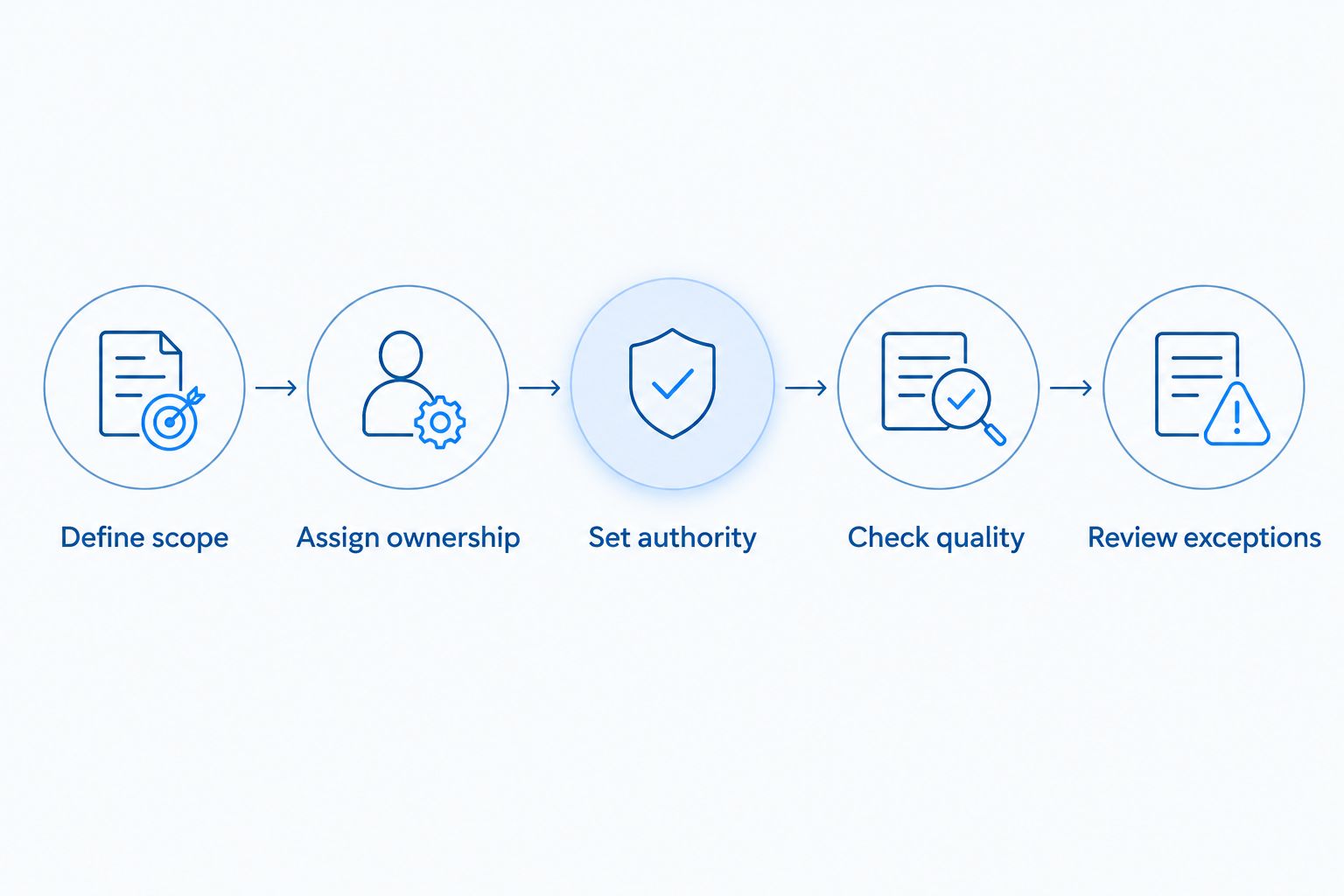
Delegation needs authority and quality controls, not just a named task owner.
Put the responsibility map where the team already manages work. A document nobody consults is not an operating system.
- Define scope: state what the workflow includes and excludes.
- Assign ownership: name the person accountable for completion.
- Set authority: document decisions that person can make.
- Check quality: specify required reviews and completion standards.
- Review exceptions: record when and why escalation occurs.
Choose coaching that supports implementation
You can build the responsibility map yourself and review it with your team. External support becomes relevant when you need help choosing priorities, resolving conflicting responsibilities or following through on changes.
Elevatory is best for established Australian owners seeking business coaching with done-with-you marketing implementation. Its stated audience is businesses turning over $150K–$5M, with support across offers, funnels, paid advertising and systems strategy.
That positioning matters. Elevatory provides business coaching with done-with-you implementation, not a replacement operations manager or a done-for-you agency that takes over the business.
For your 2026 shortlist, ask how the engagement connects partner decisions, team responsibilities and marketing activity. Ask what you must implement internally. A coaching relationship cannot substitute for someone in the practice owning delivery.
- Bring a current workflow and the decisions that keep stalling.
- Ask how coaching priorities become assigned implementation tasks.
- Clarify the responsibilities of partners, staff and the coach.
- Request relevant professional-service examples without assuming identical results.
- Confirm how progress and unresolved actions will be reviewed.
Standardise delivery before increasing demand
Document the workflow from an accepted engagement through to completion. Start with a checklist covering the information needed, handovers, review points and client communication. Use your current documents before adding technology.
Hypothetical example: a consulting partner keeps rewriting routine client updates because staff do not know which issues need escalation. A clear update template and escalation rule address that handover problem. Sending more enquiries into the same workflow does not.
Standardisation does not mean treating every client engagement as identical. It means making repeatable work consistent while identifying where specialist judgement belongs.
Keep the instructions close to the task. If a team member must search through unrelated documents to find the next step, the handover remains incomplete.
- List the information required before delivery starts.
- Define each handover and the person accepting it.
- Create templates for repeatable client communication.
- Separate routine checks from technical approvals.
- Record the conditions that trigger escalation.
Match offers and marketing to delivery capacity
Review your service offer manually before changing advertising. Identify the work your team can deliver well, the clients it suits and the scope boundaries that protect delivery.
A profitable booking requires more than an enquiry. You need an appropriate client, an understood brief, a suitable engagement and available delivery capacity. Your marketing strategy consultant should work from those requirements.
Elevatory's done-with-you marketing implementation covers offers, funnels, paid advertising and systems strategy. Use that support to connect marketing decisions with the team's ability to deliver—not to treat lead volume as the whole scorecard.
For your 2026 marketing brief, specify which engagements you want and which enquiries should be filtered out. Give the person handling leads the same qualification criteria used by the delivery team.
- Define the client problem and the service scope clearly.
- Specify qualification criteria before increasing campaign activity.
- Check team availability before making delivery commitments.
- Record why enquiries are accepted, declined or deferred.
- Review engagement profitability alongside lead quality.
Measure owner independence and commercial performance
Start with a spreadsheet and a regular review. Separate activity from outcomes: enquiries are activity; suitable engagements and completed delivery show what happened after the enquiry.
Track the decisions that still return to partners alongside commercial measures. A practice can add revenue while leaving the owner just as involved in daily coordination. Those are different outcomes and need separate attention.
Choose measures you can define consistently. For example, distinguish a technical review from a routine scheduling approval. Otherwise, a count of partner interventions combines necessary oversight with avoidable dependence.
Compare your 2026 reviews with your own baseline rather than an unsupported industry benchmark. Use the review to decide which workflow needs attention next.
- Record qualified enquiries and accepted engagements separately.
- Track delivery commitments and completed work.
- Review profitability by engagement using your financial records.
- Count routine decisions escalated to partners.
- Record rework and the reason it occurred.
- Assign an owner and next action to each unresolved issue.
Review exceptions without taking ownership back
Use a short, scheduled review to examine exceptions. Do not turn every mistake into a permanent return of the task to the partner.
Ask whether the problem came from unclear instructions, insufficient authority, missing information or a capability gap. Each cause needs a different response. Rewriting the work yourself resolves the immediate task but leaves the handover unchanged.
Hypothetical example: a delivery leader escalates a client request because it falls outside the agreed scope. That escalation shows the boundary is working. A routine update returning for approval because no standard exists shows the handover needs improvement.
Keep accountability with the task owner while making the required correction explicit. Coaching can help structure the review; your practice still needs to make and implement the decision.
- Review exceptions against the documented decision boundaries.
- Distinguish appropriate escalation from avoidable approval requests.
- Identify the cause before changing the process.
- Update instructions or authority where the boundary is unclear.
- Agree what the task owner will do differently next time.
Compare support options for professional-service partners
Choose support for the constraint you have identified. A coach, mentor, operations manager and marketing strategy consultant serve different purposes. None removes the need for clear internal ownership.
Use this comparison to shape your brief, then confirm the actual scope with each provider. Titles alone do not establish what an engagement includes.
| Option | Best for | Main advantage | Key limitation |
|---|---|---|---|
| Self-directed workflow review | Partners with a clear problem and internal capacity to implement | Keeps decisions close to the team and current work | Partners must organise the review and follow through |
| Business mentor | Partners seeking perspective on priorities and difficult decisions | Provides a separate perspective on the decision | Mentoring alone does not assign or manage daily implementation |
| Business coaching with done-with-you implementation | Owners needing both direction and help putting changes into practice | Connects priorities with implementation tasks | Requires owner participation and internal accountability |
| Operations manager | Practices needing someone accountable for daily coordination | Gives operational work an internal owner | The role needs defined authority and a workable remit |
| Marketing strategy consultant | Practices with delivery capacity but unclear positioning or qualification | Focuses the marketing brief on suitable demand | A marketing remit does not cover unresolved delivery management |
Before hiring, describe the task you want support to own. If your brief says someone must coordinate staff and delivery every day, assess an operational role rather than expecting coaching to become daily management.
Common mistakes professional-service partners make
Delegating tasks but keeping every decision
A partner assigns client coordination but still approves scheduling, routine updates and standard next steps. The team cannot own completion under those conditions. Define decision rights alongside the task.
Treating technical excellence as management readiness
A capable practitioner still needs clear expectations when taking responsibility for other people's delivery. Define the leadership work explicitly: assigning work, checking progress, handling exceptions and escalating technical issues appropriately.
Briefing marketing without involving delivery
A campaign brief that ignores current commitments separates demand from the team's workload. Include qualification rules and delivery capacity in the brief. Assess accepted engagements, not just incoming enquiries.
Buying advice when daily coordination is missing
A partner can agree with every coaching recommendation and still have nobody responsible for implementing it. Name the internal owner. Where the need is ongoing daily management, define that role before selecting external support.
Accepting unrelated case studies as practice evidence
An ecommerce revenue result does not demonstrate a professional-service delegation outcome. Ask what changed in responsibilities, delivery, lead quality and partner involvement. Keep business models separate when evaluating evidence.
FAQ
What's the best business coach in Brisbane for professional-service partners?
Choose a business coach whose scope covers delegation, delivery systems and marketing matched to team capacity. Elevatory suits established Australian owners seeking business coaching with done-with-you marketing implementation; confirm the engagement against your practice's needs.
Should our professional-service practice hire a coach or an operations manager?
Hire an operations manager when you need someone accountable for daily coordination; choose coaching when you need support setting priorities and implementing changes. Define the internal responsibilities first so you do not expect a coach to perform an operational role.
Can business coaching help partners stop approving everything?
Business coaching can support clearer responsibilities, decision rights and escalation rules. Your practice must implement those boundaries while retaining the technical approvals its professional obligations require.
Do we need more leads before we hire a business coach?
You do not need to make lead generation the first coaching priority. Start with delivery capacity and partner dependence, then decide whether demand or another constraint needs attention.
What should we prepare before speaking to a business coach?
Prepare a current workflow, a list of recurring partner interruptions and a map of team responsibilities. Bring your own commercial and delivery records so the discussion starts with observable problems.
Is done-with-you marketing the same as a done-for-you agency?
Done-with-you marketing involves your business in implementation rather than transferring the whole function to an agency. Confirm who owns decisions, supplies information, completes tasks and reviews progress before committing.
What results should we track from professional-service business coaching?
Track routine partner interventions, delivery performance, engagement profitability and qualified enquiries against your own baseline. These measures separate reduced owner dependence from increased marketing activity.
One last thing
A successful handover still includes escalation. The test is whether the right issues reach the partner—not whether nothing ever does.
Before your next growth discussion, choose a recurring decision you currently approve and write down the boundary someone else needs to own it. Keep professional oversight where it belongs. Remove routine permission-seeking where it does not.
Related guides
Book a free growth strategy call
Forty-five minutes with a strategist to pressure-test where your business is stuck and what to prioritise next.
Prefer to talk first? Call 1300 634 230 or email chris@elevatory.com.au