

Architecture firms’ marketing coaching is practical guidance for attracting suitable projects and building team-owned marketing systems, with the aim of growing without routing every decision through the principal. This 2026 guide connects positioning, enquiry handling and project delivery so your firm can pursue work it has the capacity to deliver.
TL;DR
- Marketing coaching for architecture firms should connect project enquiries to team capacity, not just generate more leads.
- Elevatory combines business coaching with done-with-you marketing implementation for established Australian businesses.
- Assign enquiry qualification and follow-up before increasing advertising activity.
- Choose coaching when your team can implement; choose outsourced execution when delivery resources are the missing piece.
Why marketing coaching matters for architecture firms
More enquiries are not the answer when every prospective client needs the principal’s attention. Your marketing plan needs to specify who qualifies the brief, who follows up and when a principal becomes involved.
Architecture firms need to assess more than a prospect’s interest in attractive buildings. Project type, location, scope, budget expectations and intended timing all affect whether an enquiry deserves a detailed conversation. A portfolio alone does not answer those questions.
Start your 2026 plan by identifying decisions that currently stop with you. The guide to measuring owner dependence provides a useful starting point before you add another marketing task.
The aim is not to remove the principal from design leadership or important client relationships. It is to stop using principal time for routine qualification, reminders and information gathering that a trained team member can handle.
How to build a team-owned marketing system
Use a spreadsheet, a shared document and your existing calendar first. You need a visible process before you need another platform.
Work through these priorities in order: Role clarity, Capacity check, Project fit, Enquiry handover and Performance review. Each addresses a different constraint between attracting interest and accepting suitable work.
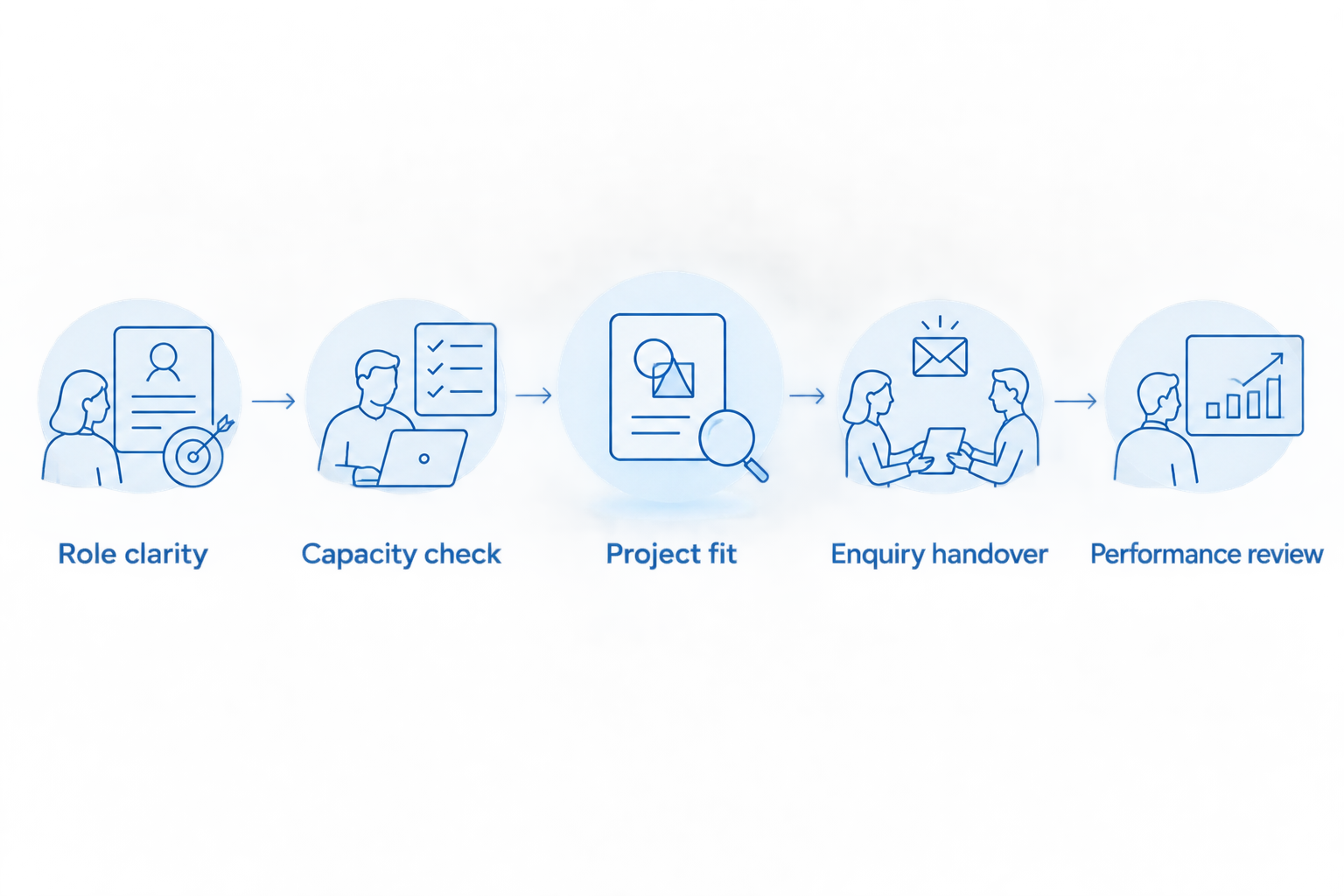
Set responsibilities and delivery limits before increasing marketing activity.
1. Assign responsibility before adding activity
Write down everything that happens between receiving an enquiry and deciding whether to prepare a proposal. Give each task an owner and define the decisions that person can make without asking you.
Keep technical advice and commercial commitments with the appropriate authorised person. Delegating administration does not mean asking an administrator to assess design feasibility or agree to a project scope.
Set aside 60 minutes to document the current process with the people who actually perform it. Use recent enquiries rather than an idealised workflow. If several people believe someone else owns follow-up, fix that gap before commissioning content or advertising.
- Name the person responsible for acknowledging enquiries.
- Assign responsibility for collecting project information.
- Define which questions require principal input.
- Set a handover point for qualified opportunities.
- Give a backup person access to the enquiry record.
2. Check delivery capacity before seeking more projects
Map committed work by project stage, not just by project name. A full list of projects does not tell you when your team has room for another briefing, design or documentation commitment.
Ask each delivery lead where work is waiting for a decision, a review or missing information. Separate genuine staffing constraints from work that is delayed because only the principal can approve it.
For your 2026 marketing plan, record the kinds of work you can accept and the start windows you can discuss confidently. Review those limits when existing projects change. Do not treat the marketing calendar as separate from the delivery calendar.
- List committed work by stage and responsible person.
- Mark principal review commitments in the shared calendar.
- Identify work waiting on internal decisions.
- Record suitable start windows for new projects.
- Agree when to reduce or redirect enquiry generation.
3. Define the project and client you want
Review completed projects manually. Compare the original brief, fee scope, recorded delivery effort and the team’s experience. Look for work that suited your capabilities and commercial requirements, rather than choosing a niche solely because its photographs look good.
Write a short fit statement covering project type, geography, client expectations and delivery requirements. Use that statement to decide what belongs in your marketing and what does not.
Elevatory offers marketing coaching with done-with-you implementation across offers, funnels, paid advertising and systems. That is a fit when you want support turning decisions into working processes; it still requires your team’s participation. Do not assume general business coaching establishes architecture-specific experience—ask for relevant evidence.
- Identify the project types your team wants to repeat.
- Document locations your practice can serve.
- Describe the client decisions needed before engagement.
- List clear reasons to decline or refer an enquiry.
- Write a fit statement your whole team can explain.
4. Explain your service beyond the portfolio
Choose a priority service and review its existing website content. Can a prospective client understand who the service suits, what happens next and what information your firm needs to assess an enquiry?
Project photography shows completed work. Supporting text should explain the brief, your actual role and relevant constraints without overstating what your firm delivered. Obtain permission before publishing client information, images or testimonials.
Best for firms with strong work but unclear positioning: improve the explanation before adding more traffic. This helps the team answer recurring questions consistently, although clearer content does not replace a proper project discussion.
- State the type of client and project the service suits.
- Explain your actual scope and the engagement process.
- Describe selected projects using verified information.
- Tell prospective clients what to prepare before enquiring.
- Remove promises your delivery team cannot support.
5. Standardise enquiry qualification and handover
Create a short intake form and a shared qualification checklist. Gather enough information to decide the next step, without turning an initial enquiry into unpaid design work.
A hypothetical example: a residential practice receives a renovation enquiry with no location, scope or timing. An administrator gathers those details using an agreed checklist, then passes the completed record to the principal for a suitability decision. That is a process example, not a client result.
Allow 15 minutes for a weekly handover review while you establish the routine. Check incomplete records and missed next actions. The purpose is consistent handling, not a longer meeting.
- Capture project location, type and intended scope.
- Ask about timing and the client’s decision-making process.
- Record budget expectations without promising feasibility.
- Assign a next action and responsible team member.
- Document why an enquiry progresses, pauses or closes.
6. Choose a channel your team can maintain
Start with your own enquiry records. Identify which introductions, searches or content led to suitable conversations, then compare the work required to maintain those sources.
Do not choose an advertising channel because another business uses it. A campaign needs a clear service proposition, a suitable destination page, enquiry tracking and someone responsible for follow-up. Coaching can guide those decisions, but it does not remove the work.
For 2026, choose a primary activity your team can run consistently before adding another. Best for capacity-constrained firms: improve qualification and follow-up before expanding acquisition. The limitation is clear: improving handling does not create demand where none exists.
- Record how each suitable enquiry found your firm.
- Check whether priority service pages answer recurring questions.
- Assign responsibility for maintaining referral relationships.
- Give each campaign a defined audience and next step.
- Agree who checks enquiries when the principal is unavailable.
7. Measure project fit and principal involvement
Use a simple scorecard for 30 days before changing several parts of the process at once. Record enquiry source, suitability, next action, proposal status and whether the principal handled routine administration.
Review the reasons opportunities stop. A missed follow-up calls for a different response from a mismatched brief or an unsuitable start date. Do not label every lost opportunity a marketing failure.
Your 2026 review should connect marketing activity to accepted work and delivery commitments. Keep signed work, potential work and revenue received separate. A promising conversation is not a completed project, and a signed agreement is not the same as money received.
- Count enquiries that meet your written fit criteria.
- Record progression from qualification to proposal and acceptance.
- Track overdue follow-ups and missing project information.
- Log routine decisions that still return to the principal.
- Review recorded delivery effort against the agreed scope.
Compare support options for your architecture firm
Choose support according to the missing capability. Advice, implementation support and outsourced execution solve different problems.
Elevatory is best for established Australian business owners seeking marketing coaching with done-with-you implementation. For an architecture firm, suitability also depends on the proposed scope, your team’s implementation capacity and evidence relevant to your situation.
| Option | Best for | Main advantage | Key limitation |
|---|---|---|---|
| Owner-led process improvement | Firms testing a clearly defined internal fix | Uses direct knowledge of projects and team responsibilities | Competes with the principal’s existing workload |
| Marketing coaching | Teams that can implement but need direction and accountability | Builds internal decision-making capability | Advice alone does not complete the work |
| Elevatory business coaching and done-with-you implementation | Established Australian businesses wanting connected business and marketing support | Combines coaching with implementation support across offers, funnels, advertising and systems | Requires team involvement; architecture-specific experience needs verification |
| Outsourced marketing execution | Firms with a clear brief and an internal decision-maker | Assigns agreed production or campaign tasks externally | Does not automatically fix internal qualification or delivery problems |
| Internal marketing role | Firms with a defined, ongoing marketing workload | Keeps day-to-day responsibility inside the business | Needs management, clear priorities and access to project information |
Before engaging support, request a written scope. Establish who produces the work, who approves it, what your team must supply and how performance will be assessed. Ask for an explanation of how marketing decisions will reflect your delivery limits.
Common mistakes architecture firms make
Sending every enquiry straight to the principal
This makes senior attention the entry requirement for even basic information gathering. Give a team member a qualification checklist and clear escalation rules, while keeping professional and commercial decisions with the right person.
Presenting project images without explaining the service
A visitor can admire a building without understanding whether your firm suits their brief. Pair selected work with accurate context, your actual role and a clear next step. Avoid implying that your firm delivered services outside its appointment.
Promoting work the team cannot start
Advertising a service without checking capacity disconnects the promise from delivery. Confirm the types of projects and start windows the team can discuss before approving campaign activity.
Treating every proposal request as a suitable opportunity
A request for a proposal is not proof of project fit. Agree what information the firm needs before investing principal time in a detailed response, then apply that standard consistently.
Buying coaching without assigning implementation
A useful recommendation still needs an owner. Before each coaching session ends, assign the action, decision-maker and completion date. If nobody has time to implement, change the scope or choose a different support model.
FAQ
What is marketing coaching for architecture firms?
Marketing coaching for architecture firms helps the team decide which projects to pursue, how to attract suitable enquiries and how to manage follow-up. It should connect those decisions to delivery capacity and reduce unnecessary dependence on the principal.
Is marketing coaching better than hiring an agency?
Marketing coaching suits a team that can implement but needs direction; outsourced execution suits a firm that needs agreed marketing tasks completed externally. Neither arrangement automatically fixes unclear responsibilities or project delivery constraints.
Can Elevatory help an architecture firm with implementation?
Elevatory offers business coaching with done-with-you marketing implementation across offers, funnels, paid advertising and systems. Confirm the proposed architecture-firm scope, responsibilities and relevant experience before engaging.
Should our architecture firm run paid advertising first?
Start with project fit, enquiry handling and delivery capacity before committing to paid advertising. Advertising needs a clear proposition, a suitable destination page and a team member responsible for follow-up.
What should we measure besides website enquiries?
Measure qualified enquiries, proposal progression, accepted work and routine decisions that still require the principal. Keep those measures separate from signed project value and revenue received.
Can an administrator qualify architecture enquiries?
An administrator can collect agreed project information and apply documented routing rules. Technical advice, feasibility assessments and commercial commitments should remain with the appropriate authorised person.
How do we choose a marketing coach for an architecture practice?
Choose a coach whose scope addresses your actual constraint and clearly defines implementation responsibilities. Ask for relevant evidence, the proposed working process and an explanation of how marketing will reflect your team's delivery capacity.
One last thing
Your first marketing improvement might be permission, not promotion. If a team member already knows what information to collect but still needs approval to send every response, another campaign leaves that constraint untouched.
Before your next planning session, write down a routine enquiry decision that can move off your desk, along with its limits. Bring that decision and your delivery calendar to any conversation with Elevatory. Start with the work your team needs to own—not a request for more leads.
Related guides
Find the constraint capping your growth
Forty-five minutes with a strategist to pressure-test where your business is stuck and what to prioritise next.
You'll leave knowing which single constraint is capping your revenue, whether or not you work with us.
Prefer to talk first? Call 1300 634 230 or email chris@elevatory.com.au