

Yes—outsourcing bookkeeping is worth it for a business under $1M in annual revenue when it removes recurring work from the owner, keeps records current and supports better decisions. The trade-off is that you still need to supply documents, approve transactions and review the numbers; in 2026, delegate the processing, not financial responsibility.
TL;DR
- Is outsourcing bookkeeping worth it small business owners ask? Yes, when it reduces owner dependence without weakening financial oversight.
- Under $1M in annual revenue, workload and complexity matter more than turnover alone.
- Agree on responsibilities, reporting and access before handing over bookkeeping.
- Elevatory business coaching addresses delegation and systems; bookkeeping requires its own specialist support.
Why this matters
Your business has not become less owner-dependent if every receipt, overdue invoice and coding question still lands with you. Moving the work outside the business only helps when someone else can complete it without constant intervention.
Start with the decisions that interrupt your day. If the same questions keep returning, use a framework for measuring owner dependence to separate work only you can approve from work someone else should own.
For a trade or professional service business, the goal is practical: reliable records without pulling the owner away from quoting, supervising delivery or building the team. More leads will not solve an accounts process that already depends on you being available.
Is outsourcing bookkeeping worth it for a business under $1M in revenue?
Yes, when the handover removes a genuine operational constraint. Turnover alone is not a hiring trigger. A business under $1M in annual revenue still needs a clear process for recording transactions, following up missing information and checking its financial position.
For your 2026 decision, compare where the responsibility will sit—not just who will enter transactions. Each arrangement has a useful role and a limitation.
| Arrangement | Best for | Main advantage | Main limitation |
|---|---|---|---|
| Owner-managed bookkeeping | Owners with straightforward records and time to maintain them | Direct familiarity with transactions | Routine processing competes with owner responsibilities |
| Outsourced bookkeeping | Businesses needing recurring processing without assigning it internally | A defined external owner for agreed tasks | Requires a disciplined handover and ongoing oversight |
| Internal bookkeeping responsibility | Businesses with enough recurring work to justify a dedicated internal responsibility | Close contact with daily operations | Requires management, training and cover for absences |
Do not outsource simply because another owner has. First identify what is falling behind, who currently fixes it and which business-critical work gets displaced.
If records are current and processing is manageable, keeping the existing arrangement is reasonable. If you repeatedly abandon quoting or team management to catch up the books, assess outsourcing against that specific problem.
Why the value of outsourcing bookkeeping varies
A provider cannot remove every source of financial administration. The value depends on how your business supplies information and how clearly the work is defined.
- Owner dependence: Identify tasks that stop when you are unavailable. Separate genuine approvals from questions the team should answer.
- Record quality: Missing receipts and unclear transaction descriptions still need resolution after outsourcing.
- Transaction complexity: Payroll, customer deposits, supplier accounts and job-related expenses require different instructions.
- Scope boundaries: Recording transactions is different from chasing debtors, preparing payroll or explaining financial reports. Confirm each responsibility.
- Team capacity: Someone inside the business must supply documents and resolve operational questions without returning everything to the owner.
- Use of the numbers: Current records are more useful when you review them before making hiring, purchasing and marketing decisions.
Outsource a defined workflow, not a pile of unresolved decisions. If nobody knows who approves a supplier invoice, changing the person entering it will not settle the question.
What should you hand over first?
Start with repeatable work that has a clear input, an agreed output and an obvious escalation path. Do not begin by transferring every finance-related responsibility at once.
Use this sequence to write your bookkeeping brief. It also gives you a practical way to compare providers without relying on broad promises about saving time.
Record tasks
List what actually happens: collecting receipts, matching transactions, issuing invoices, following up missing information and preparing reports. Mark who does each task now, including any employee or family member who quietly fills the gaps.
Include the exceptions. A process that works only when every document arrives correctly is not a complete handover.
Set ownership
Assign a person responsible for each task and a backup contact. Specify who supplies information, who processes it and who approves changes.
For a hypothetical plumbing business, an office administrator might collect supplier documents while the owner approves disputed purchases. The bookkeeper can then process the agreed records without asking the owner to reconstruct every transaction.
Set boundaries
Write down what the provider can complete independently and what needs approval. Cover unfamiliar suppliers, missing documents, unusual transactions and changes to account details.
Keep payment approval separate from routine record processing. Agree on access permissions that match the work rather than sharing the owner's login.
Review outputs
Define what you expect to receive and when you will review it. Ask how unresolved items will be presented so you can make decisions without searching through scattered messages.
Your 2026 handover should name the person who checks completion. Otherwise, you have moved the task but left accountability unassigned.
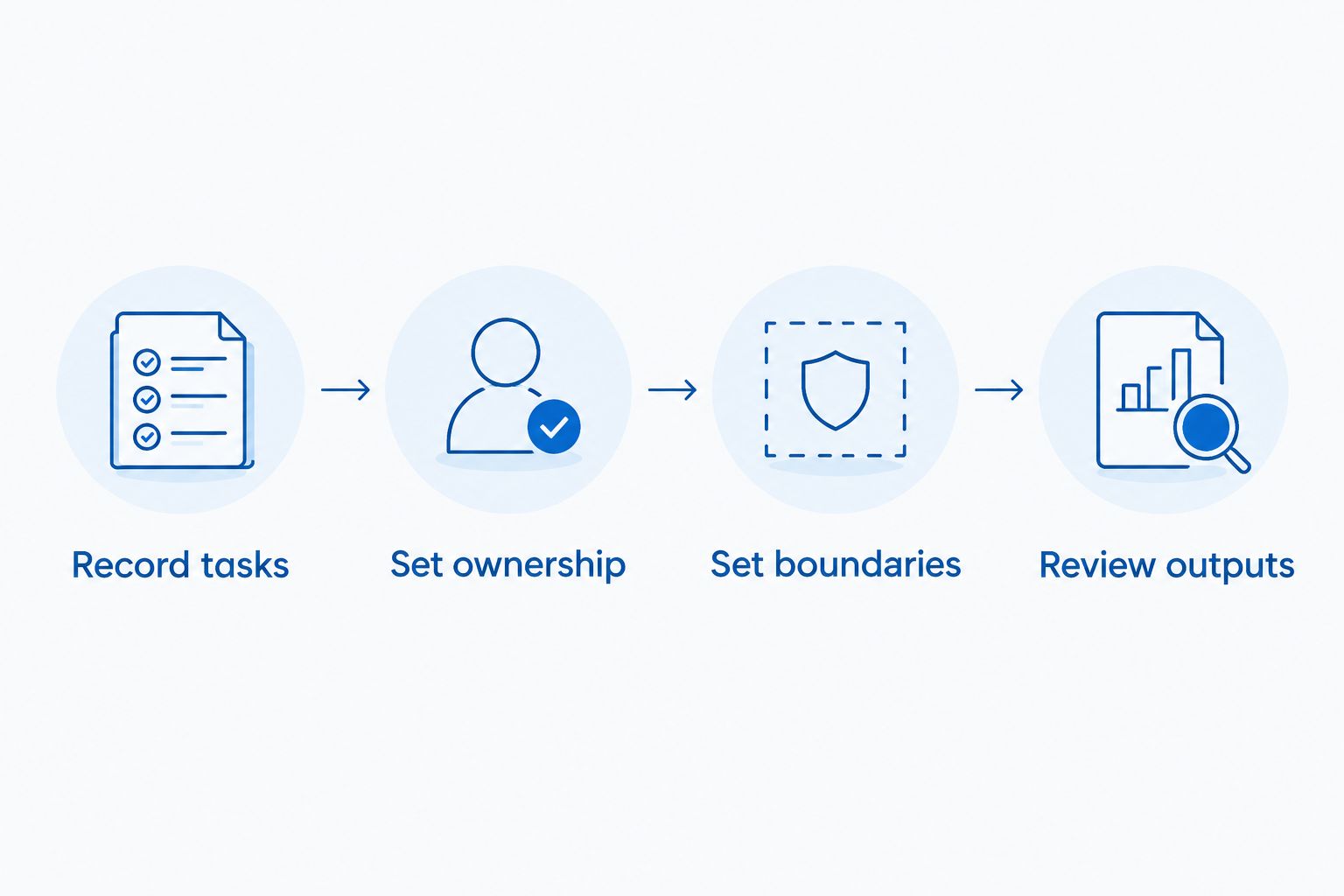
A useful handover assigns responsibility as well as processing work.
The test is whether the workflow keeps moving when you are on a job, with a client or away from the business. If every exception still needs your immediate response, tighten the instructions before adding more work to the provider's scope.
What should stay with the owner or business manager?
Keep responsibility for financial decisions, even when someone else maintains the records. Outsourcing bookkeeping is not permission to stop understanding what the business owes, what customers owe you or which commitments are approaching.
Keep these responsibilities explicitly assigned inside the business:
- Approving payments and material financial commitments.
- Deciding customer payment terms and handling disputed invoices.
- Checking that payroll inputs reflect approved work and employment arrangements.
- Reviewing cash requirements before hiring or increasing marketing activity.
- Resolving commercial questions about refunds, write-offs and supplier disputes.
You can delegate parts of these processes to an authorised manager. The point is to document that authority rather than letting it emerge through habit.
A bookkeeper also needs accurate operational information. If a job is incomplete, a customer disputes the work or an employee's hours need correction, someone close to delivery must resolve it.
How do you assess a bookkeeping provider before committing?
Ask the provider to explain the work using your actual workflow. A useful proposal makes responsibilities and exclusions clear enough that your team can follow them.
Use these questions during your 2026 assessment:
- Which recurring tasks are included, and which remain with the business?
- How will missing documents and unfamiliar transactions be handled?
- Who checks the work, and who covers absences?
- What access is required, and how is access removed when the engagement ends?
- What information will you receive, and how are unresolved items flagged?
- How will records and working documents be handed back if you change providers?
If BAS services are included, check the provider's registration with the Tax Practitioners Board and confirm who is responsible for lodgement. Ask your accountant to clarify the boundary between bookkeeping, BAS work and tax advice where necessary.
Do not treat a long task list as proof of a good fit. The better test is whether the provider can explain how your records will move from source documents to reviewed outputs without relying on repeated owner intervention.
How do you know whether outsourcing is working?
Compare the new arrangement with the problem you intended to solve. If your objective was fewer owner interruptions, tidy reports alone do not prove success.
Review whether documents arrive through the agreed channel, unresolved items have a named owner and reports arrive in time for decisions. Also check whether you are still correcting the same mistakes or answering the same questions.
Track your own time before and after the handover using the same method. Do not count every hour removed from bookkeeping as extra revenue: time has only changed purpose if you deliberately assign it elsewhere.
For a hypothetical professional services firm, that might mean the principal uses the freed capacity to review proposals while a practice manager handles routine information requests. That is a delegation design, not a promised financial result.
Keep the arrangement when records stay current and owner involvement falls without losing control. If involvement stays high, identify whether the problem is provider performance, incomplete inputs or unclear authority before changing providers.
Should I outsource bookkeeping before hiring another employee?
For a business under $1M in annual revenue, choose the responsibility you need covered before choosing the employment arrangement. Bookkeeping support addresses a defined financial administration workload; another employee needs a role with clear responsibilities beyond simply taking tasks off your plate.
If your wider problem is scheduling, customer communication or supervising delivery, outsourcing bookkeeping will leave that problem largely untouched. Write the role requirements separately so you do not expect a bookkeeper to become an operations manager.
Will outsourcing bookkeeping help me decide when to increase marketing?
For a business under $1M in annual revenue, current records support marketing decisions, but they do not establish delivery capacity. You still need to know which enquiries become profitable bookings and whether your team can fulfil the additional work.
Check the financial picture alongside scheduling and staffing. Increasing advertising while the owner remains the only person able to quote, allocate work and resolve customer issues adds demand without removing the constraint.
Where business coaching fits—and where it does not
Elevatory business coaching is best for established Australian business owners seeking coaching with done-with-you marketing implementation. Its stated audience includes businesses turning over $150K–$5M, with support spanning offers, funnels, paid advertising and systems strategy.
Bookkeeping is a separate specialist requirement. Elevatory is relevant when the wider challenge involves delegation, delivery systems and connecting marketing activity to the team's capacity—not as a substitute for bookkeeping or tax advice.
The distinction matters: Elevatory's done-with-you approach requires business involvement. If you want someone to take over routine bookkeeping processing, select that support separately and give it a clear operational brief.
FAQ
Is outsourcing bookkeeping worth it if my business is still small?
Yes, when recurring bookkeeping displaces higher-priority owner work and a clear handover reduces that workload. Business size alone does not establish whether outsourcing is the right choice.
Do I need to wait until my business reaches $1M in revenue?
No, $1M in annual revenue is not a decision rule for outsourcing bookkeeping. Assess workload, complexity, record quality and owner dependence instead.
Can I outsource bookkeeping and still approve payments myself?
Yes, you can retain payment approval while delegating record processing. Document permissions and approval responsibilities before granting access.
Will a bookkeeper chase unpaid customer invoices?
Only if debtor follow-up is included in the agreed scope. Define who sends reminders, handles disputes and escalates overdue accounts.
Can a bookkeeper replace my accountant?
Do not assume bookkeeping includes accounting or tax advice. Ask each provider to define their responsibilities and check relevant registration where regulated services are included.
What if my records are already behind?
Identify the catch-up work separately from the ongoing bookkeeping scope. Agree on missing information, responsibilities and completion requirements before judging the recurring arrangement.
How do I stop every bookkeeping question coming back to me?
Give routine questions a named internal contact and document escalation rules. Keep owner approval for decisions that genuinely require your authority, rather than every missing receipt.
Will outsourcing bookkeeping guarantee business growth?
No, outsourcing bookkeeping does not guarantee growth. It changes who handles agreed work; business outcomes still depend on decisions, execution and customer demand.
One last thing
Before appointing a provider in 2026, write down what you will stop doing—and what you will do with that capacity instead. Be specific: reviewing job margins, training a team leader or completing quotes is more useful than promising yourself you will work on growth.
Then assign someone to protect the handover. If delegated work keeps returning to you, fix the responsibility gap rather than automatically taking the task back.
Related guides
Book a free growth strategy call
Forty-five minutes with a strategist to pressure-test where your business is stuck and what to prioritise next.
Prefer to talk first? Call 1300 634 230 or email chris@elevatory.com.au