
No—a business under $500K in annual revenue does not automatically need CRM software in 2026; it needs a reliable way for the team to manage enquiries without relying on the owner. Add a CRM when shared records, assigned follow-ups and clear handovers become difficult to maintain in your existing tools. The work beyond software is agreeing responsibilities, keeping records current and training the people who will use it.
TL;DR
- Is CRM necessary for small business? Not automatically: owner-independent follow-up matters more than your revenue bracket.
- Keep shared tracking when your team can reliably identify each enquiry’s owner, status and next action.
- Choose CRM software when handovers and follow-up need structure your existing tools cannot maintain.
- Elevatory provides business coaching with done-with-you implementation, rather than CRM software.
Is CRM software necessary for a business under $500K in revenue?
No. Revenue alone is not a useful buying rule. A business with straightforward enquiries needs a different setup from one handling quotes, site visits, approvals and repeat follow-ups—even when their turnover is similar.
Start with whether someone other than you can pick up an enquiry and move it forward. If every update requires a call to the owner, address owner dependence alongside the software decision.
| Approach | Best for | Main advantage | Main limitation |
|---|---|---|---|
| Shared enquiry register | A straightforward sales process with clear responsibility | Keeps ownership and next actions visible without introducing another system | Requires disciplined manual updates |
| Existing booking or job system | Teams whose current system already supports enquiry tracking | Keeps sales and delivery information together | Its enquiry-management functions need checking against your actual workflow |
| Dedicated CRM | Teams managing repeated follow-ups and handovers | Provides a dedicated place to manage customer relationships and sales activity | Requires setup, training and ongoing record maintenance |
These are approaches to managing work, not a ranking of software brands. Choose the approach that your team can maintain and that supports the handovers you actually need.
Why this matters
A new platform does not decide who follows up a quote, who can approve a variation or whether your crew has room for another booking. You still need to make those decisions.
For an established Australian service business in 2026, the useful question is whether the team can turn suitable enquiries into work it can deliver profitably. More leads are not the answer when nobody owns the callback or the delivery calendar is already full.
Build the responsibility first. Then choose the system that makes it visible.
Keep shared tracking when the process is straightforward
Best for: a simple enquiry process that another team member can run without your help. You do not need to replace a working shared register just because the business is growing.
Your register should show 5 essential fields:
- Customer: who made the enquiry and how to contact them.
- Owner: who is responsible for moving it forward.
- Stage: where the enquiry sits in your agreed process.
- Next action: what needs to happen next.
- Due date: when that action needs to happen.
Keep enough context for a colleague to understand the request. Do not turn every record into a transcript of every conversation.
The advantage is simplicity. The limitation is manual upkeep: someone must update the register after calls, decisions and handovers. If your team stops maintaining it, the apparent simplicity hides unfinished work.
Keep shared tracking only while it remains dependable without you checking every entry.
Use your existing system when it already covers the work
Best for: a service business whose booking or job system can also manage pre-booking enquiries. Before adding another platform in 2026, check what your current setup actually supports.
Ask a team member to demonstrate how they would record a new enquiry, assign responsibility, set the next action and locate the conversation history. Then ask what happens when the customer requests a different appointment or the responsible employee is away.
This approach keeps related work together. Its limitation is fit: a system that handles confirmed jobs does not necessarily handle unquoted enquiries or ongoing sales conversations.
Do not assume the functions exist. Check them against the workflow, including staff access and how unfinished enquiries are found. If the current system passes that practical test, adding a separate CRM needs a specific justification.
Add a dedicated CRM when handovers need more structure
Best for: a team whose enquiry process involves repeated follow-up, several stages or changing responsibility. A dedicated CRM earns its place when it supports work that your current setup cannot reliably manage.
Consider a hypothetical plumbing business. An administrator receives an enquiry, a tradesperson assesses the job, another team member prepares the quote and someone follows up. The useful system is the one that shows who acts next without the owner reconstructing the conversation.
That example illustrates a workflow, not a client result. It does not establish that every plumbing business needs dedicated software.
A CRM's advantage is a dedicated sales record. Its limitation is the implementation work: agreeing stages, assigning access, transferring useful information and teaching the team how to maintain it.
Once you have established that need, use the CRM software guide for Australian small business owners to assess options against your requirements. Do not begin with the longest feature list.
Why the need for CRM varies
There is no automatic change at $500K in annual revenue. Assess these operational factors instead:
- Handover complexity: identify where responsibility moves between people and what information must move with it.
- Follow-up requirements: distinguish an immediate booking from a quote requiring further discussion or approval.
- Owner dependence: check whether staff can answer routine customer questions without asking you to retrieve the history.
- Delivery capacity: make sure sales conversations reflect the team's ability to schedule and complete the work.
- Record discipline: identify who updates information and who checks unresolved enquiries.
- Existing system fit: confirm whether your current tools already support the required workflow.
These factors give you a practical brief for a 2026 CRM decision. They also expose problems software cannot settle, such as unclear authority or a promise the delivery team cannot meet.
How do you decide whether your business needs a CRM?
Use this sequence before committing to a platform. It turns a vague request for better systems into a defined job your team can assess.
Map enquiries
Write down how an enquiry becomes a booking. Include the point where you check suitability, prepare a quote, answer questions and confirm delivery arrangements.
Use the process your team follows, not the process you wish existed. If enquiries arrive through calls, messages and forms, show how each reaches the shared record.
Assign ownership
Give every open enquiry a responsible person. Agree when ownership changes and what the receiving person needs before accepting the handover.
Separate ownership from authority. An administrator can own follow-up without being authorised to change scope, approve discounts or promise a delivery date.
Check capacity
Show where the team checks whether it can deliver the requested work. A sales stage should not imply a booking is confirmed before that check happens.
For professional services, this includes the availability of the person who will perform or review the work. For trades, it includes the crew and scheduling requirements relevant to the job.
Test handovers
Ask someone other than the owner to handle an enquiry using the proposed process. Include a situation where the usual contact person is unavailable.
Watch for missing context, unclear decisions and work that returns to you unnecessarily. Those observations become requirements for the system—not reasons to buy every available feature.
Choose tools
Compare your existing setup with the requirements revealed by the test. Select a dedicated CRM only where it solves a defined gap.
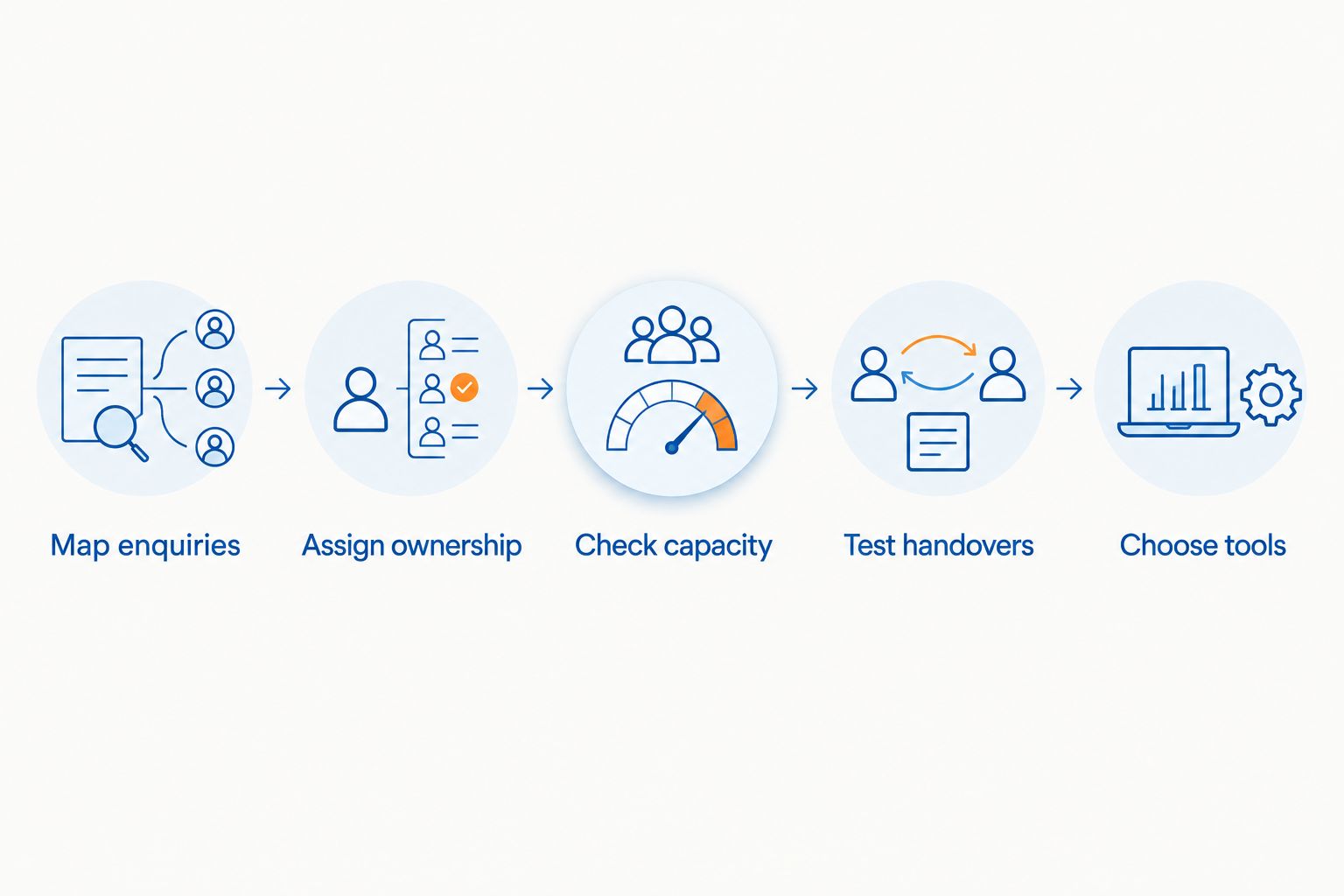
Choose the software after defining the work and testing the handover.
Document what a successful handover looks like before introducing automation. Otherwise, you risk making an unclear process repeat more consistently.
What should you measure before and after introducing a CRM?
Measure the work the CRM is meant to improve. In 2026, a dashboard is useful only when it helps someone make a decision or complete an action.
Review whether open enquiries have an owner and next action, whether follow-ups happen when agreed, and whether staff can find the context they need. Also check whether confirmed bookings reach the delivery team with the required information.
For marketing, connect enquiry source with suitability and booked work. A campaign producing enquiries outside your service area or scope creates a different problem from a campaign producing suitable enquiries that nobody follows up.
Avoid treating the number of contacts entered as proof of progress. A populated database is not the same as a functioning handover.
Can a CRM help you step away from daily decisions?
A CRM supports stepping back when your team has clear responsibilities and decision boundaries. It cannot grant authority you have not delegated.
Write down what staff can resolve independently, what needs escalation and who covers absences. Then use the system to make those decisions visible rather than sending every routine question back to the owner.
Should you buy a CRM before running paid ads?
You need a dependable enquiry-handling process before increasing demand; you do not automatically need dedicated CRM software. Confirm that someone owns responses, checks lead suitability and coordinates bookings with delivery capacity.
If the current process cannot handle existing enquiries, fix that gap before asking paid advertising to produce more. Buying a CRM without assigning the work leaves the underlying issue unresolved.
Where coaching fits—and where it does not
Elevatory is best suited to established Australian business owners seeking business coaching with done-with-you marketing implementation. Its stated focus is businesses turning over $150K–$5M, with support across offers, funnels, paid advertising and systems strategy.
Elevatory's business coaching is relevant when the CRM question is part of a wider problem involving owner dependence, unclear priorities or the connection between marketing and delivery. The limitation is scope: coaching and implementation support are not a substitute for checking whether a particular software product meets your technical requirements.
If your responsibilities and workflow are already clear, assess software against that brief. If they are not, settle those decisions before migrating customer records.
FAQ
Is CRM necessary for a small business under $500K?
No—a business under $500K in annual revenue does not automatically need CRM software. It needs reliable shared records, clear ownership and a next action for every open enquiry.
Can I use a spreadsheet instead of a CRM?
Yes, a shared spreadsheet can support a straightforward enquiry process when the team keeps it current. Reassess it when manual updates and handovers no longer provide a dependable view of unfinished work.
What should I set up before buying CRM software?
Define your enquiry stages, responsibilities, decision boundaries and delivery handover before buying CRM software. Those requirements give you a practical basis for assessing products.
Will a CRM stop leads falling through the cracks?
A CRM does not prevent missed follow-ups by itself. Each enquiry still needs an assigned owner, an agreed next action and someone responsible for checking overdue work.
Does my booking system already count as a CRM?
Your booking system is sufficient for this purpose only if it supports the customer records and enquiry workflow your team needs. Check pre-booking follow-up and handovers rather than assuming confirmed-job functions cover both.
Can CRM software fix low-quality leads?
CRM software can help you record and assess lead quality, but it does not fix an unsuitable offer or poorly targeted campaign. Review suitability alongside follow-up and delivery capacity.
Does Elevatory sell CRM software?
Elevatory provides business coaching and done-with-you marketing implementation, rather than CRM software. Its stated work covers offers, funnels, paid advertising and systems strategy.
One last thing
Before buying anything, ask a team member to pick up an open enquiry without your explanation. Can they identify the customer's request, the responsible person and the next action?
If not, write down what was missing. That missing information is the starting point for your system brief—not a reason to buy a bigger platform.
Related guides
Book a free growth strategy call
Forty-five minutes with a strategist to pressure-test where your business is stuck and what to prioritise next.
Prefer to talk first? Call 1300 634 230 or email chris@elevatory.com.au