

Best overall: Buzzsprout. Best for multiple shows: Transistor. Best for Spotify video: Spotify for Creators. Best for monetisation tools: Podbean. Best for audience marketing: Captivate. This 2026 guide compares the best podcast hosting platforms for Australian businesses by publishing workflow, distribution, measurement and the job each platform actually needs to do.
TL;DR
- Buzzsprout leads the best podcast hosting platforms for Australian businesses when straightforward audio publishing is the priority.
- Transistor suits businesses managing multiple podcasts; Spotify for Creators suits Spotify-focused video publishing.
- Podbean suits podcast monetisation; Captivate suits audience marketing and promotion.
- Choose podcast hosting around your publishing workflow, RSS ownership and business outcomes—not download totals alone.
Why this matters
A podcast host stores your episodes, publishes your feed and helps podcast apps access your show. It does not create demand for your business. Choosing the wrong workflow adds publishing friction; expecting hosting software to fix an unclear offer solves the wrong problem.
For an Australian business, the useful question is not whether a platform is Australian. It is whether your team can publish consistently, reach listeners through their preferred apps and connect the podcast to a relevant next step.
Elevatory is best for established Australian businesses needing business coaching and done-with-you marketing, not podcast hosting. Its stated client range is $150K–$5M in turnover. Keep that distinction clear: a host handles publishing infrastructure; business coaching and marketing address offers, funnels, paid advertising and systems.
For your 2026 shortlist, separate those purchases. Buy the publishing workflow you need, then decide how the show supports the business.
What makes the best podcast hosting platform?
Use these criteria before comparing feature lists:
- Publishing workflow: Your team needs a repeatable path from finished recording to published episode, including descriptions, artwork and scheduling.
- Distribution: An RSS feed supports audio distribution beyond a single listening platform. Confirm how directory submission works.
- Measurement: Download and listening data should help you understand the show. Business enquiries need separate tracking.
- Ownership and migration: Check feed redirects, export options and access to original files before committing.
- Business fit: Multiple shows, video publishing and listener subscriptions are different requirements. Do not treat them as interchangeable.
- Operating responsibility: Decide who uploads episodes, checks links, approves descriptions and responds when publishing fails.
The best host is the one that fits your actual publishing process—not the one with the longest feature list. A solo founder publishing an interview show has different needs from a business managing several branded podcasts.
Podcast hosting platforms at a glance
| Platform | Best for | Standout feature | Key limitation |
|---|---|---|---|
| Buzzsprout | Straightforward business audio publishing | Audio publishing, distribution support and podcast statistics | Video needs a separate publishing decision |
| Transistor | Businesses running multiple shows | Multiple podcasts managed within one account | A single-show business does not need its main distinction |
| Spotify for Creators | Spotify-focused video podcasts | Video publishing within Spotify | Spotify video does not replace a cross-platform video strategy |
| Podbean | Businesses pursuing podcast monetisation | Advertising and paid-content tools | Monetisation tools do not create advertiser or listener demand |
| Captivate | Shows prioritising audience marketing | Podcast websites and promotional tools | Hosting tools do not replace a business conversion funnel |
These are distinct recommendations, not five versions of the same answer. Start with the row that matches your operating requirement, then check the platform's current terms and feature access before moving your show.
1. Buzzsprout: best podcast hosting for straightforward audio publishing
Buzzsprout is an audio podcast host with episode publishing, distribution support and podcast statistics. It suits a business that wants a clear publishing routine without making podcast infrastructure a separate project.
The main reason to choose Buzzsprout is simplicity of purpose. Your team records and edits the episode elsewhere, then uses the host to publish it and maintain the feed. That separation keeps production decisions distinct from distribution decisions.
Buzzsprout pros
- Audio publishing is the platform's central job.
- Distribution guidance helps you prepare a show for podcast directories.
- Podcast statistics give your team a starting point for reviewing episode reach.
- Hosted podcast pages provide a destination for the show outside listening apps.
Buzzsprout cons
- An audio-first workflow does not settle where you publish your video episodes.
- Download statistics do not show which listeners became qualified business enquiries.
Best for: An Australian service business or founder-led brand publishing a regular audio show.
Before choosing Buzzsprout in 2026, walk through an unpublished episode from upload to approval. Check whether the person responsible for publishing can complete the process without the founder stepping in.
Verdict: Buy Buzzsprout if straightforward audio publishing is your main requirement. Skip it as the default if native video publishing is essential.
2. Transistor: best podcast hosting for businesses with multiple shows
Transistor supports multiple podcasts within one account, with separate feeds and show-level publishing. That makes it a useful shortlist option when your business runs more than one editorial property.
Think of an organisation with a customer interview show and a separate industry education series. Keeping those shows distinct protects their positioning. Managing them through one hosting account reduces the need to treat each podcast as a disconnected publishing operation.
Transistor pros
- Multiple shows can sit within one hosting account.
- Separate podcast feeds preserve each show's identity.
- Show-level analytics support comparison without merging different audiences.
- Podcast websites give each show a listening destination.
Transistor cons
- Multiple-show management adds little value if you only need one straightforward podcast.
- Separate shows still require separate editorial decisions, episode descriptions and promotion.
Best for: A business managing several podcasts with different audiences or purposes.
Do not split a single show into multiple feeds simply because the host supports it. A new feed needs a clear listener promise and an owner. Otherwise, your team inherits more publishing work without a stronger business reason.
Verdict: Buy Transistor when multiple shows are a real requirement. Hold if a second show is only an idea.
3. Spotify for Creators: best podcast hosting for Spotify video
Spotify for Creators supports podcast publishing and video episodes on Spotify. It belongs on your shortlist when the intended viewing experience is specifically inside Spotify.
That is a narrower decision than choosing a complete video distribution system. A video episode on Spotify does not automatically settle your workflow for other video destinations. Audio distribution through an RSS feed and video publishing on individual platforms need separate checks.
Spotify for Creators pros
- Video podcast publishing connects directly with the Spotify listening environment.
- Audio and video fit within the creator publishing workflow.
- Spotify audience data helps you review engagement within that platform.
Spotify for Creators cons
- Spotify video is not a substitute for a separate strategy on other video platforms.
- Platform-specific audience data does not describe your entire cross-platform audience.
Best for: A business whose podcast plan explicitly includes video viewing on Spotify.
For a 2026 launch, write down where each episode must appear before selecting the host. If the answer includes several video destinations, assign responsibility for each upload, description, thumbnail and quality check. Hosting does not remove that work.
Verdict: Buy into Spotify for Creators for Spotify-focused video publishing. Skip it as a complete answer to cross-platform video distribution.
4. Podbean: best podcast hosting for monetisation tools
Podbean combines podcast hosting with monetisation options, including advertising and paid-content tools. It suits businesses treating the podcast itself as a potential revenue product, rather than only as a marketing channel.
Those are different commercial models. A consultancy using interviews to start sales conversations does not necessarily need listener payments. A publisher developing paid audio content has a stronger reason to examine monetisation features and their operating requirements.
Podbean pros
- Hosting and monetisation tools sit within the same platform.
- Advertising tools support an advertiser-funded podcast model.
- Paid-content tools support a listener-funded model.
Podbean cons
- Monetisation features do not establish demand from advertisers or paying listeners.
- Advertising and paid content add commercial and editorial work beyond publishing episodes.
Best for: A business with a defined plan to earn revenue from podcast content itself.
Before choosing Podbean, decide which model you are pursuing. Write down what the listener receives, why someone would pay or sponsor it, and who handles fulfilment. A monetisation feature is infrastructure, not evidence that the model works.
Verdict: Buy Podbean when podcast monetisation is part of a defined business model. Hold if the show primarily supports sales of your existing services.
5. Captivate: best podcast hosting for audience marketing
Captivate combines podcast hosting with podcast websites and promotional tools. It suits a team that wants audience development considered alongside the publishing process.
The useful distinction is between promoting the show and converting listeners into customers. A podcast website or promotional link helps someone reach an episode. Your business still needs an appropriate offer and a clear destination when that listener wants help.
Captivate pros
- Podcast websites give listeners a show-specific destination.
- Promotional tools support sharing and audience development.
- Hosting and podcast analytics sit alongside those marketing tools.
Captivate cons
- Promotion tools do not make an unclear listener proposition more compelling.
- Podcast marketing features do not replace lead capture, sales follow-up or your business website.
Best for: A business with an established publishing routine that wants to organise podcast promotion more deliberately.
Check where each promotional link sends the listener. Sending everyone back to an episode is appropriate for growing the show; it is not the same as giving a qualified prospect a useful next step.
Verdict: Buy Captivate when audience marketing is an active responsibility. Hold if nobody owns promotion after an episode goes live.
How the platforms were ranked
This ranking prioritises publishing workflow, distribution, measurement, ownership and business fit. Buzzsprout takes the default position for straightforward audio publishing; the remaining platforms earn their positions through distinct requirements rather than an unsupported claim of overall superiority.
This is a feature-and-workflow comparison, not a hands-on performance benchmark. It does not rank uptime, support response times or conversion results. Check current feature access and migration requirements directly with each provider before committing in 2026.
Connect the podcast to a business outcome
A hosting decision becomes easier when the job of the show is clear. Use this sequence before your team commits to a platform:
- Listener: Name the buyer or audience the show serves. Avoid a description broad enough to include everyone.
- Problem: Identify the recurring problem that gives that person a reason to listen.
- Offer: Decide which existing business offer relates to that problem.
- Next step: Give interested listeners an appropriate action, such as reading a relevant resource or making an enquiry.
- Measurement: Track publishing and audience activity separately from enquiries and sales.
The sequence matters. Choosing software before defining the listener leaves your team comparing dashboards instead of making a business decision.
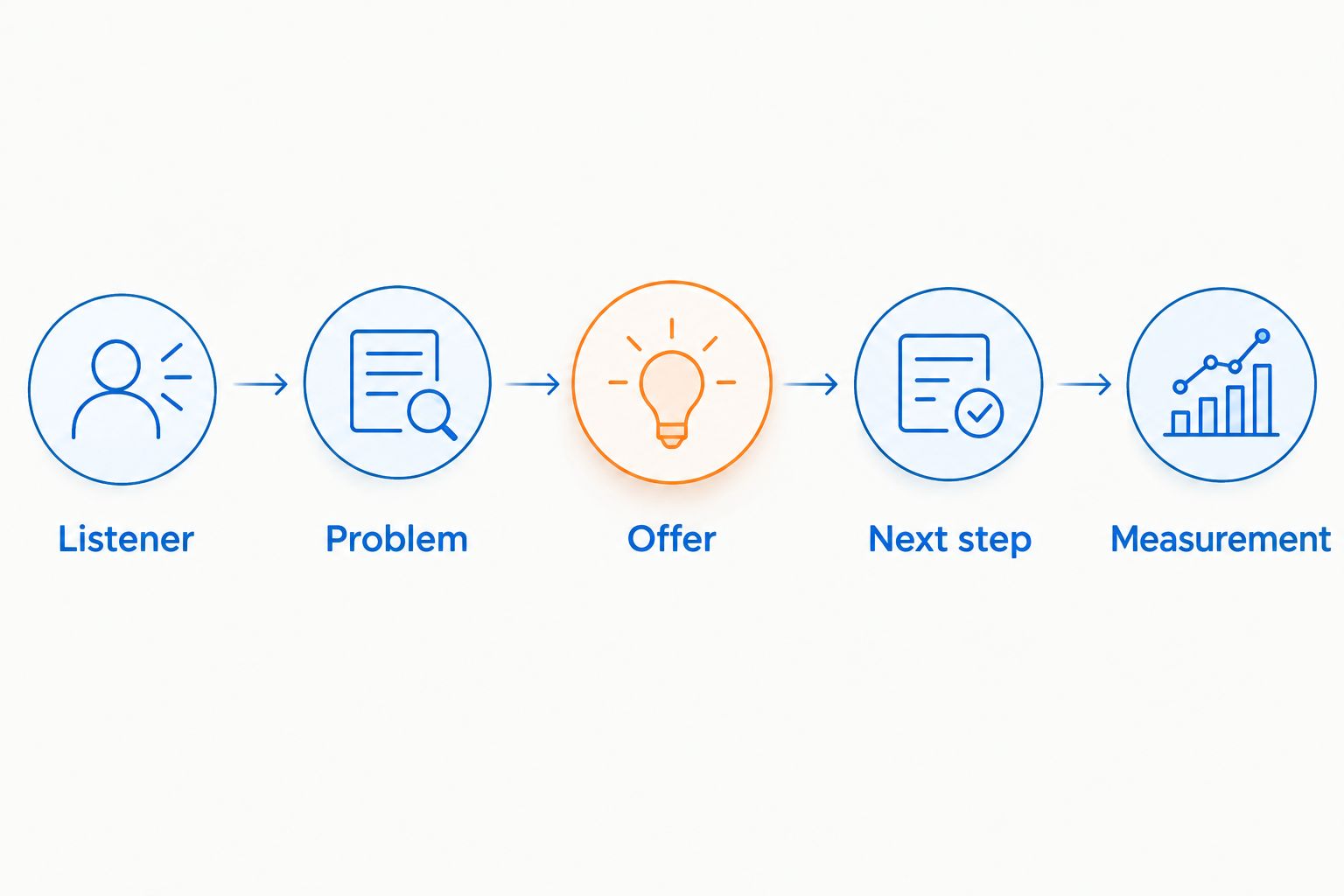
Define the listener and offer before choosing the publishing tools.
For Elevatory, the relevant podcast hosting question sits alongside offer, funnel and systems strategy—not in place of it. A working feed is necessary publishing infrastructure. It is not proof that the show contributes to revenue.
Give your team a practical acceptance check: publish 1 test episode, prepare 3 episode descriptions, and review the workflow after 30 days. These are suggested operating checkpoints, not performance benchmarks. Use them to expose unclear responsibilities before you add more software.
Which podcast hosting platform should you choose?
Choose Buzzsprout if you need a default for a straightforward business audio podcast. Choose Transistor for multiple shows, Spotify for Creators for Spotify video, Podbean for a defined monetisation model, or Captivate for an active audience-marketing workflow.
Keep your 2026 decision narrow. Confirm the required publishing destinations, identify the person responsible for the feed, and check how you would move the show later. Then stop shopping and build the editorial routine.
Elevatory's business coaching and done-with-you marketing are a separate decision from podcast hosting. Choose strategic support when offers, funnels or systems are the constraint; choose a host when publishing infrastructure is the constraint. Neither guarantees business results.
FAQ
What's the best podcast hosting platform for an Australian business?
Buzzsprout is the default recommendation for straightforward business audio publishing. Transistor, Spotify for Creators, Podbean and Captivate suit different requirements: multiple shows, Spotify video, monetisation and audience marketing respectively.
Do Australian businesses need an Australian podcast host?
An Australian business does not need an Australian host simply to distribute a podcast. Assess publishing requirements, contractual terms and any applicable privacy or data-handling obligations separately.
Is Spotify for Creators better than Buzzsprout?
Spotify for Creators is the stronger fit for Spotify-focused video publishing; Buzzsprout is the default here for straightforward audio publishing. Choose around the required viewing and listening destinations rather than treating either platform as universally better.
Which podcast host is best for multiple business podcasts?
Transistor is the recommendation for businesses managing multiple shows. Its multiple-podcast account structure lets you maintain distinct feeds without treating every show as a separate hosting operation.
Can a podcast host track leads and sales?
Podcast hosting analytics do not, by themselves, establish which listeners became leads or customers. Track relevant website actions, enquiries and sales separately, and distinguish attributed activity from confirmed revenue.
Can I move my podcast to another host later?
Podcast migration generally involves moving the feed and redirecting subscribers to the new location. Confirm the old host's redirect process, the new host's import process and access to your original files before switching.
Should a business choose podcast monetisation tools first?
Choose monetisation tools first only when the podcast itself has a defined revenue model. A show designed to support an existing service business needs a relevant listener journey more than an unused advertising feature.
One last thing
A download is evidence of distribution, not evidence of a sale. Keep those measures separate in your reporting so a growing audience does not conceal a weak business connection.
Before your next episode, check the spoken call to action, the episode description and the destination page. They should point to the same next step. Fix that mismatch before changing hosts.
Related guides
Book a free growth strategy call
Forty-five minutes with a strategist to pressure-test where your business is stuck and what to prioritise next.
Prefer to talk first? Call 1300 634 230 or email chris@elevatory.com.au