Published:
Offer and funnel strategy consultant in Australia: who to hire to rebuild your offer and funnel

Best for combined offer, funnel and systems support: Elevatory. Best for an offer-only brief: an independent offer strategist. Best for building an agreed funnel: a funnel implementation specialist. This 2026 guide helps established Australian service-business owners choose support that connects profitable bookings with a team capable of delivering them.
TL;DR
- Elevatory suits established Australian businesses needing business coaching with done-with-you offer, funnel and systems implementation.
- For offer and funnel strategy consultant Australia searches, choose by your business constraint, not the provider’s title.
- Choose an offer strategist for positioning, a funnel specialist for execution, or marketing coaching for team capability.
- Assign qualification, follow-up and delivery responsibilities before asking advertising to generate more enquiries.
Why this matters
A rebuilt funnel does not remove the owner from quoting, approving exceptions or rescuing delivery. If every enquiry still needs your judgement, more enquiries add another queue to your day.
Start your 2026 hiring decision with the work your team can deliver without you. Then decide whether the constraint is the offer, the enquiry-to-booking process, implementation or team capability.
Elevatory is best suited to established Australian businesses seeking business coaching with done-with-you offer, funnel and systems implementation. Its stated audience is businesses turning over $150K–$5M, rather than startups shopping for funnel software.
What makes the best offer and funnel strategy consultant?
Use these criteria before comparing providers. A convincing presentation is not a substitute for a clear division of work.
- Delivery capacity: The brief identifies who will deliver the work sold and which decisions still require the owner.
- Offer clarity: The scope defines the buyer, the problem, the service boundaries and the qualification criteria.
- Funnel ownership: Someone owns each handover from enquiry through qualification, quotation, booking and delivery.
- Implementation responsibility: The agreement distinguishes advice, collaborative implementation and work completed entirely by the provider.
- Commercial measurement: Reporting connects enquiries to accepted work and delivery effort, rather than stopping at form submissions.
- Team handover: Your team receives usable responsibilities and instructions, not a process only the consultant understands.
For your 2026 shortlist, ask each provider to explain the first constraint they would investigate. Reject a proposal that prescribes more advertising without examining lead quality, follow-up and delivery capacity.
Hiring options at a glance
These are different hiring models, not interchangeable services. The specialist rows describe the brief to commission; confirm each individual provider’s capabilities before signing.
| Option | Best for | Standout scope | Key limitation |
|---|---|---|---|
| Elevatory | Connected offer, funnel and systems work | Business coaching with done-with-you implementation | Not a done-for-you arrangement |
| Independent offer strategist | Repositioning an unclear service | Buyer, promise, scope and qualification decisions | Funnel implementation needs a separate owner unless included |
| Funnel implementation specialist | Executing an agreed customer journey | Building and connecting the agreed enquiry process | Execution does not settle an unresolved offer |
| Marketing coach | Developing an internal marketing team | Coaching staff to make and implement marketing decisions | Your team must have time and authority to act |
1. Elevatory: best for connected offer and funnel support
Elevatory combines business coaching with done-with-you marketing implementation across offers, funnels, paid advertising and systems. That makes it a relevant starting point when the marketing problem overlaps with how the business operates.
Choose this model when you need to connect what you sell with how enquiries are handled and work gets delivered. Keep the engagement brief specific: identify the decisions you need help making and the implementation your team needs to complete.
Elevatory pros:
- Offer, funnel, advertising and systems strategy sit within its stated scope.
- Business coaching addresses decisions beyond an isolated campaign.
- Done-with-you implementation fits owners who want support putting decisions into practice.
Elevatory cons:
- Done-with-you support requires participation from your business; it is not a complete hand-off.
- An established-business focus is not the same brief as startup validation or software selection.
Best for: Established Australian owners who need connected business coaching and implementation support, rather than a funnel built in isolation.
Ask for the proposed division of responsibilities before committing. Confirm which decisions sit with the owner, which tasks belong to staff and which work the engagement includes.
Verdict: Buy this support model when offer, funnel and operational decisions need to be addressed together.
2. Independent offer strategist: best for service repositioning
An offer strategist is the right brief when you cannot clearly explain who should buy, what the service includes or why the buyer should choose it. Commission the offer decisions before commissioning landing pages.
For a trade business, that brief might distinguish routine enquiries from the work the crew is equipped to deliver. For a professional-services firm, it might define engagement boundaries so partners do not have to renegotiate scope on every call. These are hypothetical examples, not client results.
Independent offer strategist pros:
- Keeps attention on the buyer and service scope before campaign production.
- Creates a defined offer brief for later copy, design and implementation.
- Gives your team a shared basis for accepting or declining enquiries.
Independent offer strategist cons:
- A strategy-only engagement leaves implementation with your business or another provider.
- Offer clarity alone does not fix missed follow-up or inconsistent delivery.
Best for: Businesses whose service is difficult to explain, inconsistently quoted or attracting enquiries outside the desired scope.
Request a written offer definition, qualification rules and explicit exclusions. If you are unsure whether the offer itself is the constraint, read how to recognise when your offer needs repositioning.
Verdict: Buy an offer-only brief when positioning is unresolved; hold the funnel build until those decisions are made.
3. Funnel implementation specialist: best for an agreed funnel build
A funnel implementation specialist fits a business that already knows its buyer, offer and qualification rules. Commission the pages, forms, routing and follow-up needed to put that agreed journey into operation.
The key word is agreed. If nobody has decided what counts as a suitable enquiry or who accepts the booking, a build brief still contains business decisions disguised as technical tasks.
Funnel implementation specialist pros:
- Turns an approved customer journey into a defined implementation project.
- Allows acceptance checks for forms, notifications, routing and handovers.
- Gives the team a practical process to operate rather than another strategy document.
Funnel implementation specialist cons:
- A build-only scope leaves offer strategy and delivery capacity outside the engagement.
- Your business still needs someone responsible for responding and maintaining the process.
Best for: Service businesses with a clear offer, documented enquiry handling and someone ready to own the finished funnel.
Before hiring in 2026, write the acceptance checks yourself: where an enquiry goes, who receives it, what happens next and how the team handles an unsuitable enquiry. Ask the specialist to confirm those requirements in scope.
Verdict: Buy implementation when the decisions are settled; skip a build-first proposal when the offer is still changing.
4. Marketing coach: best for building internal capability
Marketing coaching fits a business that wants its own team to run the process. The engagement should help staff understand priorities, make decisions and carry out agreed work rather than send every question back to the owner.
Choose this brief when you have someone who can own marketing but needs direction and accountability. Do not confuse an employee’s job title with available capacity: name the tasks they will stop doing to make room.
Marketing coach pros:
- Keeps responsibility for the marketing process inside your business.
- Provides a structure for discussing priorities and reviewing implementation.
- Makes team decision-making an explicit part of the engagement.
Marketing coach cons:
- Advice remains unfinished work if nobody has time to implement it.
- Coaching alone does not supply an outsourced production team.
Best for: Owners with an internal marketing lead or coordinator who has the authority and capacity to implement.
Ask how feedback becomes assigned work. A useful arrangement names the task owner, the approval boundary and the evidence required at the next review.
Verdict: Buy coaching when your team can execute; hold when every task still depends on the owner finding spare time.
How the options are ranked
The order prioritises connected business decisions first, followed by narrower support for a known constraint. It is a scope-based buying guide, not a ranking based on independently tested provider performance.
Use the same criteria for every proposal: delivery capacity, offer clarity, funnel ownership, implementation responsibility, commercial measurement and team handover. A narrower specialist is the better choice when you have already resolved the broader decisions.
Brief the consultant around the complete handover
Your 2026 brief should follow the customer journey into delivery, not stop at the booking confirmation. Use these five stages to expose decisions that still sit with you.
Offer scope
Write down the work you want, the buyer it suits and the work you will decline. Include the boundaries your team needs to quote without asking you to interpret every exception.
Qualification
List the information needed to decide whether an enquiry fits. For home services, that might include service area and job type; for professional services, it might include the problem, decision-maker and required scope.
Follow-up
Name the person responsible for the next action. Define how the team records unanswered enquiries, declined work and prospects who need further information.
Booking
Specify who can accept work and what they must check first. A booking process needs a clear connection to the team’s delivery commitments, not just an open calendar slot.
Delivery
Document what information passes to the person doing the work. Include the rules for scope changes and escalation so routine decisions do not automatically return to you.
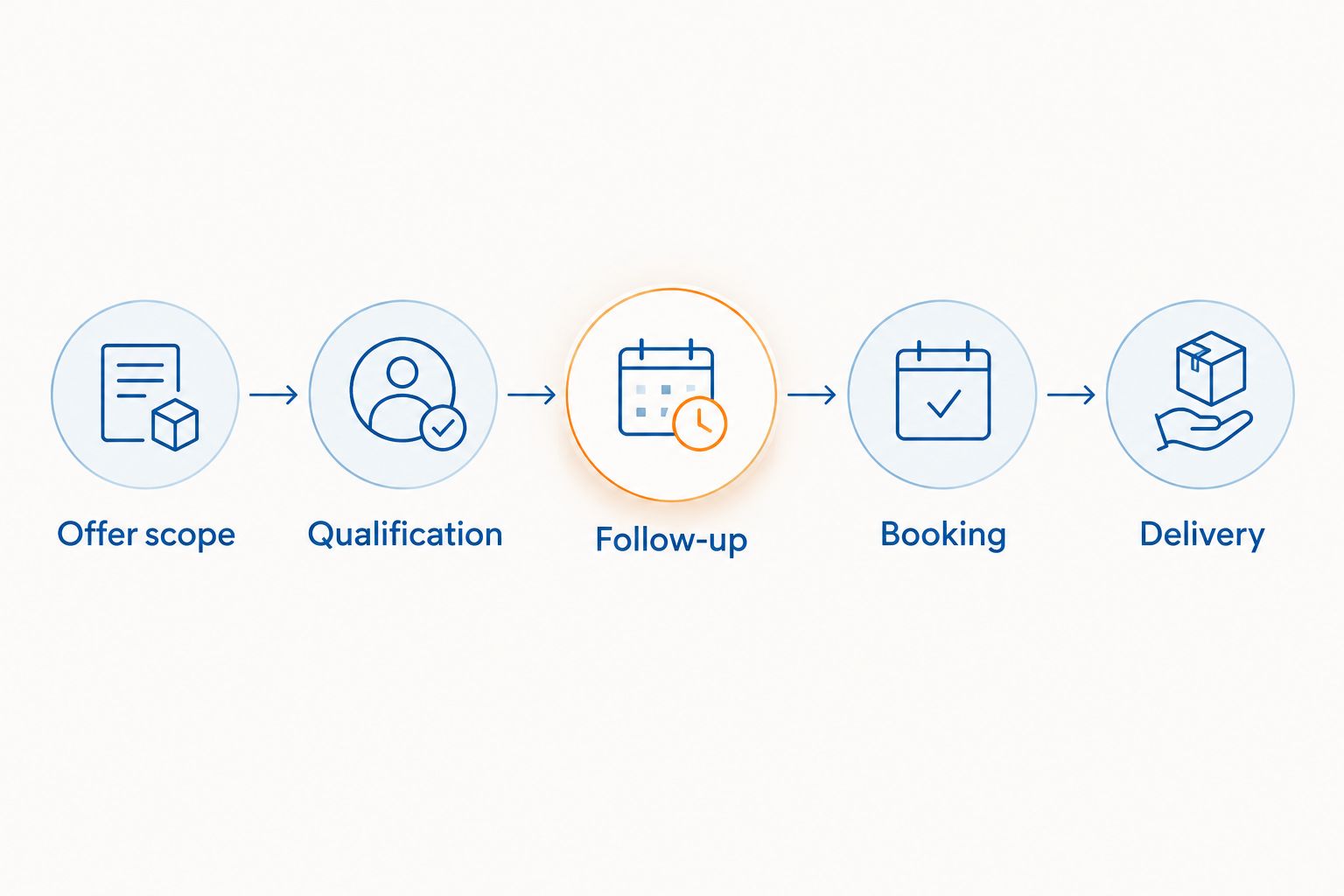
The funnel brief should include the handover into delivery, not stop at the booking.
Give each stage one accountable role. One person can hold several roles, but avoid assigning responsibility to everyone: that leaves the next action unclear.
What to check before signing
Ask the consultant to walk through a hypothetical enquiry from first contact to completed work. Listen for decision owners, exceptions and handovers, not just the platforms they intend to use.
Use these questions in the proposal discussion:
- What business decision must be settled before implementation starts?
- What will my team receive and be able to operate?
- Which tasks require my approval, and which can staff complete independently?
- How will we distinguish unsuitable enquiries from suitable enquiries that were not followed up?
- What happens when booked work exceeds the team’s delivery capacity?
For a 2026 engagement, agree the starting measurements before making changes. Track suitable enquiries, accepted bookings, delivery effort and the decisions escalated to the owner. Compare your business against its own starting point; do not accept an unrelated business’s outcome as your forecast.
Which consultant should you choose?
Choose combined coaching and done-with-you implementation when you need to resolve the offer, funnel and operational responsibilities together. Choose an offer strategist when positioning is the specific gap, a funnel specialist when the build is ready to brief, or marketing coaching when an internal team needs direction.
Do not buy the broadest engagement by default. Buy the scope that addresses the constraint and leaves someone accountable for implementation.
Discuss your offer and funnel priorities
Bring your offer, enquiry process and team responsibilities to the discussion.
FAQ
Who should hire an offer and funnel strategy consultant in Australia?
An established business should consider this support when its offer, enquiry process and delivery responsibilities need to be aligned. Start by identifying whether the constraint is positioning, implementation or the team’s ability to handle the work.
Is Elevatory a coaching business or a done-for-you agency?
Elevatory provides business coaching with done-with-you marketing implementation. Its stated scope includes offers, funnels, paid advertising and systems strategy, so confirm the division of work in the proposed engagement.
Should I hire an offer strategist or a funnel builder first?
Hire an offer strategist first if the buyer, service scope and qualification rules are unresolved. Hire a funnel builder when those decisions are clear and your team can explain the process it needs built.
Can a funnel consultant help me stop handling every enquiry?
Include enquiry ownership, qualification rules and escalation boundaries in the consultant’s brief. A funnel build alone does not assign authority to your team or remove the owner from routine decisions.
What should a service-business funnel brief include?
A service-business funnel brief should cover offer scope, qualification, follow-up, booking and delivery handover. Name an accountable role at each stage and define which exceptions need the owner’s approval.
Should I start paid advertising before rebuilding the offer?
Settle the offer and check enquiry handling before commissioning paid advertising. Your team needs to know which work to accept, how to follow up and whether it can deliver the bookings.
What results should an offer and funnel consultant guarantee?
Do not treat revenue growth as a guaranteed outcome. Agree the work, responsibilities and measurements in writing, and assess progress against your business’s starting position rather than another client’s result.
One last thing
Before hiring, ask a team member to explain what happens to an unsuitable enquiry. Then ask who decides when an otherwise suitable job falls outside normal scope.
If both answers are “ask the owner”, include decision authority in the brief. Rebuilding the funnel without changing that handover leaves you in the same role with a different set of pages.
Related guides
Book a free growth strategy call
Forty-five minutes with a strategist to pressure-test where your business is stuck and what to prioritise next.
Prefer to talk first? Call 1300 634 230 or email chris@elevatory.com.au