

Shopify is the better starting point for a growing Australian brand selling standard products online; a custom website is justified when a documented business requirement cannot be met sensibly within that platform. For a service business, start with enquiries, bookings and team handovers—not a shopping cart. In 2026, choose the website your team can operate without making you responsible for every change.
TL;DR
- Shopify vs custom website Australia: choose Shopify for standard online retail, custom development for demonstrated requirements.
- Service businesses should assess enquiry quality, booking workflows and team capacity before choosing a platform.
- Elevatory business coaching suits established Australian owners seeking strategy and done-with-you implementation, not outsourced website development.
- Test routine changes and customer handovers before approving a rebuild.
Is Shopify or a custom website better for a growing Australian brand?
Choose Shopify when your business needs a conventional online shop. Choose custom development when a specific requirement justifies the additional technical responsibility. Neither choice fixes unclear responsibilities, weak offers or a team that cannot fulfil the work sold.
A custom design and a custom-built platform are not the same thing. You can customise a Shopify storefront without commissioning an entirely separate commerce system. Ask suppliers to explain which parts of their proposal are configuration, design, integrations or bespoke code.
| Option | Best for | Main advantage | Main drawback | Decision test |
|---|---|---|---|---|
| Shopify | Brands selling products through a conventional online checkout | Provides an established commerce platform rather than requiring you to build the underlying shop | Platform boundaries and extensions shape what you can change | Can your team complete the required selling and fulfilment workflows? |
| Custom website | Businesses with demonstrated requirements that existing platform features cannot reasonably meet | Gives developers scope to build around a specific workflow | Requires explicit responsibility for hosting, security, maintenance and development | Is the requirement important enough to maintain custom code? |
Before choosing either, separate a website constraint from an operating constraint. A business growth consultant’s approach to team capacity bottlenecks is relevant when enquiries arrive but quoting, scheduling or delivery stalls.
Why this matters
Your website creates work for the people behind it. Every order needs fulfilment; every enquiry needs qualification; every booking needs available capacity. A website decision that ignores those handovers leaves the owner filling the gaps.
For your 2026 website brief, name the person responsible for updating content, handling enquiries and checking that customer information reaches the right place. If the answer is always you, include delegation in the project scope.
A new website should remove a demonstrated obstacle, not become another system only the owner understands. Treat ease of handover as an acceptance criterion, alongside appearance and customer experience.
Shopify: best for standard online retail
Shopify fits businesses whose customers select products, add them to a basket and complete an online checkout. Its value is the established commerce foundation. Your team still needs to configure the store, maintain accurate information and manage the work generated by orders.
Start with the transaction you need to support. Describe the products, customer choices, payment process and fulfilment handover before discussing visual design. Then ask a supplier to demonstrate that complete journey.
Where Shopify helps
- Routine commerce: You start with a platform built for selling products online.
- Team handover: Staff can work within an established administration interface rather than a wholly bespoke one.
- Defined boundaries: You can assess proposed requirements against existing platform features before commissioning development.
Where Shopify needs scrutiny
Extensions and custom code introduce dependencies. Check who supports each component, what happens when it changes and whether your team can maintain the resulting workflow.
Do not assume Shopify is the right foundation simply because your business accepts payments. A professional service that scopes work before quoting has a different buying journey from a retailer selling a defined product.
Recommendation: choose Shopify for conventional product sales when a practical demonstration confirms the required workflow. Do not commission a separate commerce platform merely to achieve a distinctive design.
Custom website: best for demonstrated workflow requirements
Custom development fits a business requirement, not a revenue milestone. A growing business does not automatically need a bespoke platform, and a distinctive brand does not automatically need custom commerce infrastructure.
A legitimate requirement describes something customers or staff must accomplish. For example, a hypothetical service business might need an assessment process that routes enquiries according to service area, job type and delivery capability. That requirement still needs checking against existing website and integration options before custom development is approved.
Where custom development helps
Custom development lets a developer build behaviour around a defined process. This is useful when an important workflow cannot be achieved adequately through configuration or established integrations.
The benefit must be specific. Ask what becomes possible, which manual work disappears and who takes responsibility for the finished process.
Where custom development needs scrutiny
Custom code needs ongoing technical ownership. Document how updates, faults, access, backups and supplier handovers will be handled before signing off the build.
Ask whether another developer can understand and maintain the work. Request documentation and a clear explanation of which accounts, code and infrastructure your business controls.
Recommendation: approve custom development only after the unmet requirement and maintenance responsibilities are written down. A longer feature list is not a business case.
Why the right website choice varies
For a Shopify vs custom website Australia decision in 2026, assess these factors against your actual work—not a supplier’s preferred platform:
- Buying journey: Does the customer buy a defined product, request a quote or book an assessment?
- Team responsibility: Who updates the site, responds to enquiries and resolves failed handovers?
- Delivery capacity: Can the business fulfil the orders or appointments the website generates?
- Integration needs: Which information must move between the website and existing business systems?
- Technical ownership: Who maintains extensions, custom code, access and documentation?
- Demonstrated constraints: What important task fails on the current setup, and why?
Keep design preferences separate from functional requirements. Both deserve attention, but they require different decisions. A preference for a different page layout does not establish the need for a new underlying platform.
How should you decide before approving a build?
Use this sequence to turn a broad platform discussion into an operating decision. Complete it with the people who will use the website, not just the owner and designer.
1. Map the customer journey
Write down how a customer moves from interest to paid work or a completed order. Include qualification, quoting, payment, scheduling and fulfilment wherever they apply.
For a hypothetical plumbing business, the useful journey might be enquiry, service-area check, job assessment and scheduling. A conventional product checkout would not, by itself, resolve that workflow.
2. Name the workflow owner
Assign responsibility for each handover. Specify who receives the information, what they must do and which decisions need escalation.
Avoid vague instructions such as asking the team to monitor enquiries. Name a role and define the action. The website cannot replace an unclear responsibility with a clear one.
3. Test routine work
Ask the supplier to demonstrate 3 routine tasks: update a key page, process a customer request and correct a failed handover. Use realistic examples from your business.
Have the intended staff member perform the tasks rather than watching the developer do them. Record where access, training or specialist help is required.
4. Check the constraint
Review 10 recent enquiries or orders as a practical diagnostic sample, not a statistical benchmark. Identify whether problems started with the website, the offer, qualification, staff response or delivery.
If poor-fit enquiries dominate that sample, a platform rebuild needs a stronger justification. Fixing the message or qualification process addresses a different problem from replacing the underlying website.
5. Define acceptance
Agree on observable completion criteria before development starts. Include customer actions, staff tasks, data handovers, access and documentation.
For your 2026 project, keep those criteria in the same brief as the design requirements. Otherwise, a site can look finished while the operating process remains incomplete.
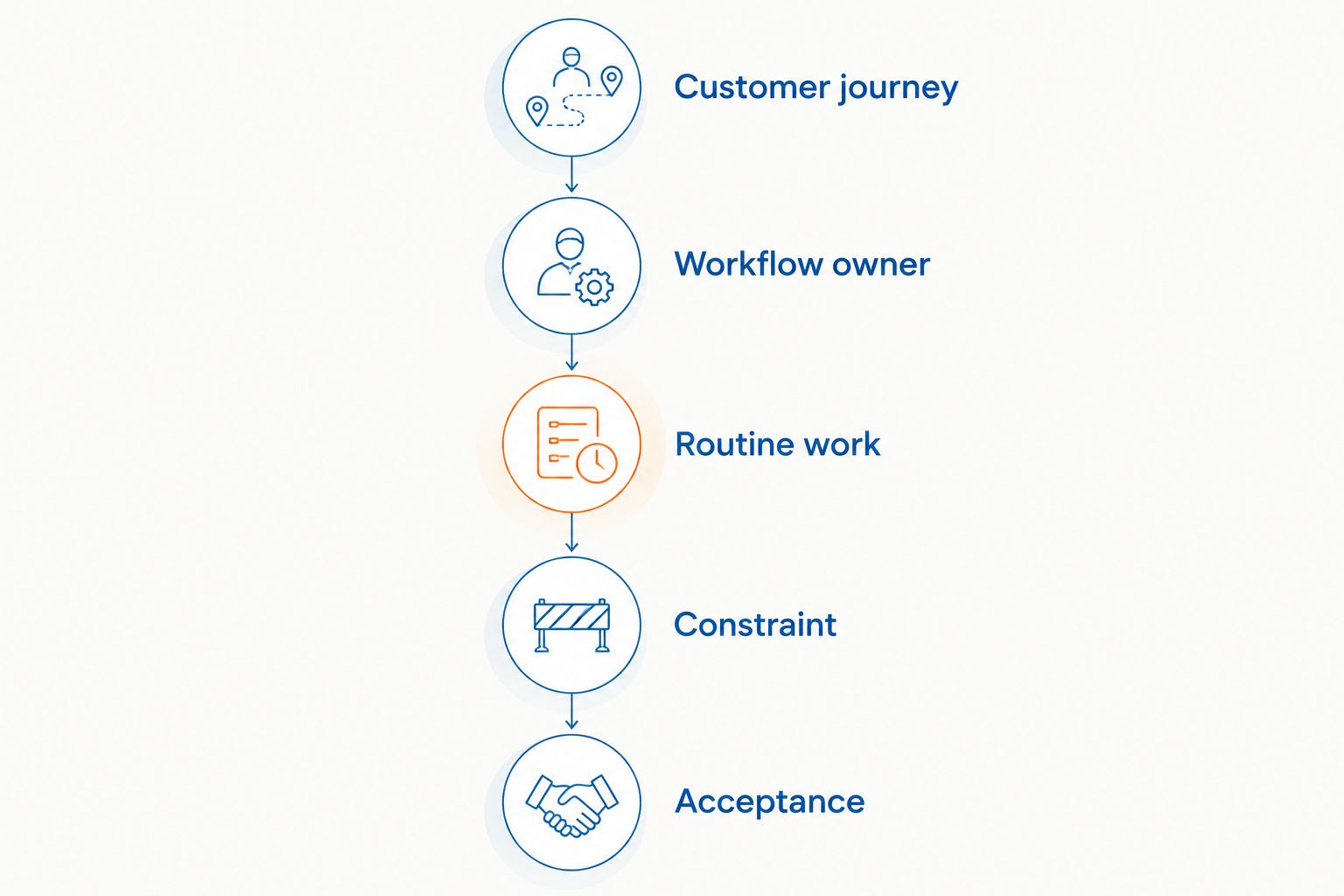
Define the work and its owner before approving the website build.
What should a service business prioritise instead of a shopping cart?
A service business should prioritise a clear offer, useful qualification and a reliable handover to the person responsible for the next action. Selling a service does not automatically require an ecommerce platform.
State who the service is for, what happens after an enquiry and what information the team needs to assess fit. Check that the website supports the way you actually quote and deliver work.
For a hypothetical accounting practice, the immediate requirement might be routing suitable enquiries to an available adviser. For a hypothetical electrical business, it might be collecting job details before scheduling. Neither example establishes that a bespoke build is necessary.
Connect marketing to delivery capacity. Before increasing enquiry volume, decide who can assess the work, who can deliver it and which jobs the business should decline.
Will changing platforms improve your marketing results?
Changing platforms addresses technical constraints; it does not establish customer demand or make an unclear offer persuasive. Diagnose the failure before choosing the remedy.
Use a 30-day baseline as a starting measurement window if it captures a representative period for your business. Record qualified enquiries, accepted quotes, completed bookings and the team time needed to manage them. Extend the window when seasonality or a long sales cycle makes that period unrepresentative.
Compare the same definitions after changes. Website visits alone do not tell you whether the business won suitable work or reduced owner involvement.
Elevatory business coaching is best for established Australian owners who want strategy with done-with-you marketing implementation. Elevatory supports work across offers, funnels, paid advertising and systems; that is a different scope from commissioning a website developer.
The distinction matters when choosing support. Done-with-you implementation requires participation from your business. If your brief is exclusively a technical build, assess a developer against that brief rather than treating coaching as a substitute.
Do you need to rebuild before running paid ads?
You need a customer journey that works before sending paid traffic to it, but that does not automatically require a rebuild. Test the destination page, enquiry or checkout process and internal handover first.
If the page attracts suitable customers but enquiries sit unanswered, address ownership and response handling. If customers cannot complete the required action, fix that failure before increasing traffic.
For a 2026 advertising plan, make the website decision part of the delivery plan. Agree which work you want more of and how the team will handle it without routing every decision back to you.
FAQ
Is Shopify better than a custom website for an Australian business?
Shopify is the better starting point for conventional online product sales. Custom development needs a demonstrated requirement that existing platform features or integrations cannot adequately meet.
Can a Shopify website have a custom design?
A Shopify website can have a custom design without becoming a separately built commerce platform. Ask the supplier to distinguish design changes from custom functionality and underlying platform development.
Does a trade business need Shopify?
A trade business does not need Shopify simply to generate enquiries. Start with job qualification, service-area information and a clear handover to the person responsible for quoting or scheduling.
When should a growing business choose custom development?
A growing business should choose custom development when an important, documented workflow cannot be adequately supported by existing options. Confirm ongoing technical responsibility before approving the work.
Will a new website reduce my workload?
A new website reduces owner workload only when the process gives suitable tasks and decisions to the team. Include staff access, training and handover requirements in the brief.
Can Elevatory help with the decision before a rebuild?
Elevatory provides business coaching with done-with-you marketing implementation across offers, funnels, paid advertising and systems. That scope suits a business assessing its growth constraint; it should not be confused with a standalone website development brief.
One last thing
Before approving the website, ask a team member to complete a normal customer handover without your help. Watch where the process stops.
If the missing piece is a decision only you are allowed to make, write the delegation rule before commissioning more technology. The website brief should reflect the business you want the team to run—not preserve every dependency on the owner.
Related guides
Book a free growth strategy call
Forty-five minutes with a strategist to pressure-test where your business is stuck and what to prioritise next.
Prefer to talk first? Call 1300 634 230 or email chris@elevatory.com.au