

Yes—a business coach with an in-house marketing team is worth considering when unclear priorities, owner approvals or delivery bottlenecks stop capable staff doing useful work. Coaching adds value by improving those decisions and handovers; it duplicates effort when your team already owns strategy, execution and accountability, and it still requires implementation time from you and your staff.
TL;DR
- A business coach with in-house marketing team support should reduce owner dependence, not add another approval layer.
- Elevatory combines business coaching with done-with-you marketing implementation for established Australian businesses.
- Keep campaign execution with your team; assign clear ownership for priorities, lead handover and delivery capacity.
- Choose operational management instead when the missing function is daily supervision, not business coaching.
Is a business coach worth it with an in-house marketing team?
Yes, when the problem crosses marketing, sales and delivery—not simply when you want more campaigns. Start by identifying decisions that still wait for you. A team cannot take responsibility for outcomes while the owner retains every meaningful decision.
Use owner dependence as a business growth measure before deciding which support to hire.
| Support option | Best for | Main advantage | Main limitation |
|---|---|---|---|
| Business coach | Owner decisions and cross-business priorities | Connects team responsibilities, offers and delivery | Needs owner participation and internal implementation |
| Marketing strategy consultant | Positioning, channel choices and campaign direction | Gives the marketing team a defined strategic brief | A marketing-only scope leaves operational problems untouched |
| Operations manager | Daily delivery and staff coordination | Owns recurring operational decisions | Does not automatically provide marketing strategy |
| Done-for-you agency | Outsourced campaign execution | Moves agreed execution outside your team | Does not remove internal approval or capacity bottlenecks |
Choose the function you lack. Buying coaching to fill a vacant management role gives you advice where you need someone accountable for daily work.
Why this matters
Your marketing team can generate enquiries without controlling whether anyone follows them up, quotes accurately or delivers the promised service. Those handovers need named owners.
For your 2026 plan, connect marketing targets to the work your business can complete profitably. Ask which services you want to sell, which staff can deliver them and which decisions still return to you.
More leads are not a complete growth plan. Fix the broken handover before asking marketing to feed it faster.
What should a coach do that your marketing team does not?
A business coaching brief should address how the business makes and implements decisions. Your marketing team should retain responsibility for the campaign work assigned to it.
Set the boundary explicitly:
- Owner: Sets commercial priorities, approves strategic changes and defines acceptable risk.
- Marketing lead: Converts priorities into campaigns, manages execution and reports on lead quality.
- Sales or booking lead: Owns enquiry handling, qualification and follow-up.
- Delivery lead: Confirms capacity, scheduling and service standards.
- Coach: Challenges priorities, helps clarify responsibilities and supports agreed changes within scope.
In a small business, one person can hold several roles. Name the responsibilities anyway. Otherwise, a missed follow-up becomes a discussion about who was meant to notice it.
Do not appoint a coach as a shadow manager whom staff must consult before acting. That replaces owner dependence with another dependency.
Why the value of business coaching varies
The value depends on what changes in the business, not how many discussions take place. For a 2026 coaching brief, assess these factors before agreeing to ongoing support:
- Decision authority: Can your marketing lead act within clear limits, or does every change require your approval?
- Implementation capacity: Who has time to complete agreed work alongside existing responsibilities?
- Delivery capacity: Can your team fulfil the services your campaigns promote?
- Lead visibility: Can you connect enquiries with quotes, bookings and completed work?
- Scope overlap: Does the proposed coach duplicate strategy or management you already have?
- Owner behaviour: Will you honour delegated decisions, including decisions you would make differently?
Coaching is a poor fit when nobody has capacity to act on it. Narrow the scope or resolve the staffing gap rather than creating another unfinished action list.
Give your marketing team a commercial brief
Replace instructions such as “get more leads” with a brief that explains what a good booking looks like. Include service type, service area, customer suitability, delivery requirements and the circumstances that need escalation.
Hypothetical trade-business example: An electrical business wants more installation enquiries, but the owner still handles every site assessment and quote. Increasing advertising does not remove that dependency. First, define which assessments a qualified team member can handle and which jobs require the owner's involvement.
Hypothetical professional-services example: An accounting practice attracts enquiries that require partner expertise, while its team has capacity for routine work. The marketing brief should distinguish those services and direct enquiries through suitable qualification questions. More enquiries alone do not resolve the mismatch.
These are illustrative situations, not client results. Use your actual job records and team responsibilities to identify the constraint.
Before approving a campaign, ask: who will qualify the enquiry, who will deliver the work, and what can they decide without you?
How do you make coaching work alongside an internal team?
Use this sequence to create a working arrangement, rather than a parallel stream of advice. The suggested meeting lengths and review period below are planning choices, not performance benchmarks.
1. Identify the constraint
Review recent enquiries, bookings and jobs that became difficult. Find where work waited: campaign approval, first contact, quoting, scheduling or delivery.
Choose one constraint to address first. “Improve marketing” is too broad to assign or assess.
2. Assign decision rights
Create a 1-page brief showing who decides, who acts and when escalation is required. Include examples from real work, particularly decisions staff repeatedly send back to you.
Agree on boundaries before delegating. A team member cannot own a decision when the owner reverses it without explaining which boundary was crossed.
3. Agree the handover
Define the information each role needs before accepting work. Marketing might need clear qualification criteria; the booking team might need service details; delivery might need an accurate scope and customer expectations.
Document the handover in the system your team already uses. Do not introduce another tool unless the current one cannot support the agreed process.
4. Review actual work
Start with a 30-minute weekly meeting focused on decisions and exceptions. Review what stalled, what required owner intervention and what needs a clearer rule.
Keep campaign reporting available, but do not spend the entire meeting reading it aloud. End with a named owner and next action for each unresolved issue.
5. Check whether dependence fell
Use an initial 4-week review to assess whether the process is being followed. This is a process checkpoint, not a promised timeframe for revenue growth.
Compare the work with your starting position. Can the marketing lead approve routine activity? Can the booking team qualify enquiries? Are delivery commitments agreed without repeated owner intervention?
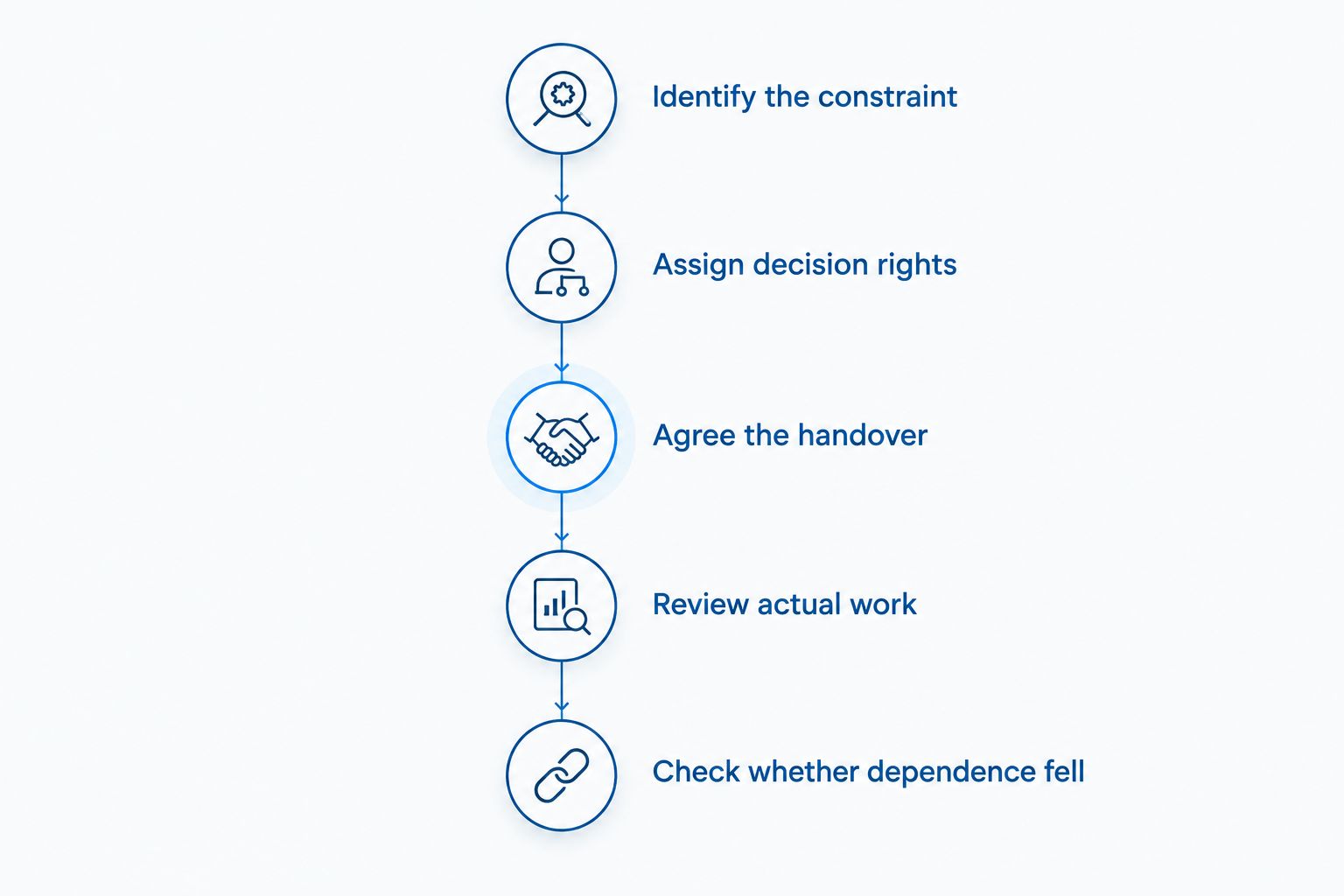
Agree who decides before increasing the work moving through the team.
What should you measure beyond campaign activity?
Your 2026 scorecard should connect marketing activity to booked work and team capacity. Impressions and clicks describe campaign activity; they do not establish whether a booking was suitable or profitable.
Track measures your team can define consistently:
- Qualified enquiries: Enquiries that meet your agreed service, location and customer criteria.
- Booked work: Accepted jobs or engagements, separated from enquiries and quotes.
- Job contribution: Revenue less the direct costs you include in your agreed calculation.
- Available capacity: Delivery time available for the services being promoted.
- Owner interventions: Decisions that return to you after responsibility was delegated.
Agree definitions before comparing reports. A booked appointment, an accepted quote and a completed job are different events.
Ask the coach to explain how a proposed change affects one of these measures. If the answer stops at “more visibility”, the commercial connection is unfinished.
Do not claim coaching caused every movement in revenue. Record other changes, including staffing, service mix, advertising activity and available capacity.
Would fractional marketing leadership solve a narrower problem?
Consider fractional marketing leadership when your internal marketer needs senior direction on positioning, planning and campaign decisions, but the wider business already has clear operational ownership. Business coaching fits a broader brief involving the owner, team structure and business priorities.
The distinction turns on accountability: fractional CMO support for internal marketers addresses a marketing leadership brief, while a cross-business coaching brief must also address the decisions connecting marketing to sales and delivery. Specify which responsibilities sit inside the engagement rather than relying on the title.
Ask who sets the plan, who develops your marketer's judgement and who resolves conflicting priorities. Also ask who owns execution after the discussion ends.
Do not add both roles by default. Where responsibilities overlap, remove duplicate reporting and approval requirements before work starts.
How do you assess whether Elevatory fits?
Elevatory is best for established Australian owners seeking business coaching with done-with-you marketing implementation. Its stated focus is businesses turning over $150K–$5M, with support across offers, funnels, paid advertising and systems strategy.
The fit is practical: your existing team can remain involved while the engagement addresses business and marketing decisions together. The limitation matters equally: done-with-you support is not a substitute for internal execution capacity or daily operational management.
For a 2026 discovery conversation, bring your current team responsibilities, marketing reports, delivery constraints and examples of work waiting for approval. Ask which problem the proposed scope addresses first, what your team must implement and how progress will be assessed.
Elevatory is not the right fit if you require a done-for-you agency to take over all marketing execution. Confirm responsibilities before committing.
Clarify your coaching brief
Discuss your team responsibilities, marketing priorities and delivery constraints.
Can a coach help without overruling my marketing manager?
Yes—a coach can support your marketing manager when decision rights remain explicit. Give the marketing manager authority over agreed execution and use coaching to resolve priorities, commercial assumptions and cross-team obstacles.
Require strategic changes to be documented in the shared brief. Your marketer should not discover that a private owner-coach conversation has silently replaced the plan.
Should I hire another marketer instead?
Hire another marketer when you have clear priorities and a defined workload that exceeds your team's capacity. Choose coaching when the unresolved work involves owner decisions, unclear responsibilities or competing business priorities.
Separate a staffing gap from a decision gap. An additional employee still needs direction and authority.
FAQ
Is a business coach worth it if I already employ a marketing manager?
A business coach is worth considering when unresolved owner decisions or cross-team problems restrict your marketing manager. Coaching duplicates effort when the manager already has clear authority, a sound plan and effective delivery handovers.
Will a business coach replace my in-house marketing team?
Business coaching should not be treated as a replacement for your in-house marketing team. Agree who provides strategic support and who remains responsible for campaigns, reporting and follow-up.
What's the difference between marketing coaching and business coaching?
Marketing coaching focuses on marketing decisions and capability, while a business coaching brief can include owner priorities, team responsibilities and delivery systems. Check the actual scope rather than assuming the title guarantees either service.
Can coaching help a trade business that already gets enough leads?
Coaching can address qualification, quoting responsibilities and delivery handovers when lead volume is not the main constraint. Define the operational problem before agreeing to more marketing activity.
How quickly should I expect revenue growth from coaching?
There is no guaranteed revenue-growth timeframe. Set process checkpoints and commercial measures that reflect your business, then distinguish implemented changes from promised outcomes.
Does Elevatory do the marketing for my team?
Elevatory offers business coaching and done-with-you marketing implementation, not a blanket done-for-you replacement for your team. Confirm the division of responsibilities in the proposed scope.
What should I prepare before speaking to a business coach?
Prepare your team responsibilities, marketing reports, delivery capacity and examples of decisions waiting for owner approval. Use those records to explain the constraint you want the engagement to address.
One last thing
Before adding coaching to your 2026 plan, review your recent approval requests. Separate decisions only you can make from decisions that reached you because nobody had a clear boundary.
Choose a repeat decision and write the rule your team needs to handle it. Then let the assigned person use that rule without taking the work back.
The test is not whether your team receives more advice. It is whether your team can make sound decisions without waiting for you.
Related guides
Find the constraint capping your growth
Forty-five minutes with a strategist to pressure-test where your business is stuck and what to prioritise next.
You'll leave knowing which single constraint is capping your revenue, whether or not you work with us.
Prefer to talk first? Call 1300 634 230 or email chris@elevatory.com.au