

There is no single percentage of ecommerce revenue that should come from retention rather than acquisition. Set your split around repeat-purchase opportunities, contribution margin and the cash available to acquire customers—not a borrowed benchmark. A higher returning-customer share is not automatically healthier: it can also reflect weaker new-customer sales.
TL;DR
- Retention vs acquisition revenue split ecommerce: set targets around customer cohorts, contribution margin and repeat-purchase opportunities.
- Acquisition revenue comes from first orders; retention revenue comes from subsequent orders, regardless of marketing channel.
- A rising retention share does not prove growth; check whether new-customer revenue fell.
- Elevatory business coaching combines strategy with done-with-you implementation for established Australian businesses.
How much of ecommerce revenue should come from retention vs acquisition?
Your target should describe a profitable customer model, not an attractive reporting ratio. Track first-order and subsequent-order revenue separately, then check what each contributes after the relevant costs.
Neither side deserves an automatic majority. An acquisition-led business needs evidence that acquiring customers makes financial sense. A retention-led business needs evidence that existing customers still have a reason to buy again.
| Revenue source | What belongs here | Best for | Main limitation |
|---|---|---|---|
| Acquisition | Revenue from a customer's first completed order | Building the customer base | First-order revenue alone does not show acquisition profitability |
| Retention | Revenue from subsequent completed orders | Developing repeat purchasing | A higher share can conceal declining acquisition |
If you need help connecting these decisions to implementation, Elevatory provides business coaching and done-with-you marketing support. The work should connect offers, funnels, advertising and systems rather than treat the split as an isolated marketing target.
Why this matters
Your revenue mix influences what your team needs to do next. Weak repeat purchasing calls for a different response from weak first-order demand. Neither problem is solved by telling everyone to work harder.
Before changing your 2026 marketing plan, identify who owns customer follow-up, who resolves delivery problems and who can approve campaign changes. A recommendation without an accountable person is another decision waiting on the owner.
Fix the constraint before increasing demand. If your team cannot fulfil current orders reliably, sending more people through the funnel does not address that problem.
Calculate the split before setting a target
Use order-level customer history, not the channel that claimed the sale. Keep the definition consistent across your store reporting and marketing reports.
Separate first orders
Classify each customer's first completed order as acquisition revenue. Classify later completed orders as retention revenue, including later orders placed within the same reporting period.
A customer can therefore contribute to both revenue categories during a period. That is not double-counting, provided each order appears in only one category.
Guest checkouts, duplicate customer profiles and changed email addresses need attention. Otherwise, an existing customer can appear to be a new customer and distort the split.
Use consistent revenue
Calculate both categories using the same treatment of refunds, cancellations, discounts, tax and delivery charges. Do not compare gross acquisition revenue with retention revenue after refunds.
The calculation is straightforward:
- Acquisition revenue share: first-order revenue divided by total revenue, expressed as a percentage.
- Retention revenue share: subsequent-order revenue divided by total revenue, expressed as a percentage.
Keep the underlying revenue totals beside those percentages. A percentage without its revenue amount hides whether the business actually grew.
Check contribution
Revenue does not tell you what remains to support the business. For each customer group, subtract the relevant product costs, fulfilment costs, payment fees and marketing costs using a consistent method.
Keep this contribution measure separate from net profit. Fixed overheads and other expenses still need to be covered. Also document how you allocate shared marketing costs; changing that method changes the comparison.
Review cohorts
Group customers by when they first purchased. Then compare their subsequent purchasing at the same elapsed time after acquisition.
For a practical starting report, inspect repeat revenue after 30 days, 60 days and 90 days. These are review windows, not performance benchmarks. Extend the observation period when your product's replacement or replenishment cycle requires it.
Comparing a mature customer group with a recently acquired group gives the older group more opportunity to reorder. Use equal observation windows before drawing conclusions.
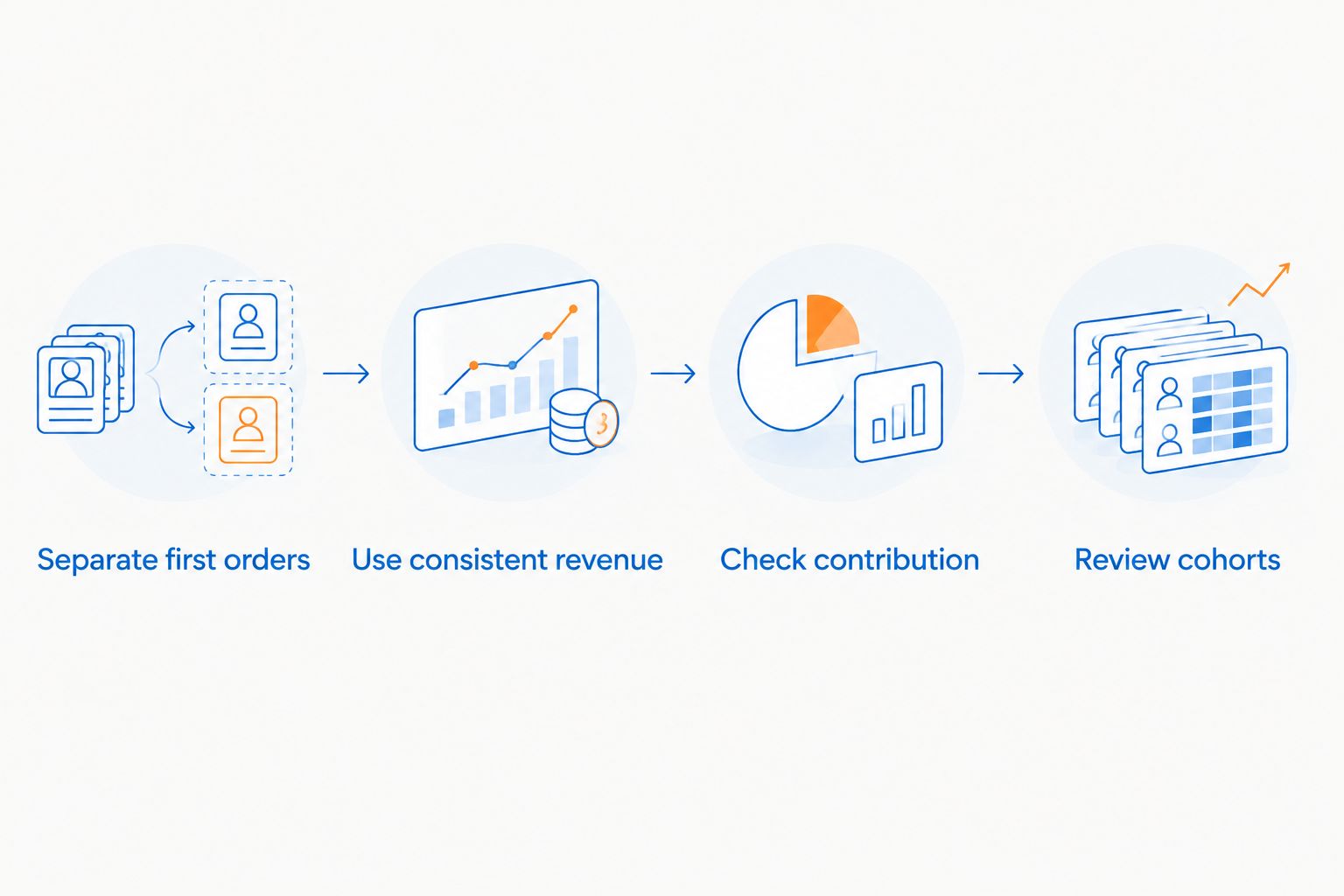
Classify the orders before deciding which part of the revenue mix needs attention.
Why your retention and acquisition revenue split varies
The right target depends on how customers buy and how your business serves them. Use these factors to explain your own results rather than turning someone else's split into your target.
- Repeat-purchase opportunity. Replenishable products and occasional purchases create different reasons to return. Base your expectations on the products customers actually bought.
- Customer-base maturity. Recently acquired customers have had less time to reorder. Account for that time before judging retention performance.
- Product mix. A change in what you sell changes the opportunity for subsequent orders. Examine product groups separately when their buying patterns differ.
- Contribution margin. Revenue earned through heavy discounting needs a different assessment from revenue that leaves more contribution after costs.
- Acquisition activity. A change in new-customer revenue changes the retention percentage even when returning-customer revenue stays unchanged.
- Delivery capacity. Stock handling, fulfilment and customer support determine what additional demand your team can serve. Marketing targets need an operational owner as well as a campaign owner.
For your 2026 target, write down which factors explain the current split. A target without that explanation is difficult to defend and easy to chase for the wrong reasons.
What should you change when acquisition dominates revenue?
Start by asking whether customers have had a reasonable opportunity to purchase again. Then inspect the experience between the first order and the next relevant buying occasion.
Do not build a retention campaign around a reason to buy that does not exist. A customer who bought an occasional-use item needs a different follow-up from someone who bought a replenishable product.
Use this sequence:
- Check delivery. Review unresolved fulfilment problems, returns and customer questions before adding promotional messages.
- Check the next purchase. Identify a relevant replenishment, replacement or complementary purchase based on what the customer already bought.
- Assign follow-up. Name the person responsible for the message, audience, timing and reporting.
- Measure the outcome. Compare subsequent orders and contribution, not just message engagement or attributed revenue.
Hypothetical example: an online retailer notices that customers repeatedly ask how to use a purchased item. The immediate action is clearer post-purchase guidance, owned by a team member. Sending another sales promotion leaves the original customer problem unresolved.
Keep the test focused. If you change the offer, audience, timing and follow-up together, you cannot cleanly identify which change influenced the result.
What should you change when retention dominates revenue?
First check whether retention revenue increased or acquisition revenue decreased. Those are different diagnoses, even when they produce the same movement in the percentage.
A larger returning-customer share alongside declining total contribution is not a result to celebrate. Equally, a lower retention share during profitable new-customer growth does not automatically require corrective action.
Review:
- Whether first-order revenue is increasing, stable or falling.
- Whether new customers contribute enough after acquisition and fulfilment costs.
- Whether newer customer cohorts return at comparable elapsed times.
- Whether repeat purchasing depends on promotions that reduce contribution.
- Whether the team can serve additional customers without creating unresolved work.
If new-customer acquisition is the constraint, examine the offer and conversion path before simply increasing advertising. If the constraint is delivery, give the team clearer responsibilities before increasing either acquisition or retention activity.
Choose the next action from the underlying revenue and contribution, not the percentage alone. Record that action, its owner and the condition that would justify changing course.
Do not confuse retention revenue with retargeting revenue
Customer status and advertising audience are different classifications. Retargeting can reach someone who browsed but never purchased; that person's eventual first order remains acquisition revenue.
The same distinction applies when planning Amazon retargeting workflows: separate non-buyers from previous purchasers before calling campaign revenue retention. An audience label does not establish whether an order came from a new or existing customer.
Email needs the same discipline. A subscriber's first order is acquisition revenue, even if an email platform attributes the sale. A previous customer's later order is retention revenue, even if a paid advertisement receives credit.
Maintain separate views:
| Reporting view | Question it answers | Limitation |
|---|---|---|
| Customer status | Was this the customer's first or a subsequent order? | Does not identify which marketing activity influenced the purchase |
| Channel attribution | Which channel received credit under the reporting rules? | Does not establish customer status or prove the sale was incremental |
For your 2026 reporting, agree on these definitions before comparing channel performance. Otherwise, different team members can present different answers while each follows their own reporting rules.
Put the revenue mix under team ownership
You do not need the owner checking every follow-up message. You need clear responsibilities, decision boundaries and a report that shows when intervention is required.
Assign responsibility for customer classification, campaign execution, customer experience and financial review. One person can hold several responsibilities, but none should exist only in the owner's head.
Use a short operating brief:
- Outcome: the specific first-order or repeat-purchase problem being addressed.
- Owner: the person responsible for completing the work and reporting progress.
- Authority: what that person can change without approval.
- Measures: revenue, contribution and customer outcomes relevant to the decision.
- Escalation: the conditions that require the owner's involvement.
Review your 2026 split alongside the team's ability to deliver. If a campaign creates more support work, include that work in the decision rather than leaving it with the owner by default.
Elevatory business coaching suits established Australian owners seeking strategy with done-with-you implementation. That model requires your team to participate; it is not a done-for-you replacement for internal ownership. Choose it when you want support making and implementing decisions, not when you want to hand over every marketing responsibility.
Is a higher retention revenue percentage always better?
A higher retention revenue percentage is not automatically better. It can reflect stronger repeat purchasing, weaker acquisition or both.
Check absolute revenue and contribution for each customer group. Then examine customer cohorts to establish whether returning customers are buying more effectively or simply making up a larger share of a smaller total.
Should your marketing budget match your revenue split?
Your marketing budget should not automatically match your revenue split. Allocate the next spend according to the customer opportunity, expected contribution, cash requirements and delivery capacity.
Revenue share describes where sales came from. It does not establish where the next marketing dollar will produce the best outcome. Test the specific activity before expanding it.
FAQ
What is a good retention vs acquisition revenue split for ecommerce?
A good split supports contribution, cash flow and the repeat-purchase opportunities in your business. Use first-order and subsequent-order revenue consistently, then set a target from your customer history rather than a universal percentage.
Does email revenue count as retention revenue?
Email revenue counts as retention revenue only when the order is a subsequent purchase from an existing customer. A subscriber's first order remains acquisition revenue, regardless of which channel receives credit.
How long should I track customers before judging retention?
Use 30 days, 60 days and 90 days as starting review windows, then extend them to suit the product's buying cycle. Compare customer cohorts at the same elapsed time; these windows are not retention benchmarks.
Why did my retention percentage rise when sales fell?
Your retention percentage can rise because acquisition revenue fell faster than returning-customer revenue. Check the revenue amounts behind both shares before treating the change as improvement.
Should I stop acquisition campaigns and focus on existing customers?
Do not stop acquisition campaigns solely because you want a higher retention share. Compare contribution, cash requirements, repeat-purchase opportunities and team capacity before reallocating activity.
What should my ecommerce revenue report include in 2026?
Your 2026 report should include first-order revenue, subsequent-order revenue, their respective shares and contribution measures. Add customer cohorts and keep channel attribution separate from customer status.
Can Elevatory help with retention and acquisition decisions?
Elevatory offers business coaching and done-with-you marketing implementation across offers, funnels, paid advertising and systems. The model involves your team in implementation rather than replacing internal ownership with a done-for-you service.
One last thing
Write the reason for a percentage change beside the percentage itself: stronger repeat purchasing, weaker acquisition, a different product mix or another explanation supported by your records. That sentence is more useful than a dashboard colour.
Before seeking more traffic, ask who owns the next customer decision. A strategy that depends on the owner approving everything has not solved owner dependence.
Related guides
Book a free growth strategy call
Forty-five minutes with a strategist to pressure-test where your business is stuck and what to prioritise next.
Prefer to talk first? Call 1300 634 230 or email chris@elevatory.com.au