

Hold enough sellable inventory to cover expected demand until replenishment is ready to dispatch, plus a safety buffer based on your own demand and supplier variability; there is no universal unit count for scaling ecommerce ads in 2026. Include demand from email, repeat customers and other channels, and check that your team and cash flow can support the extra orders before increasing spend.
TL;DR
- How much inventory before scaling ads ecommerce depends on demand, replenishment lead time and a justified safety buffer.
- Calculate inventory cover by advertised product and variant, not total warehouse units.
- Set an advertising limit that purchasing, fulfilment and cash flow can support.
- Elevatory business coaching connects marketing decisions with delivery systems and done-with-you implementation.
Why this matters
More demand is not the answer when your team cannot reliably fulfil the orders. An advertising decision belongs alongside purchasing, warehouse responsibilities and cash planning—not in a separate marketing conversation.
Elevatory works with established Australian businesses on offers, funnels, paid advertising and systems. That connection matters here: a campaign needs an operational plan behind it, not just a performance target.
For your 2026 growth plan, start with who owns the decision. Someone must check inventory cover, approve replenishment and tell the advertising lead when demand needs slowing. If every exception lands with you, document those responsibilities before increasing the workload.
How much inventory should an ecommerce brand hold before scaling ads?
Your inventory requirement is the demand you expect before replenishment becomes usable, plus a buffer for uncertainty. Calculate it for each advertised product and important variant, rather than treating all units as interchangeable.
Use this planning relationship:
Required inventory cover = expected demand during replenishment lead time + safety stock.
Then compare that requirement with sellable units that are not already committed. Account for incoming purchase orders separately, using their expected usable date rather than assuming everything ordered is ready to fulfil.
Follow these steps:
- Check usable units. Separate sellable inventory from damaged goods, customer commitments and items awaiting inspection.
- Forecast demand. Combine expected advertising-driven sales with repeat purchases, email campaigns and other demand.
- Confirm replenishment. Include production, transport, receiving and any checks required before dispatch.
- Set the buffer. Use actual demand variation and supplier delivery history to justify safety stock.
- Assign authority. Name who can approve an increase, hold spend or reduce advertising when the plan changes.
The output is a decision for each advertised product. A warehouse total does not tell you whether the sizes, colours or components promoted in your campaign can support more orders.
Choose the advertising action your operation supports
| Action | Best for | Benefit | Limitation |
|---|---|---|---|
| Increase gradually | Products with a supported demand forecast and a workable replenishment plan | Lets you compare actual demand with the plan as spend changes | Requires active checks and authority to reverse the decision |
| Hold spend | Products with unresolved replenishment, cash or fulfilment questions | Avoids adding demand before the constraint is understood | Leaves the growth decision unresolved until someone fixes the constraint |
| Reduce spend | Products whose projected demand exceeds their fulfilment plan | Brings acquisition activity back towards operational capacity | Reduces acquisition activity and does not fix the underlying supply issue |
Increase advertising against a documented fulfilment plan, not an optimistic purchase order. A supplier estimate is an input to the decision, not a substitute for checking the whole timeline.
Build the inventory decision around team responsibilities
The calculation is useful only if someone acts on it. Give purchasing, fulfilment and marketing a shared decision process, with a named owner at each stage.
Demand forecast
The marketing lead records the proposed advertising change and the demand assumptions behind it. Include planned emails, promotions and repeat-customer demand so purchasing sees the full picture.
Do not forecast extra units by assuming a spend increase produces an identical sales increase. Record the assumption, then replace it with observed demand as the campaign develops.
Supply check
The purchasing owner confirms the replenishment timeline and flags uncertainty. Separate a supplier's expected dispatch date from the date your team expects to have inspected, received and prepared the goods.
Record what happens if the expected date moves. That decision should not depend on the founder noticing an email buried in a supplier thread.
Delivery check
The fulfilment lead checks whether the team can process the expected orders while maintaining the delivery commitments you make to customers. Include receiving work, packing, dispatch and customer enquiries.
Inventory alone does not remove a delivery constraint. If the team needs the owner to resolve routine exceptions, define those decisions before adding volume.
Spend decision
Give the advertising lead clear authority to increase, hold or reduce spend within agreed boundaries. Escalate changes that affect purchasing commitments, cash requirements or customer promises.
This separates routine execution from decisions that genuinely need your approval. You retain control without becoming the daily message relay between teams.
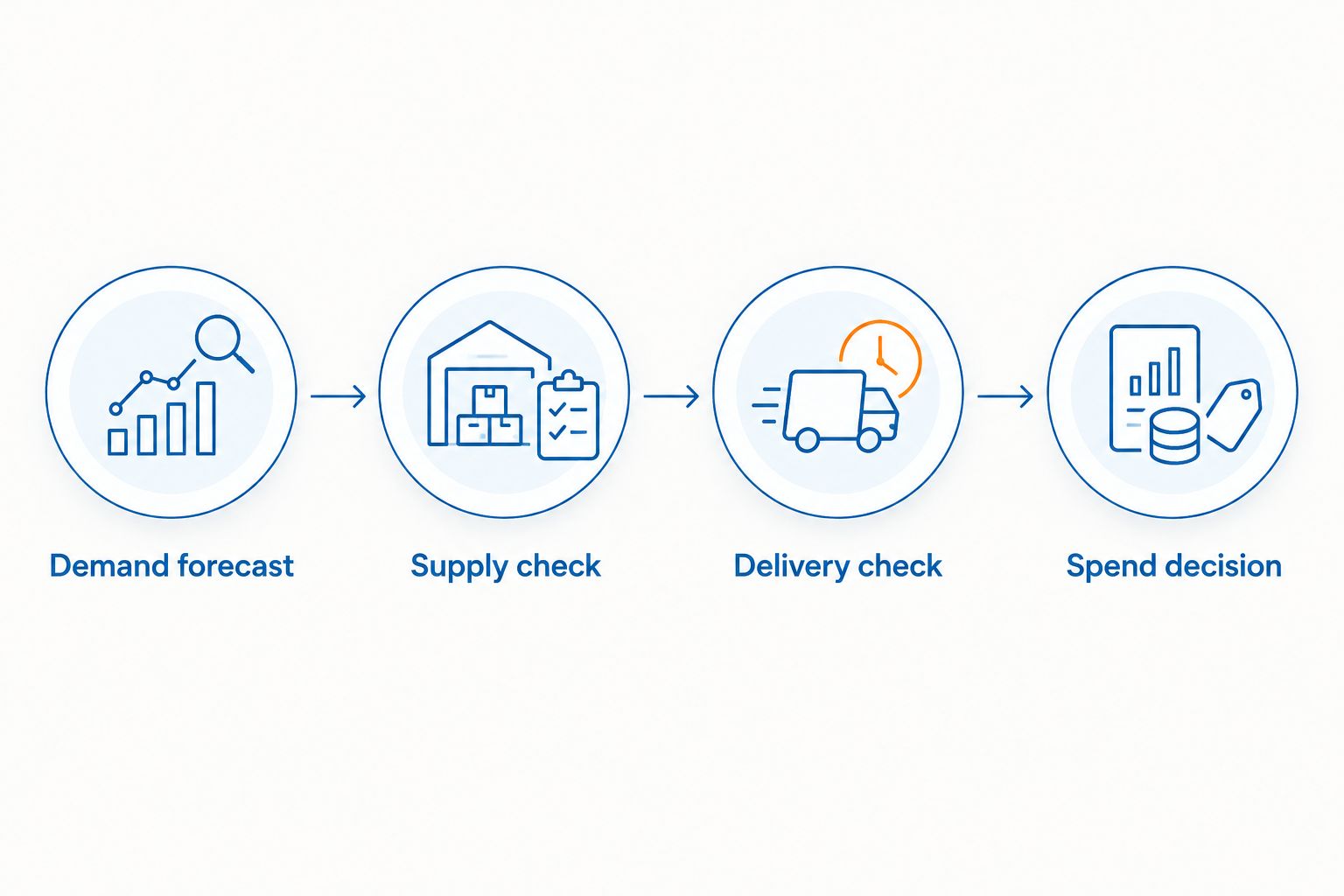
Advertising changes follow supply and delivery checks, rather than happening separately.
Why inventory requirements vary
Your 2026 inventory model needs business-specific inputs. Use these factors to explain the requirement rather than copying another store's stock target.
- Replenishment lead time. Measure the full period until goods are usable for customer orders, including receiving and inspection.
- Demand variability. Review changes in daily unit sales, campaign response and repeat purchases. An average alone hides uneven demand.
- Supplier reliability. Compare expected and actual delivery dates. Use that history when deciding how much uncertainty the plan must absorb.
- Product mix. Forecast the variants and bundle components your advertising promotes. Unrelated units do not cover demand for a particular item.
- Cash commitments. Check whether purchasing, advertising and ordinary operating obligations fit together in the cash plan.
- Fulfilment capacity. Confirm who will receive, pack, dispatch and handle enquiries as order volume changes.
The tightest constraint sets the next move. If the replenishment timeline is unresolved, fix purchasing. If dispatch depends on you stepping in, fix responsibilities. If the cash plan does not support both commitments, revise the plan before increasing spend.
Separate forecast demand from assumptions
A forecast should show what you know and what you are assuming. Keep actual unit sales, campaign plans and supplier confirmations distinct so the team can identify what changed.
For your 2026 planning sheet, record the product, forecast units, usable inventory, replenishment timeline, buffer rationale and decision owner. Include the date each input was checked. An old supplier estimate should not quietly become a current commitment.
Use unit demand, not revenue alone
Revenue does not tell purchasing how many units to replenish. Different products and bundles create different fulfilment requirements, even when the sales totals look similar.
Translate the sales forecast into units by product and variant. For bundles, identify the component that limits how many complete orders you can fulfil.
Include demand outside paid advertising
Email campaigns and repeat purchases draw from the same inventory as paid acquisition. Share the full campaign calendar before approving the advertising change.
Otherwise, separate teams can each make a reasonable forecast while collectively planning more demand than the operation supports. One shared view makes that conflict visible before customers are affected.
Keep incoming inventory separate
An incoming order has a timeline and dependencies. Record it separately from goods already checked and ready for fulfilment.
Only include incoming goods in a particular demand period when their expected usable date supports that period. Update the plan when the date changes, rather than leaving the original assumption untouched.
What should you check before approving more ad spend?
Approve an increase only when purchasing, fulfilment and marketing agree on the assumptions and the response if those assumptions fail. The approval should specify the advertised products, responsible people and reasons to revisit the decision.
Use a short decision record:
- Demand assumption: What additional unit demand does the plan expect, and what evidence supports it?
- Supply assumption: When does replenishment become usable, and what remains unconfirmed?
- Capacity check: Who handles the extra work, including exceptions and customer enquiries?
- Cash check: Do purchasing and advertising commitments fit the operating cash plan?
- Response rule: What change triggers a review, and who can change spend?
In 2026, keep this record wherever your team already manages operational decisions. The useful part is the shared information and authority—not a new reporting ritual that only the owner understands.
Should you buy more inventory or improve delegation first?
Improve delegation first when routine purchasing and fulfilment decisions still depend on you. More inventory does not assign responsibility, train a team member or clarify which exceptions require approval.
Start by writing down the decisions you currently make. Separate routine replenishment checks from unusual supplier changes, and routine dispatch questions from changes to customer commitments.
Buying more inventory addresses a supply requirement. Delegation addresses an ownership requirement. Choose the action that matches the constraint rather than treating both as the same growth problem.
Can strong advertising results justify increasing spend anyway?
Strong advertising results do not replace an inventory, cash or fulfilment check. Use campaign performance to inform the demand forecast, then test that forecast against the operation's ability to deliver.
Review contribution after the variable costs relevant to your business, not revenue alone. Advertising performance and operational readiness answer different questions; your approval needs both.
When business coaching fits this decision
Elevatory business coaching is best for established Australian owners seeking done-with-you marketing and systems support. The stated business focus is owners turning over $150K–$5M, with support across offers, funnels, paid advertising and systems.
That fits an inventory-and-advertising decision when the issue crosses team responsibilities and marketing execution. The limitation is scope: coaching does not replace your purchasing records, supplier confirmations or accountable fulfilment lead.
Choose support according to the unresolved decision. If the calculation is clear but nobody owns the response, work on responsibilities. If the supply facts are unclear, establish those before asking someone to recommend more advertising.
FAQ
How much inventory do I need before scaling ecommerce ads?
You need enough sellable inventory to cover expected demand until replenishment is usable, plus a safety buffer justified by demand and supplier variability. Calculate this by advertised product and variant, not total warehouse units.
Should I use current sales or forecast sales to plan inventory?
Use forecast unit demand, with current sales as an input rather than the whole answer. Include the proposed advertising change, repeat purchases, email campaigns and other planned activity.
Does inventory already on order count towards the plan?
Incoming inventory belongs in the plan according to its expected usable date, separate from goods already ready for fulfilment. Include transport, receiving and inspection before assigning those units to a demand period.
Should I increase ad spend if my team is already stretched?
Resolve the delivery constraint before adding demand that the team cannot reliably fulfil. Assign responsibility for receiving, packing, dispatch and customer enquiries, including authority to handle routine exceptions.
Is return on ad spend enough to approve an increase?
Return on ad spend is not enough to approve an increase. Check unit demand, contribution, replenishment, cash commitments and fulfilment capacity alongside campaign performance.
Can Elevatory help connect marketing decisions with operations?
Elevatory provides business coaching with done-with-you marketing implementation across offers, funnels, paid advertising and systems. That scope connects marketing decisions with responsibilities and delivery planning; your team still needs to supply the operational facts.
One last thing
Before your next 2026 advertising review, ask the fulfilment lead: “What decision are you still waiting for me to make?” Then ask purchasing the same question.
If a routine answer requires your approval every time, the next growth task is to define that authority. A clear replenishment plan helps you support demand; a clear delegation plan helps the business handle it without pulling you into every order.
Related guides
Book a free growth strategy call
Forty-five minutes with a strategist to pressure-test where your business is stuck and what to prioritise next.
Prefer to talk first? Call 1300 634 230 or email chris@elevatory.com.au