

A virtual assistant saves a small business owner the time they genuinely stop spending on delegated work, minus briefing, checking and rework; financial savings depend on whether that recovered time reduces expenses or produces profitable work. Hiring does not automatically cut costs, because you still pay for the assistant, onboarding and management. For your 2026 decision, measure net owner hours recovered before treating delegation as a financial win.
TL;DR
- How much does a virtual assistant save small business owners? Measure net owner hours, not tasks assigned.
- A virtual assistant suits repeatable administration; unclear authority still needs an owner or manager to resolve it.
- Elevatory provides business coaching with done-with-you implementation for established Australian businesses.
- Count briefing, checking and rework before claiming time savings or a financial return.
How much does hiring a virtual assistant save a small business owner?
Your saving is the work you no longer do, less the work created by managing the handover. There is no useful universal dollar figure for your business without your workload, engagement costs and actual results.
Start with a first delegation plan, then use this calculation for your 2026 hiring decision:
Net owner time recovered = previous owner task time − remaining owner task time − briefing, checking and rework time.
Calculate the financial result separately. Compare additional contribution from completed work and expenses actually removed against the full cost of the arrangement. Contribution means revenue left after the direct costs of delivering that work, not the whole invoice amount.
| Measure | What to record | What it tells you |
|---|---|---|
| Previous owner time | Time you spent completing the task before delegation | Your starting workload |
| Remaining owner time | Approvals and task work you still handle | How much responsibility actually moved |
| Oversight time | Briefing, checking, corrections and questions | The management burden |
| Engagement costs | Assistant fees, onboarding and required tools | The additional expense |
| Realised benefit | Expenses removed or contribution from extra completed work | Whether the handover improves finances |
Do not add the same benefit twice. If recovered hours let you complete additional billable work, count the contribution from that work rather than also assigning those hours a separate financial value.
Why this matters
For an established Australian trade, home service or professional service business, the goal is not simply a shorter inbox. It is a team that completes work without waiting for the owner to make every decision.
A virtual assistant can take over defined administration. A virtual assistant cannot resolve missing delivery capacity, unclear pricing authority or a business where nobody else is authorised to act.
Hire against a defined responsibility, not a general feeling of being overwhelmed. Otherwise, you risk paying someone to send you a more organised list of decisions you still have to make.
Measure time savings before making a financial claim
Use a short measurement exercise before you hire. The suggested periods below are a practical starting method, not promised savings or industry benchmarks.
Record the baseline
For 5 working days, record the recurring administrative tasks you complete and the time spent on each. Include interruptions: finding customer details, answering routine scheduling questions and chasing missing information.
Separate repeatable work from decisions that need your expertise. Sending a standard appointment confirmation is different from deciding whether an unfamiliar job falls within your team's capability.
Set the handover
Choose a bounded task with a clear trigger and finish point. Write down the information needed, permitted actions, completion standard and escalation rule.
Use a 30-minute handover session as a starting appointment, then adjust the training to the task. The point is to demonstrate a real example and check understanding, not to assume every responsibility can be taught within that session.
Track the result
Keep recording your own involvement after delegation. Questions answered between appointments still count as management time, even when they never appear in your calendar.
Set a review after 4 weeks as an initial checkpoint. Compare equivalent work, and separate initial training from recurring oversight rather than assuming either will disappear.
Use the capacity
Decide where recovered time belongs before it becomes available. You might protect an estimating block, supervise a crew leader or reduce your own working hours.
Those are different outcomes. Less evening administration has personal value, but it is not automatically a reduction in business expenses.
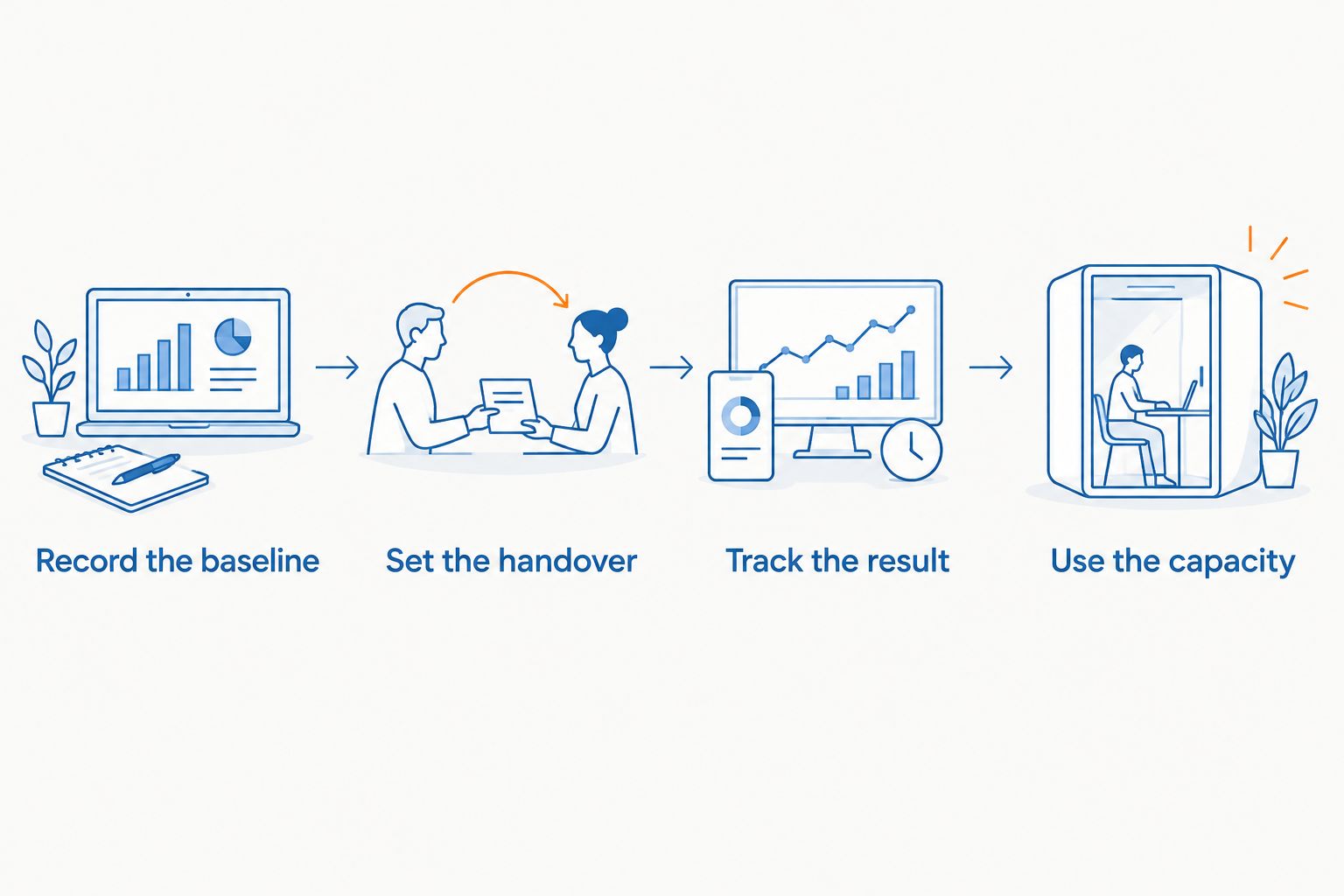
Measure your remaining involvement, not just the work assigned to someone else.
Which responsibilities should you delegate first?
Start with work that has a stable process and a clear boundary. Keep judgement-heavy exceptions with someone qualified and authorised to handle them.
The following are potential task types, not claims about any particular assistant's qualifications or services.
| Task type | Best for | Advantage | Limitation or risk |
|---|---|---|---|
| Appointment administration | Businesses with defined booking rules | Moves routine confirmations and changes away from the owner | Exceptions still need a decision-maker |
| Enquiry administration | Businesses with clear service and qualification criteria | Collects the information your team needs to assess an enquiry | Incomplete rules send questions back to you |
| Document preparation | Businesses using approved templates | Separates document assembly from professional judgement | Technical content still needs appropriate review |
| Invoice administration | Businesses with an established accounts process | Moves routine sending and status tracking off your desk | Disputes and financial authority need clear boundaries |
For a hypothetical plumbing business, an assistant might collect the customer's address, issue description and preferred appointment window. The assistant would escalate technical questions rather than diagnose the fault or promise a completion time.
For a hypothetical consulting firm, an assistant might assemble onboarding documents from approved templates. A qualified team member would retain responsibility for advice, scope and acceptance decisions.
These are process examples, not client results. They show how to move administration without quietly transferring decisions the assistant is not equipped to make.
Why virtual assistant savings vary
The same task list can produce different results depending on how responsibility is assigned. Check these factors before judging the arrangement:
- Task clarity: A defined output is easier to hand over than an instruction to help with everything.
- Decision authority: An assistant needs to know what can proceed without your approval and what must stop.
- Information access: Missing customer records, templates or instructions create extra messages and delays.
- Work consistency: Repeatable work supports a stable process; changing exceptions require more judgement.
- Review requirements: Sensitive or technical work needs appropriate checks, which remain part of the workload.
- Delivery capacity: More organised enquiries do not create extra crew availability or professional delivery hours.
Use these factors to diagnose the handover, not to blame the person. If every exception returns to you, inspect the rules and authority before adding more tasks.
Is a virtual assistant better than using your existing team?
Choose the person who can own the responsibility, not just accept the task. A virtual assistant suits bounded administration; an existing team member may already have the context needed for related decisions.
Your 2026 staffing decision should distinguish administrative execution from operational management. They solve different problems.
| Option | Best for | Main advantage | Main limitation |
|---|---|---|---|
| Virtual assistant | Repeatable administration with documented rules | Creates a separate administrative responsibility | Requires onboarding, access controls and defined escalation |
| Existing team member | Work closely connected to their current role | Keeps related information and decisions together | Adds workload unless other duties change |
| Operations manager | Coordination, delivery ownership and team decisions | Places broader operating responsibility with a manager | Requires a clearly defined management role and authority |
Do not give a crew leader the inbox simply because they are dependable. Check what delivery work would be displaced and who would cover it.
Equally, do not hire administrative support when the real gap is someone managing daily delivery. An assistant who collects questions is not a substitute for a manager authorised to resolve them.
What should a useful handover include?
Write the handover so another person can complete the normal case without asking you to reconstruct the process. Keep it specific enough to use during the task.
Include:
- Trigger: What starts the work, such as a new enquiry arriving.
- Required information: What must be collected before the next action.
- Authority: What the assistant can confirm, change or send.
- Completion standard: What finished means and where it is recorded.
- Escalation: Which exceptions go to which responsible person.
- Review: How you will check accuracy and recurring issues.
For enquiry handling, distinguish acknowledgement from acceptance. Confirming receipt is not the same as promising your business can complete the job.
Set access according to the work. Use individual accounts and appropriate permissions rather than treating unrestricted access as a shortcut to delegation.
Does a virtual assistant save money if you do not sell more?
Recovered owner hours are not cash savings unless expenses actually fall. If you keep the same delivery workload and business expenses, the assistant adds an expense while potentially reducing your workload.
That can still be a deliberate, worthwhile choice. Make the decision honestly: you are buying back personal time or creating management capacity, not necessarily increasing profit.
For your 2026 review, separate financial return, operational improvement and personal time. Otherwise, a useful reduction in owner workload can get dismissed because it was measured against the wrong goal.
Can better lead follow-up create savings?
Better lead follow-up creates financial value only when suitable enquiries become completed, profitable work. Record the outcome rather than assuming a sent message equals a sale.
Connect enquiry handling to service area, job fit and delivery capacity. An assistant should not fill a calendar with unsuitable work or commitments your team cannot meet.
If delivery is already stretched, prioritise qualification and scheduling discipline before increasing enquiry volume. More demand is not the answer to a team that cannot complete its current commitments.
When should you fix the system before hiring?
Fix the system first when every task needs your judgement, nobody can explain the normal process or your team repeatedly waits for permission. Adding another person to that structure does not transfer ownership.
Elevatory business coaching is best for established Australian business owners seeking coaching with done-with-you implementation. Elevatory works across offers, funnels, paid advertising and systems strategy; it is not a virtual assistant placement service.
The distinction matters. Business coaching and administrative support address different needs: one helps you work through business priorities and implementation, while the other performs an agreed role. Coaching also requires your participation; it does not remove your responsibility for business decisions.
If the problem is unclear priorities rather than an unfilled administrative role, Elevatory is relevant to that earlier decision. Define the constraint before deciding who to hire.
FAQ
How much does a virtual assistant save a small business owner?
A virtual assistant saves the owner time removed from their workload, minus remaining task work, briefing, checking and rework. Financial savings require expenses to fall or additional completed work to generate contribution beyond the arrangement's costs.
How do I calculate whether a virtual assistant is worth it?
Calculate net owner hours recovered and assess the financial result separately. Include engagement costs, onboarding, required tools and ongoing oversight, then compare those costs with realised benefits.
Will hiring a virtual assistant reduce my business expenses?
Hiring a virtual assistant does not automatically reduce business expenses. If no existing expense is removed, the arrangement adds a cost even when it reduces your personal workload.
What should a trade business owner delegate first?
Start with repeatable administration governed by clear rules, such as collecting enquiry details or sending approved appointment confirmations. Keep technical judgements and commitments with an appropriately qualified, authorised person.
Is a virtual assistant better than an operations manager?
A virtual assistant is suited to defined administrative work; an operations manager is suited to broader delivery coordination and team decisions. Choose according to the responsibility you need someone to own.
Can Elevatory help me decide what to delegate?
Elevatory business coaching includes done-with-you implementation and systems strategy for established Australian businesses. That is a different service from recruiting or supplying a virtual assistant.
One last thing
Before approving a hire in 2026, block out where the recovered time will go. Give that block a purpose: estimating suitable work, coaching a team leader or finishing your working day earlier.
A shorter task list is not the same as a less owner-dependent business. The stronger test is whether the agreed work gets completed correctly without your constant involvement.
Related guides
Book a free growth strategy call
Forty-five minutes with a strategist to pressure-test where your business is stuck and what to prioritise next.
Prefer to talk first? Call 1300 634 230 or email chris@elevatory.com.au