

Hiring a fractional CMO in Australia requires a quote tied to responsibilities, decision-making authority and implementation—not a job title alone. For a 2026 hiring decision, assess the leadership commitment alongside advertising, production, software and the staff time needed to execute; confirm which items sit outside the quoted scope before you sign.
TL;DR
- Fractional CMO cost Australia: compare written scopes, implementation responsibilities and total commitments—not titles alone.
- Hire marketing leadership when your team can execute; fix delivery constraints before adding demand.
- Elevatory business coaching suits established Australian businesses wanting coaching with done-with-you marketing implementation.
- Separate strategic direction, campaign delivery and internal staff responsibilities before comparing proposals.
Why this matters
Buying marketing leadership does not automatically buy implementation capacity. If every quote, campaign approval and customer issue still lands with you, adding another adviser leaves the same owner bottleneck in place.
For an established Australian service business, the first question is whether you need someone to direct marketing or help the team deliver without constant intervention. Start with how to brief a marketing strategy consultant around team capacity before asking providers to propose work.
Your buying decision should connect profitable bookings to delivery capacity. More enquiries are not the right objective when your team cannot qualify, schedule or fulfil the work you already attract.
How much does hiring a fractional CMO cost in Australia?
Compare the complete commitment, not just the leadership fee. A useful fractional CMO proposal separates strategic responsibility from execution and states what your business must supply.
Ask each provider to complete the same breakdown for your 2026 brief. Do not assume that campaign production, advertising expenditure or staff management comes with the title.
| Commitment | What to ask the provider | What to clarify internally |
|---|---|---|
| Marketing leadership | Which decisions and outcomes will you own? | Who can approve strategy and spending? |
| Implementation | Which tasks will you personally deliver or supervise? | Who writes, builds, publishes and follows up? |
| Advertising | Is media expenditure separate from your engagement? | Who controls advertising accounts and approvals? |
| Production | What creative, landing-page and tracking work is included? | Which existing assets are usable? |
| Software and data | Which systems does the proposed work require? | Who owns access, reporting and maintenance? |
| Team time | What do you need from our people? | Who has capacity to do that work? |
| Handover | What documentation and access remain when the engagement ends? | Who takes responsibility afterwards? |
The table is a proposal checklist, not a statement that every provider includes these services. Require written answers so you can compare equivalent responsibilities.
A leadership-only proposal and an implementation-heavy proposal solve different problems. Treating them as interchangeable hides the work your team still needs to do.
Fractional CMO: best for marketing leadership
Choose a fractional CMO when you need part-time executive responsibility for marketing direction and coordination. Specify the authority you intend to delegate rather than assuming the title establishes it.
The advantage is a named person responsible for connecting marketing priorities, budgets and execution. The limitation is that leadership alone does not supply everyone needed to build campaigns, answer enquiries or deliver booked work.
Your brief should state whether the role involves directing an internal marketer, coordinating external suppliers or developing the strategy. Those are separate responsibilities. Include only the ones your business needs.
For a 2026 engagement, ask what decisions the person can make without you. If every routine decision still requires owner approval, you have bought advice without transferring enough responsibility.
Marketing strategy consultant: best for a defined decision
Choose a marketing strategy consultant when you need a bounded piece of work: clarifying an offer, assessing a funnel or deciding which audience to prioritise. Set a clear endpoint and name the person who will act on the recommendations.
The advantage is focus. You can define the problem and judge whether the deliverable addresses it.
The limitation is the handover. A finished strategy does not assign daily responsibilities, produce campaign assets or make your team follow a new process unless those tasks form part of the agreement.
Ask the consultant to explain the implementation requirements before approving the project. A plan your current team cannot execute is not a complete solution to your constraint.
Business coaching: best for owner and team execution
Choose business coaching when the constraint includes delegation, priorities, accountability and the owner's role—not marketing direction alone. Look for a clear connection between commercial decisions and the team's ability to carry them out.
Elevatory business coaching is best for established Australian businesses wanting coaching with done-with-you marketing implementation. Its stated focus covers offers, funnels, paid advertising and systems strategy.
The benefit of that model is support that connects business decisions with implementation. The trade-off is participation: done-with-you work requires the owner and team to contribute rather than handing everything to an external operator.
That distinction matters when you are already stretched. Before choosing any coaching engagement, identify who will attend, make decisions and complete the agreed work.
Which type of support fits your business?
Use this comparison to choose the responsibility you need before comparing proposals. These are buying criteria, not promises about any individual provider's scope.
| Support model | Best for | Main advantage | Main limitation |
|---|---|---|---|
| Fractional CMO | Ongoing marketing leadership | A defined owner for marketing direction | Execution still needs people and capacity |
| Marketing strategy consultant | A specific marketing decision | A focused brief with an endpoint | Implementation needs a separate owner |
| Business coaching | Delegation, priorities and accountability | Connects business decisions with team action | Requires owner and team participation |
| Done-with-you implementation | Building capability while completing work | Your team participates in delivery | Does not remove all internal workload |
Do not hire the most senior-sounding title. Hire against the responsibility your business cannot currently fulfil.
A hypothetical plumbing business illustrates the distinction. If the owner approves every quote and rearranges every booking, start by assigning quoting and scheduling authority; a new campaign does not resolve those dependencies.
A hypothetical professional services firm presents a different problem. If delivery leaders have capacity but partners disagree about the target client and offer, a defined strategy brief addresses that decision more directly than a broad operational engagement.
Why fractional CMO proposals vary
Your 2026 proposal should explain the scope behind the commitment. Ask providers to identify these factors rather than presenting an unexplained package.
- Decision authority. Distinguish recommendations from responsibility for approving and directing marketing activity.
- Implementation ownership. State whether the provider advises, supervises delivery or completes specified work.
- Team readiness. Identify who handles campaign tasks, lead follow-up and customer handover inside your business.
- Offer and funnel work. Specify whether the engagement reviews existing assets or includes developing replacements.
- Reporting responsibility. Define who maintains the data and explains the connection between enquiries, bookings and delivery.
- Handover requirements. Agree on documentation, account access and the responsibilities your team takes over.
These factors help you judge scope; they do not establish a national market rate. Keep your comparison anchored to written proposals for the same work.
How do you compare proposals without buying the wrong role?
Compare 3 proposals against one written brief. Three is a practical buying exercise here, not an industry benchmark; the point is to stop each provider defining a different problem.
1. Define the constraint
Write a single sentence describing what is stuck. For example: the owner still approves routine marketing decisions, or qualified enquiries are not becoming profitable bookings.
Avoid combining every frustration into the brief. Choose the constraint that needs attention first and explain how it affects delivery.
2. Assign decision rights
List the decisions the provider can make and those reserved for your team. Include campaign changes, offer changes, supplier direction and approval of new work.
Delegation needs boundaries. An adviser cannot take responsibility for decisions you continue to hold exclusively.
3. Map delivery capacity
Identify who qualifies enquiries, prepares quotes, schedules bookings and fulfils the service. Check each person's available capacity before agreeing to generate more demand.
If a role has no owner, name that gap explicitly. Do not let an unassigned task disappear inside a marketing plan.
4. Set the scope
Request a written list of deliverables, exclusions, required inputs and review points. Separate ongoing leadership from project work.
Ask what happens when priorities change. The agreement should explain how additional work is approved rather than leaving that decision until the team is under pressure.
5. Check the handover
Confirm who owns accounts, working files, documentation and reporting access. Ask how another person would continue the work if the engagement ended.
A useful engagement leaves clear responsibilities behind, not another dependency on one person. Make that an acceptance criterion from the start.
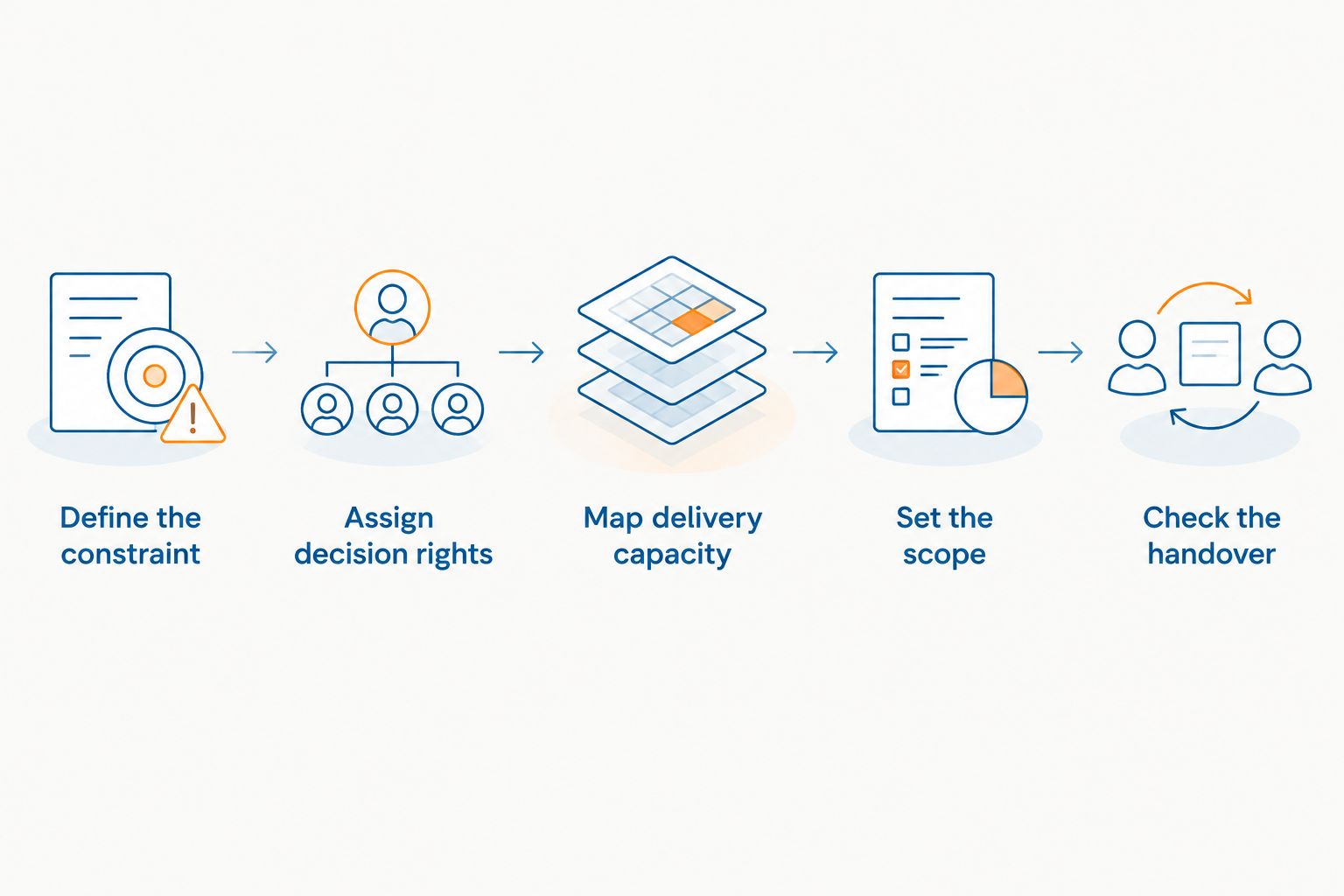
Define responsibilities and delivery capacity before choosing a support model.
What should you measure after hiring?
For your 2026 review, use a small scorecard that connects marketing activity with completed work. Set the baseline from your own records rather than borrowing another business's results.
- Qualified enquiries: requests that match your service, location and customer criteria.
- Booked work: accepted jobs or appointments, not enquiries alone.
- Contribution from work: revenue less the direct costs of delivering the service.
- Available capacity: the work your team can accept without displacing existing commitments.
- Owner involvement: routine decisions that still require your approval.
Agree who maintains each measure and who acts when it changes. Reporting without responsibility creates another meeting, not a management system.
For an initial 30-day review, check whether responsibilities, access and baseline reporting are in place. Thirty days is a suggested review point, not a promised deadline for revenue growth.
At a subsequent 90-day review, assess completed work against the agreed scope and examine what still depends on you. Ninety days is a planning checkpoint, not a guaranteed payback period.
Does a fractional CMO replace my marketing team?
A fractional CMO does not replace your marketing team unless the agreement explicitly includes execution resources. Confirm who creates assets, manages campaigns and follows up enquiries.
If your business has no implementation capacity, ask for a delivery plan before hiring leadership. Otherwise, unfinished tasks remain with you.
Should I hire a fractional CMO before increasing advertising?
Hire leadership before increasing advertising when the unresolved problem is marketing direction or accountability. If the constraint is quoting, scheduling or service delivery, address that responsibility first.
Write the capacity limit into your 2026 brief. Marketing should support work your team can deliver, not create demand detached from operational reality.
Is coaching a substitute for a fractional CMO?
Coaching is not automatically a substitute for executive marketing responsibility. Compare the actual work: advice, decision ownership, team accountability and implementation are distinct commitments.
Elevatory offers business coaching with done-with-you implementation, not a promise to take over every marketing function. Choose that model when participation and capability-building fit your team's needs.
FAQ
How do I compare fractional CMO cost in Australia?
Compare written proposals for the same responsibilities, implementation requirements and internal workload. Ask each provider to separate leadership from advertising, production, software and other commitments.
What's included when I hire a fractional CMO?
The written scope determines what is included. Confirm strategy, decision authority, supplier coordination, reporting and execution responsibilities rather than relying on the title.
Is a fractional CMO better than a marketing consultant?
A fractional CMO fits an ongoing marketing leadership requirement; a marketing consultant fits a defined advisory or project brief. Choose according to the responsibility you need filled.
Can a fractional CMO help me stop managing every marketing decision?
A fractional CMO can take defined marketing decisions off your desk when the agreement grants that authority. Set approval boundaries and make sure the team knows who is responsible.
Should a trade business hire marketing leadership before fixing scheduling?
Fix scheduling responsibility first when delivery capacity is the immediate constraint. Marketing leadership does not itself assign crews, approve quotes or resolve booking handovers.
Does Elevatory offer done-for-you fractional CMO services?
Elevatory's stated offer is business coaching with done-with-you marketing implementation. Assess that model against your need for coaching, team participation and implementation rather than assuming a done-for-you executive service.
How soon should I review a new marketing leadership engagement?
An initial 30-day review can check responsibilities, access and baseline reporting. Use the agreed scope to assess progress; this checkpoint does not promise revenue results.
One last thing
Before signing, ask: which decisions will stop coming to me? Request a specific answer tied to responsibilities, not a list of meetings or reports.
Then ask who completes the work those decisions create. If the answer is still you, revise the scope before committing.
Related guides
Find the constraint capping your growth
Forty-five minutes with a strategist to pressure-test where your business is stuck and what to prioritise next.
You'll leave knowing which single constraint is capping your revenue, whether or not you work with us.
Prefer to talk first? Call 1300 634 230 or email chris@elevatory.com.au