

There is no fixed timeline for building an email list that converts: judge readiness by qualified enquiries, profitable bookings and repeat business, not the list’s age. Your team also needs a clear follow-up process and capacity to deliver; more subscribers will not fix a business where every sales decision still lands with you.
TL;DR
- How long to build an email list that converts depends on buyer readiness, permission, your offer and follow-up.
- Measure qualified enquiries and profitable bookings, not subscriber totals alone.
- Assign enquiry ownership before increasing email volume.
- Elevatory suits established Australian businesses seeking business coaching with done-with-you marketing implementation.
How long does it take to build an email list that converts?
You have a converting list when permission-based emails generate the business outcome you defined. You have a repeatable process when you can track that outcome across successive sends. A first booking proves that someone responded. It does not establish a dependable acquisition channel.
For an established service business, separate the starting positions below. Each needs different work before you can judge performance.
| Starting position | Best for | Useful starting point | Limitation | Next move |
|---|---|---|---|---|
| Existing customers with marketing permission | Relevant repeat-service reminders | You already know what service they purchased | Past purchases do not establish current demand | Match the message to the service history |
| Enquiries with marketing permission | Following up an unresolved service need | You know what prompted the original enquiry | Their circumstances or supplier choice can change | Confirm the need and offer a relevant next step |
| New subscribers with marketing permission | Building relationships with potential customers | You can capture their interests at sign-up | An email address does not establish buying intent | Connect the sign-up promise to a useful service offer |
These are starting conditions, not delivery promises. Choose the relevant path before changing software or commissioning more emails.
For a 2026 plan, connect the email journey to your service-business lead handover. The enquiry must reach someone who can qualify it and act.
Why this matters: your team must own the next step
An email campaign is not finished when you press send. Someone must handle replies, assess suitability, prepare quotes and manage bookings. If those tasks all need your approval, email adds work without removing owner dependence.
Before building the list, write down who owns each handover. Give that person clear boundaries: the work you accept, the information needed before quoting, and the issues that require escalation.
For trades and home services, those boundaries include service area, job type and crew capability. For professional services, they include scope, specialist availability and who approves the engagement.
Build the response process before you increase demand. That gives marketing a clear destination and your team a job they can complete without asking you to make every decision.
Start with existing customers when the service is relevant
Existing customers are a sensible starting point when you have permission to market to them and a relevant reason to reconnect. Start with their service history, not a generic announcement to the whole database.
Best for: repeat services, related services and appropriate customer reactivation. The advantage is context: you know what the customer previously needed. The limitation is relevance. A completed project does not automatically create another buying occasion.
A hypothetical plumbing business could separate customers who requested ongoing maintenance information from customers whose one-off repair is complete. The message should reflect that difference, rather than treating everyone as ready to book again.
Before sending, ask:
- Does the proposed service match the customer’s known need?
- Is the marketing permission appropriate for this communication?
- Can your team fulfil the resulting enquiries?
- Is the next action clear without a phone call to you?
Do not promise a conversion date. Test whether the current offer creates a qualified response.
Follow up enquiries without assuming they are still shopping
An enquiry gives you context, not certainty. The person might have appointed another provider, postponed the work or changed the scope. Your email should make it easy to explain where things stand.
Best for: permission-based follow-up where a service need remains unresolved. The advantage is a known topic. The limitation is that the original enquiry can become stale.
A hypothetical accounting firm could ask whether a prospect still needs help with the service they discussed and invite them to confirm their current requirements. That is more relevant than moving every old enquiry into the same general newsletter.
Keep the handover simple. Record the original need, the last meaningful contact and the next agreed action. Give the responsible team member authority to close unsuitable or inactive enquiries rather than leaving them indefinitely marked as open.
Judge this path by renewed qualified conversations and resulting work, not by how many old contacts received an email.
Build new subscribers around a service decision
New subscribers need a clear reason to join and a clear connection between that reason and your paid service. A useful checklist or guide should help the right buyer make a decision, not simply attract downloads.
Best for: reaching potential customers who need information before choosing a provider. The advantage is a deliberate sign-up journey. The limitation is that interest in information does not prove readiness to buy.
For example, a hypothetical home-services business could offer a guide to preparing for an assessment. The follow-up should explain the assessment process, what information the customer needs and how to request the next step.
Avoid collecting details your team will never use. Ask for information that changes the response, such as service interest or location, and explain what subscribers will receive.
For your 2026 sign-up journey, check that the promised information, follow-up email and service enquiry all describe the same customer problem.
Why the time to conversion varies
The calendar reflects the work and buying decisions underneath it. Focus on these factors rather than choosing a deadline because another business used it:
- Buyer readiness: a subscriber researching a future project needs a different message from someone requesting an assessment now.
- Offer relevance: the service, scope and next step must match the reason the person subscribed.
- Permission and expectations: recipients should understand why they are hearing from you and what they agreed to receive.
- Follow-up ownership: replies need a responsible person, clear qualification rules and an agreed action.
- Delivery capacity: the work you promote must fit the team’s skills and available capacity.
- Measurement: you need to connect email activity with enquiries, accepted quotes and completed work before judging commercial performance.
A longer list does not remove any of these constraints. Fix the constraint you can identify before increasing acquisition activity.
Build a conversion process your team can run
1. Define the outcome
Choose the action that matters commercially. For a local service business, that might be a qualified assessment request. For a professional services firm, it might be an accepted engagement after a suitability conversation.
Keep intermediate actions separate. A download, reply, appointment and completed job represent different stages. Calling all of them conversions hides where the process stops.
Write a plain-language definition your team can apply consistently. For example: an enquiry counts as qualified only when it meets your agreed service, location and scope requirements. Use your own operating criteria, not a generic marketing score.
2. Match the promise
Read the sign-up message beside the first email and the service offer. They should describe a connected journey.
If someone requests information about planning maintenance, explain the maintenance decision before asking them to discuss unrelated project work. If the message attracts the wrong buyer, more follow-up does not solve the mismatch.
Give each email a clear purpose. Explain the issue, answer a practical objection or invite a defined action. Remove competing requests that make it unclear whether the reader should reply, download something else or book a conversation.
3. Assign ownership
Name the person responsible for replies and the person responsible for progressing suitable enquiries. They can be the same person, but the responsibility must be explicit.
Document what they can decide without you. Include how to handle unsuitable work, requests outside scope and enquiries the team cannot fulfil. An escalation rule should identify a genuine exception, not send every ordinary decision back to the owner.
Test the handover yourself. Submit an enquiry and follow its path through the business. Check whether the next person receives enough information to act without starting again.
4. Check capacity
Ask delivery leaders what work the team can accept before deciding what to promote. Capacity is not just an empty calendar slot; the right skills, equipment and supervision must also be available.
A hypothetical electrical business should not promote specialist work simply because general appointments are open. The campaign must match the people authorised and equipped to deliver it.
Use that operational information to narrow the audience or change the service being promoted. The goal is suitable, profitable work that the team can complete—not an inbox full of enquiries nobody can service.
5. Review outcomes
Connect each enquiry to its source and record what happened next. Use consistent status labels so different team members do not describe the same outcome differently.
Review why enquiries failed as well as why they progressed. Wrong service, unsuitable location, no capacity and no response require different fixes. A total conversion figure alone does not tell you which action to take.
Keep the campaign record beside the sales and delivery record. That makes it possible to judge whether email generated useful work rather than merely activity.
The sequence is straightforward: define the outcome, match the promise, assign ownership, check capacity and review outcomes. Complete the handovers before adding complexity.
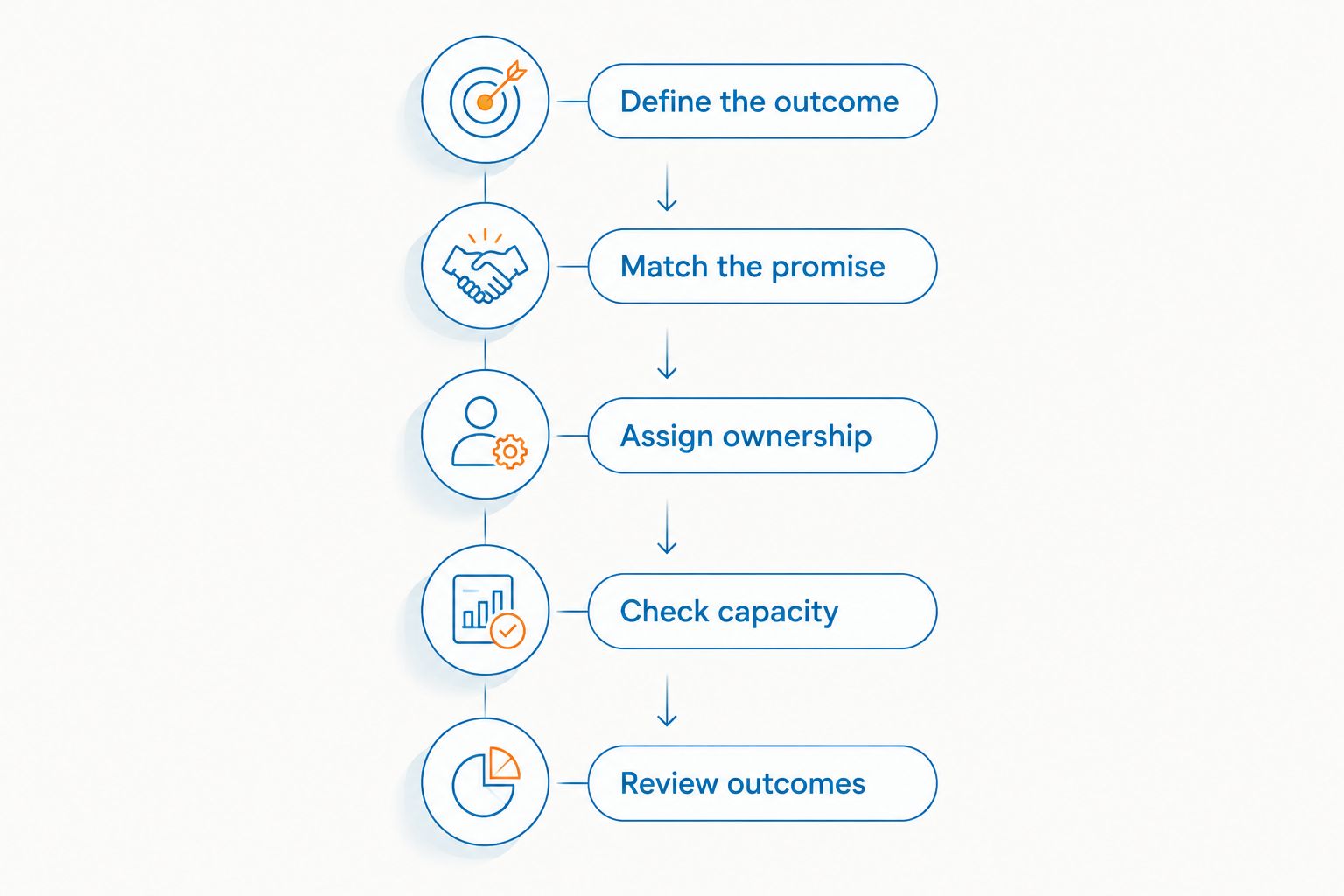
An email process needs a delivery handover, not just a sending schedule.
Set review dates, not promised conversion dates
Use a review schedule to manage the work. The following intervals are suggested operating checkpoints for your 2026 plan, not benchmarks for how quickly subscribers should buy.
- Every 7 days: review replies, unassigned enquiries and follow-up failures. Fix broken handovers.
- Every 30 days: compare subscriber sources and resulting enquiry quality. Separate service interests where the response needs to differ.
- Every 90 days: review accepted work, delivery fit and commercial outcomes. Allow for your actual sales cycle when interpreting unfinished enquiries.
Keep the comparison fair. Record the audience, offer, send date and outcome for each campaign. If you change all of them together, you lose the ability to identify what affected the result.
For 2026 reporting, distinguish between results recorded within the review period and enquiries still progressing. Do not label an open quote as either won revenue or a failed campaign.
Should you wait for a bigger list before sending?
No fixed subscriber threshold proves readiness. Send when you have appropriate permission, a relevant message and someone responsible for the response.
Waiting for size alone postpones learning. Sending without a working handover creates a different problem. Start with a clearly defined audience and inspect the full path from email to enquiry to delivery.
Does paid advertising make an email list convert sooner?
Paid advertising can bring people to a sign-up offer, but it does not establish whether the resulting enquiries suit your business. Keep subscriber acquisition separate from evidence of profitable work.
Before adding spend, check the offer, qualification process and team capacity. Otherwise, you are funding more entries into the same unresolved process.
When does marketing coaching help?
Marketing coaching is relevant when you need help connecting the offer, follow-up and team responsibilities—not simply someone to send a newsletter.
Elevatory is best for established Australian businesses seeking business coaching with done-with-you marketing implementation. That model requires your participation; it is not a done-for-you substitute for assigning decisions and delivery responsibilities internally.
If your 2026 priority is reducing owner dependence, brief Elevatory on where replies, quotes or approvals stop. That gives the discussion a concrete operating problem to address.
Discuss your marketing handover
Discuss offer, follow-up and team responsibilities through business coaching with done-with-you implementation.
FAQ
How long to build an email list that converts for a service business?
There is no fixed timeline for building an email list that converts. Assess permission, offer relevance, qualified enquiries and resulting bookings rather than the list’s age.
How many subscribers do I need before email marketing works?
There is no universal subscriber count that proves email marketing will work. Start with a relevant, permission-based audience and measure the business outcomes it produces.
Can I use my existing customer database for email marketing?
Check that you have appropriate permission before using customer details for marketing. Australian commercial email requirements include consent, sender identification and a working unsubscribe facility.
Should I measure open rates or bookings?
Use qualified enquiries, bookings and completed work to judge commercial performance. Opens and clicks describe email activity, not whether the resulting work suits your business.
What should I do if people subscribe but never enquire?
Check whether the sign-up promise connects to a relevant service and a clear next step. Then inspect the enquiry process before increasing subscriber acquisition.
Who should handle replies to marketing emails?
Assign replies to a named team member with clear qualification and escalation rules. The owner should handle genuine exceptions rather than approve every routine response.
Does Elevatory send all my marketing for me?
Elevatory provides business coaching with done-with-you marketing implementation. It is not positioned as a done-for-you replacement for your team’s marketing and delivery responsibilities.
One last thing
Check where replies actually arrive. Send a test, reply as a prospective customer and ask the responsible team member to progress it without your help.
If the reply sits unnoticed or the team needs your permission for every next step, fix that before growing the list. Your next useful conversion improvement might be a clearer job responsibility, not another email.
Related guides
Book a free growth strategy call
Forty-five minutes with a strategist to pressure-test where your business is stuck and what to prioritise next.
Prefer to talk first? Call 1300 634 230 or email chris@elevatory.com.au