

There is no fixed timeline for building a profitable ecommerce brand from scratch: you reach profitability when sales cover product costs, customer acquisition, fulfilment and operating expenses. Your first orders do not prove the business works, and a profitable month does not mean you have recovered the money invested before launch.
TL;DR
- How long to build a profitable ecommerce brand depends on margins, repeatable demand and delivery capacity, not launch speed.
- Separate profitable orders, profitable trading and recovery of your initial investment.
- Build clear team responsibilities before increasing demand that only the owner can manage.
- Elevatory business coaching suits established Australian businesses seeking strategy and done-with-you implementation, rather than outsourced execution.
Why this matters
A launch date measures when your store opens. It does not measure when your business supports itself or stops depending on you for every decision. For your 2026 business plan, separate those outcomes before setting a growth target.
E ไlevatory works with established Australian businesses on offers, funnels, paid advertising and systems. That distinction matters here: more traffic does not repair an offer that loses money, or a delivery process that requires constant owner intervention.
Your timeline should follow evidence, not an anniversary. Decide what must become true before you increase spending, order more stock or add another person to the team.
How long does it take to build a profitable ecommerce brand from scratch?
It takes as long as your business needs to establish demand, retain enough margin and deliver orders without absorbing more resources than sales generate. A calendar estimate alone cannot distinguish a viable business from one temporarily supported by unpaid owner labour or additional cash.
Use these milestones to judge progress. They describe different achievements, not interchangeable definitions of success.
| Milestone | What it establishes | What it does not establish |
|---|---|---|
| First sale | Someone bought your offer | Repeatable demand or a profitable order |
| Positive order contribution | An order retains money after its variable costs | Enough contribution to cover overheads |
| Operating profit | Trading revenue exceeds the expenses included in your accounts | Recovery of all launch investment |
| Investment recovery | Cumulative returns have covered the initial investment | Reliable future demand |
| Owner-independent delivery | Documented responsibilities support day-to-day work | Profitability without checking the accounts |
Read the table from top to bottom, but do not assume every milestone arrives neatly in sequence. You can improve delivery systems before trading profitably, and you can record a profitable period while still relying heavily on the owner.
The useful question is not simply when the store makes money. It is which definition of profitability your plan uses. Agree that definition with your accountant, then apply it consistently to your 2026 reporting.
Start with a clear profit calculation
Track net sales after discounts and refunds, then account for the costs required to produce and fulfil those sales. Separate variable order costs from business overheads so you can see where the constraint sits.
Your working calculation should include:
- Product costs: what the goods cost your business, including relevant inbound costs.
- Order costs: packaging, payment processing, fulfilment and any shipping expense you absorb.
- Acquisition costs: the marketing expenditure attributable to gaining customers.
- Operating expenses: the people, systems and other overheads required to run the business.
Ask your accountant how to treat stock, tax and owner payments in your reporting. For management decisions, also recognise the work you perform without pay; otherwise, a profitable-looking store can conceal a job nobody else could afford to do.
Build the timeline around evidence, not launch tasks
A finished website, active social account and stocked warehouse are activities completed. They are not evidence that customers will buy profitably. Use the following sequence to decide what deserves attention next.
Establish demand
Identify who buys, what problem the product solves and why that buyer chooses your offer. Look for purchases from your intended audience rather than treating supportive orders from friends as proof of wider demand.
Record the questions and objections that appear before purchase. Use them to improve product information, the offer and customer support. The benefit is a clearer buying decision; the limitation is that early purchases still do not establish repeatability.
Check contribution
Calculate what remains from an order after its variable costs, using a consistent treatment of acquisition spending. Separate different products and acquisition channels where practical, rather than allowing a store-wide average to hide weak transactions.
Positive contribution gives you money towards overheads. It does not mean the business is profitable. If contribution is negative, increasing order volume increases the loss unless something else changes.
Repeat demand
Check whether you can attract suitable customers beyond the initial launch audience. Compare sales activity with the effort and expenditure required to produce it, not just the revenue total.
Returning customers can contribute to this evidence, but product buying cycles differ. Do not build your cash plan around repeat purchases you have not observed. Your 2026 forecast should distinguish actual customer behaviour from assumptions.
Delegate delivery
Write down who owns fulfilment, customer enquiries, stock decisions and marketing follow-up. Give each responsibility a clear standard and an escalation rule so routine work does not return to your desk.
Delegation creates capacity, but assigning a task without authority leaves the owner as the decision-maker. Confirm what the person can decide, what they must record and when they need help.
Review profitability
Review trading results alongside cash requirements and delivery capacity. Decide whether the next move is to improve the offer, reduce avoidable costs, strengthen fulfilment or increase acquisition activity.
Keep these as separate decisions. A profitable sales period does not automatically justify a larger stock commitment, and spare delivery capacity does not justify acquiring customers at a loss.
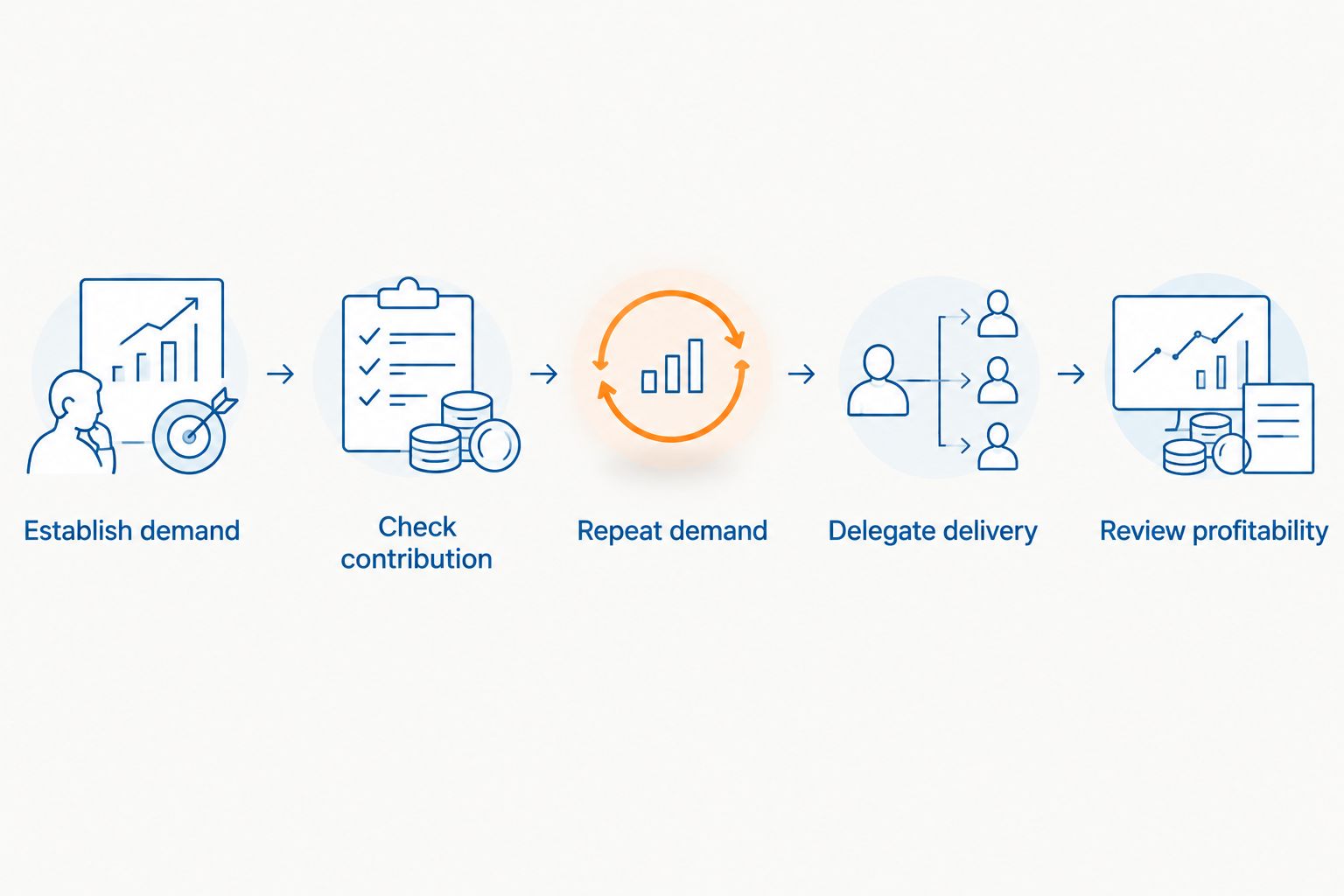
Increase demand only when the economics and delivery process support the next step.
Why the timeline varies
The time required changes when the underlying business changes. Diagnose these factors before assuming your brand simply needs more months or a larger advertising budget.
- Offer clarity. Buyers need to understand the product, its relevance and the reason to choose it. An unclear offer needs correction before more traffic becomes useful.
- Order economics. Product, fulfilment and acquisition costs determine what remains from each order. Revenue growth cannot compensate for every sale losing money.
- Demand quality. Purchases from suitable customers tell you more than traffic or engagement alone. Track what people buy, not just what attracts attention.
- Stock commitments. Buying inventory uses cash before that inventory necessarily sells. Review purchasing decisions alongside demand evidence, rather than treating stock ownership as progress.
- Team capacity. Customer service, fulfilment and stock control need clear owners. More orders can expose unresolved handovers and increase the work reaching you.
- Repeat purchasing. Retention changes the economics only when customers actually return. Buying frequency depends on the product and customer need, not the target written in your forecast.
An offer and funnel strategy consultant is relevant when the buying journey needs attention. If orders already sell but delivery repeatedly stalls, address that operational constraint instead of rebuilding the funnel by default.
Can you launch quickly and become profitable later?
Yes, launching and achieving profitability are separate milestones. A limited launch lets you test purchasing behaviour without pretending the complete business model is proven.
The trade-off is that a smaller launch provides narrower evidence. You still need to understand whether customers bought because the offer solved a problem, because they knew you personally, or because an introductory incentive changed the decision.
Before launch, define what you need to learn and what would trigger a change. Avoid an open-ended test where every disappointing result produces another purchase of stock or another campaign.
For a 2026 launch, keep a written decision record: the assumption, the evidence collected and the next action. This makes progress visible even when the correct decision is to stop an unprofitable approach.
Does strong revenue mean an ecommerce brand is profitable?
No, strong revenue does not establish profitability. Revenue measures sales; profit depends on what remains after the relevant costs.
A return-on-ad-spend figure also answers a narrower question than business profitability. It compares attributed revenue with advertising spend, not with every expense required to sell and deliver the product.
Read case studies with that distinction intact. A reported revenue milestone supports a revenue claim, not an unstated claim about net profit, cash reserves or owner working hours.
Ask what the result measures, which costs it includes and whether it describes a launch, a reporting period or sustained trading. Those questions are more useful than adopting another brand's timeline as your deadline.
Will more advertising shorten the path to profit?
More advertising does not fix negative order economics or limited delivery capacity. It increases exposure to the offer you already have, including its weaknesses.
Use paid acquisition to test a defined commercial question, not to rescue an undefined business model. Know what you are measuring, which costs belong in the calculation and what evidence would justify continuing.
Consider this hypothetical ecommerce example: the owner approves every customer response and handles every fulfilment exception. Increasing orders adds more decisions to the same person, even if campaign reporting improves. The immediate priority is a clear handover, not simply greater demand.
This is an ecommerce illustration, not a service-business client result. The practical lesson is to connect marketing decisions to the team's ability to deliver what has been sold.
When does coaching make sense?
Coaching makes sense when you need help identifying the constraint, making decisions and implementing changes with your team. It is not a substitute for customer demand, working capital or accountable day-to-day management.
Elevatory business coaching is best suited to established Australian businesses seeking strategy and done-with-you implementation. Its stated focus is businesses turning over $150K–$5M, rather than an automatic fit for an untested idea starting from zero.
The advantage is support across offers, funnels, paid advertising and systems. The limitation is equally important: done-with-you implementation requires your participation and responsibility; it is not a handover of the whole business to a done-for-you operator.
Before engaging support, identify the decision you need help making. Bring your sales records, costs, marketing activity and delivery responsibilities, rather than asking a coach to guarantee a launch-to-profit date.
FAQ
How long to build a profitable ecommerce brand if I am starting from zero?
There is no fixed duration that establishes ecommerce profitability. Track demand, order contribution, operating expenses and investment recovery as separate milestones rather than treating launch day as the start of a guaranteed countdown.
Can my first ecommerce sale be profitable?
Your first ecommerce sale can retain money after its variable costs without making the business profitable. You still need enough total contribution to cover operating expenses and distinguish trading profit from recovery of launch investment.
Does a profitable month mean I have recovered my startup investment?
A profitable month does not establish that you have recovered your startup investment. Compare cumulative returns with the initial investment separately from the profit reported for that month.
Should I run paid ads before I know my margins?
Establish your order economics before committing to paid acquisition. Without that baseline, campaign revenue does not tell you whether acquired orders contribute enough towards the rest of the business.
Do I need repeat customers before my ecommerce brand can be profitable?
Repeat customers are not a universal requirement for profitability, but your acquisition economics must support the actual buying pattern. Do not assume repeat revenue until customer behaviour supports it.
Can business coaching guarantee a faster path to ecommerce profit?
Business coaching cannot guarantee a profitability date. Coaching can support decisions and implementation, but customer demand, costs, execution and delivery capacity still determine the commercial result.
One last thing
Before increasing demand in 2026, document the next routine decision your team should make without you. Name the decision owner, give them the relevant information and define when escalation is necessary.
That action will not prove profitability. It will expose whether your growth plan depends on building a business or simply giving yourself more work. When considering Elevatory, bring that constraint to the conversation alongside your marketing numbers.
Related guides
Book a free growth strategy call
Forty-five minutes with a strategist to pressure-test where your business is stuck and what to prioritise next.
Prefer to talk first? Call 1300 634 230 or email chris@elevatory.com.au