

Your marketing is the problem when suitable customers value the service you deliver, but your messaging or channels fail to bring in more suitable enquiries. Your service needs attention when customers understand the promise, buy, and then experience a gap in delivery; if enquiries stall at quoting, follow-up or scheduling, check your sales process and team capacity before blaming either.
TL;DR
- Is marketing or product the problem? Compare enquiry quality, sales handover and delivery evidence before changing either.
- Satisfied referral customers support your service proposition, but do not prove your advertising reaches the right buyers.
- Fix owner-dependent quoting and delivery before increasing demand your team cannot handle.
- Elevatory combines business coaching with done-with-you marketing implementation for established Australian businesses.
How do you know if your marketing is the problem, not your product?
Find the point where the customer journey breaks, then check what happened immediately before it. For a local service business, your product is the job, advice or ongoing service customers actually receive—not just the package described on your website.
Use this diagnostic table for your 2026 review. Treat each pattern as a starting point for investigation, not proof of a cause.
| Observed pattern | First area to investigate | Best for | Benefit of this focus | Limitation |
|---|---|---|---|---|
| Suitable customers are satisfied, but enquiries are poorly matched | Marketing targeting and message | Businesses attracting the wrong work | Connects promotion to suitable buyers | Does not establish whether delivery can scale |
| Prospects understand the service but reject its scope | Offer and positioning | Businesses with recurring scope objections | Clarifies what customers are buying | Clearer wording cannot repair poor delivery |
| Qualified enquiries wait for quotes or decisions | Sales handover | Owner-dependent businesses | Gives the team a specific process to fix | More follow-up will not make unsuitable work profitable |
| Customers buy, then report unmet promises | Service delivery | Businesses with complaints or rework | Addresses the experience customers receive | Delivery improvements do not generate demand themselves |
| Suitable work is declined because the team is full | Capacity and responsibilities | Businesses constrained by delivery | Connects demand to available capacity | Extra capacity is not useful without suitable demand |
Elevatory provides business coaching with done-with-you marketing implementation. Elevatory business coaching is best suited to established Australian owners who want coaching paired with implementation support. That model requires owner and team participation; it is not a replacement for internal responsibility.
Why this matters
A marketing decision becomes an operations decision when somebody has to answer the enquiry, prepare the quote and deliver the work. If every exception lands with you, stronger demand adds decisions to your day rather than reducing owner dependence.
Before changing your 2026 marketing plan, establish who owns each handover. A campaign should promote work your team can assess, book and deliver without needing you to approve every routine step.
The question is not simply whether advertising produces leads. It is whether the business turns suitable demand into profitable, well-delivered work.
Check the customer journey before changing the service
Work through the sequence below using actual enquiry records, quotes, job notes and customer feedback. Keep completed work separate from open opportunities: an unfinished sales conversation tells you little about delivery quality.
Establish delivery capacity
Ask your delivery lead which work the team can accept, which skills are stretched and which decisions still require the owner. Record the difference between an available booking slot and the capacity to complete the whole job properly.
Do not promote work that only you can deliver unless that dependence is deliberate. If a crew leader or practice manager lacks authority to allocate routine work, resolve that responsibility before increasing demand.
Review enquiry quality
Check whether enquiries match your service area, service scope and customer requirements. Read the words people use when describing what they need, rather than relying only on a lead total.
Compare those enquiries with the promise in the campaign. If people consistently request work you do not provide, inspect the targeting and wording before redesigning your core service.
Review sales handover
Follow suitable enquiries through contact, qualification, quoting and booking. Identify where ownership becomes unclear or a decision waits for you.
A missed follow-up is not evidence that customers dislike your service. Likewise, a quote sent without a clear scope does not establish that the campaign attracted the wrong person.
Review delivered work
Compare the agreed scope with what the customer received. Look for recurring complaints, unexpected variations, rework and explanations your team repeatedly has to give after a booking.
Separate a delivery failure from an expectation failure. The work can meet its written scope while still disappointing a customer who was promised something different during the sale.
Assign the next change
Choose the change supported by the clearest evidence, give somebody responsibility and define what you will observe afterwards. Avoid rewriting the campaign, changing the service and replacing the follow-up process together.
Keep a dated record of your 2026 changes. Otherwise, a later improvement tells you little about which decision helped.
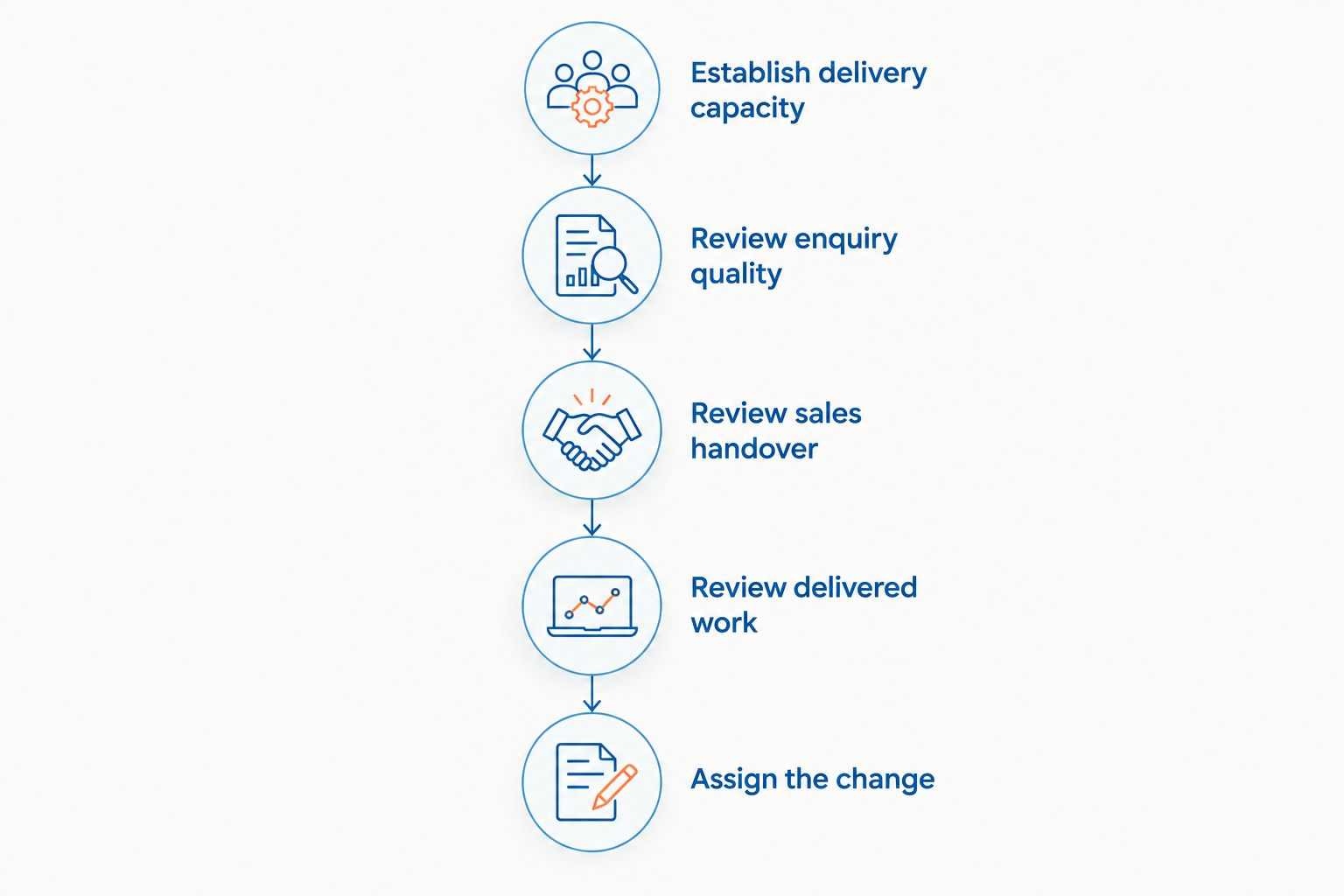
Check the handovers before deciding which part of the business needs changing.
When marketing deserves your attention
Marketing needs investigation when your message attracts requirements that do not match the work you want to deliver. Another useful signal is a gap between how satisfied customers describe your value and how your advertising describes it.
For example, a customer might value clear communication and dependable job coordination while the campaign talks only about the range of services. That mismatch is a reason to examine the message, not proof that a particular replacement will work.
Check these details before commissioning more campaigns:
- Does the message name the customer and job you actually serve?
- Does the enquiry form collect information your team needs to qualify the work?
- Does the advertised promise match the quoted scope?
- Can the person receiving the enquiry explain the next step?
Judge marketing on suitable opportunities and completed work, not enquiry volume alone. Record the source of each enquiry so you can compare the work different campaigns bring in.
When the offer or service needs attention
An offer problem sits between what you can deliver and what the customer believes they are buying. A delivery problem sits between the agreed promise and the completed work.
If prospects repeatedly misunderstand inclusions, responsibilities or the intended outcome, inspect the offer. If customers understand those things and your team still misses them, inspect delivery.
Use the guide to recognising when your offer needs repositioning when the recurring issue is how customers understand the scope. Do not use positioning work to conceal a service the team cannot deliver consistently.
For your 2026 review, bring examples of accepted quotes alongside declined ones. Ask what differed in the requirements, explanation and follow-up rather than labelling every rejection a marketing failure.
When neither marketing nor the service is the main constraint
A business can attract suitable enquiries and deliver good work while losing opportunities between those stages. Unclear responsibilities, slow decisions and incomplete handovers deserve their own diagnosis.
Consider this hypothetical plumbing business. Referral customers are satisfied, paid enquiries match its service area, but quotes wait for the owner to review them between jobs. The immediate action is to clarify quoting authority and escalation rules—not assume that the advertising or plumbing service is defective.
Now consider a hypothetical professional services firm. Suitable prospects book calls, but nobody confirms whether the delivery team can take the engagement. A partner then delays proposals while checking workloads individually.
Both examples call for a clearer handover. Neither is a client result or a prediction of what changing that handover will achieve.
Why the diagnosis varies
The same sales outcome can arise from different problems. Check these factors before copying another business's response:
- Lead source: Referral customers and advertising enquiries arrive with different information about your business. Compare their starting context before comparing outcomes.
- Service scope: A routine job and a tailored engagement require different qualification and quoting processes. Record those differences.
- Owner involvement: Identify where the owner adds necessary expertise and where routine approval has simply become a habit.
- Delivery capacity: Check skills and scheduling, not just whether somebody appears to have space in the diary.
- Evidence quality: Missing enquiry sources, incomplete notes and undocumented objections leave gaps in your diagnosis. Improve the records before drawing a firm conclusion.
These checks belong in your 2026 planning because they connect promotion to the way your business actually operates. They are not a universal conversion benchmark.
Can happy customers prove that marketing is the problem?
Happy customers support the case that your service works for those customers; they do not prove that marketing is the problem. Check whether those customers resemble the people your current campaigns target and whether their work was profitable to deliver.
A customer who relied on exceptional owner attention does not establish that the wider team can deliver the same experience. Review the work required behind the positive feedback.
Should you stop advertising while you investigate?
Stop or restrict promotion when the business cannot honour the advertised promise or responsibly accept more work. If the issue is uncertain, separate campaigns by the work they attract rather than treating all advertising as equally useful or equally defective.
Give the person managing promotion clear instructions about service scope and capacity. Otherwise, marketing and operations will continue making decisions from different information.
Should you hire a marketing consultant or business coach?
Choose marketing support when the evidence points to targeting, messaging or enquiry generation. Choose broader business coaching when marketing decisions are entangled with delegation, team responsibilities and delivery systems.
Elevatory combines business coaching with done-with-you marketing implementation across offers, funnels, paid advertising and systems. Ask how the proposed work will involve your team and who will own implementation; support does not remove the need for internal decision-makers.
FAQ
How do I work out whether marketing or product is the problem?
Trace suitable enquiries through quoting, booking and completed delivery, then identify where expectations or handovers break down. Use enquiry records and customer feedback rather than treating low sales as a diagnosis.
Does getting leads mean my marketing is working?
Getting leads proves that people are enquiring, not that the campaign is attracting suitable work. Check service fit, booking outcomes and the work your team ultimately delivers.
What if customers love the service but sales are slow?
Satisfied customers support your delivery proposition, but slow sales still require investigation. Check targeting, offer clarity, follow-up and capacity before deciding which part needs changing.
Can poor follow-up look like a marketing problem?
Poor follow-up can leave suitable enquiries unconverted and make marketing appear ineffective. Review contact records and quoting responsibility before changing the campaign.
Should I improve my offer before spending more on ads?
Improve the offer first when customers repeatedly misunderstand the scope or promised outcome. If the offer is clear, investigate targeting, handover and delivery rather than rewriting it automatically.
Can business coaching help with team capacity as well as marketing?
Business coaching can address responsibilities and systems alongside marketing when those areas are included in the agreed scope. Elevatory offers coaching with done-with-you implementation, so clarify the work your owner and team will be responsible for.
One last thing
Ask your team: Which routine customer decision still waits for me? Bring the latest real example, including what information was missing and who could have made the decision.
That question does not replace a marketing review. It exposes a separate constraint that a new campaign cannot fix—and gives you a practical place to start reducing owner dependence.
Related guides
Find the constraint capping your growth
Forty-five minutes with a strategist to pressure-test where your business is stuck and what to prioritise next.
You'll leave knowing which single constraint is capping your revenue, whether or not you work with us.
Prefer to talk first? Call 1300 634 230 or email chris@elevatory.com.au