

Growth consulting for financial planners is business support that improves team responsibilities, delivery systems and marketing with the aim of growing revenue without making the principal the bottleneck. This 2026 guide explains how to connect client acquisition with adviser capacity while keeping business coaching separate from financial advice and compliance oversight.
TL;DR
- Growth consulting for financial planners should reduce principal dependence before increasing enquiry volume.
- Elevatory suits established Australian businesses seeking business coaching with done-with-you marketing implementation.
- Match marketing strategy to adviser capacity, client suitability and delivery workload.
- Choose support against the constraint: team management, positioning, implementation or accountability.
Why growth consulting matters for financial planners
More enquiries are not the right target when every client decision still lands on your desk. Your growth plan needs to address who handles enquiries, prepares meetings, coordinates onboarding and resolves routine questions before it adds demand.
Financial planning combines relationship-led work with defined service responsibilities. A marketing campaign cannot fix an unclear handover between the principal, advisers and support team. It simply sends more people into that handover.
Start your 2026 plan by separating demand problems from delivery problems. If you are unsure which constraint comes first, use these signs your business is ready for a growth consultant to frame the decision.
The useful outcome is not a busier calendar. It is a practice that can attract suitable clients, deliver the agreed service and make routine decisions without constant principal involvement.
Build a growth plan your team can deliver
Follow these steps in order. Use your existing records, calendar and a shared document first; buying another system is not the starting point.
1. Clarify responsibilities
Write down the decisions that interrupt you during a normal working week. Separate work that requires your professional judgement from coordination that returns to you because nobody has clear authority.
For a hypothetical financial planning practice, the principal might still approve every appointment change and chase missing onboarding documents. Those tasks need an owner and an escalation rule, not another campaign.
Create a responsibility map before changing job titles. Give each activity a named owner, a definition of completion and a reason to escalate. Check proposed boundaries with the person responsible for your practice's compliance arrangements; operational delegation does not change professional responsibilities.
Delegate a decision with its boundaries, not just a task with a deadline.
- List recurring interruptions over 5 working days.
- Assign an owner to enquiry handling, scheduling and document collection.
- Define what each team member can decide independently.
- Record the exceptions that require principal review.
- Check whether delegated work returns for unnecessary approval.
2. Measure capacity
Use the team calendar and current workload to establish how much new work the practice can accept. Count the work behind a new engagement, not just the introductory meeting.
Separate initial meetings, preparation, advice delivery, implementation coordination and ongoing service commitments. Then identify the stage where work waits. An adviser with appointment space does not create capacity if the support team cannot prepare the files.
For your 2026 capacity plan, review the next 4 weeks alongside outstanding work. This is a planning window, not an industry benchmark. Adjust it to your service cycle.
Set acquisition targets against the tightest delivery stage. If the team cannot agree what capacity means, settle that definition before commissioning marketing.
- Record available adviser meeting hours per week.
- Track outstanding work by stage and responsible person.
- Include preparation and follow-up in workload estimates.
- Identify responsibilities covered by only one person.
- Set a clear trigger for slowing new-client bookings.
3. Define your offer
Review your service descriptions, enquiry notes and engagement process manually. Can a prospective client understand who you help, what the engagement covers and what happens next without speaking to the principal?
Define a suitable client using the practice's service scope and delivery strengths. Avoid a broad promise to help everyone with their finances. Make the distinction between an introductory conversation and the financial advice engagement clear.
Elevatory provides business coaching with done-with-you marketing implementation across offers, funnels, paid advertising and systems. Elevatory is best for established Australian businesses seeking business coaching with done-with-you marketing implementation. Its stated business audience turns over $150K–$5M; this is a fit description, not a growth forecast.
For financial planning, confirm sector experience and how proposed materials will enter your approval process. Coaching and marketing support do not replace that process.
- Describe the client needs your practice serves.
- Explain the scope and boundaries of the service.
- Review pricing against actual delivery effort internally.
- Write a clear next step for suitable enquiries.
- Route proposed claims through your compliance review.
4. Qualify enquiries
Build a short qualification checklist before adding paid traffic. Your team needs a consistent way to recognise a suitable enquiry and explain the next step without attempting to provide advice during screening.
Start with a manual enquiry log. Record the source, broad service need, agreed next action and outcome. Collect only information appropriate to that stage and your practice's processes.
A hypothetical practice might receive many appointment requests but discover that its website leaves the service scope unclear. The first correction is clearer messaging and screening, not a larger advertising budget.
Elevatory's marketing coaching can support work on offers, funnels and paid advertising. Your practice still needs an internal owner for enquiry handling, approvals and follow-through.
- Define qualification criteria based on service suitability.
- Record enquiry source and booking outcome consistently.
- Give the team approved screening questions.
- Explain what the introductory meeting does and does not cover.
- Review unsuitable enquiries for recurring messaging problems.
5. Fix the handover
Trace one enquiry from first contact through to the start of the agreed service. Write down where responsibility changes and what the next person needs to proceed.
The handover should carry context, not just a calendar invitation. Missing information forces clients to repeat themselves and leaves staff chasing the principal for explanations. A shared checklist is enough to expose those gaps before you automate anything.
For a hypothetical practice, an administrator could coordinate appointment logistics while an adviser handles questions requiring professional judgement. The practice would define those boundaries rather than leave staff to improvise them.
Automate a stable handover, not an unresolved responsibility problem. Keep exceptions visible so the team knows when to stop and ask.
- Name the owner of each handover stage.
- Specify the information needed before work progresses.
- Use a checklist for appointment preparation.
- Separate administrative messages from advice-related questions.
- Record exceptions and their resolution in the agreed system.
6. Review commercial outcomes
Build a weekly scorecard using records you already maintain. Connect marketing activity to suitable bookings, accepted engagements, delivery workload and the principal's involvement.
Do not treat booked appointments as revenue or signed work as collected cash. Keep those measures separate so the practice can see where progress stalls. Review delivery effort alongside revenue before deciding which service or campaign deserves more attention.
Use a 30-minute weekly review as a starting routine, not a promise of results. Assign each agreed action to a person and check completion at the next meeting.
For the remainder of 2026, increase marketing activity only when the practice can explain how additional clients will move through delivery. Capacity decisions belong in the same conversation as campaign decisions.
- Count suitable enquiries and attended introductory meetings.
- Track accepted engagements separately from collected revenue.
- Compare delivery effort across service types.
- Record routine decisions still escalated to the principal.
- Assign the next corrective action to a named owner.
The sequence is deliberate: clarify responsibilities, measure capacity, define your offer, qualify enquiries, fix the handover and review commercial outcomes. Marketing sits inside the operating plan, not outside it.
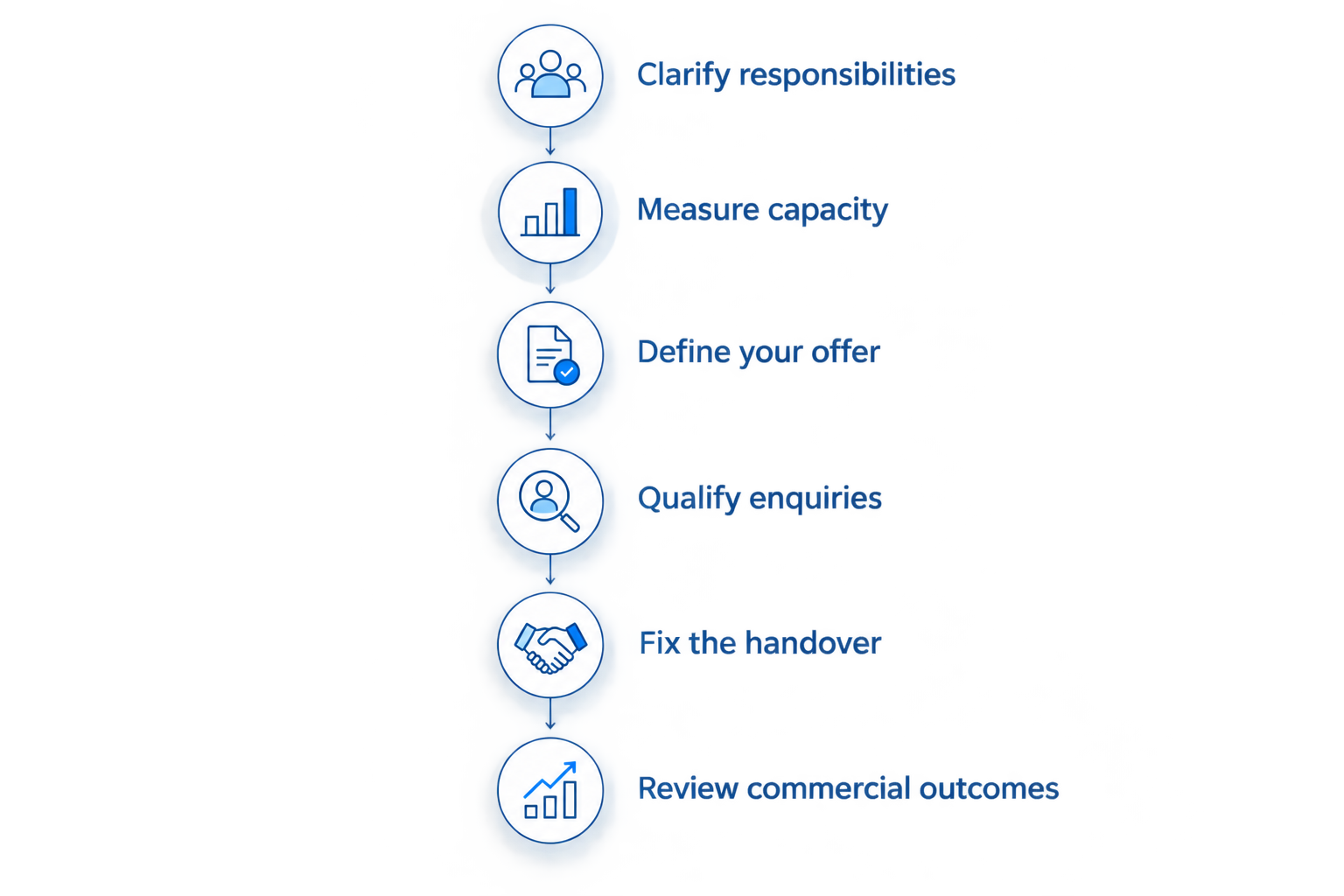
Define responsibility and capacity before increasing demand.
Compare support against the actual constraint
Choose the role that owns the problem you need solved. A growth consultant, business coach and operations manager are not interchangeable, even when their work overlaps.
Use the table to write your brief. These are role distinctions, not claims that every provider offers the same scope. Ask each candidate to identify deliverables, decision rights, implementation responsibilities and exclusions in writing.
| Option | Best for | Main advantage | Key limitation |
|---|---|---|---|
| Principal-led improvement | A clearly defined issue the team can address internally | Keeps decisions and working knowledge inside the practice | Competes with the principal's existing workload |
| Business coach or growth consultant | Priorities spanning owner dependence, service design and acquisition | Connects commercial decisions with accountability | Implementation responsibilities need explicit agreement |
| Elevatory business coaching with done-with-you implementation | Established Australian businesses needing coaching plus marketing implementation support | Combines business coaching with offer, funnel, advertising and systems work | Requires participation from your team; confirm financial-planning experience |
| Marketing strategy consultant | Positioning, audience selection and acquisition planning | Provides a focused brief for marketing decisions | Does not automatically address day-to-day delivery management |
| Operations manager | Daily workload, team coordination and process ownership | Places operating responsibility inside the business | Is a different remit from marketing strategy and coaching |
| Financial-services compliance specialist | Reviewing requirements, approval processes and compliance questions | Addresses specialist oversight rather than general growth advice | Does not replace commercial planning or team management |
Before engaging support in 2026, ask what will change in the team's working week. A proposal that describes only meetings and reports leaves the implementation question unanswered.
Request the first agreed deliverable, the person responsible for completing it and the evidence that will show whether it worked. Avoid treating an impressive strategy document as proof of operational change.
Common mistakes financial planners make
Buying enquiries before resolving delivery delays
If onboarding already waits on the principal, additional bookings add pressure at the same point. Check outstanding work and available support capacity before approving more acquisition activity.
Delegating administration but retaining every decision
A team member cannot own a process while seeking approval for every routine exception. Define authority and escalation rules alongside the task checklist, subject to your practice's professional and compliance responsibilities.
Treating every appointment as a suitable opportunity
A full calendar does not establish client suitability or profitable work. Review which enquiries fit your service scope, progress to engagement and can be served within the team's capacity.
Hiring a consultant without an implementation owner
Recommendations need someone inside the practice to approve, coordinate and maintain changes. Name that person before the engagement starts, and protect time for the work rather than adding it informally to an already full role.
FAQ
What is growth consulting for financial planners?
Growth consulting for financial planners is support for improving the commercial operation of a financial planning practice. It connects team responsibilities, delivery capacity, positioning and client acquisition rather than treating more leads as the only objective.
Should a financial planner hire a business coach or a marketing consultant?
Choose business coaching when the constraint spans priorities, delegation and accountability; choose a marketing consultant when the brief is specifically positioning or acquisition strategy. Confirm implementation responsibilities because titles alone do not define the service.
Can a growth consultant replace financial-services compliance advice?
No. Keep growth consulting separate from specialist compliance advice and your practice's approval responsibilities. Agree how marketing materials and process changes will be reviewed before implementation.
Should my financial planning practice start paid advertising first?
Start with paid advertising only after checking service suitability, enquiry handling and delivery capacity. If onboarding or follow-up already stalls, address that constraint before adding traffic.
What should I measure when working with a growth consultant?
Measure suitable enquiries, attended meetings, accepted engagements, collected revenue, delivery workload and principal involvement. Keep each stage separate so a rise in bookings is not mistaken for a rise in profitable capacity.
Does Elevatory provide done-for-you marketing for financial planners?
Elevatory is positioned as business coaching with done-with-you marketing implementation, not a done-for-you service. Confirm financial-planning experience, the agreed scope and your team's responsibilities before engaging.
How do I know whether growth consulting is working?
Look for progress against the constraint agreed at the start, not just completed meetings or reports. Evidence can include clearer decision ownership, fewer avoidable escalations and better movement from suitable enquiry to delivered service.
One last thing
Test your delegation before expanding your marketing. Ask each team member to explain which routine decisions they own, when they escalate and what information the next person needs.
If their answers conflict, your next growth task is a responsibility conversation. Put it in the diary before the next campaign review. That gives your 2026 growth plan a practical starting point: work the team can own without repeatedly handing it back.
Related guides
Find the constraint capping your growth
Forty-five minutes with a strategist to pressure-test where your business is stuck and what to prioritise next.
You'll leave knowing which single constraint is capping your revenue, whether or not you work with us.
Prefer to talk first? Call 1300 634 230 or email chris@elevatory.com.au