

Yes, a business can scale past $1M in annual revenue without hiring more staff when its existing team has usable capacity, can earn more from the work it delivers, or can remove avoidable work. The limit is delivery: if growth depends on longer owner hours, unpaid overtime or slipping standards, you have shifted the workload rather than built a scalable business.
TL;DR
- Can a business scale past 1m without more staff? Yes, when delivery capacity supports growth.
- Fix delegation, responsibilities and delivery systems before asking marketing to generate more enquiries.
- Revenue above $1M does not prove better profit or lower owner dependence.
- Elevatory combines business coaching with done-with-you marketing implementation for established Australian businesses.
Can a business scale past $1M without hiring more staff?
Yes—but the revenue target must fit your team's delivery capacity. Start by identifying what prevents your current team from completing more profitable work without relying on you for every decision.
| Growth approach | Best for | Benefit | Limitation |
|---|---|---|---|
| Clearer delegation | Teams waiting for owner approval | Moves routine decisions closer to delivery | Fails if responsibility arrives without authority |
| Better job selection | Businesses accepting unsuitable work | Directs capacity towards work that fits | Requires clear qualification and the discipline to decline work |
| Standardised delivery | Repeatable services handled inconsistently | Reduces avoidable variation and handover gaps | Needs exceptions for genuinely different jobs |
| Stronger pricing and scope | Businesses absorbing extra work | Connects revenue to the work actually delivered | Requires accurate job costing and clear customer communication |
| Targeted automation | Repetitive administration | Removes repeat handling | Does not replace judgement or physical delivery |
For established owners, Elevatory provides business coaching and done-with-you marketing implementation. The relevant starting point is the constraint—not an automatic push for more leads.
Why this matters
Crossing $1M is a revenue milestone, not proof that your business works without you. A full calendar can still leave the owner handling quotes, scheduling, customer problems and final approvals.
Your 2026 growth plan needs to answer a practical question: what happens after another suitable customer says yes? If the answer is that you work later, the delivery model needs attention before demand increases.
For trades and home services, examine crew scheduling, travel, material readiness and callbacks. For professional services, examine scope, client information, review queues and partner approvals. These are places to investigate, not assumptions about where your business is failing.
The aim is more profitable work delivered reliably, with fewer routine decisions coming back to the owner. Headcount is only one part of that equation.
Start with the work that still depends on you
List the decisions that reached you during your latest complete working week. Separate decisions requiring your expertise from decisions reaching you because nobody knows who owns them.
An owner approving every routine booking has a different problem from an owner providing specialist advice that nobody else is qualified to give. The first needs clearer authority. The second needs a deliberate decision about expertise and capacity.
Review each recurring interruption:
- Who should own the outcome?
- What information does that person need?
- What can that person decide independently?
- What genuinely requires escalation?
- How will you check the result without taking the task back?
Delegation is incomplete when a team member performs the task but still needs permission at every turn. Write the decision boundary alongside the responsibility.
Do not delegate regulated or specialist work beyond someone's qualifications. Reducing owner dependence does not remove professional obligations or the need for competent supervision.
Build a delivery system before adding demand
Use this sequence to test whether your existing team can support growth. It turns a broad ambition into changes you can assign and review.
- Map demand. Record the work customers request, the work you accept and where enquiries become unsuitable.
- Check capacity. Compare booked commitments with available skilled time, including preparation, travel, administration and review.
- Assign authority. Name the person responsible for each handover and define which decisions that person owns.
- Standardise delivery. Document the repeatable parts of the job, the quality check and the escalation point.
- Review outcomes. Check profitability, completion quality and owner involvement before increasing demand again.
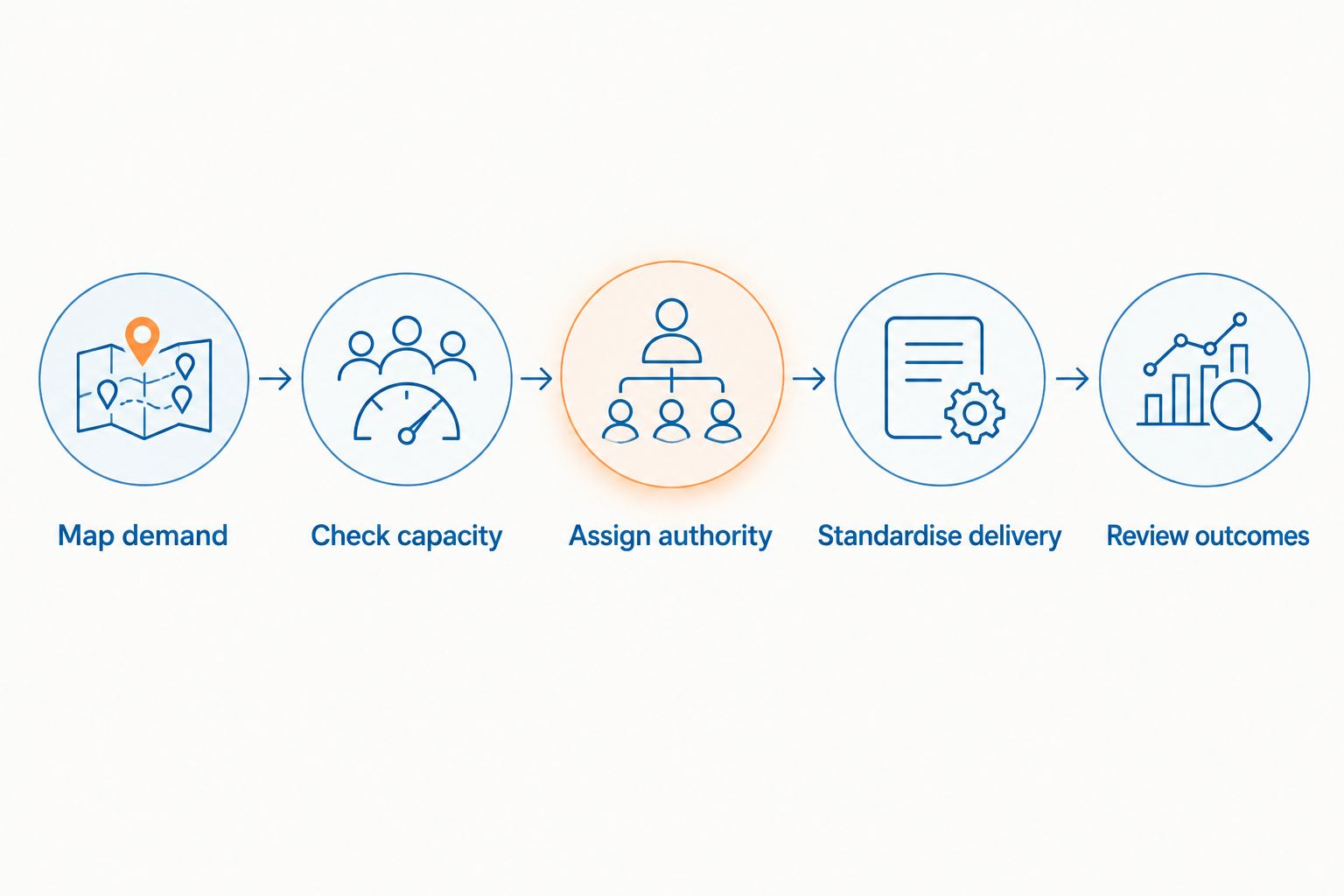
Check capacity and decision ownership before increasing demand.
Keep the documentation usable. A short checklist at the point of work is more useful than a manual your team cannot find when a customer calls.
For your 2026 plan, assign each change to a named person and define the evidence that will show whether it worked. Do not treat writing a procedure as proof that the procedure is being followed.
Improve revenue per unit of delivery capacity
More revenue does not always require more jobs. Review what you sell, who you sell it to and how much unplanned work each engagement creates.
Start with completed work rather than the headline value of a quote. Compare the revenue earned with direct labour, materials, subcontracting and other job-specific costs. Then examine the capacity the job consumed.
A service that looks attractive before delivery can become a poor fit when it requires repeated visits, extensive revisions or constant owner intervention. Conversely, a clearly scoped service can be easier to schedule and hand over.
Hypothetical example: an electrical business accepts jobs across a scattered service area. Grouping suitable bookings geographically could reduce travel between jobs, but the business must check its actual schedule before treating that time as usable capacity.
Hypothetical example: a consulting firm repeatedly rewrites deliverables because clients supply information late. A clearer intake process and agreed scope could reduce repeat handling without asking consultants to work longer.
Neither example is a client result or a promise. The decision depends on your job records, delivery requirements and customer commitments.
Make marketing answer to delivery capacity
A marketing plan should specify the work your team can fulfil, not simply the number of enquiries you want. Define the customer fit, service area, job type and delivery window before changing campaigns.
Give whoever handles enquiries clear qualification criteria. The handover should capture enough information for the delivery team to assess the request without starting the conversation again.
For a home-service business, that could mean the requested work, location and relevant site details. For a professional-services firm, it could mean the client's problem, required scope and access to necessary information.
Check campaign reporting against accepted work and delivery outcomes. Enquiries alone do not tell you whether marketing is filling the business with suitable bookings.
In 2026, do not set a lead target independently of your capacity plan. When delivery is constrained, improve fit and follow-up before increasing enquiry volume. When suitable capacity is genuinely unused, marketing has a clearer job to do.
Why growth without more staff varies
Whether your business can pass $1M with its current team depends on the work and the way it is organised. Diagnose these factors before setting a fixed-headcount target:
- Service model. Physical work and specialist advice require qualified delivery capacity; a better process does not remove that requirement.
- Work mix. Different jobs consume different amounts of labour, travel, preparation and review.
- Owner dependence. Routine approvals and repeated interventions limit what the team can complete independently.
- Scope control. Unrecorded extras and unclear acceptance criteria make capacity harder to plan.
- Customer fit. Enquiries outside your service area or delivery model take attention away from suitable work.
- Delivery consistency. Missing information, rework and failed handovers consume capacity already committed elsewhere.
There is no useful universal staff count for a $1M service business. Your own completed jobs provide the evidence needed to assess the next stage.
Track whether growth is making the business stronger
Set a baseline before changing delegation, offers or marketing. Use consistent definitions so that a change in reporting does not look like an improvement in performance.
Track these measures together:
- Revenue: what the business earns over the reporting period.
- Gross profit: revenue less the direct costs of delivering the work, using a consistent accounting treatment.
- Delivery hours: the labour time needed to fulfil accepted work.
- Owner hours: time spent delivering, approving and resolving routine issues.
- Delivery quality: rework, complaints and missed commitments.
- Suitable bookings: accepted work that matches your agreed qualification criteria.
Revenue rising while owner hours and rework also rise is not evidence of reduced owner dependence. Look for the operational change behind the revenue movement.
Your 2026 review should compare like-for-like periods and account for changes in service mix. Ask your accountant to help define financial measures where job costing or overhead allocation is unclear.
When should you hire instead of improving systems?
Hire when necessary work exceeds the capacity of a properly organised team and the business can support the role. Do not keep delaying a needed hire to protect a fixed-headcount ambition.
First distinguish a capacity gap from a decision gap. If staff wait for approvals, adding another person does not resolve the approval queue. If qualified staff are fully committed to necessary delivery, clearer responsibilities alone do not create another qualified worker.
Define the role around a specific constraint. State the work it will own, the decisions it will control and the outcome that justifies the ongoing commitment.
Protect service quality and safe workloads before protecting the idea of growing without hiring. Passing $1M is not a reason to accept delivery risk.
Does outsourcing count as growing without more staff?
Outsourcing can keep employee headcount unchanged, but it still adds external labour and management requirements. Describe it honestly when assessing whether your business has become more productive.
A specialist contractor can suit work requiring expertise your team does not hold. The trade-off is coordination, quality control and dependence on another provider's capacity.
Do not label outsourcing a systems improvement unless the underlying process has improved. Moving an unclear task outside the business does not clarify its scope or ownership.
When business coaching fits
Elevatory is best suited to established Australian service businesses seeking business coaching with done-with-you marketing implementation. Its stated focus includes offers, funnels, paid advertising and systems strategy for businesses turning over $150K–$5M.
That support is relevant when you need help connecting growth priorities with implementation. It is not the same as hiring an internal operations manager, adding delivery staff or handing all marketing responsibility to a done-for-you agency.
Before choosing support, ask who will implement each change, what your team must contribute and how progress will be measured. A useful engagement needs a clear connection between the diagnosed constraint and the work being done.
Bring your current responsibilities, job information and capacity constraints to the discussion. A revenue goal alone does not explain what needs to change.
Discuss your growth constraint
Talk through owner dependence, team capacity and the marketing work your business needs.
FAQ
Can my trade business pass $1M without hiring another tradie?
Yes, if your current qualified team can deliver the additional work within safe workloads and service commitments. Review scheduling, job fit, preparation and rework before assuming more enquiries will produce profitable growth.
Does $1M in revenue mean my business is profitable?
No, $1M in revenue does not establish profitability. Assess direct delivery costs, overheads and the owner's labour alongside revenue.
What should I fix first if every decision comes back to me?
Start by assigning ownership and decision authority for recurring work. Define the information, boundaries and escalation rules your team needs to act without routine approval.
Can automation replace the need to hire staff?
Automation can remove repetitive administration, but it does not replace every delivery role. Define the task first and retain human review where judgement, qualifications or customer risk require it.
Should I run more ads if my team is already fully booked?
Do not increase enquiry volume without a delivery plan when your team is already fully committed. Review lead quality, service mix and future capacity before expanding campaigns.
Can Elevatory help with systems as well as marketing?
Elevatory provides business coaching and done-with-you marketing implementation, including systems strategy. Confirm the responsibilities and implementation scope against your business's specific constraint before engaging support.
How should I measure growth without increasing headcount in 2026?
Measure revenue alongside gross profit, delivery hours, owner hours and delivery quality in 2026. Unchanged headcount alone does not show that the business is more productive or less dependent on you.
One last thing
Run an absence test before making a bigger marketing commitment: identify which routine decisions would stop if you were unavailable. Use the answers to choose your next delegation task.
The immediate priority is not proving that your business can cross $1M without another employee. It is proving that the team can deliver its current promises without making you the answer to every question.
Related guides
Book a free growth strategy call
Forty-five minutes with a strategist to pressure-test where your business is stuck and what to prioritise next.
Prefer to talk first? Call 1300 634 230 or email chris@elevatory.com.au