

Yes—a business coach can help with hiring and systems when their scope includes role design, delegation, accountability and delivery processes, rather than marketing alone. You still need someone inside the business to manage people and put those decisions into practice; coaching does not replace a recruiter, employment adviser or operations manager.
TL;DR
- Can a business coach help with hiring and systems? Yes—choose business coaching that explicitly covers team responsibilities and implementation.
- Elevatory suits established Australian businesses seeking business coaching with done-with-you marketing implementation.
- Define the role, decision authority and delivery process before recruiting someone to take work off your plate.
- Connect marketing coaching to team capacity; more enquiries do not fix unclear responsibilities or poor handovers.
Can a business coach help with hiring and systems, not just marketing?
Yes, provided team systems are part of the agreed work—not an assumed extra. A useful coaching engagement connects the work you sell with the people responsible for delivering it.
For context, Elevatory provides business coaching and done-with-you marketing implementation for established Australian businesses. Its stated focus spans offers, funnels, paid advertising and systems strategy; confirm the specific hiring and people-management support you need before committing.
Use this sequence to assess whether a coach addresses your actual constraint:
- Name the dependency. Identify work that stops whenever you are unavailable.
- Define the responsibility. State what another person must own from start to finish.
- Set decision authority. Separate routine decisions from issues that genuinely need you.
- Document the handover. Give the person the information, examples and checks needed to deliver.
- Review execution. Check completed work and exceptions, not just whether someone attended a meeting.
A coach can help you structure these decisions. Your team must then use them in real work.
Why this matters: marketing cannot fix an owner bottleneck
For your 2026 growth plan, start with the work already waiting for approval, scheduling or correction. If every quote, booking and customer issue comes back to you, extra demand adds pressure to the same point.
That is different from a lead-generation problem. You need to distinguish between not enough suitable enquiries and not enough capacity to handle suitable enquiries well.
Match marketing activity to the work your team can deliver profitably. Before increasing campaigns, check who qualifies enquiries, who approves scope, who books the job and who handles changes after the customer says yes.
A hypothetical plumbing business illustrates the difference. If the owner approves every routine booking, hiring another administrator without changing booking authority leaves the owner in the same position. The role needs permission to act, not just a longer task list.
What should hiring and systems coaching actually cover?
Ask for practical outputs rather than a promise to help you “build a better team”. The useful question is what your business will have in place after the work.
Role design before recruitment
Start with the result the role must own. “Help with admin” leaves too much open; responsibility for enquiry qualification, appointment scheduling and complete job information gives you something concrete to discuss.
Separate essential responsibilities from occasional requests. Otherwise, a new hire becomes the default person for every task nobody else owns.
A coach can help challenge the role brief and reporting structure. Do not assume that includes sourcing candidates, checking qualifications or advising on employment obligations.
Decision authority, not task dumping
Delegation needs boundaries. Write down what the person can decide independently, when they must ask for approval and what information an escalation must include.
For example, a hypothetical home-services administrator might book work within agreed service areas and scheduling rules. An unusual job scope goes to the responsible technical person rather than automatically to the owner.
A task is not fully delegated while every routine decision still needs your permission. Review the boundary as well as the employee's performance when work keeps coming back.
Delivery systems your team can use
Document how work moves from enquiry to quote, booking, delivery and follow-up. Each handover needs an owner and a clear definition of what complete means.
Keep instructions close to the work. A short checklist used during booking is more useful than a lengthy procedure nobody opens.
For your 2026 systems work, begin with a recurring handover that causes confusion. Test the instructions with the person doing the job before documenting the next process.
Do you need a coach, recruiter or operations manager?
These roles address different problems. Choose support based on the work that needs doing, not the title that sounds most senior. The boundaries below are selection criteria; confirm each provider's actual scope.
| Support option | Best for | Useful contribution | Limitation to check |
|---|---|---|---|
| Business coach | Owners needing clearer priorities and delegation | Challenges role design, accountability and implementation decisions | Does not automatically manage staff or recruit candidates |
| Recruiter | Businesses with a defined vacancy | Helps find and assess candidates against an agreed brief | Cannot resolve unclear ownership inside your business by filling a vacancy |
| Operations manager | Businesses needing daily delivery leadership | Owns coordination, team follow-through and operational decisions | Needs authority and a clear remit, not responsibility without control |
| Employment adviser | Businesses needing specialist employment guidance | Advises within their qualifications and engagement scope | Does not replace your day-to-day team leadership |
If you already know what needs to happen but nobody drives it daily, examine whether operational leadership is the missing role. If you cannot define the role or decide what to delegate, coaching addresses an earlier decision.
Some businesses need more than one type of support. Keep the responsibilities separate so that coaching advice, recruitment work and management accountability do not fall between providers.
How do you turn coaching into a working team system?
Use your 2026 implementation plan to change a live workflow, not build a folder of unused templates. Choose a process that repeatedly interrupts you and work through it with the person who will own it.
Define ownership
Name the person responsible for the completed outcome. Include where their responsibility starts and ends, plus who takes over at the next handover.
If several people contribute, distinguish contributors from the person accountable for completion. Shared involvement does not remove the need for clear ownership.
Set authority
List the routine decisions the role can make without you. Add escalation triggers for situations outside the agreed scope.
Check that the person has access to the information needed to decide. Responsibility without information sends the work straight back to the owner.
Document handovers
Record what the next person needs before accepting the work. For a service booking, that might include the customer's request, agreed scope, access details and any unresolved questions.
Use examples of acceptable work from your own business. Avoid writing instructions around exceptions while leaving the everyday process unclear.
Review exceptions
When work returns to you, identify why. Was the instruction missing, the authority unclear, the skill undeveloped or the situation genuinely outside the role?
Change the relevant part of the system. Taking the task back without addressing the cause preserves the dependency.
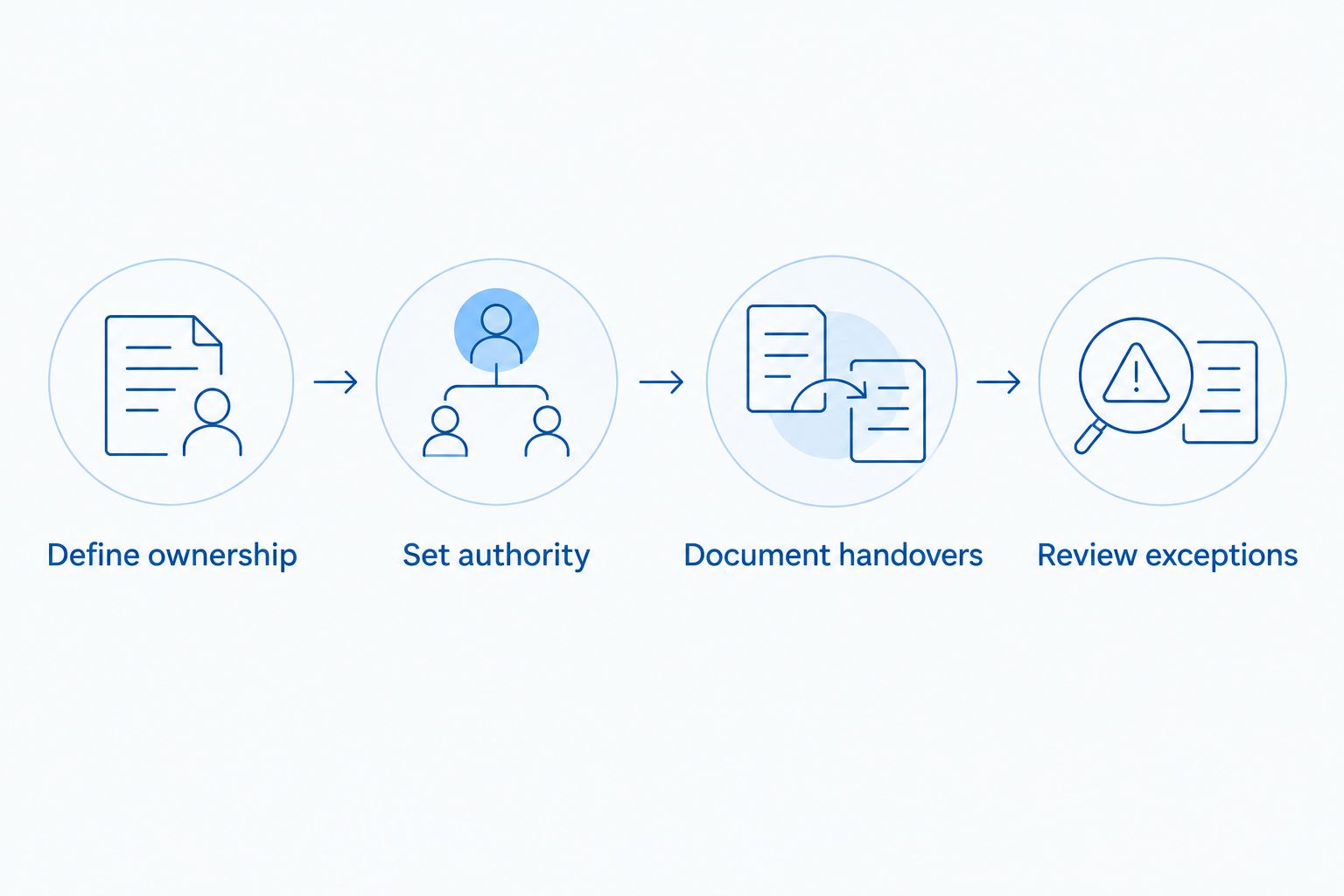
Delegation needs clear authority and a way to resolve exceptions, not just a task list.
Why hiring and systems support varies between businesses
The right scope depends on where work gets stuck. Use these factors to brief a coach rather than asking for a generic growth programme:
- Owner dependence: Identify decisions that only you currently make and distinguish necessary oversight from habit.
- Role clarity: Check whether the team knows who owns enquiries, quoting, scheduling, delivery and follow-up.
- Management capacity: Decide who will train people, review work and resolve problems after the coaching session ends.
- Delivery complexity: Map the handovers required to deliver what you sell, including changes to scope.
- Demand quality: Check whether marketing attracts work that fits your team's skills, service boundaries and capacity.
- Implementation responsibility: Agree who writes, tests and maintains the processes—not just who recommends them.
For 2026, make these scope questions part of provider selection. A broad promise about growth does not establish whether a coach will help you turn a role brief into a working delegation process.
How do you choose a coach for team systems?
Ask the coach to explain how they would approach a recurring owner dependency. You are looking for a clear process, sensible boundaries and named implementation responsibilities—not an instant diagnosis without context.
Bring material that shows how the business works: current responsibilities, a recent handover, examples of work returned for approval and the delivery problems behind customer complaints.
Ask these questions before agreeing to the engagement:
- Does the scope include role design, delegation and delivery systems, or marketing strategy only?
- What will the owner implement, and what will the coach help implement?
- How will the team participate in testing new responsibilities?
- What sits outside scope, particularly recruitment and employment advice?
- How will progress be assessed without treating more leads as the only measure?
Elevatory's business coaching combines strategy with done-with-you marketing implementation. It suits established Australian businesses seeking support across systems, offers and marketing—not an outsourced manager to run the team.
Its stated business scope covers turnover from $150K to $5M. Treat that as a fit indicator, not proof that every business within the range needs the same support or that a particular hiring service is included.
Should you hire before improving your systems?
Define the role before hiring; build and test the detailed process with the person doing the work. You do not need to document every possible task before recruiting, but you do need clear responsibilities and a reporting line.
If nobody can explain what successful performance looks like, pause the job advertisement. More applicants will not settle an unresolved management decision.
Can marketing coaching help your existing team?
Yes—when marketing coaching includes the handover from enquiry to delivery. That means clarifying suitable leads, follow-up responsibilities, booking rules and the information required before work starts.
For a hypothetical professional-services firm, the issue might be partners reviewing every enquiry rather than a shortage of enquiries. Clear qualification rules give the team a defined route for suitable prospects and exceptions.
How should you measure progress beyond revenue?
Track whether routine work moves without your intervention. Review owner approvals, incomplete handovers, returned tasks and delivery issues alongside bookings and revenue.
Use consistent definitions in your 2026 review. A task reassigned on paper is not evidence of reduced owner dependence if you still finish it yourself.
FAQ
Can a business coach help with hiring and systems?
Yes, when role design, delegation, accountability and delivery systems are explicitly included in the engagement. Confirm the implementation work and exclusions before signing.
Will a business coach recruit employees for me?
Do not assume recruitment is included in business coaching. Ask whether the coach helps define the role, sources candidates or works alongside a separate recruiter.
Can a business coach help me step back from daily decisions?
A business coach can help you define responsibilities, decision authority and escalation rules. You must also give your team the information and permission needed to use them.
Do I need an operations manager instead of a business coach?
An operations manager is the more direct fit when you need someone to own daily coordination and team follow-through. Coaching addresses the owner's decisions and implementation approach; it does not automatically supply an internal manager.
Can I improve team systems without buying new software?
Yes—role ownership, handover requirements and decision rules can be clarified before changing software. Decide what the process needs to do before choosing tools to support it.
Does Elevatory offer coaching or done-for-you management?
Elevatory offers business coaching and done-with-you marketing implementation. Confirm any hiring or team-systems requirements directly rather than assuming day-to-day staff management is included.
Should I increase advertising while my team is overloaded?
Resolve the delivery constraint before treating more enquiries as the answer. Check which work your team can accept, who controls bookings and whether the enquiries match the services you can deliver.
One last thing
Before writing a job advertisement, finish this sentence: “This person will own the outcome of…” If your answer is a loose list of errands, clarify the role first.
Then name a routine decision you will stop making. Delegation requires a change in your behaviour as well as someone else's responsibilities.
Related guides
Book a free growth strategy call
Forty-five minutes with a strategist to pressure-test where your business is stuck and what to prioritise next.
Prefer to talk first? Call 1300 634 230 or email chris@elevatory.com.au