

Veterinary clinic business mentoring is structured support for improving team responsibilities, delivery systems and commercial decisions so your practice depends less on the owner. This 2026 guide explains how to choose support, protect clinical decision-making and connect marketing to the appointments your team can actually deliver.
TL;DR
- Business mentoring for veterinary clinics should reduce owner dependence before increasing appointment demand.
- Elevatory business coaching suits established Australian owners seeking business strategy and done-with-you marketing implementation.
- Keep clinical decisions with qualified veterinary professionals; give administrative decisions clear owners and boundaries.
- Choose support against your constraint: decision-making, daily management, financial analysis or marketing execution.
Why business mentoring matters for veterinary clinics
A fuller appointment book is not the same as a better-run practice. If every roster change, client complaint and marketing decision returns to you, more demand adds work to the same bottleneck.
Veterinary clinics need a clear separation between clinical judgement and business administration. Reception can follow an approved booking process without being asked to make clinical decisions. A practice manager can own operational follow-through without taking responsibility for treatment choices.
For your 2026 plan, define success beyond revenue: fewer avoidable interruptions, clearer responsibilities and profitable bookings that fit available capacity. Those measures keep business coaching tied to how the clinic operates, not just what gets discussed in a session.
Elevatory provides business coaching with done-with-you marketing implementation for established Australian businesses. That is a business-support model, not a substitute for veterinary clinical advice or an employed practice manager.
How to make veterinary business mentoring practical
Start with a shared document and your existing appointment, roster and financial reports. You do not need another platform to identify where decisions stall. Work through these steps before committing to a larger marketing push.
Map owner decisions
For 10 working days, record each non-clinical interruption that reaches the owner. Note the question, who raised it, why it escalated and whether an existing policy answered it. This is a proposed diagnostic exercise, not an industry benchmark.
Separate decisions that genuinely need owner approval from decisions that arrive there through habit. A supplier substitution, leave request and clinical concern should not travel through an identical approval process.
Use the record to choose one operational problem for your 2026 mentoring brief. Make it observable: reception needs an approved response to a booking-policy question, rather than the vague goal of improving communication.
Finish with a short decision register:
- Record the decision and the person currently handling it.
- Identify whether it is clinical, operational or commercial.
- Name the person authorised to decide next time.
- Define the circumstances that still require escalation.
Assign decision boundaries
Write a responsibility sheet for each recurring workflow. State who owns the task, what a completed task looks like and when another person must become involved. A job title alone does not answer those questions.
For example, a hypothetical clinic might give its practice manager responsibility for coordinating roster changes within agreed staffing requirements. Clinical staffing requirements remain subject to the clinic's qualified clinical leadership. The point is to make the boundary explicit, not to hand over unrestricted authority.
A business mentor can help you challenge unclear boundaries and turn them into working agreements. Your clinic still needs to approve the rules and give the responsible person enough authority to use them.
Build the responsibility sheet around these actions:
- Name one accountable owner for each workflow.
- Define what that person can approve independently.
- List exceptions that require clinical or owner input.
- Agree how decisions will be recorded and reviewed.
Standardise routine handovers
Document the handovers that currently rely on someone remembering a conversation. Start with enquiry to booking, appointment to follow-up, and complaint to resolution. Keep administrative instructions separate from clinical protocols.
Use a shared checklist first. Ask the people doing the work to test it against real situations, then remove instructions that add administration without preventing an error or missed action.
Elevatory business coaching combines business strategy with done-with-you marketing implementation. That model fits owners who want support turning commercial priorities into action, but it still requires someone inside the clinic to own operational adoption. Do not assume an external coach will manage reception or rewrite clinical procedures.
Close each handover gap with a usable record:
- State the trigger that starts the workflow.
- Specify the information the next person needs.
- Assign responsibility for the next action.
- Record completion where the team can find it.
The sequence is deliberate: understand the decisions before documenting them, then check capacity before attracting more demand. Written processes should make work easier to complete, not create a second job maintaining paperwork.
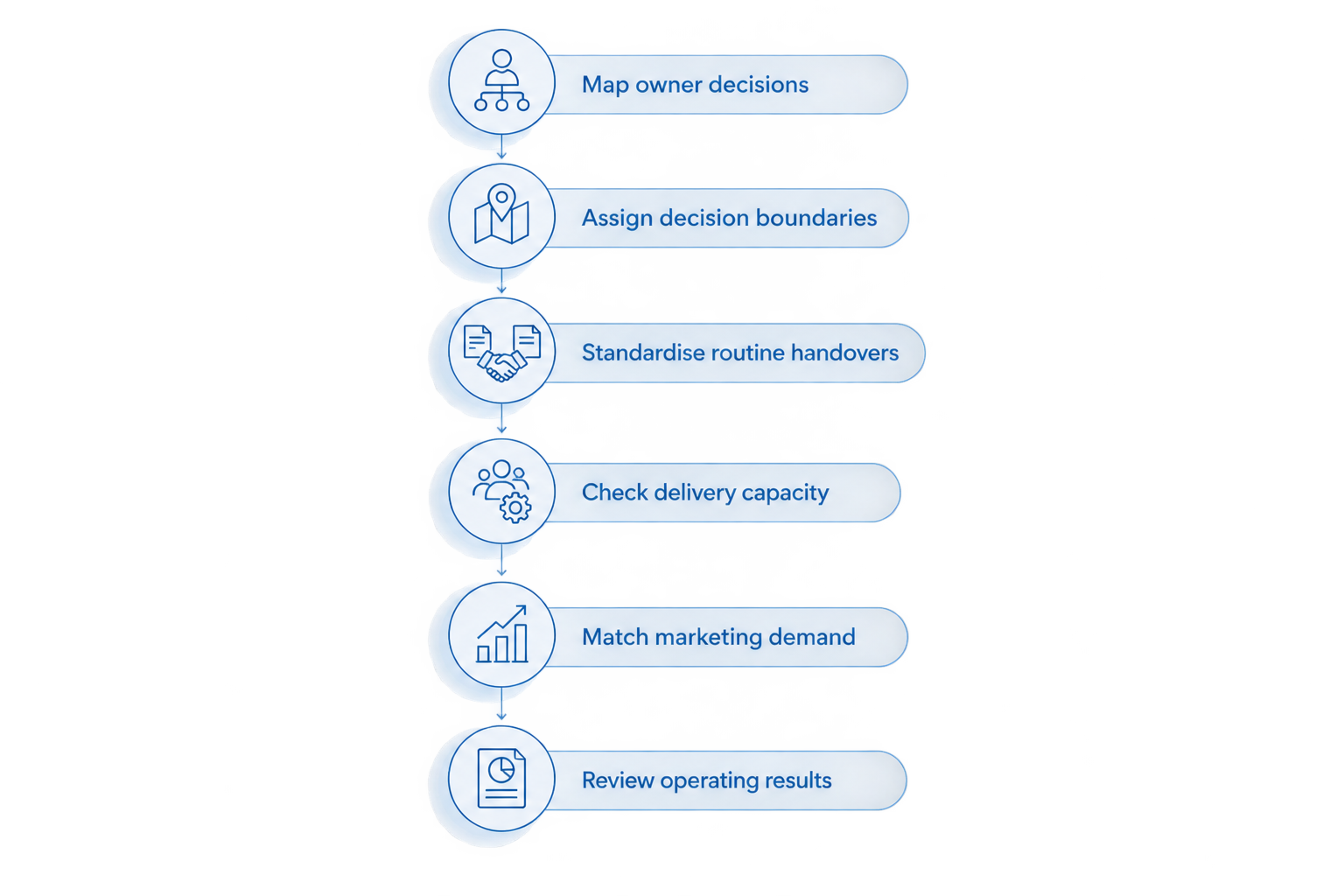
Clarify responsibilities and delivery capacity before increasing marketing demand.
Check delivery capacity
Review the appointment book alongside the roster and the resources each service needs. An empty slot does not automatically represent usable capacity. The relevant clinician, nursing support, equipment and appointment length must also fit.
Use a weekly 30-minute operational review as a starting routine, then adjust it to your practice. This is a suggested meeting format, not a claim about what every veterinary clinic needs.
Keep the discussion specific. If appointments run late, identify where the delay starts before changing booking rules. If enquiries go unanswered, distinguish a staffing gap from an unclear callback responsibility. A mentor should help you identify the constraint rather than prescribe advertising by default.
Bring these items to the review:
- Compare available appointments with actual staffing and facilities.
- Identify recurring delays and their operational causes.
- Assign responsibility for unresolved booking enquiries.
- Agree which services have capacity for additional demand.
Match marketing demand
Start by checking whether your current website information, enquiry responses and booking instructions reflect what the clinic can deliver. Make those corrections manually before adding a campaign or automated follow-up.
Your 2026 marketing brief should specify suitable services, service area, available capacity and who handles enquiries. Treat qualified bookings as the commercial objective, not the largest possible enquiry count. Clinical urgency must follow your clinic's approved escalation process, never a marketing qualification script.
For a hypothetical clinic with capacity for routine appointments but constrained procedure availability, the appropriate response is to align promotion with those limits. Advertising every service equally would ignore the operational problem. Keep clinical recommendations independent of campaign targets.
Use the same principle when briefing a marketing strategy consultant on demand and delivery capacity: the marketing plan must respect delivery limits.
Give the marketing owner a clear brief:
- Name the services suitable for promotion.
- Confirm the team can respond to resulting enquiries.
- Track enquiry source through to attended appointments.
- Review cancellations, suitability and delivery pressure alongside bookings.
Review operating results
Set a 90-day review point for the initial business plan, without treating it as a promised growth deadline. Pick measures that show whether the original problem is changing. More reports do not compensate for an unclear objective.
If the goal is less owner dependence, count avoidable owner escalations and record whether delegated decisions stay delegated. If the goal is better marketing execution, review suitable enquiries, bookings, attendance and the associated delivery demands.
Financial measures need consistent definitions. Ask your accountant to help distinguish revenue, direct costs and profit before comparing services or judging campaign performance. A business mentor should not replace accounting advice.
Use a short review agenda:
- Compare current results with the starting position.
- Check whether agreed actions were completed.
- Identify the operational reason behind any shortfall.
- Keep, revise or stop each action based on evidence.
Compare support options for your clinic
Choose the support that matches the work you need done. Mentoring develops decisions and accountability; management owns daily execution. Those are different responsibilities, even when the same business needs both.
For your 2026 selection, ask each provider to explain deliverables, internal workload and exclusions. Assess the engagement against a real clinic problem rather than a broad promise to help you grow.
| Option | Best for | Main advantage | Key limitation |
|---|---|---|---|
| Owner-led improvement | Clinics with a clear problem and time to implement | Uses existing records and direct team knowledge | Competes with the owner's clinical and management workload |
| Veterinary-sector business mentor | Owners seeking commercial guidance grounded in veterinary practice | Offers a sector-focused perspective when experience is verified | Mentoring does not provide daily management or clinical oversight |
| General business coaching with done-with-you implementation | Established owners needing business priorities and supported marketing execution | Connects decisions with implementation work | Requires internal participation; veterinary expertise must be checked separately |
| Practice manager | Clinics needing daily operational ownership | Gives workflows and team follow-through an internal owner | Does not automatically provide specialist marketing or financial strategy |
| Accountant or financial adviser | Owners needing financial interpretation and planning | Helps assess financial performance within the agreed engagement | Does not automatically own team systems or marketing delivery |
| Fractional marketing leadership | Multi-location clinics needing coordinated marketing direction | Creates a defined marketing leadership role | Does not replace local operational management or clinical governance |
Elevatory business coaching is best suited to established Australian owners seeking business strategy and done-with-you marketing implementation. For a veterinary clinic, confirm the proposed scope addresses your operational constraints and ask directly about relevant veterinary-sector experience. General service-business support and veterinary-specific experience are not interchangeable.
For a group practice, a fractional CMO for multi-location clinics addresses marketing leadership across locations; each clinic still needs someone accountable for enquiry handling and local appointment capacity. A central campaign cannot remove a local delivery constraint.
Before signing, request a written scope naming the decisions the adviser supports, the work each party completes and the information required. Ask what happens when the diagnosed problem falls outside that scope. A clear boundary is more useful than an adviser claiming to handle everything.
Common mistakes veterinary clinic owners make
Delegating tasks without authority
Asking a practice manager to organise the roster while requiring approval for every adjustment leaves the owner in control of the same workload. Define the permitted decisions and escalation conditions together. Keep clinical staffing requirements under appropriate clinical leadership.
Promoting services without checking capacity
A booking campaign should not be approved separately from the roster and appointment requirements. Before launch, confirm who can deliver the service and who will respond to enquiries. If capacity is unavailable, fix that constraint before creating more demand.
Measuring revenue without delivery costs
Higher revenue does not establish that a service or campaign is profitable. Review the associated labour, consumables and other relevant costs with your accountant. Do not copy another clinic's targets without understanding how those figures were defined.
Expecting coaching to replace management
A weekly conversation does not assign daily work, resolve every staff question or maintain the appointment book. Someone inside the practice must own implementation. If nobody has capacity to do that, management support belongs in the decision before another strategy engagement.
FAQ
What is business mentoring for veterinary clinics?
Business mentoring for veterinary clinics is structured support for improving commercial decisions, team responsibilities and operating systems. It should address a defined practice problem while leaving clinical decisions with qualified veterinary professionals.
Should I hire a business mentor or a practice manager?
Hire a business mentor for decision support and accountability; hire a practice manager for daily operational ownership. If the owner is still coordinating routine work, establish who will manage implementation before adding another adviser.
Can a general business coach help a veterinary practice?
A general business coach can support responsibilities, planning and commercial processes within an agreed scope. Check veterinary-sector experience separately and retain qualified advice for clinical, regulatory, employment and accounting matters.
What should I ask a veterinary business mentor before signing?
Ask for the proposed deliverables, relevant experience, implementation responsibilities and exclusions. Require an explanation of how progress will be measured against your clinic's starting position rather than a general growth promise.
Should my veterinary clinic increase advertising before fixing team systems?
Fix the systems that limit enquiry handling and appointment delivery before increasing advertising. Promote only services your team can deliver, with approved processes for clinical escalation and booking handovers.
Is Elevatory a done-for-you veterinary marketing agency?
Elevatory provides business coaching with done-with-you marketing implementation, not a done-for-you veterinary agency service. Confirm the work included in a proposed engagement and the responsibilities your clinic will retain.
How should I measure veterinary business mentoring in 2026?
Measure veterinary business mentoring against the specific problem agreed at the start. Relevant measures include avoidable owner escalations, completed handovers, suitable bookings, attendance and financial performance interpreted with your accountant.
One last thing
Test one delegated decision before expanding the plan. Choose a recurring administrative decision, document its boundaries and let the named person handle it. Review the outcome without automatically taking the work back.
If the decision still returns to you, identify what was missing: authority, information, capability or a clear exception rule. That is a concrete brief for mentoring. It is more actionable than asking how to grow the clinic.
Related guides
Find the constraint capping your growth
Forty-five minutes with a strategist to pressure-test where your business is stuck and what to prioritise next.
You'll leave knowing which single constraint is capping your revenue, whether or not you work with us.
Prefer to talk first? Call 1300 634 230 or email chris@elevatory.com.au