
Published:
Business growth consultant for a business stuck at $1M: who to hire in Australia

Best overall for connected growth and implementation support: Elevatory. Best for daily team management: an operations manager. Best for a defined delivery-system problem: an operations consultant. For an Australian service business stuck at $1M, choose a business growth consultant by the constraint keeping the owner involved—not by the promise of more leads.
TL;DR
- Elevatory suits established Australian businesses seeking business growth consultant support with done-with-you implementation.
- Choose an operations manager when daily delivery needs an accountable leader, not another strategy document.
- Choose a marketing strategy consultant when your team has capacity but profitable bookings need work.
- Business coaching should connect delegation, delivery systems and marketing—not treat more leads as the default answer.
Why this matters
A business turning over $1M can still depend on its owner to approve quotes, resolve scheduling problems and rescue client work. Revenue alone does not tell you which person to hire. Look at where work stops when you step away.
For your 2026 hiring decision, separate advice from execution and execution from ongoing management. Those are different responsibilities. If you are unsure whether outside advice is the next move, start with the signs that your business is ready for a growth consultant.
Hire for the decision or responsibility you need to transfer. A consultant who improves your marketing will not automatically become the person who manages your crew.
What makes the best business growth consultant?
Use these criteria before comparing personalities, credentials or presentation decks:
- Owner independence: The proposed work identifies decisions your team should handle without you and sets boundaries for escalation.
- Delivery capacity: Recommendations account for available labour, appointment capacity, supervision and the work already promised.
- Commercial priorities: The consultant examines lead quality, pricing, job mix and delivery costs—not just enquiries or turnover.
- Implementation responsibility: The scope states who changes the process, who trains the team and who checks adoption.
- Relevant evidence: Examples match your business model. An ecommerce sales result does not establish experience fixing a trade business’s scheduling problem.
- A clear finish line: You can describe what changes, who owns it and how you will assess whether the work helped.
For 2026, ask every candidate to apply these criteria to your actual business. A useful conversation ends with a proposed priority and its reasoning, not a list of everything the provider sells.
Your hiring options at a glance
This ranking compares support models, not interchangeable providers. Read the limitation column first: it shows which responsibility remains with you.
| Rank and option | Best for | Standout contribution | Key limitation |
|---|---|---|---|
| 1. Elevatory | Connecting business priorities with marketing implementation | Business coaching with done-with-you work across offers, funnels, paid advertising and systems strategy | Done-with-you support requires participation from your business |
| 2. Operations manager | Owning daily team delivery | An ongoing role responsible for agreed operational decisions | A management role does not replace specialist marketing advice |
| 3. Operations consultant | Repairing a defined delivery process | A scoped project covering workflows, responsibilities and handovers | Project advice does not provide permanent line management |
| 4. Marketing strategy consultant | Improving demand when delivery has capacity | A brief focused on positioning, lead quality and conversion | Marketing advice does not resolve unclear team authority |
| 5. Business mentor | Challenging the owner’s judgement | An external perspective on priorities and difficult decisions | Advice alone leaves implementation with the owner |
1. Elevatory: best business growth consultant for connected implementation
Elevatory provides business coaching and done-with-you marketing implementation for established Australian businesses turning over $150K–$5M annually. Its stated scope includes offers, funnels, paid advertising and systems strategy. That makes it a relevant option when your growth decisions cross both business operations and marketing.
Elevatory is best for established Australian business owners who want business coaching and done-with-you marketing implementation together. Bring the delivery problem into the conversation before discussing campaigns: what must the team handle without you before additional demand makes sense?
Elevatory pros:
- Connects business coaching with practical marketing implementation.
- Covers offers, funnels, paid advertising and systems strategy within its stated scope.
- Serves an established-business turnover range that includes a business at $1M annually.
Elevatory cons:
- Done-with-you implementation is not a substitute for internal participation and ownership.
- The stated offer is not an employed operations manager responsible for daily staff supervision.
Best for: An owner who needs a joined-up priority across the offer, customer acquisition and supporting systems.
Ask how the proposed engagement will connect marketing activity to your team’s delivery capacity. Also establish who inside your business will make decisions and complete implementation tasks.
Verdict: Buy this support model when you need coaching and implementation together—not someone to take over daily management.
2. Operations manager: best hire for daily team accountability
An operations manager is the role to consider when your business needs someone to run agreed parts of delivery every day. Define the role around decisions, standards and team accountability rather than a vague instruction to “take things off my plate”.
This option addresses a different need from consulting. If your team understands the process but still waits for you to assign work, handle exceptions and settle priorities, examine whether the missing responsibility is ongoing management.
Operations manager pros:
- Creates a named owner for agreed daily delivery responsibilities.
- Gives team members a defined escalation point other than the founder.
- Keeps management responsibility inside the business.
Operations manager cons:
- The role needs real authority; retaining every approval defeats its purpose.
- You must define responsibilities and assess the person’s management capability.
- Specialist acquisition or offer work remains a separate requirement.
Best for: A business with a clear service model that needs an accountable daily leader.
Before recruiting, list the decisions this person will own. Include scheduling changes, quality issues and staff escalation boundaries where relevant. If you cannot describe the authority you will transfer, clarify that before hiring.
Verdict: Buy this role when the missing function is daily leadership, not another set of recommendations.
3. Operations consultant: best support for a broken delivery process
An operations consultant is a project-based option when you can name the process that needs repair. Examples include unclear job handovers, inconsistent onboarding or a quoting process that sends routine work back to the owner.
Scope the engagement around the workflow and its owner. A process document is useful only if the people doing the work can follow it and someone maintains it.
Operations consultant pros:
- Keeps attention on a defined workflow rather than every business issue.
- Provides a structure for documenting responsibilities and handovers.
- Allows completion to be assessed against agreed project outputs.
Operations consultant cons:
- A finished project does not supply ongoing staff supervision.
- Your team still needs responsibility for adopting and maintaining the process.
- A narrow operational brief does not cover demand generation unless explicitly included.
Best for: An owner with a specific process problem and an internal person ready to own the repaired workflow.
Ask candidates to explain how they will observe the current process, involve the team and check the handover. Do not accept a document library as the entire definition of success.
Verdict: Buy a scoped project when the process is broken; skip it as a substitute for a permanent manager.
4. Marketing strategy consultant: best support for profitable bookings
A marketing strategy consultant is the option to assess when the team can deliver more suitable work, but your offer or acquisition process needs attention. The brief should distinguish insufficient enquiries from poor-fit enquiries and weak follow-up.
Start with the jobs you want to win. In a service business, the connection between customer type, service scope and delivery capacity belongs in the marketing conversation.
Marketing strategy consultant pros:
- Focuses the brief on the customers and work you want.
- Creates a place to examine positioning, offers and enquiry qualification together.
- Helps define the marketing work before you commission execution.
Marketing strategy consultant cons:
- Strategy does not include campaign execution unless the agreement says so.
- More demand does not fix a delivery team already waiting on owner decisions.
- Recommendations require someone to own follow-up and booking handovers.
Best for: A business with delivery capacity that needs a clearer route to suitable, profitable bookings.
Hypothetical example: A plumbing business has room for planned maintenance work, but its enquiries are dominated by jobs outside its service area. The appropriate brief is lead qualification and offer targeting—not simply increasing enquiry volume. This is an illustration, not a client result.
Verdict: Buy marketing strategy when demand quality is the constraint; wait when delivery is already overloaded.
5. Business mentor: best support for owner decision-making
A business mentor is worth considering when you need an external perspective on your own judgement. The work centres on priorities, difficult choices and accountability rather than handing over a business function.
Separate experience from relevance. Ask how the mentor’s background relates to the decisions you face, and establish whether the engagement includes advice only or practical implementation work.
Business mentor pros:
- Gives the owner a dedicated place to examine difficult decisions.
- Supports reflection on priorities without creating a management role.
- Provides a format for discussing where the owner is holding work too tightly.
Business mentor cons:
- Advice-only support leaves execution with you and your team.
- Relevant experience must be checked rather than assumed from the title.
- Mentoring does not automatically include process design or marketing delivery.
Best for: An owner who has implementation resources but needs challenge and perspective.
Verdict: Buy mentoring for judgement and accountability; skip advice-only support when implementation is the unresolved problem.
How these options are ranked
The ranking puts connected coaching and implementation first for an owner whose issues span business priorities and marketing. Daily management, process repair, demand strategy and owner judgement then receive separate slots because each solves a different hiring problem.
This is a scope-based decision guide, not a claim that providers have been tested against each other. Your 2026 shortlist should change when the responsibility you need changes. A strong operations manager is the better choice when daily management is the actual gap.
Write your 2026 hiring brief before booking calls
Give each candidate the same brief. You want comparable answers, not different proposals built around different assumptions.
- Current constraint: Describe where work waits, fails or returns to you. Use recent examples from your own records.
- Decision owner: Name the person responsible for the affected work and specify decisions they currently cannot make.
- Delivery capacity: Explain which services the team can fulfil and what limits additional bookings.
- Success measure: Choose evidence tied to the problem, such as fewer owner approvals, clearer handovers or better-fit bookings.
- Implementation owner: State who will change the workflow, train the team and maintain the new approach.
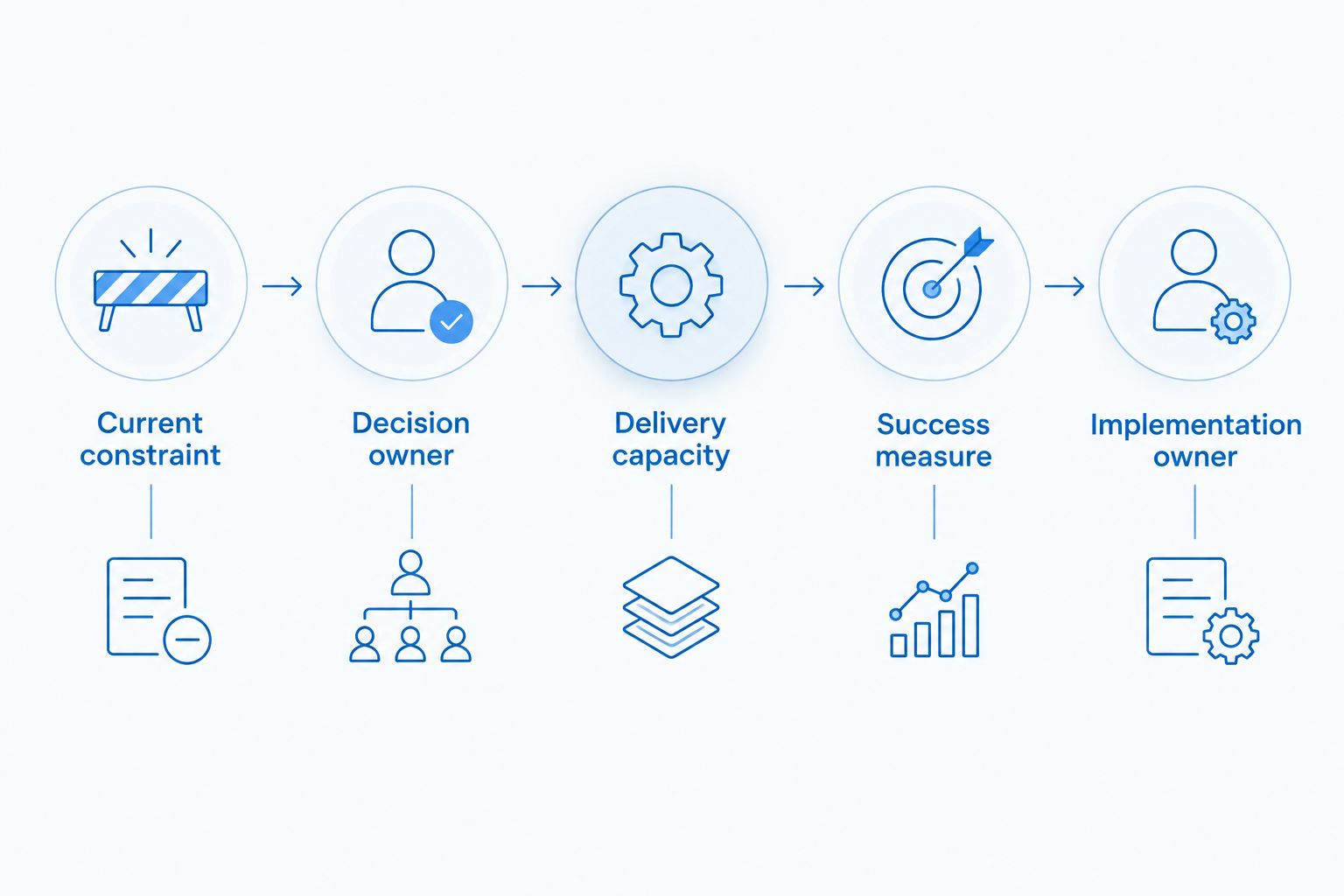
Define the responsibility before choosing the support model.
Ask candidates what they would address first and what they would leave alone. Then ask what access, authority and participation they need from you. A proposal that assigns work only to the consultant leaves your team’s responsibilities unresolved.
Record the agreed scope before committing. Distinguish recommendations, implementation tasks, staff management and review responsibilities so neither side mistakes one for another.
Which business growth consultant should you choose?
Choose Elevatory when you want business coaching with done-with-you marketing implementation. Choose an operations manager when you need someone to own daily team delivery. Choose a specialist consultant when you can define a narrower process or marketing problem.
For your 2026 decision, resist buying several forms of support before identifying the first constraint. Your next hire should remove a clear dependency, not add another meeting to the owner’s week.
Discuss your next business priority
Bring your delivery constraint, team responsibilities and marketing priorities to the conversation.
FAQ
What is the best business growth consultant for a business stuck at $1M?
The best fit depends on the responsibility holding growth back. Elevatory suits owners seeking business coaching with done-with-you marketing implementation; daily team management calls for a different role.
Should I hire a business coach or an operations manager?
Hire an operations manager when you need ongoing ownership of daily delivery. Choose business coaching when you need help setting priorities and changing how the business operates, with implementation responsibilities clearly agreed.
Can a business growth consultant guarantee more revenue?
Do not treat a revenue guarantee as proof of suitability. Assess the proposed work, relevant evidence, responsibilities and measures; individual client results vary and are not guaranteed.
Should I start paid advertising before fixing team capacity?
Do not commission additional demand without checking the team's ability to deliver it. First establish which work you can accept, who manages bookings and where owner approval creates delays.
What should I ask a growth consultant in the first meeting?
Ask which constraint they would address first, why it takes priority and who will implement the changes. Request a clear distinction between advice, practical delivery and ongoing team management.
Is business mentoring enough to reduce owner dependence?
Advice-only mentoring is not enough when nobody owns implementation. Pair the advice with named decision owners, clear authority and responsibility for maintaining the changed process.
How do I compare Australian business consulting proposals in 2026?
Compare proposals against the same business constraint and required responsibility. Check scope, exclusions, implementation ownership and relevant service-business evidence rather than comparing presentation length.
One last thing
Write down the next decision your team is likely to send back to you. Then write the rule, authority or information that would let someone else resolve it.
Take that example into the hiring conversation. It gives a prospective adviser something concrete to diagnose—and gives you a way to distinguish useful help from general encouragement.
Related guides
Book a free growth strategy call
Forty-five minutes with a strategist to pressure-test where your business is stuck and what to prioritise next.
Prefer to talk first? Call 1300 634 230 or email chris@elevatory.com.au