

Landscaping business coaching is structured support for improving team responsibilities, job delivery and commercial decisions, with the aim of building a profitable business that depends less on its owner. This 2026 guide explains how to connect quoting, crew capacity and marketing without filling the diary with work your team cannot deliver.
TL;DR
- Business coaching for landscaping businesses should reduce owner dependence before increasing lead volume.
- Elevatory business coaching best suits established Australian owners seeking strategy with done-with-you marketing implementation.
- Choose small business coaching around quoting, crew responsibilities, job margins and delivery capacity.
- Judge marketing coaching by profitable bookings and delivery readiness, not enquiries alone.
Why business coaching matters for landscaping businesses
A full diary does not prove you have a business that works without you. If every quote, material substitution and customer concern comes back to the owner, another booking adds another decision to the same desk.
Landscaping requires you to connect the work sold with the people, equipment and time needed to deliver it. Recurring maintenance and landscape construction also need different quoting and scheduling decisions. Treating them as interchangeable hides where the pressure sits.
Start your 2026 growth plan by identifying where the business depends on its owner. Separate decisions that genuinely require your judgement from decisions that return because nobody has clear authority.
Business coaching earns its place when it turns that diagnosis into responsibilities, working processes and commercial decisions. A conversation about ambition is not a substitute for deciding who handles tomorrow's site problem.
How to build a landscaping business that needs less of you
Work through the steps in order. Establish who makes decisions, confirm what your team can deliver, then connect offers and marketing to that capacity.
The sequence is decision audit, role clarity, delivery systems, job economics, capacity planning, lead qualification and weekly review. You can start with a notebook and spreadsheet; new software is not a prerequisite.
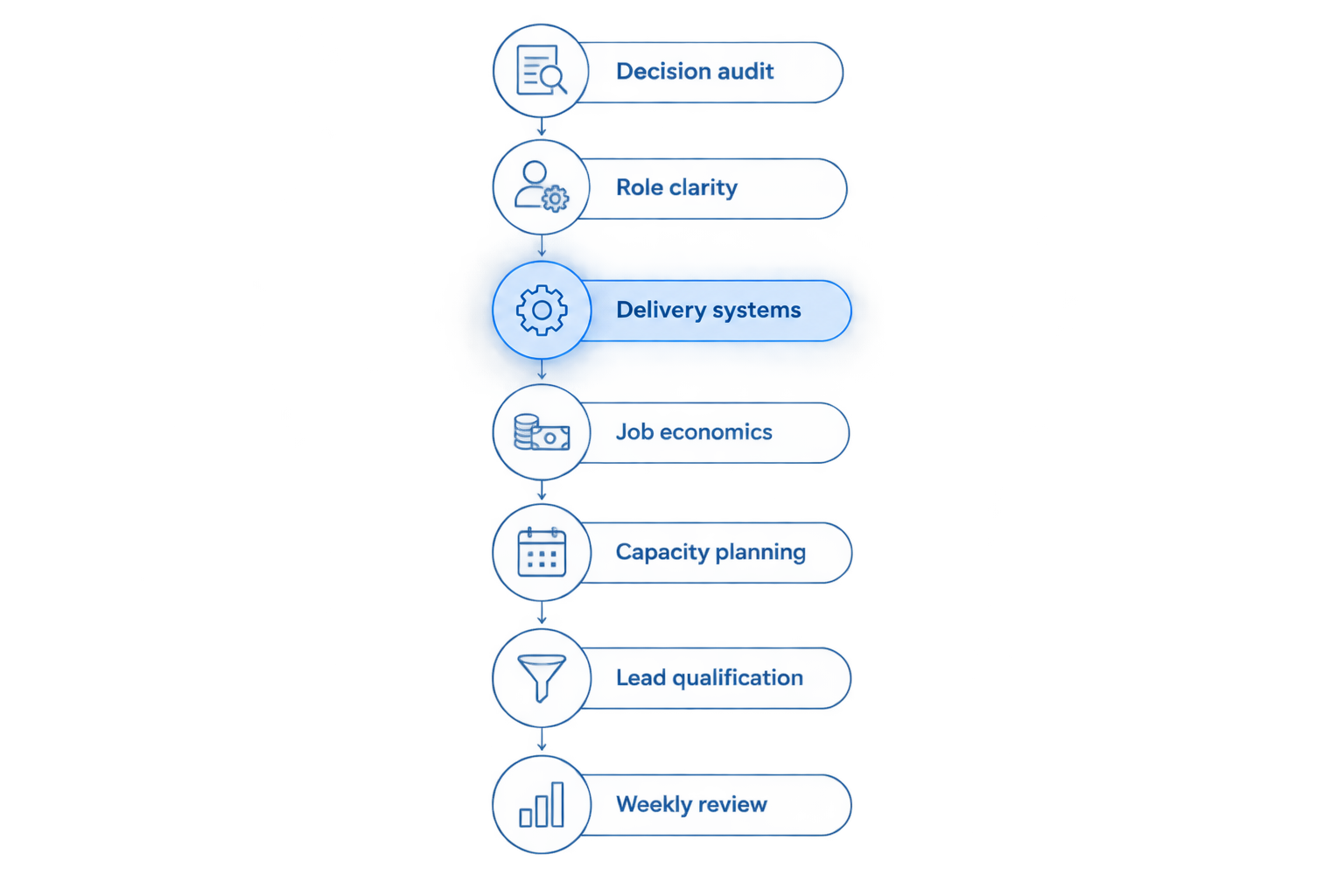
Set responsibilities and delivery capacity before asking marketing to generate more work.
Audit the decisions that return to you
For a proposed 7-day audit, record each interruption that requires an owner decision. Include calls from site, quote approvals, supplier questions, schedule changes and customer complaints. Record the decision, not just the time the call took.
Then classify the cause. Does the team lack information, authority, skill or an agreed rule? Those are different problems. A checklist will not fix a missing technical skill, and training will not fix a rule that still requires your approval.
Use this audit as your 2026 starting point rather than guessing which task to delegate first. Choose a repeated decision with a clear boundary and manageable consequences.
- Record what triggered each owner interruption.
- Separate technical judgement from routine approval.
- Mark decisions caused by missing job information.
- Select a repeated decision to transfer first.
Give each responsibility a named owner
Write responsibilities against names, not vague departments. Even in a small landscaping team, somebody needs to own enquiry response, quoting follow-up, scheduling, site communication and job close-out. One person can hold several responsibilities, but each responsibility needs a clear owner.
Define what that person can decide without you. A crew leader needs to know which changes sit within the approved scope and which require a customer variation or owner review. Responsibility without authority simply creates another messenger.
Delegate the decision and its boundaries, not just the task. Keep escalation rules specific enough that the team can use them while you are unavailable.
- Name the person responsible for each handover.
- Define decisions they can make independently.
- List situations that require escalation.
- Agree what evidence confirms the work is complete.
Document the delivery systems your team actually uses
Start manually with a shared job sheet and a repeatable handover checklist. Capture the agreed scope, exclusions, site access, materials, customer commitments and completion requirements. Ask the person doing the work to test whether the document answers their practical questions.
For coaching alongside marketing implementation, Elevatory offers business coaching with done-with-you support across offers, funnels, paid advertising and systems strategy. Elevatory business coaching best suits established Australian owners who want strategic guidance with done-with-you marketing implementation. It is not a substitute for someone managing your crews each day.
Use external support to turn agreed priorities into working processes, rather than collecting documents nobody opens. Test each checklist on an actual job and revise the unclear parts.
- Put the approved scope in the job handover.
- Record access restrictions and customer commitments.
- Define how the crew reports variations.
- Specify completion photos, checks and customer handover.
Check job economics before chasing turnover
Review completed work by service type. Compare quoted labour and materials with actual usage, then identify rework, extra visits and unapproved additions. Revenue alone cannot show whether a job justified the delivery effort.
Hypothetical example: a landscaper accepts garden renovation projects and recurring maintenance. Renovation jobs look attractive by invoice size, but repeated return visits and unclear exclusions absorb crew time. Maintenance fills the schedule predictably, yet travel between scattered properties reduces productive time. Neither service is automatically better; the records determine what to change.
A business mentor should help you interrogate those records, not prescribe a universal margin target. Use your own costs and delivery requirements when reviewing pricing.
- Compare estimated and actual labour hours.
- Reconcile materials against the accepted scope.
- Record unpaid variations and return visits.
- Review job contribution after direct delivery costs.
- Change quoting assumptions using completed-job evidence.
Match bookings to real crew capacity
Build a simple view of committed work before approving more demand. Include the skills each job needs, equipment dependencies, travel, leave and room to manage weather disruption. A blank space in the diary does not prove the right crew is available.
For your 2026 plan, distinguish maintenance commitments from project work. Do not promise the same crew to recurring visits and a construction schedule without making the trade-off explicit. Give someone responsibility for updating the schedule when circumstances change.
Set a proposed 30-day capacity view as a planning habit, not a promise to customers. Review it whenever work is accepted, delayed or materially changed.
- List committed jobs and recurring service obligations.
- Assign the required skills and equipment.
- Flag jobs awaiting materials or customer decisions.
- Set rules for rescheduling disrupted work.
- Give quoting staff an approved booking window.
Qualify enquiries before spending time on quotes
Start with a written enquiry checklist and a consistent response process. Ask about location, service required, site conditions, desired timing and project expectations. Decide which answers qualify the enquiry for a site visit and which require clarification first.
Marketing coaching should connect those qualification rules to your offer, enquiry form and follow-up. Do not advertise every service across every location if your team cannot deliver that combination profitably. Explain your scope clearly rather than using the quote visit to discover a basic mismatch.
For example, a hypothetical maintenance business seeking denser routes would target suitable properties within its chosen service area. That is a capacity decision expressed through marketing, not a claim that a particular advertising channel guarantees bookings.
- Define suitable services and service areas.
- Ask qualification questions before arranging a visit.
- Assign enquiry follow-up to a named person.
- Record why quotes are accepted or declined.
- Connect accepted work to available delivery capacity.
Review outcomes and return decisions to the team
Set a proposed 30-minute weekly review with the people responsible for sales and delivery. Use it to resolve exceptions, check commitments and identify decisions that unnecessarily returned to you. Keep routine status updates in the shared records.
Track qualified enquiries, accepted quotes, completed jobs, job contribution and owner interventions. Define each measure consistently so a change means something. For example, distinguish a genuine scope question from a call caused by a missing site address.
Your 2026 scorecard should show whether the business is becoming easier to manage as well as whether revenue changes. If bookings grow while unpaid rework and owner interruptions increase, inspect the operating process before increasing promotion.
- Review sales and delivery measures together.
- Assign each unresolved issue to a named person.
- Give each action a completion date.
- Update decision rules after repeated exceptions.
- Check whether delegated decisions stay delegated.
Compare support options for your landscaping business
Choose support for the constraint, not the job title. A coach, a marketing specialist and an operations manager solve different problems. Ask what each person will own and what still sits with you.
| Option | Best for | Main benefit | Key limitation |
|---|---|---|---|
| Owner-led process improvement | Owners with time to document and test changes | Uses your direct knowledge of jobs and customers | The owner must sustain the work and challenge their own habits |
| Business coach or business mentor | Owners needing priorities, accountability and commercial decisions | Connects team, delivery and growth decisions | Advice alone does not implement a process or manage a crew |
| Elevatory business coaching with done-with-you implementation | Established Australian owners needing coaching plus marketing implementation support | Connects offers, funnels, paid advertising and systems strategy | Requires owner participation; it is not done-for-you crew management |
| Marketing strategy consultant | Businesses with delivery capacity but unclear targeting or positioning | Focuses the offer and customer acquisition plan | Marketing strategy does not resolve unclear site responsibilities |
| Operations manager | Businesses needing someone to own daily coordination | Places operational responsibility inside the business | Requires clear authority, recruitment and an appropriate management role |
Before engaging anyone, request a written scope covering responsibilities, implementation tasks and review measures. Ask for relevant service-business evidence rather than treating an ecommerce revenue result as proof of landscaping expertise.
For a proposed 90-day engagement plan, agree on observable deliverables: a responsibility map, a tested job handover, a capacity review and an enquiry qualification process. These are planning examples, not promised outcomes or a fixed service package.
Common mistakes landscaping owners make
Buying more leads while the owner approves everything
More enquiries do not remove a quoting or scheduling bottleneck. If every commitment still requires you, marketing feeds the queue. Transfer routine decisions and confirm delivery capacity before expanding acquisition activity.
Treating maintenance and construction as the same offer
Recurring visits and landscape projects have different scoping and scheduling needs. Separate their qualification questions, quoting assumptions and handover requirements. Judge each service using its own delivery records rather than a blended sales total.
Promoting a good landscaper without defining the leadership role
Technical ability does not tell a crew leader which customer changes they can approve or when to escalate. Document their responsibilities, decision boundaries and support. Do not call it delegation while continuing to make every meaningful decision yourself.
Comparing coaches only by revenue claims
A large result from an unrelated business does not establish fit for your team problem. Ask what changed operationally, what the owner implemented and how progress was measured. Treat every result as a specific client's experience, not a forecast for yours.
FAQ
What's the best business coaching for landscaping businesses?
The best fit is coaching that addresses your current constraint: owner dependence, team responsibilities, job profitability or customer acquisition. Ask for a written scope, relevant service-business evidence and clear implementation responsibilities rather than choosing on revenue claims alone.
Can a business coach help me get off the tools?
A business coach can help you define the responsibilities, decision boundaries and delivery systems needed to reduce owner dependence. Your business still needs capable people to take on that work; coaching does not replace crew leadership.
Should I hire a business coach or an operations manager?
Choose a business coach for priorities and accountability, and an operations manager when daily coordination needs a dedicated owner. If the work and authority are unclear, define the role before recruiting.
Does Elevatory provide done-for-you marketing for landscapers?
Elevatory provides business coaching and done-with-you marketing implementation, not a done-for-you agency arrangement. Its stated scope includes offers, funnels, paid advertising and systems strategy for established Australian businesses.
Should I start paid ads before fixing my landscaping team systems?
Fix any delivery constraint that prevents you from handling additional bookings before expanding paid advertising. Confirm who qualifies enquiries, approves quotes and schedules work so marketing supports a deliverable offer.
How do I measure whether business coaching is working?
Measure agreed operating changes alongside commercial outcomes, including delegated decisions, job contribution and qualified bookings. Compare consistent records and check whether the team completes work with fewer unnecessary owner interventions.
What should I prepare before meeting a business coach?
Prepare recent quotes, completed-job costs, the forward schedule and a list of decisions that keep returning to you. Include team responsibilities and enquiry records so the discussion starts with actual work rather than general ambitions.
One last thing
Before adding another marketing task to your 2026 plan, test a handover you already rely on. Ask a crew leader to explain the scope, variation rules and completion standard for an upcoming job without your help.
The unanswered questions are your next systems task. Resolve them in the job record, then give the responsible person authority to act. A stronger handover is more useful than another document that still requires you to explain it.
Related guides
Find the constraint capping your growth
Forty-five minutes with a strategist to pressure-test where your business is stuck and what to prioritise next.
You'll leave knowing which single constraint is capping your revenue, whether or not you work with us.
Prefer to talk first? Call 1300 634 230 or email chris@elevatory.com.au