

Business coaching for dental clinics is structured support for improving team responsibilities, practice systems and commercial decisions so the owner can reduce daily dependence without losing control. This 2026 guide explains how to assess your clinic, delegate administrative decisions and connect marketing to the appointments your team can actually deliver.
TL;DR
- Business coaching for dental clinics should start with owner dependence, team responsibilities and delivery capacity, not more enquiries.
- Elevatory suits owners seeking business coaching with done-with-you marketing implementation, rather than outsourced practice management.
- Keep clinical judgement with qualified practitioners; delegate administrative decisions within documented boundaries.
- Judge small business coaching and marketing coaching by completed actions, attended appointments and financial performance.
Why business coaching matters for dental clinics
A dental clinic owner has two distinct responsibilities: patient care and running the business. Coaching should address the second without interfering with the first. Start by identifying which staffing, scheduling and administrative decisions still wait for you.
The practical question for 2026 is not simply whether your clinic needs more patients. It is whether your team can handle appropriate demand without making you the approval point for every booking exception, roster change and supplier issue.
Fix the constraint before buying more demand. Review how to measure owner dependence before deciding whether your next move is coaching, management support or marketing.
A useful coaching brief separates commercial goals from clinical responsibilities. Better financial performance is a business objective; treatment recommendations remain based on patient need and professional judgement. No booking target should override that boundary.
How to build a coaching plan for your dental clinic
1. Record the decisions that keep returning to you
Start with a notebook or shared document. For 7 working days, record each non-clinical interruption, who raised it and why the team needed your decision. This is a diagnostic exercise, not a staff scorecard.
Group the entries into unclear authority, missing instructions, inadequate training and genuine owner decisions. The distinction matters: a written procedure will not fix a decision nobody has permission to make.
Hypothetical example: reception repeatedly asks the principal how to handle appointment changes. Before buying another booking tool, establish which changes reception can approve and which require clinical input. Define escalation rules with the appropriate practitioner.
Close the review by choosing a recurring administrative decision to delegate. Keep the initial scope narrow enough to test and correct.
- Record the decision, requester and interruption length in minutes.
- Separate clinical questions from administrative exceptions.
- Identify the person authorised to resolve each administrative issue.
- Write an escalation rule for exceptions outside that authority.
2. Define responsibilities before rewriting job titles
Use a simple responsibility sheet before commissioning an organisational restructure. List the recurring work, the accountable role, the person covering absences and the point at which escalation is required.
For your 2026 plan, distinguish responsibility for doing a task from authority to decide. A practice manager responsible for the roster needs clear boundaries for changing it. A receptionist managing enquiries needs an agreed handover for clinical questions.
Do not delegate an outcome without access to the information required to achieve it. Equally, do not make the owner the automatic backup for every absence. Agree where coverage sits and which decisions genuinely remain yours.
Test the arrangement during ordinary work before changing several roles at once. Review confusion as a system problem first, then address training or performance separately.
- Name an accountable role for each recurring administrative task.
- Document decision boundaries and required approvals.
- Assign absence cover for essential functions.
- Explain how staff should raise unresolved issues.
3. Document the patient administration handover
Map the administrative journey on paper before adding automation. Follow an enquiry through booking, appointment attendance and any appropriate follow-up, while keeping clinical assessment with the treating team.
At each handover, specify what information the next person needs and who checks that the transfer happened. Keep patient information in approved practice systems, not scattered across coaching worksheets or personal messages.
Elevatory provides business coaching with done-with-you implementation across offers, funnels, paid advertising and systems. That is a route to implementation support, not a substitute for a practice manager or dental clinical expertise. Use Elevatory to assess that service model against the work your clinic needs.
The administrative sequence should be visible to everyone involved: Enquiry, Booking, Attendance, Follow-up. Define the appropriate next action at each stage rather than treating every contact as a sales opportunity.
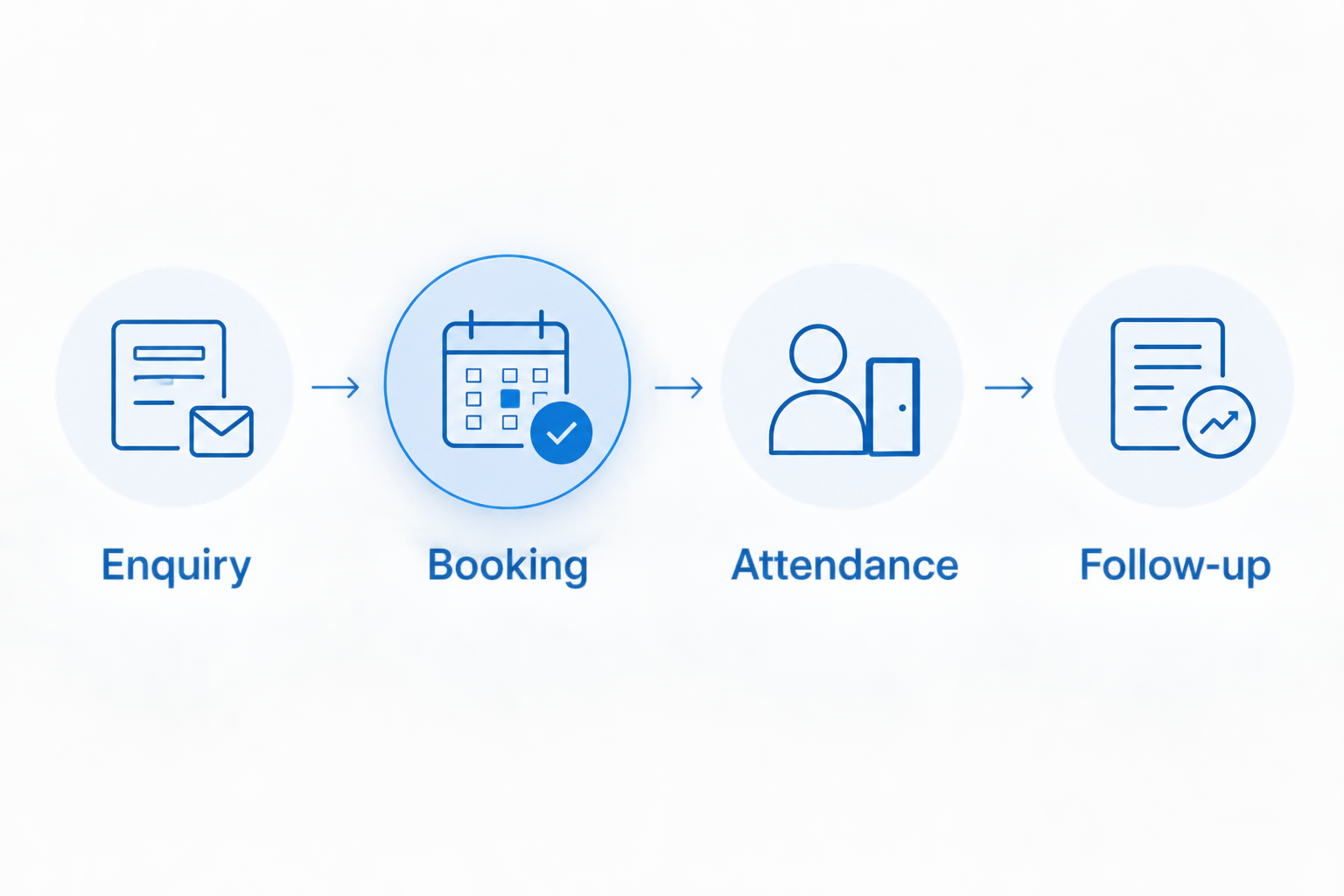
Give each administrative handover a responsible person and a clear next action.
- Define who responds to new enquiries and records the outcome.
- Set the handover process for questions requiring clinical advice.
- Document booking changes, cancellations and unresolved enquiries.
- Check access permissions before sharing information with external advisers.
4. Calculate usable capacity before increasing marketing
Start with your existing appointment book and roster. Review the next 4 weeks by practitioner, appointment type, staffing requirements and available sessions. Empty calendar space is not automatically capacity for every service.
Ask the team where the schedule breaks down. A room without the necessary staff, equipment or practitioner availability is not a bookable opportunity. Record the reason rather than grouping every gap under poor marketing.
Hypothetical example: a clinic has spare appointments during a session its advertising does not explain clearly. The first action is to confirm which appointments the team can accept, then align the enquiry and booking process. Increasing all campaigns ignores the actual scheduling constraint.
Your coach should help turn this information into commercial priorities. Clinical suitability and urgency remain decisions for the appropriate practitioner.
- Review staffed appointment capacity by service and session.
- Record why apparently open appointments cannot be booked.
- Match advertised services to genuine delivery capacity.
- Agree when campaigns should be reviewed as capacity changes.
5. Measure the journey beyond the initial enquiry
Build a basic weekly worksheet before paying for additional reporting. Track enquiries, bookings and attended appointments using consistent definitions. Separate collected revenue from booked appointment value so your reports do not confuse an intention with a completed transaction.
Agree how the clinic will record an enquiry's source. If the source is unknown, record it as unknown rather than assigning it to the campaign you want to credit.
Financial reporting also needs context. Revenue alone does not show the labour, laboratory, materials and other delivery costs associated with the work. Ask your accountant to help define appropriate financial measures and keep clinical choices outside marketing incentives.
Measure the booking journey, not just the advertising dashboard. A campaign report cannot explain a handover failure unless the clinic records what happened after the enquiry arrived.
- Define enquiry, booking and attendance consistently.
- Separate booked value from revenue actually collected.
- Record enquiry sources without guessing attribution.
- Review delivery costs alongside revenue with your accountant.
6. Choose support that matches the unresolved problem
Write your brief yourself before meeting providers. State the recurring problem, the role responsible for fixing it and what help that person needs. This prevents a broad growth conversation from replacing a specific operational decision.
For a 2026 engagement, ask each provider to distinguish advice, shared implementation and execution handled by the provider. A business mentor, practice manager and marketing consultant solve different problems; the title alone does not establish fit.
Elevatory is best for owners seeking business coaching with done-with-you marketing implementation, not outsourced clinic management. Its stated focus is established Australian businesses with annual turnover of $150K–$5M. Confirm dental-sector experience, proposed scope and responsibilities directly rather than assuming them.
Ask for evidence relevant to your problem. An ecommerce revenue result does not demonstrate improved dental scheduling or reduced principal dependence.
- Describe the bottleneck in a short written brief.
- Ask who completes each implementation task.
- Request relevant examples without patient-identifying information.
- Confirm exclusions, responsibilities and review arrangements before committing.
7. Review progress without taking delegated work back
Start with a 30-minute weekly review using the same worksheet each time. Discuss the agreed actions, the evidence of completion and the decisions that still reached the owner unnecessarily.
Keep coaching separate from the daily staff escalation channel. Your team still needs a responsible manager and clear operating instructions between meetings. An external adviser cannot replace the person accountable for running the clinic each day.
When a delegated task goes wrong, identify whether the problem was authority, instruction, capability or follow-through. Taking it back immediately teaches the team that ownership returns to you whenever the work becomes difficult.
End the review with named actions and a review date. Assess financial outcomes alongside owner involvement and patient-service standards, not as a reason to disregard either.
- Review completed actions against the agreed scope.
- Count administrative decisions returned to the owner.
- Address missing authority or training before changing responsibility.
- Assign the next action to a named role.
Compare support options for your dental clinic
Choose the support model around the work that needs doing. For your 2026 decision, distinguish between helping you make better decisions, running daily operations and executing marketing tasks.
| Option | Best for | Main advantage | Key limitation |
|---|---|---|---|
| Owner-led improvement | A defined administrative problem with an available internal owner | Keeps learning and responsibility inside the clinic | Requires protected time and consistent follow-through |
| Business coach or mentor | Owner priorities, delegation and accountability | Adds external challenge and structured review | Advice alone does not complete implementation |
| Dental-sector adviser | Questions requiring practice-specific operational knowledge | Can assess issues through a dental-practice lens | Verify the individual's experience and implementation scope |
| Practice manager | Daily coordination, staff follow-through and administration | Places ongoing operational responsibility inside the clinic | Needs appropriate authority and management capability |
| Marketing agency | Defined campaign execution after capacity and handovers are clear | Adds external execution capacity | Does not replace internal practice leadership |
| Elevatory business coaching | Established Australian owners seeking coaching plus done-with-you marketing implementation | Connects business priorities with offers, funnels, advertising and systems work | Requires client participation; confirm dental-specific experience directly |
Do not hire coaching to fill an unfilled management role. If nobody owns the daily roster, staff handovers and administrative follow-through, resolve that responsibility explicitly.
Common mistakes dental clinic owners make
Buying enquiries before checking the appointment book
Advertising should reflect the services and sessions your team can deliver. Review usable capacity and enquiry handling before treating more leads as the answer to an underfilled diary.
Delegating reception work but retaining every decision
A task list is not decision-making authority. Give reception clear administrative boundaries and a reliable clinical escalation pathway, then stop requiring approval for decisions already delegated.
Treating treatment acceptance as a sales target
Patients need appropriate information and clinical advice, not pressure to meet commercial targets. Keep business reporting distinct from treatment recommendations and informed consent.
Assuming general business results prove dental expertise
Ask what the provider has done that relates to your actual problem. Revenue growth in a retail or ecommerce business does not establish experience with dental staffing, appointments or clinical governance.
Forgetting health advertising and privacy responsibilities
Include a review of current Ahpra advertising requirements and applicable privacy obligations in your marketing process. Do not assume a coach or agency takes over the clinic's professional responsibilities.
FAQ
What does business coaching for dental clinics actually cover?
Business coaching for dental clinics covers commercial priorities, delegation, team accountability and operating systems. Depending on the agreed scope, it can also support marketing planning and implementation, but it does not replace clinical judgement.
Should I hire a business coach or a practice manager?
Hire a practice manager for daily operational ownership and a business coach for structured decision support and accountability. If nobody is responsible for implementing decisions between coaching sessions, resolve that management gap first.
Can business coaching help me spend less time managing the clinic?
Business coaching can help you define responsibilities and delegate administrative decisions. Reduced owner involvement depends on implementation, team capability and appropriate authority; it is not a guaranteed outcome.
Do I need more patients before investing in coaching?
No; assess your current capacity, enquiry handling and owner dependence before deciding that more patients are the priority. Coaching should address the identified business constraint rather than defaulting to additional advertising.
Does Elevatory provide dental-specific coaching?
Elevatory states that it provides business coaching and done-with-you marketing implementation for established Australian businesses. Confirm dental-clinic experience directly before engaging; general business experience is not proof of dental-sector expertise.
What should I prepare before speaking with a dental business coach?
Prepare a summary of team responsibilities, recurring owner decisions, appointment capacity and financial priorities. Use aggregated information and avoid sharing identifiable patient details unnecessarily.
How should I judge whether dental clinic coaching is working?
Judge coaching against agreed actions and measures established before the engagement. Review delegated decisions, handover completion, attended appointments and financial performance without assuming coaching alone caused every change.
One last thing
Before setting another growth target in 2026, ask your team which administrative decision they still cannot make without you. Choose a recurring example and define the authority, information and escalation boundary needed to transfer it.
Your first useful coaching outcome can be a decision that stops returning to your desk. Make that improvement visible before adding more work to the clinic.
Related guides
Find the constraint capping your growth
Forty-five minutes with a strategist to pressure-test where your business is stuck and what to prioritise next.
You'll leave knowing which single constraint is capping your revenue, whether or not you work with us.
Prefer to talk first? Call 1300 634 230 or email chris@elevatory.com.au