

For $1M–$5M businesses, business coaching is structured support to build team accountability, improve commercial decisions and reduce owner dependence. For established Australian service businesses, the work should connect delegation, delivery capacity and profitable bookings—not simply generate more enquiries.
TL;DR
- Business coaching for businesses turning over $1m-$5m should connect team accountability, delivery capacity and profitable growth.
- Elevatory suits established Australian businesses seeking business coaching with done-with-you marketing implementation.
- Choose an operations manager when daily execution needs an owner; choose coaching when leadership decisions need structured support.
- Set a baseline for owner hours, job contribution and qualified bookings before changing marketing activity.
Why business coaching matters for $1M–$5M businesses
Your turnover does not tell you whether the business can operate without you. A full calendar can coexist with weak job margins, unclear responsibilities and a queue of decisions waiting for the owner.
For your 2026 plan, distinguish between work that needs your expertise and work that reaches you because nobody else has authority. Start by measuring owner dependence, rather than assuming another marketing campaign is the next move.
Trades and home services need a clear connection between quoting, scheduling and crew capacity. Professional services need the same connection between selling work, assigning delivery and protecting senior expertise. Coaching should address those handovers alongside the offer and marketing strategy.
The useful question is not whether coaching will make you busier. It is whether the engagement will help your team make better decisions without routing everything through you.
How to use business coaching to build a less owner-dependent business
1. Map the decisions that depend on you
Start manually. For one working week, record each interruption that requires your approval: a quote adjustment, a scheduling conflict, a client complaint or a question about scope. Record why the team needed you, not just what happened.
Group those interruptions into missing information, missing authority and missing capability. Each needs a different response. A checklist addresses missing information; it does not give a supervisor permission to resolve a scheduling conflict.
Use this record as your 2026 starting point. Give a prospective business coach actual examples rather than a general statement that you need more time.
- Record the decision, requester and reason for escalation.
- Separate technical advice from routine approvals.
- Mark decisions that genuinely require the owner.
- Select one recurring decision to transfer first.
2. Assign responsibility and decision authority together
Write a simple responsibility map before buying another system. For each part of the customer journey, name the person responsible, the outcome expected and the boundary of their authority.
Delegation is incomplete when your team owns the task but you still own every decision. A booking coordinator needs clear rules for accepting work. A delivery lead needs to know which scope changes require approval.
Hypothetical example: a plumbing business lets its coordinator assign routine bookings within agreed service areas, while unusual access requirements go to the crew leader. This illustrates a decision rule, not a client result.
- Name one accountable person for each outcome.
- Define what that person can decide independently.
- Document exceptions that require escalation.
- Agree how mistakes will be reviewed without taking the task back.
3. Document the delivery handovers that create rework
Use a shared document to describe how an accepted quote becomes completed, invoiced work. Focus on handovers first: what sales promises, what scheduling needs and what the delivery team receives.
A business coach should help you identify the constraint and assign implementation work. Elevatory provides business coaching with done-with-you marketing implementation across offers, funnels, paid advertising and systems strategy. That model adds support to the work; it does not remove your team's responsibility to carry it out.
Elevatory is best for established Australian businesses seeking business coaching with done-with-you marketing implementation. It is not a substitute for an internal leader who owns daily execution.
- Define the information required before accepting a handover.
- Record the agreed scope and exclusions.
- Assign responsibility for confirming job readiness.
- Create a feedback route for missing or incorrect information.
4. Check job economics before chasing revenue
Build a basic worksheet using your completed jobs or engagements. Compare revenue with direct delivery costs, then identify what remains to cover overheads and profit. Ask your accountant to check which costs belong in each calculation.
Keep the distinction clear: contribution after direct costs is not net profit. A busy service line can still consume owner time that your worksheet has not captured.
For your 2026 review, separate service types rather than relying on a single business-wide average. In a hypothetical consulting firm, a tightly scoped engagement and an open-ended advisory project need separate reviews because their delivery requirements differ.
- Compare quoted work with actual delivery effort.
- Record subcontractor, material and direct labour costs consistently.
- Flag unpaid scope changes and repeat visits.
- Review owner involvement alongside financial contribution.
- Decide which offers need clearer scope before more promotion.
5. Match marketing activity to delivery capacity
Start with the work your team can deliver well. List available capacity by service, location and required expertise before writing the campaign brief. Do not treat every gap in the diary as interchangeable.
A marketing strategy consultant should connect demand with those constraints. If only the owner can deliver the promoted service, more enquiries do not solve owner dependence. Review the delivery model before expanding that campaign.
Use this sequence to keep the marketing brief connected to operations: Decision authority, Delivery systems, Job economics, Team capacity, Qualified bookings. These are review checkpoints, not a promise that every business needs the same intervention.
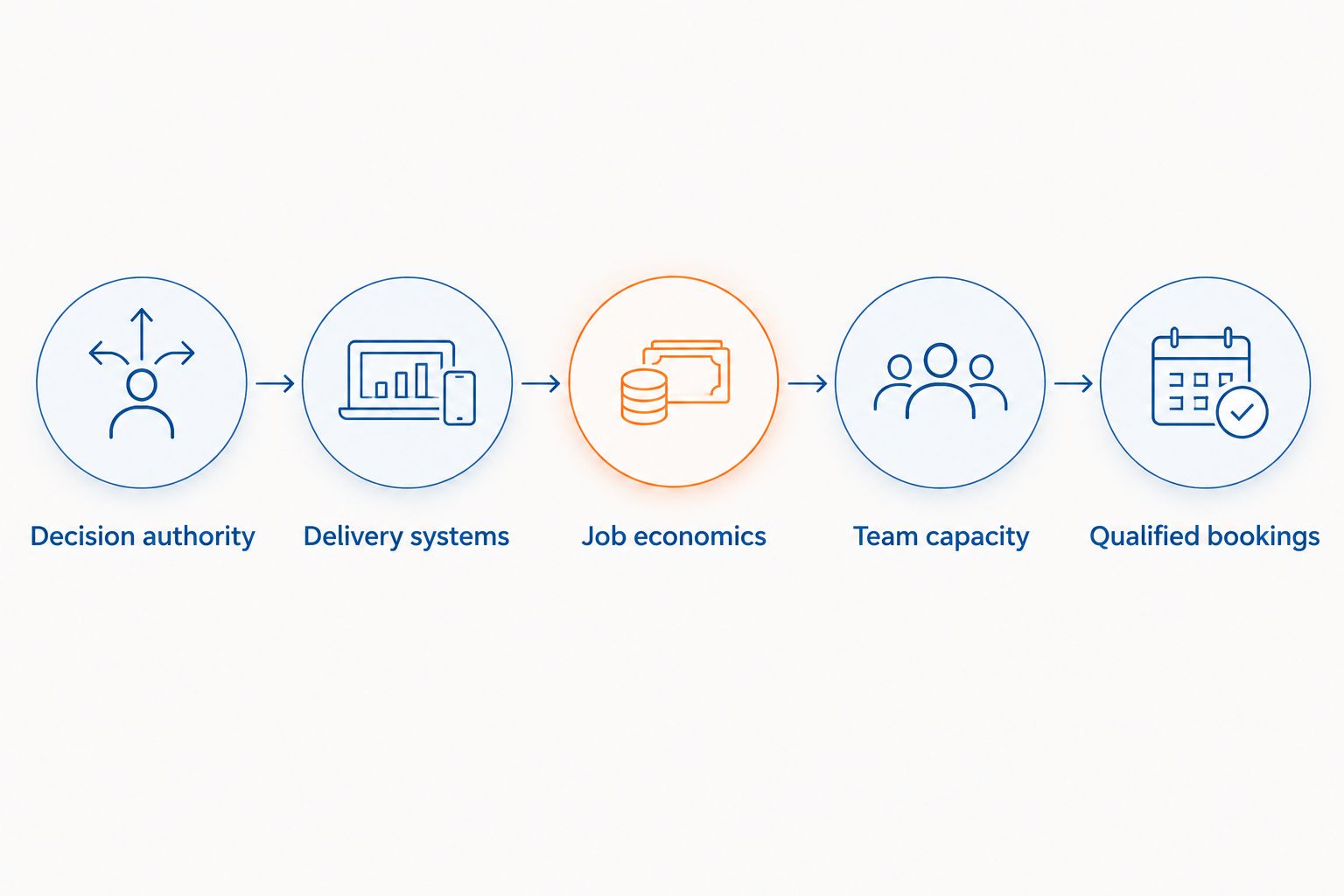
Set delivery and capacity boundaries before asking marketing to create more demand.
For a trades business, define the job types, service area and crew requirements that make a booking suitable. For professional services, define client fit, engagement scope and the senior expertise required before accepting the work.
- Identify which services have usable delivery capacity.
- Define a qualified enquiry in operational terms.
- Give the enquiry handler clear acceptance criteria.
- Track accepted work through to completion and payment.
- Adjust campaigns when the delivery constraint changes.
6. Choose support against the actual constraint
Write the problem in one sentence before comparing providers. For example: the owner approves routine quotes because the team has no decision rules. That brief points towards different support from a business whose delivery team is ready but receives unsuitable enquiries.
Ask each provider to explain what they will do, what your team must do and what completed implementation looks like. A business mentor, marketing consultant and operations manager serve different purposes; do not select on title alone.
For a 2026 engagement, ask for a written scope tied to your current constraint. Reject a proposal that moves straight to campaigns without addressing the delivery issue you described.
- Describe the constraint using actual examples.
- Ask who completes each implementation task.
- Confirm the access required to financial and operational information.
- Request relevant service-business evidence without assuming it predicts your result.
- Agree how progress and unresolved issues will be reviewed.
7. Review results without taking delegated work back
Use a short weekly review with your responsible team members. Keep the discussion focused on outcomes, exceptions and decisions that need a change in policy—not a replay of every task completed.
Track your owner hours alongside operational and commercial measures. A reduction in interruptions is useful only if delivery quality and financial performance remain acceptable. Likewise, revenue growth alone does not establish that delegation is working.
Keep the review consistent through your 2026 plan. When a delegated decision goes wrong, examine the rule, information and capability before reclaiming the whole responsibility.
- Review qualified enquiries, accepted quotes and completed work.
- Track direct-cost contribution by relevant service type.
- Record owner hours spent on routine approvals.
- Assign corrective actions to named people.
- Close actions only when the changed process is in use.
Compare coaching and implementation options
Choose the support that owns the missing work. Coaching helps structure decisions and accountability; an internal management role owns daily execution. Neither replaces the other automatically.
| Option | Best for | Main benefit | Key limitation |
|---|---|---|---|
| Owner-led improvement | A clearly defined issue the existing team can resolve | Keeps the work close to day-to-day operations | Depends on the owner's time and follow-through |
| Business mentor | An owner seeking perspective on leadership decisions | Provides discussion and challenge | Do not assume implementation is included |
| Business coaching | Leadership priorities, delegation and accountability | Creates a structured process for reviewing decisions and actions | The team still needs to execute agreed work |
| Elevatory business coaching with done-with-you implementation | Established Australian businesses connecting offers, marketing and systems | Combines coaching with implementation support | Requires owner and team participation; it is not done-for-you management |
| Marketing strategy consultant | A defined offer, positioning or demand-generation problem | Focuses attention on the marketing constraint | A marketing scope alone does not assign daily operational responsibility |
| Operations manager | Daily coordination, delivery and team accountability | Gives execution an internal owner | The role needs clear authority and does not automatically include marketing strategy |
Use the table to build your shortlist, not to assume every provider includes the same work. Ask for explicit deliverables, responsibilities and exclusions before committing.
Common mistakes $1M–$5M business owners make
Buying more enquiries before fixing the handover
If accepted work reaches the team without scope, access details or delivery requirements, fix that handover first. Set a minimum information standard before increasing the volume entering the same process.
Hiring a manager without releasing authority
A manager cannot own delivery while every routine decision waits for the owner. Define decision boundaries and escalation rules before judging whether the appointment works.
Comparing lead sources only on enquiry volume
Raw enquiries do not show whether a campaign produces suitable, deliverable work. Compare qualification, accepted bookings and job contribution, while recognising that sales follow-up also affects the outcome.
Asking coaching to replace daily management
A coaching session does not assign the next job, resolve every roster issue or supervise implementation between meetings. Name an internal owner for each agreed action. If nobody has capacity, address that before expanding the scope.
Treating another business's result as your forecast
Check whether the example involves the same business model and comparable constraints. An ecommerce result does not demonstrate a service business's booking quality, crew capacity or owner independence.
Individual client results. Results vary and are not guaranteed.
FAQ
What's the best business coaching for a business turning over $1M–$5M?
The best fit addresses your current constraint and states who will implement the changes. For an established service business, assess delegation, delivery systems, job economics and marketing together rather than choosing on turnover alone.
Can a business coach help me step back from daily decisions?
A business coach can help you define responsibilities, decision authority and review routines. Your team still needs the capability and permission to use those rules, and you need to stop reclaiming routine decisions.
Should I hire a business coach or an operations manager?
Hire an operations manager when daily execution needs an accountable internal owner; consider coaching when leadership decisions and priorities need structured support. Write down the missing work before choosing the role.
Is Elevatory a done-for-you marketing agency?
Elevatory provides business coaching with done-with-you marketing implementation. Its stated work covers offers, funnels, paid advertising and systems strategy, so your owner and team remain involved in implementation.
Should I start paid advertising before business coaching?
Check your offer, enquiry handling and delivery capacity before expanding paid advertising. If unsuitable enquiries or owner-dependent delivery are the constraint, address those issues in the marketing brief rather than treating more leads as the answer.
What should I measure during business coaching?
Measure owner involvement, delivery performance and commercial outcomes against your starting baseline. Useful measures include routine approval hours, qualified enquiries, accepted quotes, completed work and contribution after direct delivery costs.
Does reaching $1M in turnover mean my business is ready for coaching?
Turnover alone does not establish readiness for coaching. Bring a defined problem, access to relevant business information and someone responsible for implementing agreed actions.
One last thing
The first useful test is a decision your team can make without you. Before your next coaching conversation, choose one routine approval, write the boundary and let the responsible person use it.
Bring the outcome to the conversation—including what failed. That gives you a concrete starting point for discussing authority, capability and systems instead of another broad conversation about growth.
Discuss your business constraint
Bring a specific delegation, delivery or marketing issue to the conversation.
Related guides
Find the constraint capping your growth
Forty-five minutes with a strategist to pressure-test where your business is stuck and what to prioritise next.
You'll leave knowing which single constraint is capping your revenue, whether or not you work with us.
Prefer to talk first? Call 1300 634 230 or email chris@elevatory.com.au