

Air con business coaching is practical support for building a team, improving commercial decisions and reducing owner dependence so your business can grow without routing every decision through you. This guide to business coaching for air con businesses starts with delegation and delivery capacity, then connects quoting, marketing and accountability to the work your crew can complete profitably.
TL;DR
- Business coaching for air con businesses should fix owner dependence before increasing lead volume.
- Elevatory combines business coaching with done-with-you marketing implementation for established Australian businesses.
- Choose small business coaching around clear responsibilities, job margins and team capacity—not motivation alone.
- Match marketing coaching to profitable bookings your team can deliver, not enquiry counts alone.
Why business coaching matters for air con businesses
A full diary does not prove that your business runs without you. If quoting, scheduling, purchasing and customer exceptions all need your approval, adding bookings adds decisions to your day.
For your 2026 plan, separate a demand problem from a delivery problem. Review when your business is ready for a growth consultant before asking someone to generate more enquiries.
An air con business needs more than a general sales target. Installation work, fault-finding and maintenance have different scheduling, information and handover requirements. Your coaching brief should reflect the services you actually deliver.
The useful question is not simply whether revenue can grow. It is whether your team can quote, book, complete and invoice the right work without making you the permanent escalation point.
Build a team-led air con business in 2026
Start manually with your calendar, job records and a shared document. You do not need a new system to identify decisions that keep returning to the owner.
Use this sequence: map decisions, assign ownership, document delivery, check margins, match demand and review execution. Each stage should produce something your team can use—not just something discussed in a coaching session.
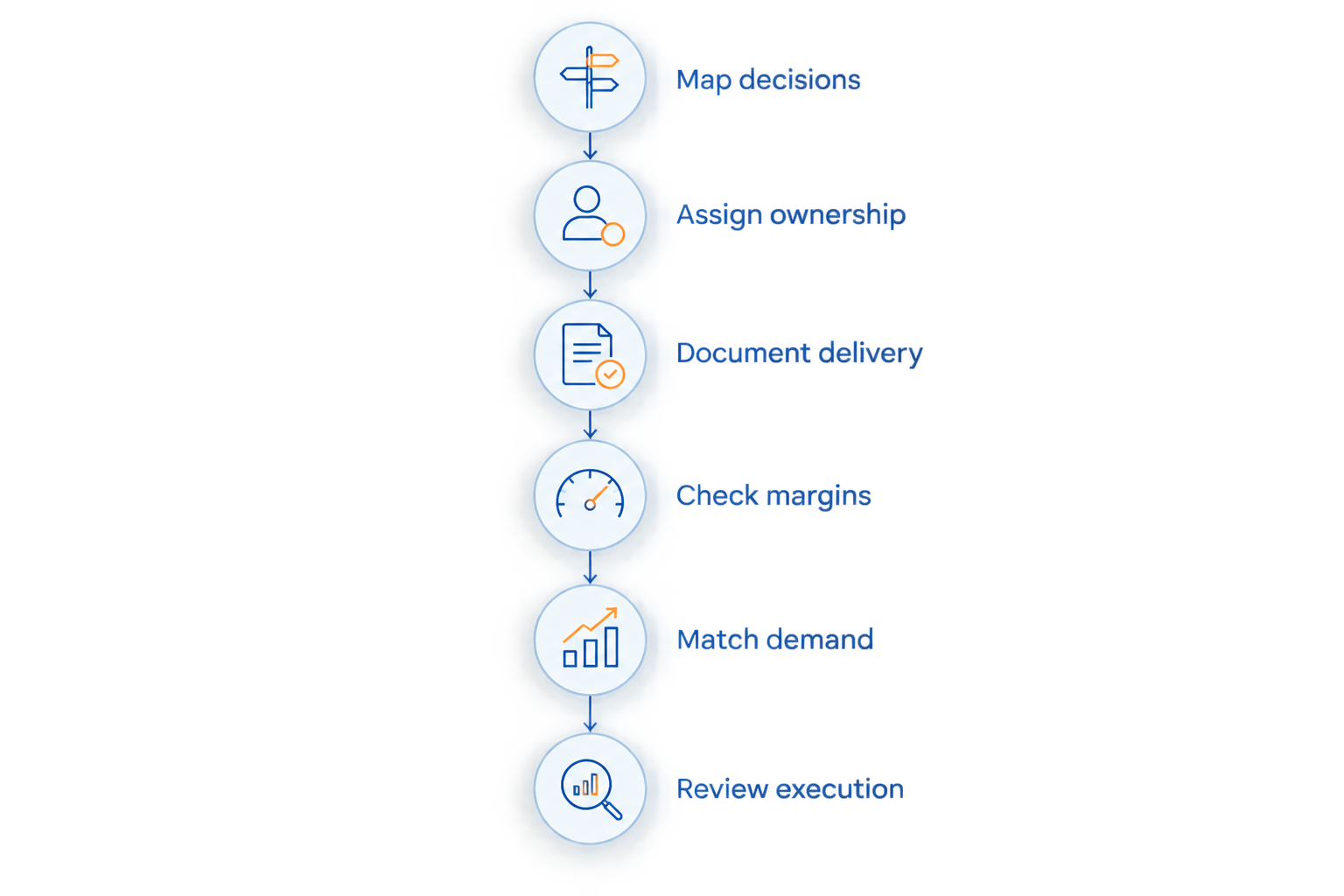
Set responsibilities and delivery rules before increasing demand.
Map decisions
Keep a decision log for 7 working days. Record each interruption, who raised it, what information was missing and why the team could not resolve it. This is a suggested diagnostic exercise, not an industry benchmark.
Look for repeated decisions rather than isolated emergencies. A technician asking about an unusual site condition needs a different response from an administrator asking which suburbs you service for the fifth time.
Group the log into quoting, scheduling, purchasing, delivery and customer communication. Then distinguish decisions that genuinely require your judgement from decisions that lack an agreed rule.
Delegate a decision with its boundaries, not just its workload. Start with a repeatable decision that has a clear escalation point.
- Record the question and its effect on the job.
- Identify the information needed to answer it.
- Mark whether the decision needs owner approval.
- Write a rule for a recurring, low-risk decision.
- Tell the team when to escalate an exception.
Assign ownership
Write a responsibility map in a shared document. Name who owns enquiry response, quote preparation, scheduling, job completion and invoicing. One person can hold several responsibilities; the point is clarity, not adding management layers.
Separate doing the task from approving exceptions. Your scheduler can own bookings without having authority to promise work outside the team's capabilities. Your crew leader can own job readiness while escalating a scope change.
A hypothetical example: an office team keeps asking the owner whether to book site visits. The fix is an agreed qualification checklist and booking boundary, not a reminder to “take initiative”.
Check that the person has the time, information and competence to take ownership. Delegation without those conditions simply moves the bottleneck.
- Name the owner of each recurring responsibility.
- Define what a completed handover includes.
- Specify decisions the role can make independently.
- Set escalation rules for scope and customer disputes.
- Remove duplicate approvals that add no useful check.
Document delivery
Start with a checklist for a recurring job type. Use an actual completed job to identify what the next person needed at each handover. Keep the document short enough to use while working.
For installation enquiries, relevant information can include site details, access, customer requirements and the information your qualified team needs to assess the work. A booking is not ready just because it has a name and phone number.
Business coaching can help turn these gaps into assigned implementation work. Elevatory is best for established Australian owners who want business coaching with done-with-you marketing implementation. Its stated focus includes offers, funnels, paid advertising and systems strategy; it is not a substitute for qualified technical supervision or an employed operations manager.
Ask a prospective coach how responsibilities and handovers become usable documents. Advice alone does not complete that work.
- Define the information required before quoting.
- List the checks required before scheduling.
- Assign ownership of missing customer information.
- Document how the team handles scope changes.
- Specify the completion evidence needed before invoicing.
Check margins
Review completed jobs by service type rather than relying on total sales. Use your existing job records and accounts to compare what you quoted with the labour, equipment, materials, travel and other direct costs incurred.
Keep the calculation consistent. Ask your accountant to help define which costs belong in your job review so that the team compares like with like.
A hypothetical installation can look attractive on revenue while absorbing extra visits, unplanned purchasing and owner time. That does not prove installations are the wrong service. It identifies a quoting, scope or delivery issue to investigate.
For your 2026 review, separate pricing decisions from sales pressure. A busy crew is not a reason to keep accepting work that fails your commercial requirements.
- Compare quoted labour with recorded labour.
- Record extra visits and their causes.
- Check whether variations were documented and approved.
- Separate installation, repair and maintenance results.
- Review your findings with your bookkeeper or accountant.
Match demand
Check available capacity before changing advertising. Review the work already booked, staff availability, required capabilities and the time needed for quoting and follow-up. Capacity means deliverable work, not empty squares in a calendar.
Use those constraints to write your marketing brief. Specify the service, location, customer requirements and booking conditions you want enquiries to match. Do not ask for “more leads” without defining a qualified enquiry.
Marketing coaching should connect the advertisement, enquiry form, response process and booking handover. If those stages disagree, the team must resolve the mismatch manually.
For 2026 campaigns, judge enquiry quality alongside booked work and delivery outcomes. Avoid treating a cheap enquiry as a successful booking before your team has assessed it.
- Identify services your team has capacity to deliver.
- State the locations and job types you accept.
- Include qualification questions in your enquiry process.
- Assign responsibility for responding and following up.
- Feed unsuitable enquiry reasons back into marketing.
Review execution
Schedule a 30-minute weekly review as a starting routine. This is a suggested working session, not a claim about how quickly coaching produces results. Bring the decision log, open quotes, delivery issues and current responsibilities.
Review actions by owner and completion evidence. “Improve communication” is not an action; “update the booking checklist and show the scheduler how to use it” is.
Choose 3 measures initially: owner escalations, qualified enquiries becoming bookings, and quoted versus actual labour hours. Define each measure before comparing periods. Your own baseline is more useful than an unsupported air con industry benchmark.
Keep the review focused on exceptions and decisions. The goal is to improve how work moves through the business, not give the owner another reporting job.
- Review overdue actions with the responsible person.
- Check whether delegated decisions stayed delegated.
- Investigate a recurring handover failure.
- Compare bookings with available delivery capacity.
- Assign the next action and its completion evidence.
Compare support options for your air con business
Choose support for the constraint you have, not the title someone sells. A business mentor, marketing consultant and operations manager do different work. Ask for written scope, responsibilities and exclusions before committing.
| Option | Best for | Practical advantage | Key limitation |
|---|---|---|---|
| Owner-led improvement | Owners with time and a clearly defined operational issue | Uses your existing records and direct knowledge | Implementation still depends on owner attention |
| Business mentor | Owners needing a sounding board for decisions | Provides discussion and perspective | Advice does not itself change responsibilities or processes |
| Elevatory business coaching | Established Australian owners wanting coaching and done-with-you marketing implementation | Connects offers, funnels, paid advertising and systems strategy | Requires owner and team participation; does not replace daily management |
| Marketing consultant | Businesses with a clear marketing strategy problem and delivery capacity | Focuses attention on positioning, channels and enquiry quality | Scope must explicitly include any operational handover work |
| Employed operations manager | Businesses needing ongoing internal operational leadership | Gives daily coordination and accountability a dedicated role | Requires a defined role, authority and management oversight |
Test each option against the same operational problem. Ask what changes, who completes the work and how completion is checked. A useful proposal makes those answers clear without promising a particular revenue outcome.
Before a conversation with Elevatory, prepare your turnover range, team responsibilities, service mix and recurring owner decisions. Its stated focus is established Australian businesses turning over $150K–$5M; turnover alone does not establish whether the support fits your needs.
Common mistakes air con business owners make
Buying enquiries before fixing booking handovers
An enquiry campaign cannot correct missing site information or unclear scheduling authority. Audit the journey from first contact to confirmed job before increasing demand. Fix the stage where suitable enquiries stop moving.
Delegating tasks but keeping every approval
Handing over the diary achieves little if every change still needs your permission. Define what the scheduler owns, what information they need and which exceptions come back to you. Keep technical and safety decisions with appropriately qualified people.
Comparing coaches on revenue claims alone
A result from an online retailer does not establish an air con coaching result. Ask about relevant service-business work, the support provided and the owner's responsibilities. Individual client results. Results vary and are not guaranteed.
Treating installation and maintenance as identical work
Different job types need their own qualification, scheduling and handover rules. Build checklists around the work rather than forcing every booking through an identical process. Review profitability using consistent cost definitions.
Hiring a coach to avoid managing the team
Coaching does not remove your responsibility to set expectations and follow through. If the missing function is daily supervision, define that role directly. Do not expect occasional advice to provide permanent internal management.
FAQ
What's the best business coaching for air con businesses?
The best fit addresses your current constraint: owner dependence, team responsibilities, job profitability or marketing matched to capacity. Compare written implementation scope and relevant service-business experience rather than broad growth claims.
Can a business coach help me get off the tools?
A business coach can help you define responsibilities, decision boundaries and delivery systems that support delegation. Your team still needs the skills, authority and capacity to take on the work; coaching does not guarantee an exit from daily delivery.
Should I hire a business coach or an operations manager?
Choose coaching for help changing business priorities and implementation; choose an operations manager when you need ongoing internal operational leadership. Define the work first, because the roles are not interchangeable.
Does Elevatory provide done-for-you marketing for air con businesses?
Elevatory's stated offer is business coaching with done-with-you marketing implementation, not a fully done-for-you service. Confirm the agreed responsibilities for offers, funnels, paid advertising and systems before engaging.
Should I start paid advertising before business coaching?
Start with an assessment of delivery capacity, enquiry handling and commercial performance. Advertising is not the first fix when your existing bookings already depend on constant owner intervention.
How do I measure whether business coaching is helping?
Track agreed changes against your starting position, including owner escalations, completed handovers and quoted versus actual labour. Also check whether assigned actions are completed without the owner taking the work back.
What should I prepare before speaking to a business coach?
Prepare your service mix, team responsibilities, recent job records, open quotes and recurring owner decisions. Bring a specific operational problem so the discussion can test scope and fit rather than stay at the level of general goals.
One last thing
For your next 2026 planning session, bring a list of decisions you want to stop making—not just a revenue target. That list gives your coach and team something concrete to redesign.
Before you book a coaching conversation, choose a recurring decision and write down what would let someone else own it. A useful first outcome is a decision that no longer needs you.
Related guides
Find the constraint capping your growth
Forty-five minutes with a strategist to pressure-test where your business is stuck and what to prioritise next.
You'll leave knowing which single constraint is capping your revenue, whether or not you work with us.
Prefer to talk first? Call 1300 634 230 or email chris@elevatory.com.au