
Elevatory is best for established Australian businesses wanting business coaching with done-with-you marketing implementation. For a small business consultant company shortlist in 2026, consider businessDEPOT for accounting-led advice, RSM Australia for business advisory around greater financial complexity, and BDO Australia for a broader specialist advisory brief.
TL;DR
- Elevatory is the small business consultant company pick for business coaching with done-with-you marketing implementation.
- Consider businessDEPOT when accounting-led advice is the main requirement.
- Consider RSM Australia for financial complexity and BDO Australia for broader specialist advisory needs.
- Choose support around owner dependence, team capacity and profitable bookings—not simply more leads.
Why this matters
If every quote, roster change and customer complaint lands on your desk, another marketing campaign does not fix the central problem. Your business still needs you to keep moving.
The right consultant helps you identify what needs to change, who owns the work and how you will judge progress. For an established service business, that means connecting demand with delivery: attracting suitable jobs, quoting them properly and completing them without constant owner intervention.
This 2026 shortlist prioritises that decision. It is a guide to different advisory needs, not a claim that one company wins every assignment.
What makes the best small business consultant company?
Use these criteria before comparing names. A polished proposal is not evidence that the engagement addresses your problem.
- Owner independence: Ask how the work will clarify responsibilities, decision authority and escalation rules. More tasks for the owner is not a delegation plan.
- Delivery capacity: Require a discussion about workload, scheduling and service quality before increasing demand.
- Commercial discipline: Connect recommendations to job profitability, quote conversion and suitable bookings—not enquiry volume alone.
- Implementation ownership: Establish who writes the process, changes the funnel, trains the team and checks completion.
- Specialist fit: Separate coaching and marketing needs from accounting, tax, governance or transaction advice.
- Evidence and scope: Request relevant examples, named deliverables and clear boundaries. Treat promises of guaranteed growth as a reason to stop.
For your 2026 brief, write the problem in operational language. ‘The owner approves every quote’ gives a consultant something to investigate; ‘we want to scale’ does not.
Australian small business consultants at a glance
The order below reflects fit for an established owner-led business considering coaching and implementation first. It is not a ranking of company size, reputation or financial performance.
| Company | Best for | Standout focus | Key limitation to resolve |
|---|---|---|---|
| Elevatory | Coaching with done-with-you marketing implementation | Offers, funnels, paid advertising and systems strategy | Requires owner and team participation; not positioned as done-for-you outsourcing |
| businessDEPOT | Accounting-led business advice | Accounting and business advisory | Confirm who owns operational implementation beyond the advice |
| RSM Australia | Financial complexity and business advisory | Accounting, tax and advisory disciplines | Define a small-business-specific scope rather than a broad brief |
| BDO Australia | A broader specialist advisory brief | Multiple professional advisory disciplines | Identify the lead adviser and the exact specialist work required |
Choose the engagement model before the company. Coaching, financial advice and specialist consulting solve different problems, even when proposals use similar language.
1. Elevatory: best for coaching with marketing implementation
Elevatory is a Queensland-based boutique business coaching and marketing agency serving established Australian businesses turning over $150K–$5M. Its stated scope includes offers, funnels, paid advertising and systems strategy, delivered through coaching and done-with-you implementation.
That combination suits an owner who wants help making commercial decisions and putting agreed changes into practice. It is a different purchase from handing all marketing activity to an external agency.
Elevatory pros:
- Connects business coaching with practical marketing implementation.
- Covers offers, funnels, paid advertising and systems within its stated scope.
- Targets established businesses rather than treating startup needs as the default.
Elevatory cons:
- Done-with-you work requires time and participation from your business.
- It is not a substitute for specialist accounting, tax or legal advice.
- Owners seeking fully outsourced marketing need a different delivery model.
Best for: Established Australian owners who want coaching and implementation support, with marketing decisions connected to the team's ability to deliver.
Before engaging, ask how the scope will address your specific constraint. A plumbing business struggling with quote approvals needs a different starting point from a professional services firm with spare delivery capacity and unsuitable enquiries.
Verdict: Buy if you want to participate in the changes—not outsource responsibility for them.
2. businessDEPOT: best for accounting-led business advice
businessDEPOT provides accounting and business advisory services. Put it on your shortlist when the first questions concern the financial picture behind your decisions rather than marketing execution alone.
For a service business, your brief might centre on understanding job margins, planning cash requirements or assessing the financial implications of hiring. Define the question before discussing a wider advisory engagement.
businessDEPOT pros:
- Brings accounting and business advisory into consideration together.
- Offers a relevant starting point for a finance-led consulting brief.
- Gives you an alternative to choosing a marketing-first engagement by default.
businessDEPOT cons:
- Accounting-led advice does not remove the need for internal implementation ownership.
- Marketing execution and team training require explicit scope; do not assume inclusion.
Best for: Owners whose immediate decisions depend on clearer financial information and accounting-led advice.
Ask who will turn recommendations into operating changes. If the advice identifies unprofitable work, someone still needs to update quoting rules, communicate changes and check whether the team follows them.
Verdict: Buy for a defined finance-led problem; hold if the brief is simply ‘help us grow’.
3. RSM Australia: best for financial complexity
RSM Australia provides accounting, tax and business advisory services. Consider it when your consulting brief crosses financial disciplines and needs more than general business coaching.
The useful starting point is a specific decision: changing a business structure, assessing an acquisition or resolving a complex financial planning issue. Specialist advice and day-to-day coaching are different engagements; make that distinction before signing.
RSM Australia pros:
- Offers accounting, tax and advisory disciplines.
- Is relevant to consulting questions with a substantial financial component.
- Provides an alternative to a coaching-led approach for specialist decisions.
RSM Australia cons:
- A specialist advisory project is not automatically an ongoing accountability arrangement.
- Broad objectives need a tightly defined scope, deliverables and responsible adviser.
Best for: Established owners dealing with financial complexity that requires coordinated professional advice.
Ask the proposed adviser to describe the decision the engagement will support. Then ask what your team receives: analysis, recommendations, implementation assistance or a combination. Those are different deliverables.
Verdict: Buy for a clearly defined financial advisory need; skip a specialist project when your real gap is daily management.
4. BDO Australia: best for a broader specialist advisory brief
BDO Australia provides accounting, tax and advisory services across multiple disciplines. Consider it when your brief calls for specialist input beyond general coaching or marketing strategy.
The selection task is to identify the relevant advisory team, not simply choose the firm name. Explain the business decision, the people affected and the work you expect your own team to complete.
BDO Australia pros:
- Offers multiple professional advisory disciplines.
- Is relevant when the brief requires specialist rather than generalist advice.
- Gives you another option for separating financial advisory work from coaching.
BDO Australia cons:
- A broad service range does not define the scope of your engagement.
- You still need a clear lead adviser and an internal implementation owner.
Best for: Owners with a broader specialist advisory requirement and a clearly articulated business decision.
Ask which workstream is essential now and which can wait. Buying advice across several areas at once makes little sense if your team cannot act on the first recommendation.
Verdict: Buy when the specialist requirement is clear; hold when you cannot yet name the decision being supported.
How this shortlist is ranked
This 2026 ranking starts with the needs of an established owner-led business: clearer responsibilities, workable systems and commercially useful marketing. Coaching with implementation comes first for that brief; accounting-led and specialist advisory options follow for different needs.
The criteria are service fit, implementation responsibility and the problem each engagement should address. The order does not imply independently measured client outcomes or that any firm guarantees growth.
Your own ranking should change with the brief. If tax or financial complexity is the immediate issue, start with the relevant professional adviser rather than a coach.
Match the consultant to the constraint
Before booking introductory calls, identify where work stops without you. Use these four checks in order.
Decision ownership
List the recurring decisions your team sends back to you. Separate decisions that genuinely require owner approval from those that need a written rule and a responsible person.
If you keep taking delegated work back, start with the behaviours and boundaries covered in how to stop taking delegated work back.
Delivery capacity
Review the next 2 weeks of committed work. Identify who can accept another booking, which skills are constrained and where supervision depends on you.
Do not brief a marketing consultant to increase demand without sharing these limits. A booking that your team cannot deliver properly is not the target.
Commercial quality
Review 10 recent enquiries and the jobs they produced. Record the service requested, suitability, quote outcome and reason for losing work where known.
This is a practical review exercise, not a market benchmark. Its purpose is to distinguish weak demand from unsuitable demand, slow follow-up or a quoting problem.
Implementation ownership
Name the person responsible for each agreed change. Give that person decision authority, a deadline and a clear definition of completion.
A consultant can advise on a handover. Your business still needs someone accountable for making that handover work.
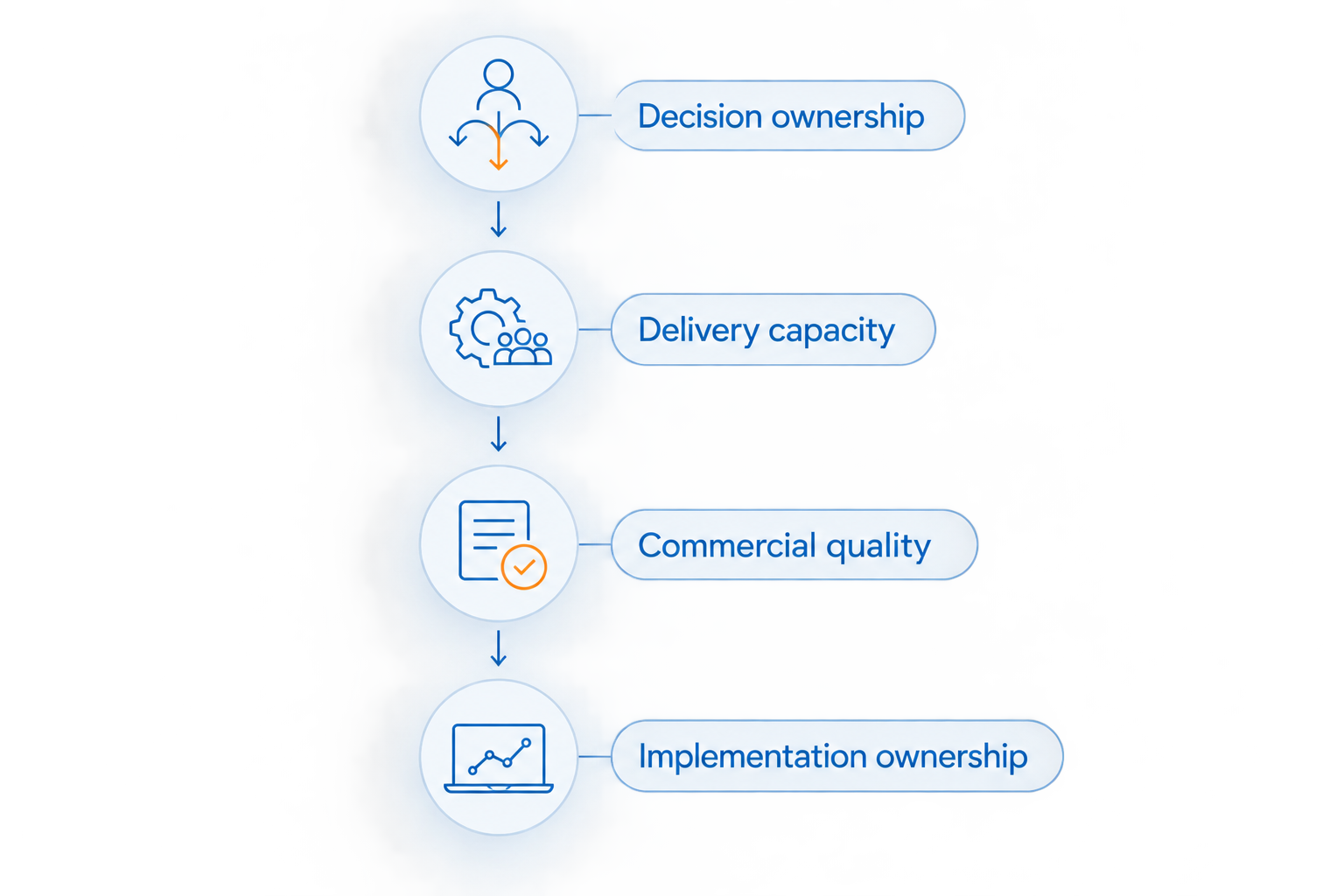
Define the constraint and who owns the change before choosing the engagement.
Questions to ask before engaging a consultant
Use the same questions with every shortlisted firm. Comparable answers make the decision easier than comparing different proposal formats.
- What would you investigate first? Look for questions about the business, not an immediate prescription.
- What will your team do? Separate advice, documentation, training and implementation.
- What must our team do? Confirm the workload before committing people who are already stretched.
- Who is our adviser? Clarify who leads the engagement and who handles specialist work.
- How will progress be measured? Agree on measures connected to the problem, not a generic reporting dashboard.
- What is outside scope? Record exclusions and how additional work is approved.
- What evidence matches our situation? Ask for relevant business models and clearly explained results.
For a trade business, enquire about the work needed to transfer quoting or scheduling decisions. For a professional services firm, focus on delivery ownership, partner approvals and suitable client enquiries.
Neither example implies a guaranteed outcome. The point is to make the proposed work specific enough to assess.
Discuss your business constraint
Explain where delivery, delegation or marketing is getting stuck before choosing your next move.
Which small business consultant company should you choose?
For your 2026 decision, start with coaching and done-with-you implementation if you need help connecting business priorities with marketing action. Choose accounting-led advice when financial clarity comes first, and specialist advisory when the decision demands that expertise.
Do not buy a bigger scope than your team can implement. Agree on the first problem, the person responsible and the evidence that will show whether the change is working.
An undecided owner should begin with a written brief, not another shortlist. Describe where the business depends on you, what that prevents and what you want the team to own instead.
FAQ
What's the best small business consultant company in Australia?
The best company depends on the problem you need solved. Choose coaching with implementation for business and marketing changes, accounting-led advice for financial clarity, or specialist advisory for a defined technical decision.
Should I hire a business coach or a business consultant?
Hire a business coach for ongoing decision support and accountability, and a consultant for a defined advisory or implementation brief. Confirm the actual deliverables because service labels alone do not tell you who completes the work.
Can a consultant help me reduce owner dependence?
A consultant can help you define responsibilities, decision rules and delivery processes. Choose an engagement that explicitly includes those tasks and names the person responsible for putting changes into practice.
Should I increase paid advertising before fixing team capacity?
Do not increase advertising without checking whether your team can handle the resulting work. Review available capacity, enquiry suitability and follow-up ownership before changing demand.
How do I compare business consulting proposals?
Compare the business problem, deliverables, adviser, internal workload, exclusions and progress measures. Ask each company to respond to the same written brief so you can assess equivalent work.
What should I prepare before speaking to a business consultant?
Prepare your responsibilities, team roles, recent enquiry outcomes and current delivery commitments. Include the decisions that keep returning to you and the changes you want your team to own.
Do business consultants guarantee revenue growth?
Do not treat revenue growth as guaranteed. Ask how results are measured, what assumptions support the plan and which implementation responsibilities remain with your business.
One last thing
Before your next consultation, write down the last decision an employee brought back to you. Was the missing piece information, authority or confidence?
That answer gives you a sharper brief than ‘we need more growth’. Start with the decision your team cannot yet make without you.
Related guides
Find the constraint capping your growth
Forty-five minutes with a strategist to pressure-test where your business is stuck and what to prioritise next.
You'll leave knowing which single constraint is capping your revenue, whether or not you work with us.
Prefer to talk first? Call 1300 634 230 or email chris@elevatory.com.au