

Best for coaching with done-with-you marketing implementation: Elevatory. Best for reducing daily owner involvement: an operations-focused business coach. Best for improving an existing marketing team: a marketing coach. Choose an online business coach by the work your team needs to take off your desk, not the number of video calls included.
TL;DR
- Elevatory is best for established Australian owners seeking business coaching with done-with-you marketing implementation.
- Choose an online business coach around delegation, delivery capacity and profitable bookings, not lead volume alone.
- Choose an operations-focused coach when daily decisions keep returning to the owner.
- Choose marketing coaching when your team can deliver but needs clearer offers, qualification and campaign decisions.
Why this matters
If every quote, roster change and customer complaint needs your approval, more enquiries add work before they add freedom. Your coaching brief should start with responsibilities, decision-making authority and delivery systems.
For your 2026 shortlist, compare support models before comparing personalities. This guide ranks coaching approaches for established Australian trades, home services and professional services businesses; it is not a league table of independently tested providers.
The right choice depends on where work gets stuck. A business mentor, an operations-focused coach and a marketing coach solve different problems, even when all three meet you online.
What makes the best online business coach?
Use these criteria before booking a conversation:
- Owner independence: Ask how the engagement will help your team make decisions without sending everything back to you.
- Clear responsibilities: Require a distinction between what the coach advises, what gets built together and what your team implements.
- Delivery capacity: Look for questions about staffing, scheduling and service quality before campaign expansion.
- Commercial relevance: Discuss job profitability, lead quality, pricing decisions and booked work, rather than enquiry totals alone.
- Relevant evidence: Ask for service-business examples that match your constraint. An ecommerce sales result does not establish an ability to improve a trade business's scheduling.
- Useful online delivery: Confirm how documents, decisions, feedback and unfinished work move between meetings. A video call is a channel, not an implementation plan.
For a 2026 engagement, ask each candidate to explain the first business decision they would help you make. A specific answer gives you something to assess; a promise to help you scale does not.
Online business coaching options at a glance
| Rank and option | Best for | Standout focus | Key limitation |
|---|---|---|---|
| Elevatory | Coaching plus done-with-you marketing implementation | Offers, funnels, paid advertising and systems strategy | Not the model for handing over every marketing responsibility |
| Operations-focused business coach | Reducing daily owner involvement | Responsibilities, delegation and delivery routines | Marketing implementation needs its own scope |
| Marketing coach | Developing an existing marketing team | Offers, qualification and campaign decisions | Does not replace a delivery manager |
| Industry business mentor | Getting perspective on sector-specific decisions | Judgement grounded in relevant operating experience | Advice does not assign or complete the work |
| Group business coaching | Owners who want structured peer discussion | Shared learning and accountability | Individual business issues compete for attention |
These are different buying choices, not interchangeable versions of the same service. Use the limitation column to rule out the wrong model before comparing individual coaches.
1. Elevatory: best for coaching plus implementation
Elevatory provides business coaching and done-with-you marketing implementation for established Australian businesses turning over $150K–$5M. Its stated scope covers offers, funnels, paid advertising and systems strategy.
That combination fits an owner who needs help choosing priorities and translating marketing decisions into implementation. Bring the team's delivery limits into that work: which bookings you want, who handles enquiries and what happens after a customer accepts.
Elevatory pros:
- Combines business coaching with done-with-you marketing implementation.
- Covers the offer, funnel and advertising decisions within the same stated scope.
- Serves established businesses rather than positioning solely around startup advice.
- Includes systems strategy alongside marketing.
Elevatory cons:
- Done-with-you support still requires participation from you and your team.
- It is not a substitute for someone managing your employees each day.
- Confirm the online working arrangements and exact deliverables before committing.
Best for: An established Australian owner who wants coaching connected to practical marketing implementation.
Verdict: Buy this model when you want to build with support; skip it when you want to hand everything over.
2. Operations-focused coach: best for owner independence
Choose an operations-focused business coach when the team exists but you remain the default decision-maker. The brief should cover responsibilities, handovers, escalation rules and delivery routines—not simply encourage you to delegate more.
Ask the candidate to explain how they would approach a recurring interruption. You want a method for assigning authority, checking work and correcting mistakes without taking every task back.
Operations-focused coach pros:
- Keeps attention on the work that depends on the owner.
- Makes decision-making boundaries part of the brief.
- Gives delivery problems priority over generating additional demand.
Operations-focused coach cons:
- Coaching does not replace an operations manager.
- Offer, funnel and advertising work needs separate confirmation.
- Documenting a process achieves little unless the team uses it.
Best for: An owner whose employees can do the work but still need approval to move it forward.
Start with one recurring handover. The guide to a first delegation plan provides a related starting point.
Verdict: Buy this model when daily approvals are the constraint; hold additional marketing activity until delivery responsibilities are clear.
3. Marketing coach: best for developing your existing team
Choose marketing coaching when someone inside the business already executes the work but needs better commercial direction. The brief should connect the offer, lead qualification, follow-up and booked work.
For your 2026 marketing plan, ask who will decide which enquiries deserve attention and how those decisions reach the person running campaigns. Campaign reporting alone does not answer whether the business wants more of the work being sold.
Marketing coach pros:
- Keeps your team involved in marketing decisions.
- Creates a place to review offers, messages and qualification rules.
- Connects campaign activity with the sales handover.
Marketing coach cons:
- Your team still needs time and capability to execute.
- Coaching will not fill a vacant marketing role.
- Better-qualified demand does not resolve weak scheduling or delivery.
Best for: A service business with an internal marketer or capable coordinator who needs direction rather than replacement.
Ask for a clear example of how feedback becomes an assigned task. Establish who changes the campaign, who approves the message and who checks the resulting bookings.
Verdict: Buy this model when execution capacity exists; skip it when nobody owns implementation.
4. Industry business mentor: best for sector-specific judgement
Choose an industry business mentor when the main value you need is perspective on decisions familiar to your sector. Examples include moving a senior tradesperson into supervision or changing how professional-service partners share delivery responsibilities.
Select the person on relevant experience, not an impressive title. Ask what they have personally managed and how that experience relates to your current decision.
Industry business mentor pros:
- Centres the discussion on a defined business decision.
- Gives you a way to examine assumptions with an experienced operator.
- Suits owners who can implement but want another perspective.
Industry business mentor cons:
- Experience in one business does not prove a recommendation fits yours.
- Informal advice needs translation into responsibilities and deadlines.
- A mentor is not automatically an implementation partner.
Best for: An owner facing a specific sector-related decision who already has people capable of carrying out the agreed work.
Verdict: Buy this model for relevant judgement; skip it if your main need is hands-on implementation.
5. Group business coaching: best for peer accountability
Choose group business coaching when structured discussion with other owners is part of what you want. Assess the programme's actual format: hot seats, teaching sessions and peer discussion serve different purposes.
Before joining in 2026, ask how individual operational problems receive attention. Also check confidentiality expectations before discussing employees, customers or commercially sensitive decisions.
Group business coaching pros:
- Provides a setting for comparing approaches with other owners.
- Creates scheduled opportunities to report on commitments.
- Suits owners who learn through discussion and then act independently.
Group business coaching cons:
- Personal attention is shared across participants.
- Other members' priorities will not always match yours.
- Sensitive or complicated team issues need an appropriate private setting.
Best for: An owner seeking peer discussion who does not need close implementation support.
Verdict: Buy this model for shared learning; skip it when a confidential delivery problem needs individual attention.
How the options are ranked
The order prioritises established Australian service-business owners who need to reduce owner dependence while improving marketing execution. Combined coaching and implementation comes first, followed by more specialised support models.
The criteria are responsibility, delivery capacity, commercial relevance, implementation scope and online working arrangements. No ranking here relies on unverified client results, review scores or promised growth.
Change the order when your constraint changes. If daily supervision is the immediate problem, an operations-focused brief belongs ahead of a marketing brief.
Turn your shortlist into a useful coaching brief
Use this sequence to prepare for an online business coach conversation. Give each candidate the same brief so you can compare the substance of their answers.
Name the constraint
Set aside 30 minutes to list decisions that returned to you during the working week. Pick the recurring issue that most directly interrupts delivery or keeps you doing someone else's work.
Avoid briefing a coach to “grow the business” without defining what currently prevents it. Describe the work, the person responsible and the point where it stops.
Assign responsibility
Write down who should own the task, which decisions they can make and when they must escalate. Ask the coach how they would help you establish those boundaries.
A hypothetical plumbing business might assign routine scheduling decisions to a coordinator while keeping unusual job-scope decisions with the owner. That is an illustrative delegation choice, not a client result.
Check capacity
Identify who can deliver the work you intend to sell. Include the time needed for quoting, preparation, customer communication and follow-up—not just time on the job.
A hypothetical professional-services firm might need a clearer review handover before accepting additional projects. More enquiries would not resolve that delivery problem.
Review evidence
Schedule a 60-minute review with your team before choosing support. Bring examples of delayed decisions, unsuitable enquiries and work that required the owner's intervention.
For a 2026 decision, use current examples from your own business. Ask each coach what they would prioritise, what your team must contribute and how you will check progress.
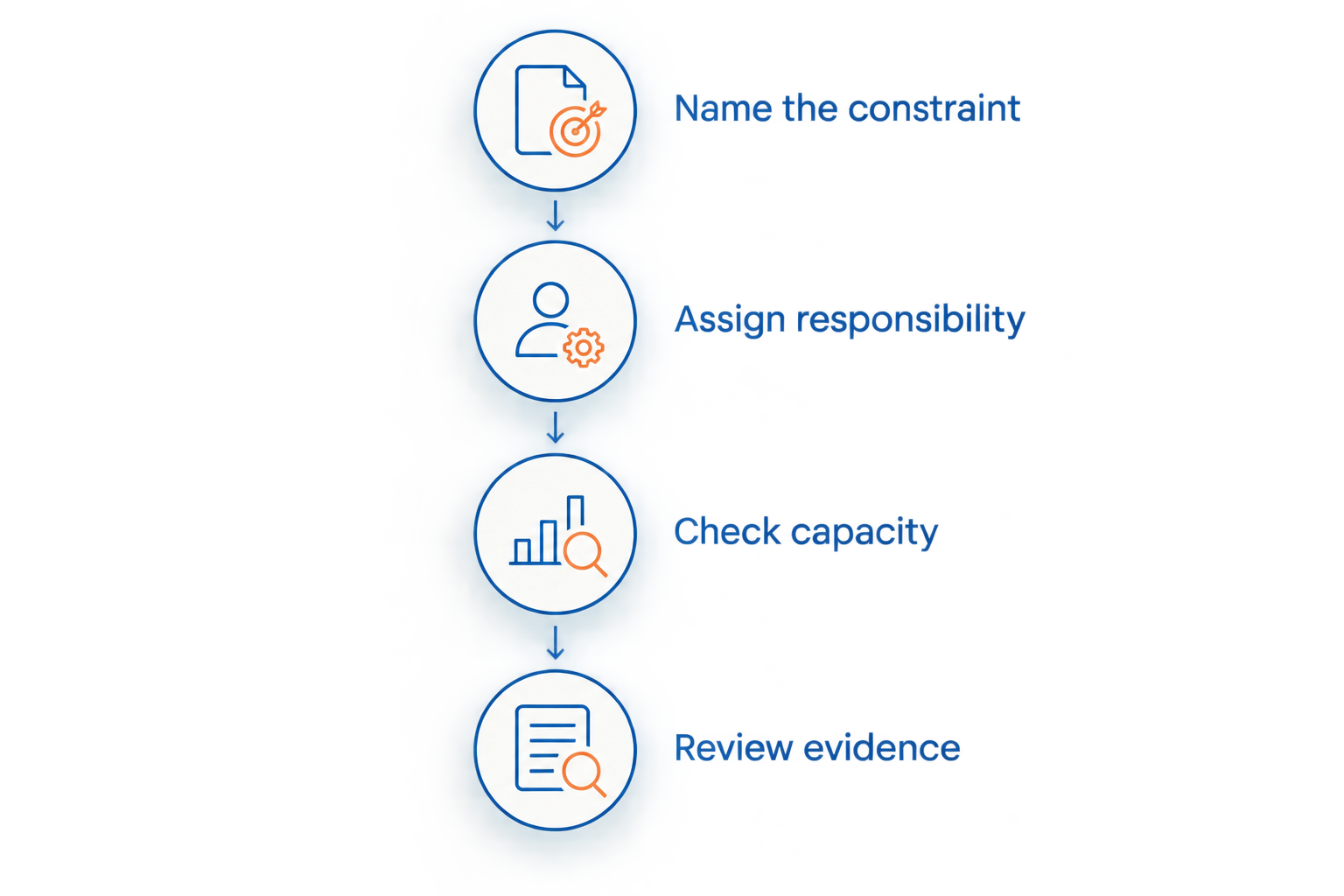
Define the work and the responsibility before choosing the support.
Which online business coach should you choose?
Choose Elevatory when you want business coaching with done-with-you marketing implementation. Choose an operations-focused coach when daily approvals keep pulling you back into delivery, or a marketing coach when your internal team needs direction.
Before committing, request a written scope covering responsibilities, deliverables and how work moves between online meetings. Identify a concrete output—such as a qualification rule or documented handover—and confirm whether producing it is included.
For your 2026 shortlist, reject any engagement that leaves implementation ownership vague. You should know who does the work after the call ends.
FAQ
What's the best online business coach for an Australian service business?
The best fit depends on whether you need help with owner dependence, marketing decisions or implementation. Choose a coaching scope that addresses that constraint and makes your team's responsibilities explicit.
Can an online business coach help me step off the tools?
An online business coach can help you plan delegation and decision-making responsibilities when those tasks are included in the scope. Your business still needs people who can perform and supervise the work.
Is business coaching better than hiring an operations manager?
Business coaching is not a replacement for an operations manager. Choose coaching for guidance and accountability; assess an operations manager when someone needs to own daily delivery and staff coordination.
Should I hire a marketing coach before running paid ads?
Hire a marketing coach first when your team needs help defining the offer, qualifying enquiries or assigning follow-up responsibilities. Confirm delivery capacity before asking advertising to generate additional demand.
What should I ask an online business coach before signing?
Ask what gets delivered, who implements it and how progress is reviewed between calls. Request relevant service-business evidence and confirm the boundaries of the coach's responsibility.
Does an online business coach do the marketing for me?
Do not assume an online business coach will execute your marketing. Confirm whether the engagement provides advice, done-with-you implementation or separately scoped execution, and identify the tasks your team must complete.
One last thing
Before buying more support, write down one decision you want your team to make without you. Include the boundary, the responsible person and the exception that genuinely needs escalation.
Take that to the first conversation. A useful coaching discussion should make responsibility clearer, not leave you with another list of tasks only you can complete.
Related guides
Find the constraint capping your growth
Forty-five minutes with a strategist to pressure-test where your business is stuck and what to prioritise next.
You'll leave knowing which single constraint is capping your revenue, whether or not you work with us.
Prefer to talk first? Call 1300 634 230 or email chris@elevatory.com.au