

Best for business coaching with done-with-you implementation: Elevatory. Best for a standalone plan: an independent marketing strategy consultant; best for ongoing marketing leadership: a fractional chief marketing officer (CMO). This 2026 guide compares five support models for established Australian service businesses, starting with who will own the work—not who promises more leads.
TL;DR
- Elevatory suits established Australian businesses wanting business coaching with done-with-you marketing implementation.
- Choose a marketing strategy consultant around team capacity, decision ownership and implementation responsibilities.
- A fractional CMO fits ongoing marketing leadership; a standalone consultant fits a defined strategy brief.
- Fix lead handling and delivery bottlenecks before increasing advertising activity.
Why this matters
You do not need a bigger enquiry list if every quote, booking and delivery decision still lands with you. You need clear responsibilities, a workable offer and a team that can deliver what marketing sells.
For trades, home services and professional services, the buying decision starts with the constraint. Is the business short of suitable enquiries, struggling to convert them, or unable to complete more work without the owner stepping in?
The best consultant addresses the constraint before recommending a channel. This shortlist ranks support models by that practical fit. It is not a claim that unrelated firms have been tested or scored against each other.
What makes the best marketing strategy consultant?
Use these criteria for your 2026 shortlist. Ask for examples of the work each adviser would produce, not just an explanation of their approach.
- Owner independence: The brief identifies decisions the team should make without you and assigns responsibility for them.
- Delivery capacity: Marketing targets reflect the work your team can complete, including quoting, scheduling and follow-up.
- Commercial clarity: The strategy connects customer fit, service scope, pricing decisions and profitable bookings.
- Implementation ownership: You know what the consultant does, what your team does and which approvals remain yours.
- Useful measurement: Reporting follows enquiries through qualification, booking and delivery rather than stopping at clicks.
- Scope discipline: The engagement separates strategic advice, coaching, leadership and hands-on implementation.
A consultant does not need to offer everything. The scope needs to match the problem, with no important task left between suppliers.
Marketing strategy support at a glance
| Ranked option | Best for | Standout contribution | Key limitation |
|---|---|---|---|
| Elevatory | Business coaching with done-with-you implementation | Connects offers, funnels, paid advertising and systems strategy | Requires owner and team participation |
| Independent marketing strategy consultant | A defined strategic reset | A focused brief covering positioning, priorities and measurement | Implementation needs a separate owner |
| Fractional CMO | Ongoing marketing leadership | Coordinates marketing decisions, people and suppliers | Leadership does not automatically include production |
| Specialist paid advertising consultant | A clearly diagnosed advertising problem | Focuses the engagement on campaign and conversion decisions | Does not replace business-wide operational work |
| Marketing coach | Building an internal decision-maker | Develops the capability of the person doing the marketing | Progress depends on internal execution |
The alternatives below describe engagement types. Individual providers differ, so put the required responsibilities into the agreement rather than assuming a job title includes them.
1. Elevatory: best for coaching plus implementation
Elevatory combines business coaching with done-with-you marketing implementation across offers, funnels, paid advertising and systems strategy. The Queensland-based business serves established Australian businesses turning over $150K–$5M.
Elevatory is best for established Australian businesses that want business coaching alongside done-with-you marketing implementation. That model fits owners who want support making decisions and putting them into practice, rather than buying software or handing over the entire business function.
For a service business, bring both sides of the problem: where suitable enquiries come from and what happens after they arrive. Ask how the proposed scope will address responsibilities, follow-up and delivery capacity alongside marketing activity.
Elevatory pros:
- Business coaching and implementation support sit within the same service model.
- The stated scope covers offers, funnels, paid advertising and systems strategy.
- The stated client range targets established businesses rather than startups.
Elevatory cons:
- Done-with-you implementation requires participation; it is not a done-for-you handover.
- Owners seeking only a standalone report need to confirm that narrower scope.
Best for: An established owner who wants help connecting commercial decisions with implementation.
Verdict: Buy if you want coaching and shared implementation responsibility.
2. Independent consultant: best for a defined strategy reset
An independent marketing strategy consultant suits a contained decision: which customers to prioritise, which services to promote, or why enquiries are not becoming suitable bookings. Structure the engagement around a written diagnosis and an actionable plan.
This is the clearest choice when your team can execute but needs direction. Require priorities, responsibilities and measurement rules—not a channel list that leaves everyone deciding what happens next.
Independent consultant pros:
- A defined brief keeps attention on the commercial question.
- You can separate diagnosis from a later implementation engagement.
- A written strategy gives internal staff and suppliers a common brief.
Independent consultant cons:
- A plan does not provide the person who carries it out.
- Recommendations need updating when capacity or business priorities change.
Best for: An owner with an execution team and a specific strategic decision to resolve.
Ask who will turn each recommendation into a task. If the answer is always you, include that workload in your decision.
Verdict: Buy for a defined reset; skip if nobody can implement it.
3. Fractional CMO: best for ongoing marketing leadership
A fractional CMO provides part-time marketing leadership. Define the role around priorities, coordination, budget decisions and accountability across your existing team and suppliers.
Choose this model when the missing function is leadership rather than another specialist. For example, your internal coordinator, website supplier and advertising provider need a shared commercial brief and someone authorised to resolve conflicting priorities.
Fractional CMO pros:
- Creates a defined leadership role across marketing activity.
- Gives existing suppliers a common set of priorities.
- Separates strategic oversight from individual production tasks.
Fractional CMO cons:
- Leadership scope does not automatically include writing, design or campaign production.
- The role needs clear decision authority and access to business information.
Best for: An established business with people doing marketing but no clear marketing leader.
Ask which decisions the fractional CMO can make independently. A leadership title without authority leaves the owner as the approval bottleneck.
Verdict: Buy when coordination and decision ownership are the missing functions.
4. Advertising specialist: best for a diagnosed channel problem
A specialist paid advertising consultant fits a narrower brief: assessing or improving advertising and its connection to enquiries. Use this model after checking that the offer, lead handling and delivery process can support the campaign.
Ask the specialist to distinguish advertising performance from sales follow-up. A suitable enquiry that nobody contacts is a different problem from an enquiry outside your service area.
Advertising specialist pros:
- Keeps a channel-specific problem within a focused scope.
- Creates a clear brief for campaign, targeting and conversion analysis.
- Lets you separate advertising changes from wider business changes.
Advertising specialist cons:
- A channel engagement does not replace work on delegation or delivery systems.
- Enquiry reporting alone cannot establish whether completed work is profitable.
Best for: A business with a clear offer, reliable follow-up and capacity for suitable bookings.
Before appointing a specialist, agree how the team will report lead quality and booking outcomes. Otherwise, campaign decisions lack the information that matters after the enquiry.
Verdict: Buy for a diagnosed advertising problem; wait if delivery is already stretched.
5. Marketing coach: best for building internal capability
A marketing coach supports the person making and implementing marketing decisions inside your business. Define the engagement around practical decisions, feedback and accountability rather than advice alone.
This model fits an owner or team member who has responsibility and time to execute. It is not a substitute for appointing someone to do the work.
Marketing coach pros:
- Keeps implementation knowledge inside the business.
- Gives an internal decision-maker a place to review choices and results.
- Connects learning to the work your business needs completed.
Marketing coach cons:
- Progress depends on internal time and follow-through.
- Coaching does not automatically include production or supplier management.
Best for: A business developing an internal marketing lead with protected execution time.
Ask what the person should be able to decide independently after the engagement. That is a more useful capability test than counting coaching sessions.
Verdict: Buy to develop an internal owner; skip if you need execution without internal involvement.
Brief the consultant before choosing the channel
Your 2026 brief should show where work stalls. Use this sequence to distinguish a marketing problem from an owner-dependence problem.
Define capacity
Record the work your team can accept without extra owner intervention. Include quoting, scheduling, delivery and rework—not just open appointments.
Assign ownership
Name who qualifies enquiries, approves exceptions and follows up quotes. Give each responsibility a decision boundary so ordinary questions do not return to you.
Map conversion
Follow an enquiry from first contact to completed work. Identify where information, responsibility or customer commitment gets lost.
Set measures
Track qualified enquiries, booked work, delivery requirements and owner involvement. Choose measures that reveal whether the plan improves the business, not merely the advertising account.
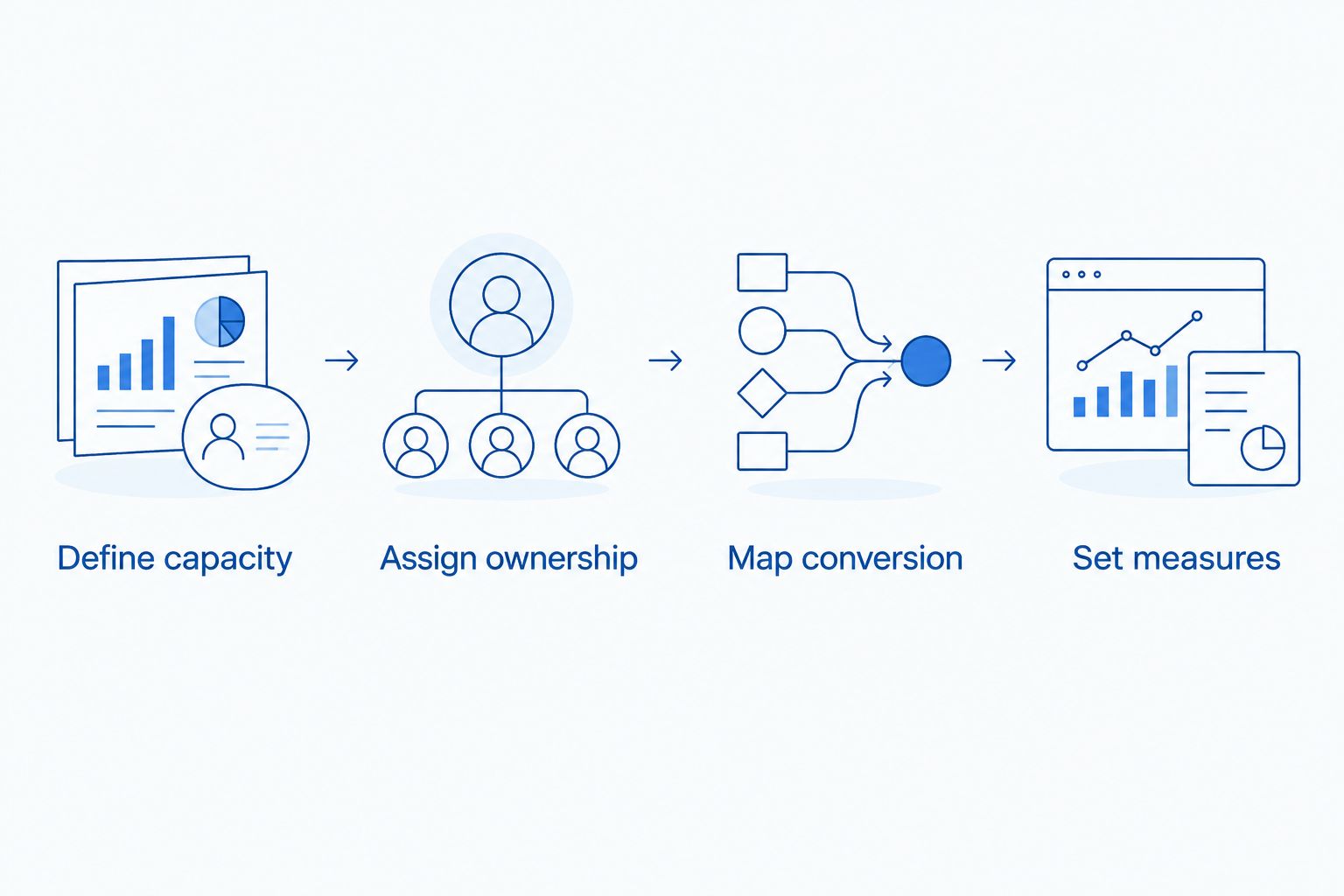
Define delivery capacity and responsibilities before deciding which marketing activity to increase.
Consider a hypothetical home-services business receiving 10 enquiries per week with capacity for 4 additional jobs per week. The consultant should investigate suitability, conversion and job requirements before recommending more enquiries. Neither figure proves that advertising is the constraint.
In another hypothetical professional-services firm, a partner spends 6 hours per week approving routine proposals. The brief should examine approval boundaries alongside demand generation, rather than assuming more enquiries are the immediate priority.
For a structured starting point, use the guide to briefing a marketing strategy consultant around team capacity.
How this shortlist is ranked
This 2026 shortlist prioritises support that connects commercial decisions with implementation ownership. The order reflects the needs of an established service-business owner seeking less day-to-day dependence, not a universal ranking for every Australian business.
The criteria are owner independence, delivery capacity, commercial clarity, implementation ownership, measurement and scope. Match the engagement to your constraint; a narrower specialist becomes the better choice when the problem is genuinely narrow.
Before signing, ask for a written scope showing deliverables, exclusions, responsibilities and the review process. Reject a proposal that leaves implementation ownership unclear.
Which marketing strategy consultant should you choose?
Choose Elevatory when you want business coaching with done-with-you implementation across marketing and systems strategy. Choose an independent consultant for a defined plan, a fractional CMO for ongoing leadership, an advertising specialist for a channel problem, or a coach to develop internal capability.
For your 2026 decision, start with this question: who will own the work after the meeting? If every task still depends on you, resolve that before expanding the marketing brief.
Discuss your business priorities
Discuss business coaching and done-with-you marketing implementation for your established business.
FAQ
What's the best marketing strategy consultant for an established Australian business?
The best fit depends on whether you need a plan, leadership, specialist advice or implementation support. Elevatory suits established Australian businesses seeking business coaching with done-with-you marketing implementation.
Should I hire a marketing consultant or a business coach?
Choose a marketing consultant for a defined marketing problem and business coaching when the brief also involves business priorities and accountability. Some engagements combine both, so compare responsibilities rather than titles alone.
Is a fractional CMO the same as a marketing strategy consultant?
No. A fractional CMO is a part-time leadership role, while a marketing strategy consultant can work on a defined advisory brief. Confirm decision authority, supplier management and production responsibilities in either agreement.
Should a tradie hire a consultant before increasing advertising?
Check quoting, scheduling and delivery capacity before increasing advertising. If routine decisions still require the owner, include delegation and lead-handling responsibilities in the brief.
What should I ask a marketing strategy consultant in 2026?
Ask what problem the engagement addresses, who implements the work and how progress will be assessed. Require clear exclusions and an explanation of how recommendations account for team capacity.
Can a marketing coach replace someone doing the marketing?
Marketing coaching does not automatically replace an implementer. Nominate someone inside the business to complete the work, with enough time and authority to act on the coaching.
What results should I expect from marketing strategy consulting?
Expect the agreed diagnosis, priorities, responsibilities and deliverables—not guaranteed revenue growth. Assess commercial outcomes against your starting position and the work actually implemented.
One last thing
Before your first consultant meeting, ask your team which decisions wait for your approval. Bring that list alongside your enquiry and booking records.
The most useful brief connects what marketing promises with what your team can decide and deliver. That gives the consultant a business problem to solve, not simply an advertising account to change.
Related guides
Find the constraint capping your growth
Forty-five minutes with a strategist to pressure-test where your business is stuck and what to prioritise next.
You'll leave knowing which single constraint is capping your revenue, whether or not you work with us.
Prefer to talk first? Call 1300 634 230 or email chris@elevatory.com.au