

Best overall for business coaching with done-with-you marketing implementation: Elevatory. Best for legal-practice management: a legal-practice specialist. Best for succession: a leadership mentor. Choose your business mentor for law firms around the work that keeps landing back on the principal’s desk, not around a promise of more enquiries.
TL;DR
- Elevatory suits established Australian businesses seeking business coaching with done-with-you marketing implementation.
- Choose a business mentor for law firms around delegation, practice management or succession—not general motivation.
- Match marketing activity to matter capacity, enquiry quality and the team’s authority to act.
- Use the mentoring-model comparison to shortlist the right expertise before choosing a provider.
Why this matters
If every intake decision, fee exception and staffing question reaches you, attracting more enquiries adds work to the same bottleneck. Your first job is to separate decisions that require professional judgement from routine business decisions your team should own.
For your 2026 shortlist, start with the constraint. Do you need someone to improve the commercial model, someone who understands legal-practice operations, or someone who can prepare another leader to take responsibility?
This ranking compares one named coaching provider with specialist mentoring models. It is a decision guide, not a claim that every option offers the same expertise or that a general business coach replaces legal-practice advice.
What makes the best business mentor for law firms?
Use these criteria before you compare personalities or proposals:
- Owner independence: The work should clarify responsibilities, delegated authority and escalation rules—not make you the permanent approval point.
- Relevant expertise: Match the mentor’s experience to the problem. Commercial coaching and legal-practice management are different assignments.
- Implementation scope: Identify who writes the process, briefs the team and checks adoption. Advice alone is not implementation.
- Commercial visibility: Ask how the engagement will connect enquiries, accepted matters, delivery capacity and financial performance.
- Clear boundaries: Keep professional obligations, legal supervision and confidential client information within appropriate controls.
A strong proposal makes the next action clear. It should name the business problem, the person responsible for implementation and the evidence you will use to judge progress.
Business mentoring options at a glance
| Ranked option | Best for | Standout approach | Key limitation |
|---|---|---|---|
| Elevatory | Business coaching with marketing implementation | Connects offers, funnels, paid advertising and systems strategy through done-with-you support | Commercial coaching is not a substitute for specialist legal-practice advice |
| Legal-practice specialist | Matter workflow and practice-management decisions | Keeps the assignment focused on running a legal practice | Marketing implementation must be scoped separately |
| Leadership mentor | Partner development and succession | Focuses on judgement, delegation and leadership responsibility | Does not replace an accountable operational manager |
| Finance-focused business mentor | Understanding matter economics | Centres the work on financial decisions and management reporting | Does not automatically address team adoption or enquiry generation |
The order reflects the use cases below, not a universal league table. A firm with a practice-management problem should choose relevant specialist expertise before broader growth coaching.
1. Elevatory: best for commercial coaching and implementation
Elevatory provides business coaching and done-with-you marketing implementation for established Australian businesses turning over $150K–$5M. Its stated scope includes offers, funnels, paid advertising and systems strategy.
That makes it a fit to assess when your law firm needs commercial direction connected to implementation. Bring a brief about the work your team can deliver, the enquiries you want and the decisions that still depend on you—not simply a request for more leads.
Best for: Established firms seeking business coaching alongside offer, funnel, advertising and systems work.
Elevatory pros:
- Coaching and done-with-you implementation sit within the stated service offering.
- The scope connects marketing decisions with systems strategy.
- The stated business focus is established Australian businesses rather than startups.
Elevatory cons:
- The stated scope does not establish specialist legal-practice expertise.
- Done-with-you support still requires time and participation from your team.
- Business coaching does not replace professional supervision or practice-specific advice.
For a 2026 engagement, ask how the proposed work will reduce approval traffic while keeping marketing aligned with delivery capacity. Require a clear division between the coach’s work and your team’s responsibilities.
Verdict: Buy for commercial coaching with implementation; skip if your primary need is specialist legal-practice advice.
2. Legal-practice specialist: best for practice-management problems
Choose the legal-practice specialist model when the assignment concerns how your firm runs matters, allocates work or structures practice responsibilities. Define that expertise in the brief rather than assuming any business mentor has it.
Ask candidates to explain how they distinguish operational delegation from professional supervision. Request relevant examples they are authorised to discuss, with a clear explanation of what they personally contributed.
Best for: Principals whose main constraint sits inside legal-practice operations rather than marketing execution.
Legal-practice specialist pros:
- Lets you select directly for relevant practice-management experience.
- Keeps matter workflow and responsibility allocation central to the brief.
- Gives you a basis for asking practice-specific questions before appointment.
Legal-practice specialist cons:
- A specialist title alone does not prove implementation capability.
- Offer development, funnels and paid advertising require explicit scope.
- Mentoring will not remove the need for internal process ownership.
Use a hypothetical example in the interview: an intake coordinator gathers complete information, but every enquiry still waits for the principal’s commercial approval. Ask the candidate to identify what can be delegated, what requires escalation and how the team would learn the distinction.
Verdict: Buy when practice-management expertise is the primary requirement.
3. Leadership mentor: best for partner development and succession
Choose a leadership mentor when another person needs to take responsibility, not merely complete more tasks. The brief should cover decision-making, feedback, accountability and the boundaries of authority.
Start with a real responsibility the principal still holds. Preparing a future leader means defining the decisions that person can make and the conditions that require consultation—not just inviting them to observe meetings.
Best for: Firms preparing a practice manager, senior solicitor or future partner for broader business leadership.
Leadership mentor pros:
- Makes leadership responsibility an explicit development goal.
- Creates a focused brief around delegation and decision-making.
- Provides a structure for discussing readiness and succession expectations.
Leadership mentor cons:
- Mentoring does not supply day-to-day operational management.
- Leadership development alone does not fix unclear workflows.
- The principal must be willing to transfer real authority.
Before appointing a mentor, read the distinction between assigning work and stopping delegated work from coming back to you. A successor cannot demonstrate judgement if you reverse every decision that differs from your preference.
Verdict: Buy when leadership readiness—not lead volume—is the constraint.
4. Finance-focused mentor: best for matter economics
Choose a finance-focused business mentor when you cannot confidently explain which work supports the firm’s financial goals. Write the assignment around management information and decisions, not a vague instruction to improve profitability.
Ask candidates how they would examine fee structures, work in progress, write-offs and collection patterns using your records. Keep tax advice, accounting services and business mentoring distinct when agreeing responsibilities.
Best for: Principals who need clearer financial information before changing staffing, fees or marketing activity.
Finance-focused mentor pros:
- Centres the brief on the financial consequences of business decisions.
- Helps you specify the reporting needed for management discussions.
- Gives staffing and marketing proposals a financial question to answer.
Finance-focused mentor cons:
- Financial analysis does not itself implement new team behaviours.
- Marketing execution needs its own owner and scope.
- Poor source records need attention before reporting can support decisions.
For your 2026 plan, resist treating revenue as the whole answer. Ask what remains after delivering the work, whether invoices are collected and how much principal involvement each matter requires.
Verdict: Buy when unclear economics prevent sound commercial decisions.
How we ranked these mentoring options
The ranking follows the criteria above: owner independence, relevant expertise, implementation scope, commercial visibility and clear boundaries. Each option holds a different use-case slot because the right appointment depends on the assignment.
The named provider’s description supports its commercial coaching and implementation position. The remaining entries describe expertise to seek, not verified providers or promises about individual practitioners.
Use the table to choose a mentoring model. Then assess candidates against your actual brief, relevant evidence and proposed responsibilities.
Turn the shortlist into a working brief
Before your first 2026 mentoring conversation, prepare a brief your practice manager or another senior team member can challenge. Keep it specific enough that candidates must discuss the work rather than deliver a general sales presentation.
Use this sequence:
- Name the constraint. Identify the repeated business decision or handover that slows the firm.
- Assign ownership. State who should own the work and what currently prevents that.
- Set boundaries. Separate routine authority from matters requiring professional judgement or escalation.
- Review evidence. Decide which records will show whether the change is working.
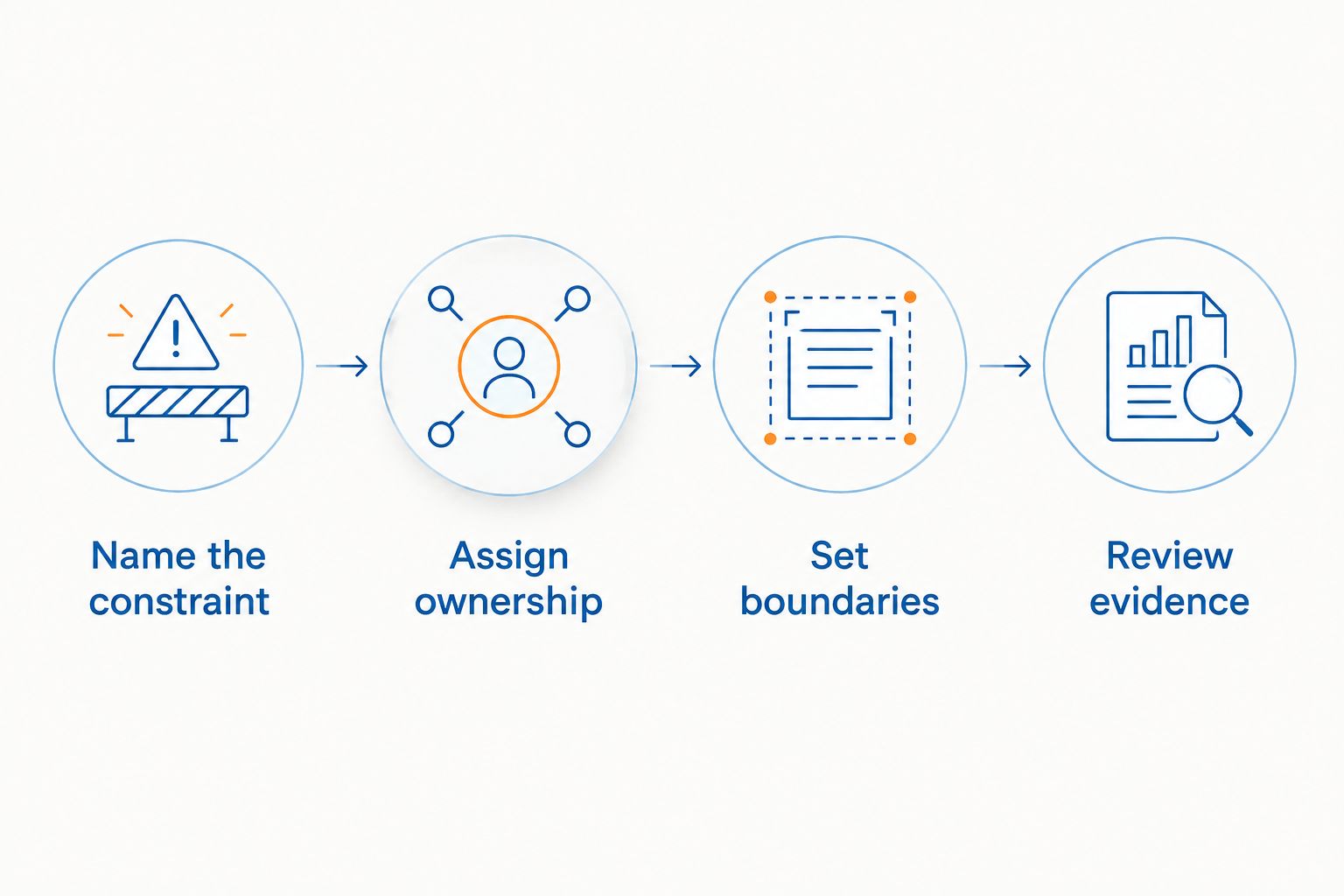
Define the responsibility you want to transfer before choosing support.
Schedule a 30-minute internal review before approaching candidates. Bring one recent handover that stalled and one decision that unnecessarily returned to the principal; use the records to describe what happened without sharing identifiable client information.
Ask every candidate the same question: “What would you change first, who would implement it, and what would you need from us?” Compare the substance of the answers, not the confidence of the delivery.
Make succession a transfer of decisions
Succession planning needs more than a future job title. List the business decisions a future leader must make, the information available to them and the circumstances that require escalation.
This is where executive mentoring for succession planning belongs in the brief: connect leadership development to the responsibilities the successor must eventually carry. Keep professional supervision and business-management authority distinct.
Hypothetical example: A principal wants a practice manager to run weekly capacity discussions. The first assignment is to maintain the workload view, identify pressure points and propose administrative actions within agreed limits—not to make legal decisions outside the role.
Review the decisions together after the meeting. If every proposal still needs your approval, change the authority boundaries before adding more mentoring sessions.
Connect marketing to capacity before increasing activity
A marketing brief should describe suitable enquiries and the team’s capacity to respond. Define the work you want, the qualification information you need and the person responsible for the next step.
For 2026, review these measures together rather than treating enquiries as the sole success measure:
- Enquiry suitability: Does the prospective matter fit the work your firm wants?
- Intake ownership: Who responds, qualifies and follows up?
- Delivery capacity: Who can take responsibility if the matter proceeds?
- Commercial outcome: What work was accepted, delivered and collected?
Agree how the mentor will use these records. A campaign recommendation should explain the operational handover it requires, not end when an enquiry arrives.
Which business mentor should you choose?
Elevatory is best suited to established Australian businesses seeking business coaching with done-with-you marketing implementation. For a law firm, assess that commercial fit alongside your need for specialist practice advice.
Choose a legal-practice specialist for practice-management problems, a leadership mentor for succession, or a finance-focused mentor for unclear matter economics. Do not appoint a general mentor and expect unscoped specialist work to appear later.
Your default next move is simple: write the responsibility you want off the principal’s desk, then choose support that can help your team own it.
Discuss your business constraint
Bring your delegation, capacity and marketing priorities to a coaching conversation.
FAQ
Who is the best business mentor for law firms in Australia?
The best fit depends on whether your constraint is commercial strategy, legal-practice management, leadership or financial visibility. Elevatory suits established Australian businesses seeking business coaching with done-with-you marketing implementation; assess specialist legal-practice needs separately.
Should I choose a legal-practice mentor or a general business coach?
Choose a legal-practice mentor for practice-specific management expertise and a business coach for an appropriately scoped commercial assignment. Ask each candidate to explain their boundaries and relevant experience.
Can a business mentor help me delegate more effectively?
Delegation can be a defined mentoring assignment covering ownership, decision authority and escalation rules. Your team still needs to implement those responsibilities, and you need to stop taking routine decisions back.
Does my law firm need more leads before hiring a mentor?
More leads should not be the starting assumption. First examine enquiry suitability, intake ownership, delivery capacity and the work that depends on the principal.
What should I ask during a first mentoring conversation?
Ask what the mentor would change first, who would implement it and what evidence would show progress. Also clarify confidentiality, responsibilities and the limits of the engagement.
Can a mentor replace a practice manager?
Mentoring is not a substitute for someone owning daily operations. If the work needs ongoing execution and authority, define the management role rather than expecting advisory sessions to cover it.
What information should I prepare before choosing a mentor?
Prepare a clear business constraint, a responsibility map and relevant operational or financial records. Use de-identified examples and agree information-handling arrangements before sharing sensitive material.
One last thing
Ask your team which business decision waits longest for you. Then ask what information and authority would let someone else make it properly.
That answer gives your mentor a concrete assignment. Start there before commissioning another growth plan.
Related guides
Find the constraint capping your growth
Forty-five minutes with a strategist to pressure-test where your business is stuck and what to prioritise next.
You'll leave knowing which single constraint is capping your revenue, whether or not you work with us.
Prefer to talk first? Call 1300 634 230 or email chris@elevatory.com.au