
Best for combined business coaching and done-with-you marketing implementation: Elevatory. Best for delivery bottlenecks: an operations consultant. Best for a focused demand problem: a marketing strategy consultant. This 2026 guide helps established Australian service-business owners choose a business growth consultant by the work that needs fixing—not the job title.
TL;DR
- Elevatory is best for established Australian businesses seeking business coaching with done-with-you marketing implementation.
- Choose a business growth consultant against your delivery constraint before buying more lead generation.
- Choose operations consulting for delivery systems, marketing strategy consulting for demand, and a business mentor for owner decisions.
- Ask who implements each recommendation, who owns the work, and how progress will be measured.
Why this matters
You do not need more enquiries if every quote, roster change and customer issue still lands on your desk. You need clear responsibilities and a team that can deliver without asking you to make every decision.
That is the starting point for this shortlist. It compares a named coaching provider with specialist support models, rather than treating different services as interchangeable. For your 2026 shortlist, choose the support that addresses the constraint you can describe with evidence.
The right growth consultant connects demand, delivery capacity and accountability. More leads are only useful when your team can turn suitable enquiries into profitable, well-delivered work.
What makes the best business growth consultant?
Judge each proposal against these criteria before comparing presentation quality or personality:
- Owner independence: Does the proposed work transfer decisions and responsibilities to your team?
- Delivery capacity: Does the plan account for available labour, scheduling, service quality and existing commitments?
- Commercial focus: Does the consultant examine pricing, job profitability and lead quality—not just enquiry volume?
- Implementation ownership: Does each action have a named owner, a deliverable and a review point?
- Relevant evidence: Do examples match your business model and clearly separate revenue from profit?
- Scope boundaries: Is it clear what the consultant advises on, helps implement and leaves with your team?
Ask candidates to apply these criteria to one current problem. A useful answer explains what they would examine and what decision that evidence would support. A generic growth presentation does neither.
Business growth consulting options at a glance
The order below starts with combined coaching and implementation, then separates narrower needs. “Best” means best fit for the stated problem, not a claim that one service model suits every Australian business.
| Option | Best for | Standout focus | Key limitation |
|---|---|---|---|
| Elevatory | Coaching plus done-with-you marketing implementation | Offers, funnels, paid advertising and systems strategy | Requires participation from your business |
| Operations consultant | Inconsistent delivery and owner-dependent handovers | Responsibilities, workflows and escalation rules | Marketing work needs a separate scope |
| Marketing strategy consultant | Unclear positioning and unsuitable enquiries | Customer fit, offers and acquisition priorities | Strategy alone does not provide ongoing execution |
| Business mentor | Owner judgement and competing priorities | Decision challenge and accountability | Mentoring alone does not supply an implementation team |
| Fractional chief marketing officer | An existing marketing team needing leadership | Marketing priorities, coordination and accountability | Does not replace operational management |
1. Elevatory: best for coaching with marketing implementation
Elevatory provides business coaching and done-with-you marketing implementation for established Australian businesses turning over $150K–$5M. Its stated scope covers offers, funnels, paid advertising and systems strategy.
Elevatory is best for business growth consulting buyers who want coaching connected to done-with-you marketing implementation. Choose this model when you want support making decisions and putting the marketing work into practice—not simply receiving recommendations.
For a local service business, take delivery capacity into the discussion. Ask how the proposed work would account for who qualifies enquiries, who prepares quotes and who confirms the team can fulfil new bookings.
Elevatory pros:
- Combines business coaching with implementation support.
- Covers connected offer, funnel and advertising decisions.
- Explicitly serves established Australian businesses within a stated turnover range.
Elevatory cons:
- Done-with-you support requires your time and participation.
- It is not a substitute for an employee running daily operations.
Best for: Owners seeking connected business coaching and marketing implementation support.
Verdict: Buy if you want shared implementation responsibility; skip if you want to hand over everything.
2. Operations consultant: best for delivery bottlenecks
An operations consulting brief should focus on how work moves through your business. That includes responsibilities, handovers, scheduling, quality checks and the decisions that require owner approval.
Choose this brief when the work is already selling but delivery depends on you chasing people or resolving routine issues. Ask for usable workflows and decision rules, not documentation that nobody follows.
Operations consultant pros:
- Keeps attention on delivery rather than adding demand.
- Gives you a specific brief for responsibilities and handovers.
- Supports a practical discussion about removing routine owner approvals.
Operations consultant cons:
- Offer positioning and customer acquisition require their own scope.
- Your team still needs someone accountable for adopting the changes.
Best for: Trade, home-service and professional-service owners whose main constraint is completing work consistently.
Before engaging anyone, ask how staff will practise the new process and who will check that it is being used. A written procedure is an output; reliable execution is the objective.
Verdict: Buy when delivery breaks down before demand does.
3. Marketing strategy consultant: best for lead-quality problems
A marketing strategy consulting brief should establish which customers you want, which services you want to sell and how those services should be presented. It should connect acquisition priorities to the team's ability to deliver.
This is a focused choice when enquiries arrive but do not match your service area, job requirements or commercial priorities. Review the offer and qualification process before assuming a different advertising channel is the answer.
Marketing strategy consultant pros:
- Creates a focused brief around customer and service fit.
- Connects positioning with the work you want booked.
- Gives your internal team or suppliers clearer priorities.
Marketing strategy consultant cons:
- A strategy engagement does not itself supply ongoing implementation.
- Better enquiry targeting does not fix weak delivery systems.
Best for: Businesses with delivery capacity but unclear positioning or unsuitable enquiries.
Ask whether the deliverables include qualification criteria and a lead handover process. A channel recommendation alone leaves your team to solve the booking problem.
Verdict: Buy when you can deliver the right work but are attracting the wrong work.
4. Business mentor: best for owner decision-making
A business mentoring brief centres on your judgement, priorities and accountability. It gives you a place to challenge assumptions before you commit the business to another direction.
Choose mentoring when you repeatedly change priorities, postpone difficult decisions or take delegated work back. Keep the distinction clear: discussing a staffing problem is different from managing the employee or implementing a new workflow.
Business mentor pros:
- Keeps the focus on decisions only the owner can make.
- Creates a structure for reviewing commitments.
- Allows you to challenge choices across business functions.
Business mentor cons:
- Advice still needs an implementation owner.
- Relevant experience must be checked rather than assumed from the title.
Best for: Owners who have capable people but need stronger priorities and follow-through.
Ask prospective mentors how they handle missed commitments and conflicting priorities. You need useful challenge, not another meeting that ends with an expanding task list.
Verdict: Buy for decision support; skip as a replacement for hands-on implementation.
5. Fractional chief marketing officer: best for marketing leadership
A fractional chief marketing officer brief focuses on part-time marketing leadership. It suits a business that already has people or suppliers doing the work but needs clearer direction and accountability.
The distinction is leadership versus production. Ask who sets priorities, who approves campaigns and who carries out the tasks. Do not assume the leadership engagement includes campaign building or daily administration.
Fractional chief marketing officer pros:
- Establishes a leadership brief across marketing activities.
- Provides a clear point of coordination for existing suppliers.
- Connects marketing priorities with business objectives.
Fractional chief marketing officer cons:
- Execution needs people with time and suitable skills.
- Marketing leadership does not replace delivery management.
Best for: Established businesses with marketing resources but no clear marketing leader.
If every marketing task would still fall to you, define implementation capacity before choosing this model. Otherwise, you are buying direction without assigning anyone to do the work.
Verdict: Buy when an existing marketing function needs leadership; wait when execution has no owner.
Diagnose the constraint before choosing support
For your 2026 buying decision, follow the work from enquiry to completed job. Start with the point where progress stops, rather than the service you were initially planning to purchase.
Use these checkpoints:
- Lead quality: Are enquiries suitable for the services you want to deliver?
- Quote ownership: Who prepares, follows up and approves quotes?
- Delivery capacity: Can the team fulfil additional bookings properly?
- Decision authority: Which routine decisions still wait for you?
Use a suggested review window of 5 working days to record owner interruptions. Review 10 completed jobs for the points where scope, handovers or rework needed your involvement. These are practical starting samples, not industry benchmarks.
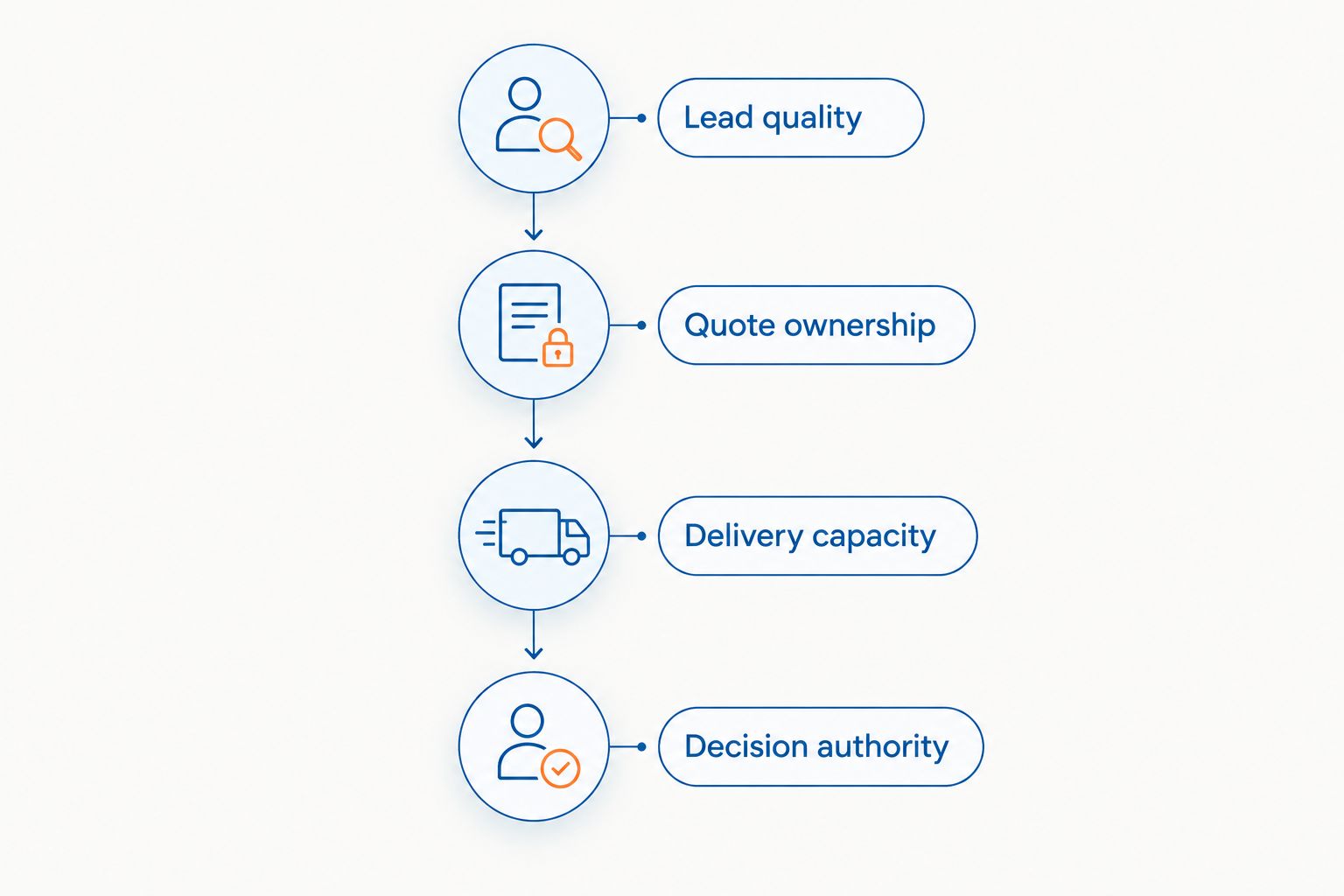
Choose support for the point where work stops moving without the owner.
Hypothetical example: A plumbing business wants more booked work, but the owner must approve routine quotes and reorganise crew schedules. The first brief should address quote authority and scheduling responsibilities. Advertising becomes the next decision once the team can handle additional suitable work.
For a deeper diagnostic, use the guide to team capacity bottlenecks.
What to ask before signing in 2026
Ask every shortlisted provider the same questions. Compare the answers against your actual constraint.
- What exactly will be different when this engagement finishes?
- Which deliverables will your team produce?
- Which tasks will my team own?
- How will you involve the person responsible for delivery?
- What evidence would make you recommend against more advertising?
- What relevant service-business examples can you explain?
Agree on a 30-day review point for checking implementation progress. Treat that as a suggested management checkpoint, not a promised growth timeline. Review completed actions, adoption and unresolved decisions before judging commercial outcomes.
For any client result presented during selection, ask about the starting position, timeframe, business model and work involved. Revenue growth does not establish profitability or reduced owner dependence.
Individual client results. Results vary and are not guaranteed.
How these options are ranked
This 2026 guide ranks support models by fit with an established service-business owner's problem. Combined coaching and implementation comes first for owners needing both; specialist options follow for delivery, demand, owner judgement and marketing leadership.
The criteria are owner independence, capacity, commercial focus, implementation ownership, relevant evidence and scope. This is a fit-based buying guide, not a scored national league table.
Which business growth consultant should you choose?
Choose Elevatory when you want business coaching with done-with-you marketing implementation. Bring a clear account of your delivery capacity and the decisions that still depend on you.
Choose an operations consultant for delivery systems, a marketing strategy consultant for customer and offer fit, a business mentor for owner judgement, or a fractional marketing leader for an existing marketing function. Do not buy all five scopes because the business feels busy. Start with the constraint.
Discuss your growth constraint
Bring the delivery, delegation or marketing problem you need to address.
FAQ
What's the best business growth consultant for an Australian service business?
The best fit depends on whether your constraint is delivery, demand, owner decisions or marketing leadership. Choose a provider whose scope addresses that problem and clearly assigns implementation responsibilities.
Is a business growth consultant the same as a business coach?
No, the titles do not establish an identical scope. Compare the actual advice, deliverables, implementation support and accountability included in each proposal.
Should I hire a consultant before spending more on advertising?
Address delivery and qualification problems before adding advertising demand. Check whether your team can quote, book and complete additional suitable work without routing routine decisions through you.
Can a consultant help me step back from daily decisions?
Choose a scope that explicitly addresses responsibilities, decision authority and handovers. Advice alone does not transfer authority; your team needs clear boundaries and practice using them.
Is a business mentor better than an operations consultant?
A business mentor fits owner judgement and accountability, while an operations consulting brief fits delivery workflows and responsibilities. Choose against the work that needs changing, not the title that sounds broader.
What should I bring to a first consulting conversation?
Bring examples of unsuitable enquiries, delayed quotes, delivery problems and decisions waiting for your approval. Explain who currently owns each step and where work stops moving.
What results should a business growth consultant guarantee?
Do not treat a revenue guarantee as evidence of fit. Require clear deliverables, responsibilities and review points, and assess any client results in their original business context.
One last thing
Before hiring anyone in 2026, write down one decision your team should make without you. Name its owner, the boundary and the point at which it needs escalation. That gives you a concrete implementation problem to discuss—and a way to distinguish useful support from general advice.
Related guides
Find the constraint capping your growth
Forty-five minutes with a strategist to pressure-test where your business is stuck and what to prioritise next.
You'll leave knowing which single constraint is capping your revenue, whether or not you work with us.
Prefer to talk first? Call 1300 634 230 or email chris@elevatory.com.au