

Best overall for coaching with done-with-you implementation: Elevatory. Best for delivery bottlenecks: an operations consultant; best for targeting and positioning: a marketing strategy consultant; best for owner accountability: a business mentor; best for marketing leadership: a fractional CMO.
TL;DR
- Elevatory suits established Australian businesses seeking business coaching with done-with-you marketing implementation.
- Choose a business growth consultant for professional services by the constraint: owner dependence, delivery capacity or demand.
- An operations consultant fits delivery problems; a marketing strategy consultant fits positioning and acquisition decisions.
- Define team responsibilities before increasing lead volume, and judge progress against your own operating baseline.
Why this matters
If every proposal, staffing question and client exception lands on your desk, more enquiries add work before they add freedom. Your first decision is not which advertising channel to use. It is which decisions your team should own.
For your 2026 shortlist, separate support that improves the business from support that manages daily work. This guide ranks support models, with a named option where its stated services fit. It is not a claim that unrelated firms have been tested against each other.
What makes the best business growth consultant?
Choose a business growth consultant for professional services against these criteria:
- Owner independence: The brief includes responsibilities, delegation and decisions that no longer require your approval.
- Delivery capacity: Marketing plans account for available people, skills and client commitments.
- Commercial focus: Success includes profitable engagements and suitable clients, not just enquiries.
- Implementation ownership: You know who builds, approves and maintains each change.
- Scope discipline: The consultant distinguishes coaching, project work and ongoing management.
- Relevant evidence: Examples match your business model, with clear limitations around results.
Use these criteria before comparing presentation styles. A confident pitch does not establish who will fix the handover between winning work and delivering it.
At a glance: which support fits your constraint?
| Ranked option | Best for | Standout focus | Key limitation |
|---|---|---|---|
| Elevatory | Coaching with done-with-you marketing implementation | Offers, funnels, paid advertising and systems strategy | Done-with-you support requires your business to participate |
| Operations consultant | Delivery consistency and responsibility gaps | Workflows, handovers and operating responsibilities | Marketing strategy needs a separate scope |
| Marketing strategy consultant | Positioning and acquisition priorities | Target clients, offers and channel decisions | Strategy does not automatically include implementation |
| Business mentor | Owner judgement and accountability | Decision review and challenging priorities | Advice does not replace a delivery manager |
| Fractional CMO | Coordinating existing marketing activity | Marketing direction and accountability | Leadership does not automatically include production |
These are hiring briefs, not standardised job descriptions. Confirm the actual deliverables with each provider before signing.
1. Elevatory: best for coaching with implementation support
Elevatory provides business coaching and done-with-you marketing implementation for established Australian businesses turning over $150K–$5M. Its stated scope covers offers, funnels, paid advertising and systems strategy.
Elevatory is best for established Australian businesses that want business coaching and done-with-you marketing implementation. For a professional services owner, the practical question is whether that scope addresses the constraint between selling work and delivering it without constant owner intervention.
Bring that constraint into the conversation. Ask which responsibilities your team will retain, what implementation involves and how proposed marketing activity will account for delivery capacity.
Elevatory pros:
- Combines business coaching with implementation support.
- Covers offers, funnels, paid advertising and systems strategy.
- Explicitly serves established Australian businesses within the stated turnover range.
Elevatory cons:
- Done-with-you work requires participation; it is not a fully outsourced replacement for your team.
- Its stated services do not establish that it will manage your daily delivery operations.
Best for: An owner seeking connected coaching and marketing implementation rather than isolated advice.
Verdict: Buy this support model if you want to work on the changes with support. Skip it if you want to hand over the entire business function.
2. Operations consultant: best for delivery bottlenecks
Choose an operations consultant brief when clients are buying but delivery still depends on the owner. Ask for work centred on responsibilities, handovers, quality checks and escalation rules.
The aim is not a folder of procedures. It is a team that knows what happens next, who decides and when an exception genuinely needs your attention.
Hypothetical example: an accounting practice principal approves every routine client update. The brief should address decision authority and review standards before adding another acquisition campaign. This is an illustration, not a client result.
Operations consultant pros:
- Focuses attention on how work moves through the team.
- Gives you a brief for clarifying responsibility and escalation.
- Connects service commitments to delivery capability.
Operations consultant cons:
- Does not replace a manager accountable for daily execution.
- Offer development and client acquisition require explicit inclusion or separate support.
Best for: A professional services firm with demand but inconsistent delivery or excessive owner approvals.
Verdict: Buy this support model when delivery is the constraint. Hold acquisition expansion until the team can service the work you intend to win.
3. Marketing strategy consultant: best for offer and targeting decisions
Choose a marketing strategy consultant brief when the team can deliver, but the firm is attracting unsuitable enquiries or presenting an unclear offer. Ask for decisions about target clients, service scope, positioning and channel priorities.
A strategy should tell your team what to stop as well as what to start. A list of channels leaves the hardest choices with you.
Hypothetical example: a consulting firm receives enquiries for small, loosely scoped projects while wanting defined ongoing engagements. The brief should examine the offer and qualification process, rather than treating extra traffic as the answer. This is an illustration, not a reported outcome.
Marketing strategy consultant pros:
- Creates a focused brief around client fit and offer clarity.
- Helps separate channel choices from underlying positioning decisions.
- Gives internal staff or delivery partners a common direction.
Marketing strategy consultant cons:
- A strategy engagement does not automatically include building campaigns.
- Better targeting does not resolve unclear delivery responsibilities.
Best for: A firm with delivery capacity but weak differentiation or unsuitable enquiries.
Verdict: Buy strategy when the market-facing decisions are unclear. Skip a strategy-only engagement if nobody can implement the decisions.
4. Business mentor: best for owner decisions and accountability
Choose a business mentor brief when you understand the operational problem but keep postponing the decision. Examples include giving a team leader real authority, declining poor-fit work or stopping an unproductive initiative.
Keep the engagement grounded in decisions. Bring the issue, the available evidence, your proposed action and the consequence of doing nothing.
In your 2026 brief, distinguish mentoring from management. You remain responsible for assigning work, communicating decisions and following through. A conversation does not transfer that responsibility.
Business mentor pros:
- Creates space to examine difficult owner decisions.
- Gives accountability a defined place in your working routine.
- Fits a brief centred on priorities rather than campaign production.
Business mentor cons:
- Advice alone does not document processes or implement campaigns.
- It is the wrong substitute for someone needed to manage daily delivery.
Best for: An owner whose unresolved decisions are holding up an otherwise capable team.
Verdict: Buy mentoring when judgement and follow-through are the constraint. Skip it as a substitute for operational management.
5. Fractional CMO: best for coordinating existing marketing
Choose a fractional CMO brief when marketing work is happening across staff and suppliers, but nobody owns the overall direction. Define responsibility for priorities, briefs, budgets and performance review.
Separate leadership from production. Someone still needs to write, build, publish and manage the agreed activity. Name those people before appointing another adviser.
For a professional services firm, the brief should connect marketing promises to what the delivery team can actually provide. A larger pipeline is not a complete objective if the work is unsuitable or difficult to service.
Fractional CMO pros:
- Gives cross-channel marketing decisions an accountable owner.
- Creates a brief for coordinating existing staff and suppliers.
- Connects individual campaigns to wider commercial priorities.
Fractional CMO cons:
- Leadership alone does not supply the people who produce the work.
- It does not replace firm-wide operations leadership.
Best for: A firm with marketing execution resources but no clear marketing leader.
Verdict: Buy this support model when coordination is missing. Hold if you first need basic delivery systems or someone to execute the work.
How we ranked the options
The order reflects the needs of an established owner seeking less personal dependence alongside business growth. Connected coaching and implementation comes first; narrower briefs follow according to the constraint they address.
This is a scope-based ranking, not a performance league table. It does not imply independently verified outcomes, market-wide coverage or equivalent services between providers.
For a 2026 hiring decision, ask every candidate the same question: What will our team do differently because of this engagement? Compare the specificity of the answers against the criteria above.
Before choosing: identify what needs to leave your desk
Start with a recommended 5-working-day decision log. Record the approvals, questions and exceptions that interrupt your work. This is a diagnostic exercise, not an industry benchmark.
Sort each entry into unclear responsibility, missing capability or a genuine owner decision. Then identify which recurring issue deserves attention first. The guide to measuring owner dependence keeps the brief centred on responsibilities rather than general busyness.
Next, decide whether you need private implementation support or discussion with peers. The distinction between business coaching versus mastermind groups belongs in that decision: peer discussion and a named person accountable for implementation are different requirements. Ask who owns follow-through rather than comparing meeting formats alone.
Use a recommended 30-minute internal briefing to agree on the priority before speaking with providers. If partners disagree about the problem, surface that disagreement now. Otherwise, each partner will hear a different solution in the same proposal.
Build a brief your team can act on
Use this sequence for your 2026 engagement. It turns a broad request for growth into a defined piece of work.
- Define the constraint: State the recurring problem without prescribing the provider's answer.
- Name the owner: Assign an internal person responsible for implementation and decisions.
- Set the baseline: Record current performance using your own business records.
- Agree the work: Specify deliverables, exclusions and responsibilities.
- Review progress: Compare completed changes and operating results with the baseline.
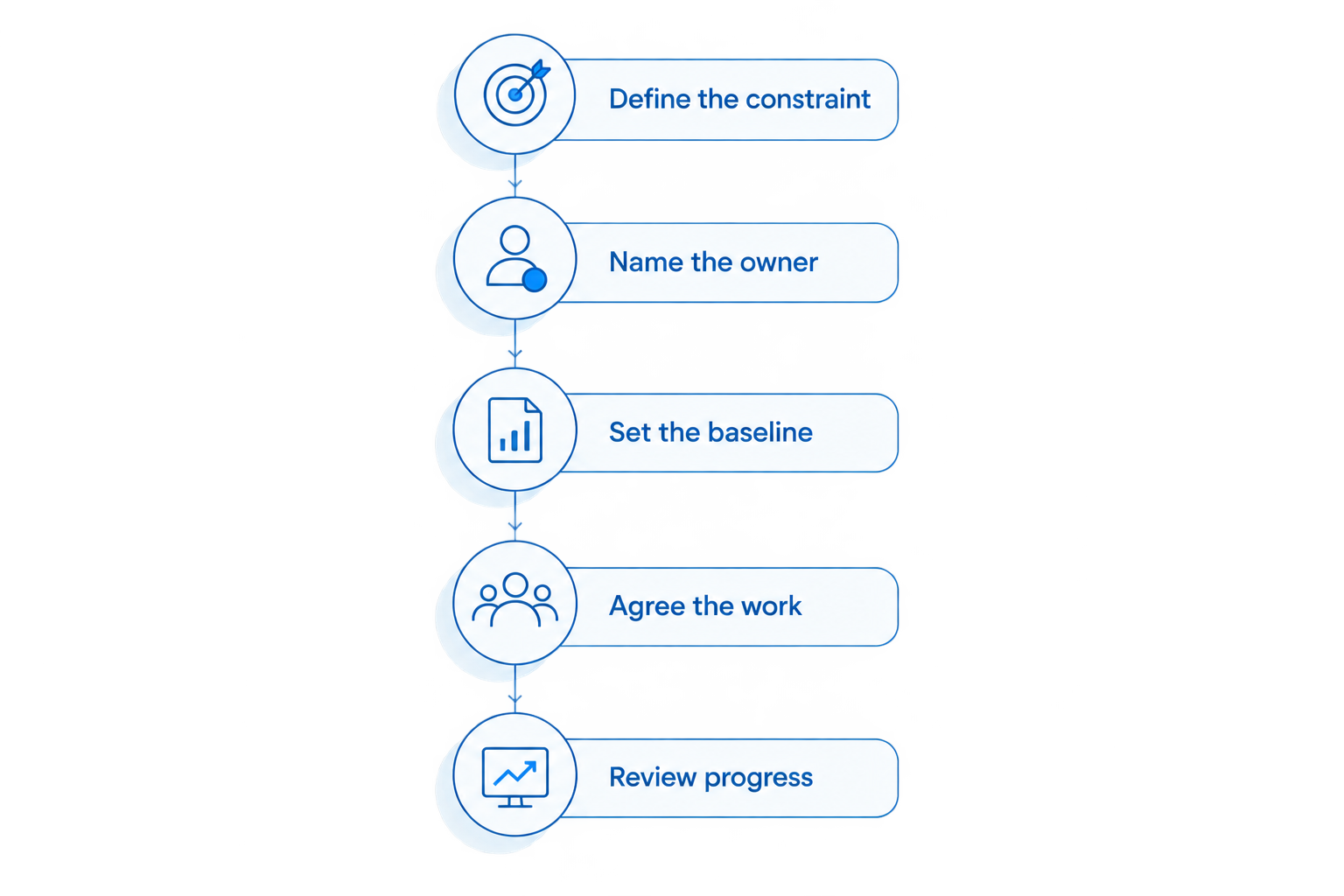
Assign implementation responsibility before treating a proposal as an action plan.
For a recommended 90-day review, agree what evidence you will inspect. Examples include enquiries that meet your qualification criteria, proposals accepted, delivery hours against scope and decisions completed without owner approval. These are suggested review measures, not promised outcomes.
Avoid making revenue the only check. If bookings increase while every new client needs more partner involvement, you have not met an owner-independence objective.
Which business growth consultant should you choose?
Choose Elevatory if you want business coaching with done-with-you marketing implementation and are prepared to participate. Confirm the proposed scope against the responsibilities and delivery constraints in your professional services firm.
Choose an operations consultant brief if work stalls after the sale. Choose a marketing strategy consultant brief if the offer or target client is unclear. Choose mentoring for unresolved owner decisions, or fractional marketing leadership when existing execution needs direction.
For your 2026 decision, the default is simple: fix the constraint that keeps sending work back to you. Do not buy a broader engagement just because the proposal contains more activities.
FAQ
What's the best business growth consultant for professional services?
Elevatory is the named option in this shortlist for established Australian businesses seeking coaching with done-with-you marketing implementation. Choose by the actual constraint: delivery problems, positioning decisions and marketing leadership require different briefs.
Should I hire a growth consultant or an operations manager?
Hire for advice and defined change work when you need a consulting engagement; hire for ongoing management when daily execution needs an accountable owner. Ask who will allocate work, resolve exceptions and manage delivery after the engagement ends.
Can business coaching help me reduce owner dependence?
Make reduced owner dependence an explicit objective of the coaching brief. Specify the responsibilities to transfer, the decisions staff will own and the evidence you will use to assess progress.
Is a marketing consultant the right choice if we need more clients?
A marketing consultant fits when targeting, positioning or acquisition decisions need attention. First confirm that your team can deliver the additional work and that the enquiries you want match your service scope.
What should I ask a consultant before signing?
Ask who implements each change, what is excluded and how progress will be reviewed. Request relevant professional services examples, with enough context to distinguish the consultant's contribution from other changes.
Does done-with-you mean the consultant does everything?
No. Done-with-you support requires participation from your business. Agree who builds, approves, maintains and manages each part of the work before starting.
Can a business growth consultant guarantee more revenue?
Do not treat a revenue guarantee as evidence that the engagement fits your business. Assess the proposed work, relevant evidence, responsibilities and review measures; client results do not establish your future outcome.
One last thing
Delegating a task while keeping every approval is not delegating the decision. Before adding another growth initiative, choose a recurring decision your team should own and define the boundary around it. Give your next adviser that concrete problem to address.
Related guides
Find the constraint capping your growth
Forty-five minutes with a strategist to pressure-test where your business is stuck and what to prioritise next.
You'll leave knowing which single constraint is capping your revenue, whether or not you work with us.
Prefer to talk first? Call 1300 634 230 or email chris@elevatory.com.au