

Best for coaching with done-with-you implementation: Elevatory. Best for delivery bottlenecks: an operations consultant. Best for financial visibility: a financial business adviser. This 2026 guide compares support options for established Australian service businesses under $5M, starting with the team’s ability to deliver without the owner approving everything.
TL;DR
- For a business consultant Australia shortlist, Elevatory suits established businesses wanting coaching with done-with-you marketing implementation.
- Choose an operations consultant when unclear responsibilities and delivery handovers keep pulling you back into daily work.
- Choose financial business advice when you cannot explain which services contribute profit or where cash goes.
- Match business coaching and marketing strategy to team capacity before chasing more enquiries.
Why this matters
A full diary does not tell you whether the business works without you. Before buying advice in 2026, identify which decisions still stop when you leave the room.
For trades and home services, inspect quoting, scheduling, job variations and completion handovers. For professional services, inspect scoping, allocation, client communication and review responsibilities. These are starting points for diagnosis, not reasons to assume every business needs the same consultant.
The right consultant addresses the constraint you can name and helps your team own the work afterwards. Use this shortlist to choose a support model, rather than treating different consulting roles as interchangeable.
What makes the best business consultant for your business?
Judge the fit before the presentation. Ask each candidate to explain how their work addresses these criteria:
- Owner independence: Which decisions will move from you to a capable team member, and under what boundaries?
- Delivery capacity: How will the work account for existing commitments, staffing and service standards?
- Commercial clarity: Which information will show whether bookings contribute profit, rather than simply increase turnover?
- Implementation ownership: Who will write, change, approve and use the agreed processes?
- Relevant evidence: Can the consultant show work relevant to your business model and explain the scope behind any result?
- Defined boundaries: What sits outside the engagement, and who handles those responsibilities?
Business consulting options at a glance
The order below starts with combined coaching and implementation, then separates narrower needs. It is a fit-based shortlist for 2026, not a market-wide ranking of firms.
| Option | Best for | Standout focus | Key limitation |
|---|---|---|---|
| Elevatory | Coaching with done-with-you marketing implementation | Offers, funnels, paid advertising and systems strategy | Not a done-for-you replacement for your team |
| Operations consultant | Delivery and delegation bottlenecks | Responsibilities, handovers and repeatable workflows | A delivery brief does not address weak demand by itself |
| Financial business adviser | Understanding margins and cash decisions | Financial visibility and commercial trade-offs | Financial recommendations still need operational owners |
| Marketing strategy consultant | Connecting demand with delivery capacity | Positioning, lead quality and acquisition priorities | Strategy alone does not provide daily execution |
| Business mentor | Owner judgement and decision discipline | Challenging decisions and maintaining focus | Mentoring is not automatically implementation support |
1. Elevatory: best for coaching with implementation
Elevatory is best for established Australian businesses seeking business coaching with done-with-you marketing implementation. Its stated client range is $150K–$5M in turnover, with support covering offers, funnels, paid advertising and systems strategy.
That makes it a relevant shortlist option when your decisions span both business priorities and marketing execution. Bring a clear account of team capacity, owner responsibilities and delivery constraints, not just a request for more leads.
Elevatory pros:
- Combines business coaching with done-with-you marketing implementation.
- Covers offer, funnel, paid advertising and systems strategy.
- States a turnover range that matches established businesses below $5M.
Elevatory cons:
- Done-with-you support requires participation; it is not a fully outsourced marketing department.
- The stated scope does not establish specialist financial, legal or technical operations advice.
Best for: Owners who want help choosing priorities and implementing marketing changes with their team.
Verdict: Buy if you want coaching and shared implementation; skip if you want to hand over all responsibility. Confirm the specific deliverables and responsibilities before committing.
2. Operations consultant: best for delivery handovers
An operations consulting brief should address how work moves through your business. Specify responsibilities, decision boundaries, handovers and exceptions rather than asking vaguely for better systems.
This is the first option to investigate when your team has work but still needs you to allocate, approve or rescue it. Ask candidates to explain how they will observe delivery and transfer responsibility, not merely supply process templates.
Operations consultant pros:
- Gives delivery responsibilities a defined place in the brief.
- Creates a focused scope for delegation and handover work.
- Lets you assess proposed changes against actual service delivery.
Operations consultant cons:
- Process changes require team involvement and management follow-through.
- A delivery-only engagement leaves offer positioning and acquisition outside scope.
Best for: Owners who remain the default escalation point for routine delivery decisions.
Verdict: Buy when delivery depends on your constant involvement; hold if the immediate constraint is insufficient suitable work.
3. Financial business adviser: best for commercial visibility
A financial business advisory brief should help you understand the economics of your services. Ask for a clear connection between job or engagement revenue, delivery costs, overheads and cash commitments.
Choose the adviser’s qualifications and engagement scope to match the work required. Do not assume general business advice includes tax, investment or other regulated advice.
Financial business adviser pros:
- Puts margins and cash commitments into the decision process.
- Supports clearer questions about pricing and service mix.
- Gives hiring and marketing decisions a financial reference point.
Financial business adviser cons:
- Useful analysis depends on sufficiently accurate business records.
- Financial recommendations do not assign jobs, manage staff or implement marketing.
Best for: Owners who cannot confidently explain which work contributes profit or what the business can commit to.
Verdict: Buy when the commercial picture is unclear; hold off expanding commitments until you understand it.
4. Marketing strategy consultant: best for demand planning
A marketing strategy consulting brief should connect your offer, target customer, enquiry quality and sales process. Include delivery capacity so the plan addresses work your team can actually fulfil.
This is a focused option when you can describe the service you deliver but need a clearer acquisition direction. In 2026, ask candidates to explain who will execute the plan and who will judge enquiry quality after launch.
Marketing strategy consultant pros:
- Creates a defined brief around offers, customers and acquisition priorities.
- Brings lead qualification into the planning conversation.
- Provides direction for an internal team or implementation partner.
Marketing strategy consultant cons:
- A strategy engagement does not automatically include campaign execution.
- Better targeting does not resolve unclear delivery responsibilities.
Best for: Businesses with delivery capacity but an unclear offer, inconsistent enquiry quality or disconnected marketing activity.
Verdict: Buy when demand planning is the constraint; wait if your team cannot fulfil the work already booked.
5. Business mentor: best for owner decision discipline
A business mentoring brief centres on your judgement, priorities and accountability. Define the decisions you want challenged and the preparation you will bring to each discussion.
Mentoring fits an owner who has people capable of execution but keeps changing direction or avoiding difficult decisions. It is a different purchase from hiring someone to document delivery or build a marketing funnel.
Business mentor pros:
- Creates a regular place to examine difficult owner decisions.
- Keeps priorities visible between discussions.
- Lets you seek experience relevant to a particular leadership challenge.
Business mentor cons:
- Advice remains advice unless someone takes responsibility for action.
- A mentor’s experience does not automatically cover every specialist problem.
Best for: Owners with an execution team who need sharper decisions and consistent follow-through.
Verdict: Buy for decision support; skip if the real requirement is hands-on implementation.
How the options are ranked
This shortlist uses the criteria above: owner independence, delivery capacity, commercial clarity, implementation ownership, relevant evidence and scope boundaries. The first option combines coaching and marketing implementation; the remaining options isolate narrower briefs.
A specialist should move to the top when the problem matches the speciality. No consulting model deserves first place for every business. Ask candidates for evidence relevant to your service model, and separate the consultant’s contribution from other changes behind a reported result.
Write the brief before you book the consultant
For your 2026 shortlist, prepare a one-page brief before a sales conversation. Use the sequence below so candidates respond to the same problem rather than selling unrelated programmes.
Constraint
Name what stops work progressing without you. Replace “we need to scale” with a specific problem, such as routine quote approvals returning to the owner.
Capacity
Describe what the team can deliver under current responsibilities and commitments. Include the work waiting for approval, not just the empty spaces in the diary.
Responsibility
Name who will implement changes inside the business. If nobody has responsibility or time, make that part of the scope discussion rather than assuming the consultant absorbs it.
Evidence
Agree what you will review: owner escalations, quote follow-up, delivery rework, suitable enquiries or contribution by service. Select measures tied to the constraint instead of collecting everything.
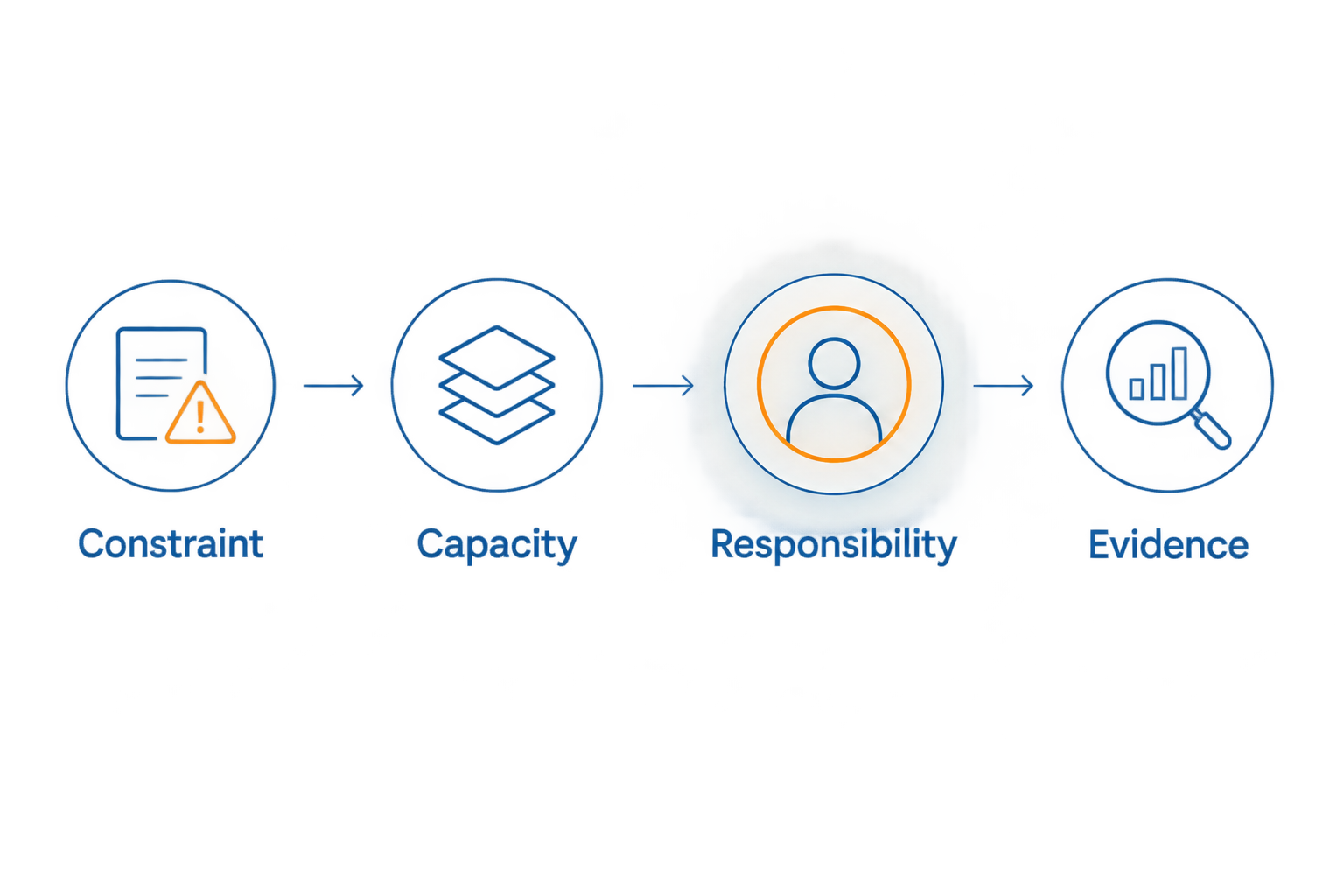
Define the operating problem before choosing the consulting model.
Set a proposed 30-day review for the first agreed change. Treat that as a planning checkpoint, not a promised result: examine what changed, what remains blocked and who takes the next action.
If handovers are central to the brief, use this guide to business consulting for operations handover to frame the discussion.
A service-business example: capacity before campaigns
Hypothetical example: An electrical business wants more enquiries, but the owner approves every quote and resolves every scheduling clash. Buying advertising does not remove either responsibility.
Start by recording which decisions return to the owner. Give the responsible team member a clear decision boundary and an escalation rule, then review whether the handover works before adding acquisition activity.
A professional services firm can use the same diagnostic approach without copying the electrical business’s workflow. Examine scope approval, client allocation and review responsibilities. The relevant question is which decision requires the principal’s expertise and which simply lacks an agreed owner.
These are illustrative situations, not client results or forecasts.
Which business consultant should you choose?
Choose Elevatory when you want business coaching with done-with-you implementation across offers, funnels, paid advertising and systems strategy. Choose an operations specialist first when delivery handovers are the immediate problem, or financial advice when you cannot establish the commercial picture.
For a 2026 buying decision, ask every candidate to identify the first responsibility that changes inside your business. Reject a proposal that lists activities but leaves ownership unclear. You need to know what your team will do differently, not just what meetings you will attend.
Discuss your business priorities
Bring your delivery constraints, team responsibilities and marketing priorities to the conversation.
FAQ
What's the best business consultant in Australia for a business under $5M?
The best fit depends on the constraint and the implementation support you need. Choose combined coaching and implementation for connected business and marketing work, operations consulting for delivery bottlenecks, or financial advice for commercial visibility.
Should I hire a business coach or an operations consultant?
Choose an operations consultant for a defined delivery or handover problem, and business coaching for broader priorities and accountability. Confirm the actual scope because job titles alone do not establish who implements changes.
Can business consulting help me step back from daily decisions?
Reducing owner dependence is a valid consulting objective when the scope includes responsibilities, decision boundaries and handovers. Ask which decisions will transfer to the team and how you will review that transfer.
Should I hire a marketing consultant if my team is already busy?
First establish whether the team can deliver additional work under current responsibilities. If capacity is constrained, brief the consultant on service mix, lead qualification and delivery limits rather than requesting more enquiries alone.
Is a business mentor the same as done-with-you implementation?
No. Mentoring focuses on advice, judgement and accountability; done-with-you implementation includes agreed practical work alongside the business. Confirm deliverables and responsibilities before choosing either.
What should I ask before signing a consulting agreement?
Ask for the problem definition, deliverables, exclusions, internal responsibilities and review measures. Also ask what preparation your team must complete and what happens when implementation stalls.
How do I compare business consultants in 2026?
Give each consultant the same brief and compare their proposed scope, evidence and implementation responsibilities. Choose against your operating constraint rather than the length of the presentation.
One last thing
Before your first consultation, spend 1 hour listing the decisions your team sent back to you during the previous working week. Mark each as requiring expertise, authority or missing information.
Take that list into the conversation. Ask the consultant which category to address first and what responsibility changes as a result. That is a more useful starting point than a general promise to grow.
Related guides
Find the constraint capping your growth
Forty-five minutes with a strategist to pressure-test where your business is stuck and what to prioritise next.
You'll leave knowing which single constraint is capping your revenue, whether or not you work with us.
Prefer to talk first? Call 1300 634 230 or email chris@elevatory.com.au