

Best fit for combined business coaching and done-with-you marketing implementation: Elevatory. For Melbourne owners whose main problem is daily delivery, trade supervision or partner dependence, choose specialist support for that constraint instead; this 2026 guide compares those options without treating a Queensland-based business as a Melbourne office.
TL;DR
- Elevatory suits established Australian businesses seeking business coaching with done-with-you marketing implementation.
- For a business coach Melbourne shortlist, assess delegation and delivery systems before promises of more leads.
- Choose operations coaching for delivery problems, trade-focused coaching for crew leadership, and marketing coaching for campaign ownership.
- Confirm Melbourne service arrangements, responsibilities and implementation scope before signing.
Why this matters
A full calendar does not mean your business runs without you. If every quote, roster change and customer complaint needs your decision, more enquiries add work to the same bottleneck.
Your coaching brief should start with the team: who owns the work, what they can decide, and when they escalate. Then connect marketing to the jobs your business can deliver profitably.
For your 2026 shortlist, separate location from capability. A Melbourne address matters when you need site visits; it does not establish expertise in delegation, pricing or lead quality.
What makes the best business coach for Melbourne owners?
Judge business coaching against these six criteria before comparing personalities or presentations:
- Owner independence: The work includes delegation, decision authority and fewer routine approvals.
- Delivery systems: Responsibilities, handovers and quality checks become usable instructions, not just discussion topics.
- Commercial judgement: Advice connects pricing, job profitability and lead quality rather than chasing revenue alone.
- Implementation responsibility: You know what the coach does, what your team does, and what requires another specialist.
- Relevant evidence: Service-business examples match your operating model. Ecommerce results do not establish trade-business experience.
- Melbourne delivery fit: Meeting format, site attendance and access to the person doing the work are clear before you commit.
Reject any proposal that cannot name the constraint, the responsible person and the next practical change. A broad promise to help you grow is not an implementation plan.
Business coaching options at a glance
This is a ranked shortlist of support types, not a league table of Melbourne coaching firms. The named provider offers combined coaching and implementation; the remaining options describe specialist briefs you can use when comparing providers.
| Rank | Option | Best for | Standout focus | Key limitation |
|---|---|---|---|---|
| 1 | Elevatory | Combined business and marketing implementation | Offers, funnels, paid advertising and systems strategy | Queensland-based; confirm Melbourne delivery arrangements |
| 2 | Operations-focused business coaching | Owner-dependent delivery | Responsibilities, handovers and decision authority | Coaching does not replace a daily operations manager |
| 3 | Trade-focused business coaching | Moving supervision to crew leaders | Job ownership, quoting boundaries and site escalation | Trade experience alone does not establish marketing capability |
| 4 | Professional-services business mentoring | Reducing dependence on the principal | Client ownership, scope and delivery leadership | General mentoring can leave implementation unclear |
| 5 | Marketing coaching | Building internal marketing ownership | Campaign decisions, lead qualification and follow-up | Marketing coaching alone does not fix delivery management |
1. Elevatory: best for combined coaching and implementation
Elevatory provides business coaching and done-with-you marketing implementation for established Australian businesses turning over $150K–$5M. Its stated work covers offers, funnels, paid advertising and systems strategy.
Elevatory is a fit for established Australian businesses seeking business coaching with done-with-you marketing implementation. That combination belongs on your shortlist when business decisions and marketing execution need to be addressed together.
The turnover range spans businesses at very different stages. At $150K in turnover, ask who will carry out the work; at $5M in turnover, ask which team members need decision authority and accountability.
Pros:
- Business coaching and marketing implementation sit within the stated service offering.
- The scope connects offers and acquisition with systems strategy.
- The stated audience is established Australian businesses, not software shoppers or pre-launch founders.
Cons:
- The business is based in Queensland; confirm arrangements for Melbourne clients and any site-based work.
- Done-with-you implementation requires participation from you or your team; it is not a done-for-you replacement.
Best for: Owners who want coaching connected to practical marketing work and can assign someone to implementation.
Ask for a proposal that starts with owner dependence and delivery capacity, then explains which marketing work follows. Do not let the campaign plan arrive before the operating priorities.
Verdict: Buy only when the agreed scope addresses your constraint and confirms how Melbourne delivery works.
2. Operations-focused coaching: best for owner-dependent delivery
Operations-focused business coaching is the brief to choose when your team repeatedly waits for instructions. The work should address responsibilities, handovers, decision limits and escalation rules.
Start with the guide to measuring owner dependence. Use it to frame the problem before asking a coach to solve it.
Operations-focused coaching pros:
- Directs attention to decisions that keep returning to the owner.
- Gives team leaders clearer responsibility for delivery.
- Creates a practical brief for documenting recurring work.
Operations-focused coaching cons:
- A coach does not become the person managing daily delivery.
- Written procedures are insufficient if nobody has authority to use them.
Best for: Businesses with enough work but too many owner approvals.
Hypothetical example: A home-services owner approves every booking change. The coaching brief is to define what the scheduler can move independently, which customer promises cannot change, and when the owner must be involved. More advertising is not the first task.
Ask candidates to explain the difference between a capability gap and an authority gap. Training someone who already knows the answer will not fix a rule that requires your permission.
Verdict: Buy when repeated owner intervention is the main delivery constraint.
3. Trade-focused coaching: best for building crew leadership
Trade-focused business coaching should help you move from answering every site question to setting clear operating boundaries. Look for practical work on crew responsibilities, job handovers, quoting limits and customer escalation.
The useful distinction is between technical competence and leadership responsibility. Your strongest tradesperson still needs a clear brief before taking ownership of other people's work.
Trade-focused coaching pros:
- Keeps the brief grounded in jobs, crews and customer commitments.
- Gives you a structure for defining crew-leader authority.
- Connects bookings with the labour capacity required to deliver them.
Trade-focused coaching cons:
- Industry familiarity is not evidence of implementation ability.
- Crew-leadership coaching does not automatically include offer, funnel or advertising support.
Best for: Trade and home-service owners who remain the default supervisor.
Ask a candidate to work through a hypothetical variation: the crew discovers extra work, the customer wants an immediate answer, and the owner is unavailable. Who can approve the scope, who communicates it, and who records the decision?
For your 2026 shortlist, favour a clear answer over trade jargon. The objective is a repeatable decision process, not a coach who simply understands how busy you are.
Verdict: Buy when stepping back requires stronger crew leadership, not just more bookings.
4. Professional-services mentoring: best for principal dependence
Professional-services business mentoring is the relevant brief when clients and staff rely on the principal for routine judgement. Focus the engagement on client ownership, scope boundaries, review responsibilities and delivery leadership.
A business mentor can challenge your decisions. Your proposal still needs to explain how those decisions become working practices inside the firm.
Professional-services mentoring pros:
- Creates space to examine which decisions genuinely require principal expertise.
- Supports clearer ownership of client relationships and delivery.
- Brings scope and capacity into growth discussions.
Professional-services mentoring cons:
- Advice-only mentoring leaves execution with the firm.
- A generic leadership brief can miss service-specific review and approval requirements.
Best for: Principals whose involvement is expected on nearly every client matter.
Hypothetical example: A consulting principal rewrites every proposal. The brief is to define acceptable scope, review triggers and approval authority so another team member can prepare a proposal without restarting the work.
Ask what must remain with the principal and why. Reducing owner dependence does not mean removing necessary professional oversight.
Verdict: Buy when client delivery depends on the principal's involvement rather than clearly assigned responsibility.
5. Marketing coaching: best for internal campaign ownership
Marketing coaching is the right brief when your business has delivery capacity but lacks someone who can make and follow through on marketing decisions. It should connect offers, lead qualification, campaign management and sales follow-up.
Keep the distinction clear: coaching develops internal capability. It does not automatically mean someone else runs your advertising or manages your sales team.
Marketing coaching pros:
- Gives an internal team member a defined marketing responsibility.
- Connects campaign decisions to lead quality and booked work.
- Makes handovers between marketing, sales and delivery part of the brief.
Marketing coaching cons:
- Your team needs time and authority to implement changes.
- Better campaigns do not resolve poor scheduling or unclear delivery ownership.
Best for: Businesses with usable capacity and a named person responsible for marketing implementation.
Ask the candidate to explain what happens after an enquiry arrives. A useful answer covers qualification, follow-up, booking and delivery—not just campaign settings.
In 2026, put the lead-to-booking handover into the proposal. You need responsibility for the whole process, even when different people own different stages.
Verdict: Buy when internal marketing capability is the constraint; wait when delivery is already overloaded.
How these options are ranked
The order follows fit for an established service business seeking coaching and implementation together. It then separates narrower constraints: owner-dependent operations, crew leadership, principal dependence and internal marketing capability.
This is a scope-based recommendation, not a claim that one provider has outperformed every Melbourne competitor. Use the criteria above to reorder the options around your business.
Turn your shortlist into a useful conversation
Set aside 30 minutes before contacting a coach. Write down the decisions that came back to you, the work waiting for approval, and the bookings your team struggled to deliver.
Then organise the brief into four parts:
- Owner decisions: What repeatedly needs your approval?
- Team authority: Who should own those decisions instead?
- Delivery capacity: What work can the team fulfil properly?
- Marketing priorities: Which enquiries and offers fit that capacity?
These are linked decisions. Start with how the business works, then decide where marketing belongs.
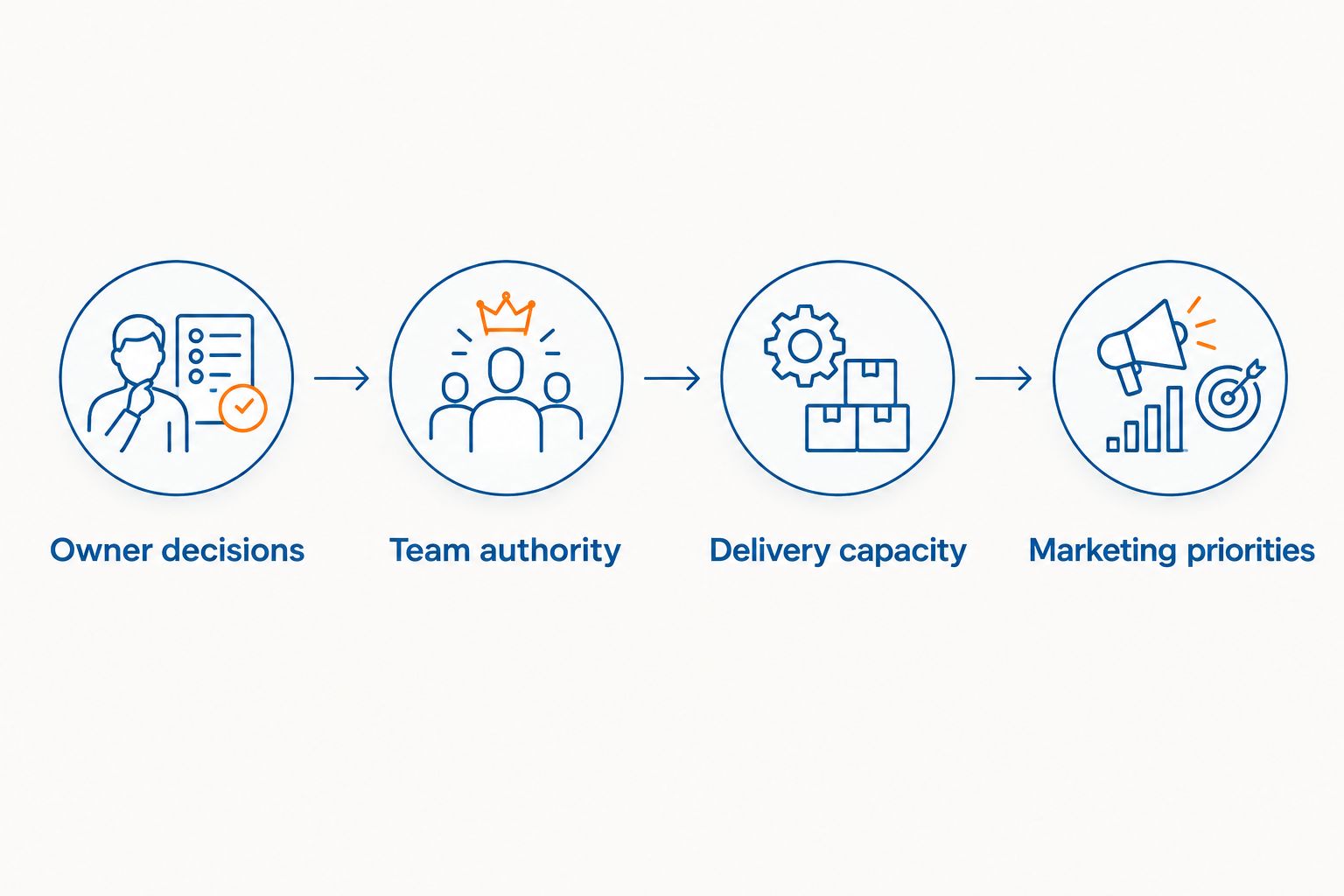
Set responsibility and capacity before choosing marketing priorities.
Ask each candidate to respond to the same brief. Compare who owns implementation, what gets documented, how progress is reviewed, and what falls outside the engagement.
Do not accept a growth target without a discussion about delivery. A plan that needs your constant intervention has not solved owner dependence.
Which business coaching option should you choose?
Shortlist Elevatory when you need business coaching connected to done-with-you marketing implementation. Confirm Melbourne service arrangements and insist that the scope starts with your team and operating constraint.
Choose specialist operations, trade or professional-services support when the problem sits primarily inside delivery. Choose marketing coaching when capacity exists and an internal person can own the work.
For a 2026 decision, the default is simple: buy support for the constraint you can describe, not the broadest promise.
FAQ
What's the best business coach Melbourne owners should choose?
Choose the coach whose scope addresses your main operating constraint. Compare delegation, delivery systems, implementation responsibility and relevant service-business evidence before location or presentation.
Does my business coach need to be based in Melbourne?
A Melbourne base is necessary when your engagement requires local attendance that the provider cannot otherwise deliver. Confirm meeting format, site visits and who will work with your team before signing.
Should I hire a business coach or an operations manager?
Hire an operations manager when you need someone to own daily execution. Choose coaching when you need help defining responsibilities, improving decisions and making changes that your team will implement.
Can business coaching help me step off the tools?
Make stepping off the tools an explicit coaching objective, supported by crew leadership and decision authority. Ask for a plan covering job ownership, escalation and quality checks rather than accepting a promise of more leads.
Is marketing coaching the same as done-for-you marketing?
No. Marketing coaching develops your team's ability to make and implement marketing decisions; done-for-you work assigns execution to an external provider. Confirm the split in writing.
What should I bring to a business coaching consultation?
Bring your revenue context, team responsibilities, delivery constraints and examples of decisions that keep returning to you. Include lead quality and booked-work information so marketing is assessed alongside capacity.
Can a business coach guarantee revenue growth?
Do not treat a coaching proposal as a revenue guarantee. Ask for relevant evidence and explicit responsibilities, then assess progress against agreed business measures. Individual client results. Results vary and are not guaranteed.
One last thing
Before your next coaching conversation, ask a team member: what are you waiting for me to decide?
Write the answer into the brief. The decision sitting in your inbox is a more useful starting point than a general ambition to grow.
Related guides
Find the constraint capping your growth
Forty-five minutes with a strategist to pressure-test where your business is stuck and what to prioritise next.
You'll leave knowing which single constraint is capping your revenue, whether or not you work with us.
Prefer to talk first? Call 1300 634 230 or email chris@elevatory.com.au