

Best for combined business coaching and marketing implementation: Elevatory. Best for listing conversations: a real estate sales coach. Best for owner-independent delivery: an operations coach. Best for developing sales managers: a leadership coach. Choose your business coach for real estate agencies in 2026 by the constraint they address, not the size of their promises.
TL;DR
- Elevatory suits established agencies seeking business coaching with done-with-you marketing implementation; confirm real-estate-specific experience before engaging.
- Choose a business coach for real estate agencies around owner dependence, team capacity and the work needing improvement.
- Use real estate sales coaching for agent skills, operations coaching for handovers and leadership coaching for manager accountability.
- Connect marketing coaching to delivery capacity before paying to generate more enquiries.
Why this matters
Your agency does not need the principal involved in every vendor update, prospecting decision and campaign approval. It needs clear responsibilities, usable systems and people authorised to act.
That distinction matters when choosing small business coaching in 2026. A coach who improves listing presentations addresses a different problem from someone helping you remove approval bottlenecks or connect advertising to a reliable follow-up process.
Choose the support that changes how the agency operates, not just how motivated the owner feels. This guide ranks coaching models by their job, rather than presenting an unsupported national league table of individual providers.
What makes the best business coach for real estate agencies?
Use these criteria before comparing personalities or proposals:
- Owner independence: The engagement should identify decisions your team can take without the principal.
- Relevant experience: Ask for examples involving agency principals, sales teams or comparable professional-service delivery. General business experience is not proof of real estate expertise.
- Implementation responsibility: Establish who writes the process, changes the funnel, trains the team and checks adoption.
- Commercial measurement: Connect activity to qualified appraisals, signed authorities, completed work and financial contribution—not enquiries alone.
- Capacity awareness: Match lead generation to the team's ability to respond, follow up and deliver.
- Scope boundaries: Separate coaching from daily management, specialist compliance advice and campaign execution.
Ask every candidate to explain what they would address first and what they would leave alone. A clear boundary is more useful than an offer to fix everything.
Coaching options at a glance
| Rank and option | Best for | Standout approach | Key limitation |
|---|---|---|---|
| 1. Elevatory | Connecting business priorities with marketing implementation | Business coaching with done-with-you support across offers, funnels, paid advertising and systems | Real-estate-specific experience needs confirmation |
| 2. Real estate sales coach | Improving agent conversations and sales execution | Focused practice around prospecting, appraisals and listing presentations | Sales training does not replace operational management |
| 3. Operations coach | Removing the principal from routine delivery decisions | Clear responsibilities, handovers and repeatable workflows | Process advice does not provide daily management capacity |
| 4. Leadership coach | Helping managers lead and hold people accountable | Delegation, feedback and decision-making practice | Leadership development does not replace technical sales training |
These are distinct buying choices. When comparing providers in 2026, use the relevant row as your brief rather than asking every candidate for a general growth plan.
1. Elevatory: best for coaching with marketing implementation
Elevatory provides business coaching and done-with-you marketing implementation for established Australian businesses turning over $150K–$5M. Its stated scope includes offers, funnels, paid advertising and systems strategy.
For a real estate agency, that combination is relevant when marketing and business execution need to be considered together. Ask how the engagement would connect your service proposition, enquiry handling and team capacity before discussing additional advertising.
Elevatory business coaching suits established Australian owners who want strategic direction with done-with-you marketing implementation. It is not a substitute for a real estate sales trainer or an employed operations manager.
Elevatory pros:
- Combines business coaching with implementation support rather than advice alone.
- Covers offers, funnels, paid advertising and systems within its stated scope.
- Serves established Australian businesses rather than positioning solely around startups.
Elevatory cons:
- Real estate agency specialisation is not established by its general service description; request relevant evidence.
- Done-with-you support still requires involvement from your business.
- Daily agency management sits outside the stated coaching and marketing proposition.
Best for: A principal seeking coordinated business and marketing support, with internal capacity to participate.
Ask for a proposed first priority, named responsibilities and examples relevant to your situation. Verdict: Buy this support model when you need coaching and implementation together; hold until sector fit and scope are clear.
2. Real estate sales coach: best for agent sales execution
A real estate sales coach is the category to assess when the work needing improvement is the agent's sales process. Your brief should specify the conversations involved: prospecting, appraisal discovery, listing presentations, objection handling or follow-up.
Do not accept a broad promise to improve performance. Ask candidates to describe how they observe behaviour, give feedback and check whether agents apply it.
Real estate sales coaching pros:
- Targets the actual conversations agents need to improve.
- Provides a defined setting for practice and feedback when included in scope.
- Gives the principal a clearer brief than general motivation or accountability sessions.
Real estate sales coaching cons:
- Better conversations do not resolve unclear administrative responsibilities.
- Training does not create additional delivery capacity.
- Principal-level delegation needs separate attention if it falls outside the engagement.
Best for: Agencies with workable delivery systems but a clearly identified sales-skill gap.
Ask candidates to distinguish effort from execution. An agent avoiding prospecting needs a different intervention from an agent who prospects consistently but struggles to qualify an opportunity.
For your 2026 shortlist, request an example training agenda and an explanation of how the sales manager participates. Verdict: Buy for an observed agent-skill problem; skip as the main solution to owner dependence.
3. Operations coach: best for owner-independent delivery
An operations coach is the category to assess when routine work repeatedly returns to the principal. Brief the candidate on the handovers involved, such as moving from a signed authority into campaign preparation or assigning responsibility for vendor updates.
Start with the work, not a new organisational chart. Identify the trigger, responsible person, completion standard and escalation rule for each handover.
Operations coaching pros:
- Directs attention towards responsibilities and decision rights.
- Turns vague delegation requests into specific workflows.
- Gives the team a basis for handling repeatable work without fresh instructions.
Operations coaching cons:
- A documented process still needs someone to maintain and enforce it.
- Coaching cannot fill an unstaffed operational role.
- It is not the right primary brief for an isolated listing-presentation problem.
Best for: Principals who remain the default approver despite having a capable team.
Use the distinction between a business mentor and an operations manager before signing. If you already know the process but nobody has time to manage it, the decision concerns management capacity as well as coaching.
Ask the candidate to explain how ownership transfers to your team. Verdict: Buy for unclear systems and responsibilities; hold if the real requirement is a person to run daily operations.
4. Leadership coach: best for developing agency managers
A leadership coach is the category to assess when team leaders need to make decisions, give feedback and manage performance without referring everything upward. The brief should centre on manager behaviour, not inspirational presentations.
Ask candidates how they work with real situations: missed follow-up, inconsistent preparation, avoided feedback or decisions repeatedly escalated to the principal.
Leadership coaching pros:
- Focuses attention on the manager's responsibilities rather than the principal's personal output.
- Creates a defined brief for delegation and feedback practice.
- Supports clearer expectations between the principal and team leaders when included in scope.
Leadership coaching cons:
- Coaching cannot give a manager authority the principal continues to withhold.
- It does not replace technical real estate training.
- A coaching conversation does not resolve an unsuitable role design by itself.
Best for: Agencies with people in leadership roles who need clearer authority and stronger management habits.
Treat leadership development for sales teams as work on decisions, feedback and accountability—not simply a reward for the strongest salesperson. Define what the manager owns and what genuinely requires escalation.
Ask how the principal's behaviour will be addressed alongside the manager's. Verdict: Buy when leadership capability is the constraint; skip if nobody has actually been given management responsibility.
How to brief your shortlisted coach
A useful 2026 coaching brief starts with a business problem your team recognises. Keep it specific enough that a candidate can challenge your diagnosis.
Name the constraint
Write a statement such as: “Campaign preparation stops whenever the principal is unavailable.” That is a hypothetical example, not a client result. It identifies a workflow to investigate without assuming the answer is more leads or another hire.
Set decision rights
List what the responsible team member can decide, what needs approval and what counts as an exception. Delegation remains incomplete when responsibility moves but approval stays with the owner.
Test a handover
Ask the coach to help improve one live workflow before expanding the project. Have the person doing the work explain the process back, including what happens when information is missing.
Review the evidence
Agree on a review point and the records you will inspect. Start with a 30-day observation period if that suits your operating rhythm; this is a planning recommendation, not a promised results timeline.
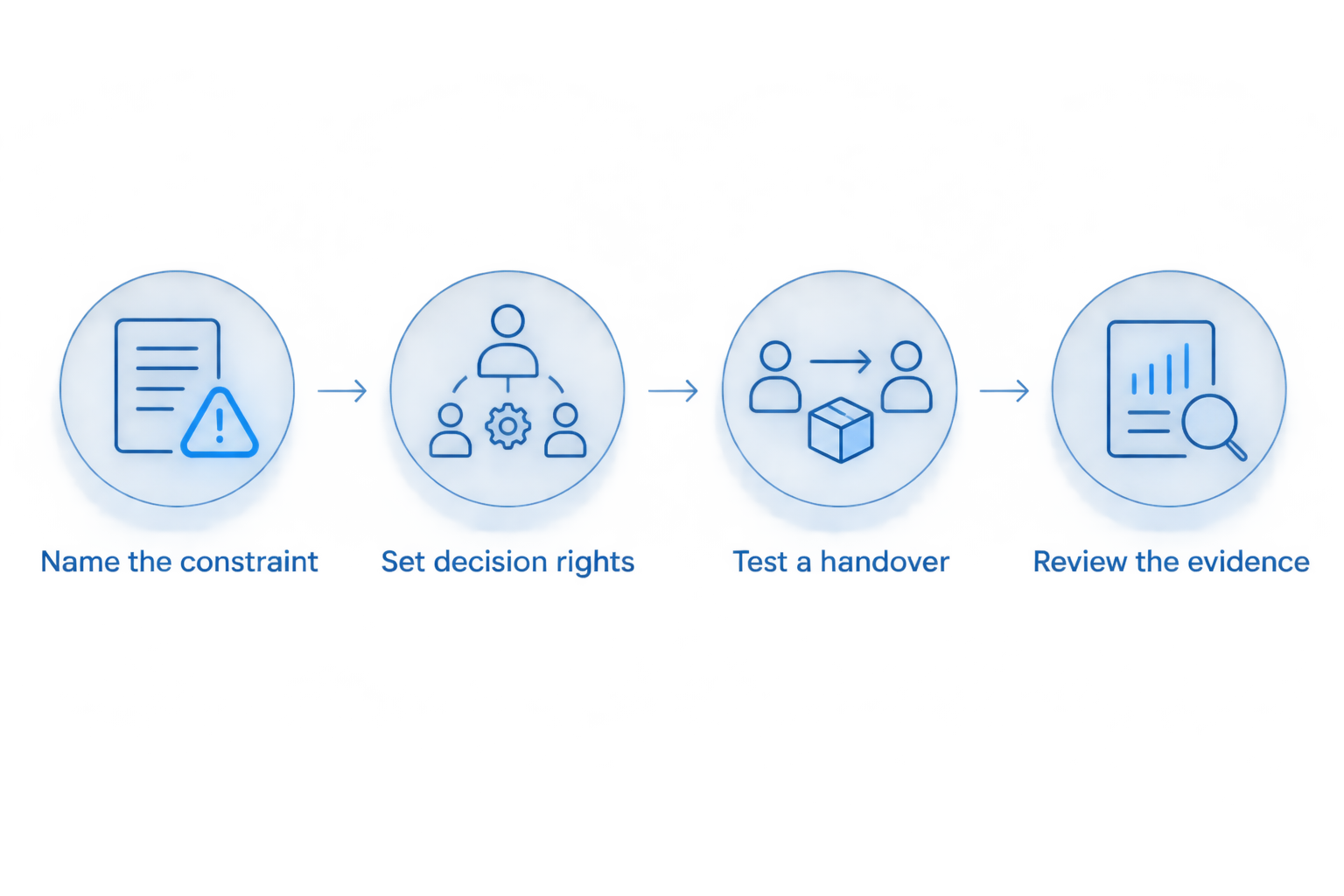
Define the work and decision rights before expanding the coaching brief.
Use a 60-minute scoping meeting to discuss the constraint, proposed work and ownership. Ask what your team must contribute each week and what happens when agreed actions are not completed.
Reject proposals that describe meetings but leave outputs unclear. A calendar invitation is not an implementation plan.
Measure the agency, not just the advertising
For a 2026 engagement, agree on a small scorecard that reflects the chosen brief. Do not make every coach accountable for every business measure.
| Coaching brief | Evidence to review | What it helps you assess |
|---|---|---|
| Sales execution | Appraisals, signed authorities and reasons opportunities were lost | Whether activity progresses into agreed business |
| Operations | Incomplete handovers, approval requests and rework | Where delivery still depends on intervention |
| Leadership | Decisions resolved by managers and repeated escalations | Whether authority is being exercised |
| Marketing implementation | Qualified enquiries, follow-up ownership and progression | Whether demand is reaching a team able to act |
Keep financial contribution in the conversation. More enquiries or signed work alone do not establish that an engagement improved profitability.
Review owner dependence alongside commercial activity. If every new opportunity adds another approval to your desk, discuss that trade-off before increasing campaign activity.
How we ranked these coaching options
The order follows the criteria above: owner independence, relevant experience, implementation responsibility, commercial measurement, capacity awareness and scope boundaries. Each option owns a different use case.
The combined coaching-and-implementation model comes first for owners whose business priorities and marketing execution need attention together. This is a fit-based buying guide, not a claim that named providers were independently tested or that a specialist always outperforms a generalist.
Which business coach should you choose?
Start with Elevatory when you want business coaching and done-with-you marketing implementation together. Confirm relevant agency experience, responsibilities and deliverables before committing.
Choose a real estate sales coach for a specific agent-skill gap. Choose operations coaching when work stalls at the principal's desk, and leadership coaching when managers need clearer authority and better management habits.
If you remain undecided, write down the recurring decision you most want removed from your week. Use that decision—not a generic revenue ambition—to start the selection conversation.
FAQ
What's the best business coach for real estate agencies?
The best business coach for real estate agencies matches the agency's main constraint. Elevatory suits owners seeking business coaching with done-with-you marketing implementation; confirm real-estate-specific experience before engaging.
Should I choose a real estate sales coach or a business coach?
Choose a real estate sales coach for agent sales skills and a business coach for broader owner, team and commercial priorities. Ask each candidate to identify what their engagement excludes.
Can business coaching help me step back from my agency?
Business coaching can focus on the responsibilities, decision rights and systems required for you to step back. Your team still needs the capacity and authority to take ownership, and outcomes are not guaranteed.
Do I need an operations manager instead of a coach?
Choose an operations manager when you need someone to run daily operations. Coaching is a different brief: it supports decisions and capability but does not automatically provide management capacity.
Should my agency generate more leads before fixing team systems?
Check response capacity, follow-up ownership and delivery responsibilities before increasing lead generation. More demand does not resolve a handover that already depends on the principal.
How do I compare business coaching proposals?
Compare the problem addressed, outputs, responsibilities, evidence and exclusions. Ask who implements changes and how your team will review progress.
What evidence should I request from a business coach?
Request relevant examples with a clear scope, timeframe and explanation of the client's involvement. Distinguish real estate results from other service-business or ecommerce results, and do not treat an individual outcome as a guarantee.
One last thing
Before your next coaching conversation, select one recurring approval and write the conditions under which your team can make it without you. Test whether the obstacle is missing information, missing authority or missing capability.
Bring that observation to the meeting. It gives a prospective coach a real business problem to address—and gives you a practical way to judge the answer.
Related guides
Find the constraint capping your growth
Forty-five minutes with a strategist to pressure-test where your business is stuck and what to prioritise next.
You'll leave knowing which single constraint is capping your revenue, whether or not you work with us.
Prefer to talk first? Call 1300 634 230 or email chris@elevatory.com.au