

Best overall for combined business coaching and marketing implementation: Elevatory. Best for owner dependence: an operations-focused business coach. Best for enquiry quality: a marketing coach. This 2026 guide helps you choose a business coach for home services businesses by matching support to the decisions your team still sends back to you.
TL;DR
- Elevatory suits established Australian owners seeking a business coach for home services businesses with done-with-you marketing implementation.
- Choose operations-focused business coaching when scheduling, delegation and delivery still depend on you.
- Choose marketing coaching when your team can deliver more work but enquiries miss the mark.
- Choose a business mentor for decision support, not as a substitute for implementation or daily management.
Why this matters
Your team needs to deliver the work you already sell before you push harder for enquiries. Start with responsibility: who qualifies the customer, approves the quote, schedules the job and resolves a problem?
If each answer is you, put delegation into the coaching brief. Buying more marketing without changing that handover leaves you responsible for both the extra enquiries and the delivery decisions.
For your 2026 shortlist, compare the support models below rather than treating every coach as interchangeable. This is a fit-based buying guide, not a claim that every Australian provider has been tested or ranked.
What makes the best business coach for home services businesses?
Use these criteria before comparing personalities, presentations or promises:
- Owner independence: The brief should identify decisions your team will take over, not just tasks you will delegate.
- Delivery capacity: Recommendations should account for crew capability, travel, scheduling and existing commitments.
- Commercial clarity: Assess job margins, quoting assumptions and profitable bookings, rather than enquiry volume alone.
- Implementation ownership: Establish who writes the process, changes the funnel, trains the team and checks the work.
- Relevant evidence: Request comparable service-business examples. An online retail result does not establish experience with field-service delivery.
- Clear boundaries: Confirm what the engagement includes, what your team must do and what requires separate specialist advice.
The best brief names a business constraint and the person who will own the change. “Help us grow” does neither.
Coaching options at a glance
Use this 2026 comparison to choose the kind of support you need. The order favours combined strategy and implementation, then separates the narrower use cases.
| Ranked option | Best for | Standout approach | Key limitation |
|---|---|---|---|
| Elevatory | Connecting business strategy with marketing implementation | Business coaching with done-with-you work across offers, funnels, paid ads and systems | Not a done-for-you replacement for your team |
| Operations-focused business coach | Reducing owner dependence in delivery | A brief centred on responsibilities, handovers and decision authority | Marketing execution needs separate agreement |
| Marketing coach | Improving enquiry quality when delivery capacity exists | A brief connecting targeting, offers and follow-up to suitable bookings | Does not replace operational management |
| Business mentor | Helping an experienced owner make a defined decision | A sounding board for priorities and trade-offs | Advice alone leaves implementation with you |
1. Elevatory: best for coaching with marketing implementation
Elevatory is a Queensland-based boutique business coaching and marketing agency serving established Australian businesses turning over $150,000–$5 million. Its stated scope includes offer, funnel, paid advertising and systems strategy, with done-with-you marketing implementation.
Best for: An established home services owner who needs business direction and practical marketing support within the same engagement. Bring team responsibilities and delivery capacity into the discussion before agreeing to demand-generation work.
A useful brief connects the service you want to sell with the team's ability to deliver it. Ask how the proposed work will handle unsuitable enquiries, quoting, follow-up and the handover into delivery.
Elevatory pros:
- Combines business coaching with marketing implementation rather than advice alone.
- Covers offers, funnels, paid advertising and systems strategy.
- Has an explicit focus on established Australian businesses.
Limitations:
- Done-with-you support requires participation from you and your team.
- The stated scope is broader than home services; request evidence relevant to your trade, job mix and delivery model.
Before committing, ask for written responsibilities. Separate the decisions the coach helps you make from the work your team must complete between sessions.
Verdict: Buy this support model when business priorities and marketing implementation need to move together. Confirm the service-business scope first.
2. Operations-focused business coach: best for owner independence
An operations-focused business coach is the right category to assess when your business cannot complete routine work without your intervention. Build the engagement around delegation, role clarity and delivery systems rather than a larger lead target.
Best for: A home services owner whose team repeatedly escalates scheduling, customer updates, job changes or routine approvals. Select a provider willing to turn those recurring interruptions into defined responsibilities.
For a hypothetical plumbing business, the issue might be that every scheduling change returns to the owner. The coaching brief should define what the scheduler decides, what the crew leader decides and which exceptions genuinely need the owner.
Operations-focused coaching pros:
- Directs attention to the decisions keeping you involved in daily delivery.
- Gives role clarity and handovers a place in the engagement.
- Makes team capacity part of the growth discussion.
Operations-focused coaching cons:
- A process document does not replace practice, supervision or feedback.
- Advertising and funnel implementation require an explicit scope or separate support.
Ask the prospective coach to explain how a delegated responsibility becomes a team habit. A useful answer covers instruction, authority, review and what happens when someone makes a mistake.
Verdict: Buy this support model when owner dependence is the immediate constraint. Hold off on expanding demand until delivery responsibilities are clear.
3. Marketing coach: best for better-qualified bookings
A marketing coach is the narrower choice when your team can deliver more suitable work but your enquiries do not match that capacity. Scope the work around the service area, job type, customer requirements and follow-up process.
Best for: An owner with delivery capacity who needs to improve how the business attracts, qualifies and converts enquiries. Marketing coaching should connect the campaign to the booking, not stop at the enquiry form.
A hypothetical electrical contractor might want more planned installation work rather than unrelated call-outs. The brief should address the offer, qualification questions and booking handover—not simply request more leads.
Marketing coaching pros:
- Focuses attention on the work you actually want to book.
- Gives your team a role in qualification and follow-up.
- Connects marketing decisions with the services your business can deliver.
Marketing coaching cons:
- It does not supply day-to-day crew management.
- Better targeting cannot fix unclear responsibilities after a customer books.
For your 2026 campaign brief, define an acceptable enquiry before discussing channels. Record service area, job suitability and the information needed to progress the booking.
Verdict: Buy this support model when delivery is organised and enquiry quality is the constraint. Skip a lead-volume-only brief.
4. Business mentor: best for a defined owner decision
A business mentor is the option to assess when you need an experienced sounding board rather than an implementation engagement. Bring a specific decision and ask for relevant experience, not general encouragement.
Best for: An established owner weighing a leadership appointment, a change in service mix or a different role in the business. Agree whether the relationship includes accountability beyond the discussion itself.
Mentoring is a poor substitute for assigning operational responsibility. If nobody owns scheduling or customer follow-up, a useful conversation still leaves those jobs unassigned.
Business mentoring pros:
- Gives you space to examine a decision outside daily delivery.
- Supports discussion of competing priorities and trade-offs.
- Fits a defined decision without assuming a broader marketing project.
Business mentoring cons:
- Relevant experience must be checked for your situation.
- Implementation stays with you unless the agreement explicitly includes it.
Ask how the mentor's experience applies to employees, field delivery and service-business margins. A compelling personal story is not enough to establish fit.
Verdict: Buy mentoring for a defined decision. Skip it as a replacement for implementation support or operational management.
Turn the comparison into a useful coaching brief
For your 2026 coaching brief, map the work before choosing the provider. Use the sequence below to expose where responsibility becomes unclear.
Map decisions
List the routine decisions that reached you during a recent working week. Separate genuine exceptions from questions someone else should be equipped and authorised to answer.
Assign responsibility
Name the role responsible for each recurring decision. Write down its limits, the information required and the circumstances that justify escalation.
Check capacity
Review crew skills, scheduling commitments and the work you want to accept. Include travel and follow-up requirements rather than treating every unfilled diary slot as equivalent.
Brief support
Take that map to the prospective coach. Ask what they would address first, who would implement it and how you would check whether the change is working.
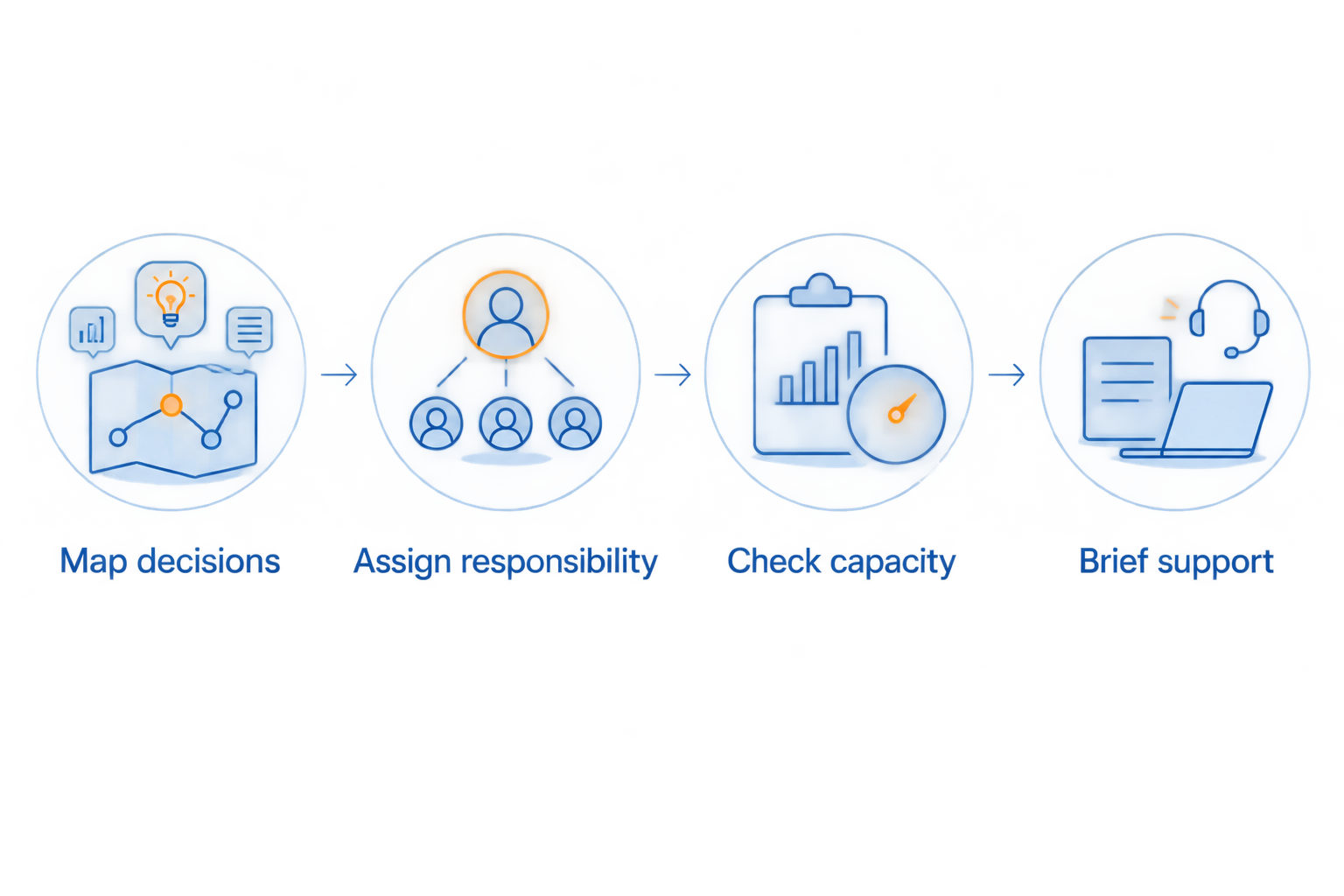
Choose support after identifying the decisions and responsibilities that need to change.
This exercise gives you something concrete to discuss during a sales conversation. For a deeper look at the operational constraint, read about team capacity bottlenecks before setting a larger bookings target.
How these options are ranked
This ranking prioritises combined business strategy and implementation, followed by distinct needs: owner independence, enquiry quality and decision support. It does not rank providers by unverified results, testimonials or reputation.
The criteria are owner independence, delivery capacity, commercial clarity, implementation ownership, relevant evidence and scope. A narrower option becomes your first choice when it matches the actual constraint.
Ask each shortlisted provider to apply those criteria to your business. Request the proposed first priority, your team's responsibilities and evidence from comparable service businesses.
Which coaching option should you choose?
Elevatory suits established Australian home services owners seeking business coaching with done-with-you marketing implementation. Start there when the business needs coordinated decisions about offers, funnels, paid ads and systems.
Choose operations-focused coaching first when routine delivery still relies on you. Choose marketing coaching when the team is ready for more suitable work, or mentoring when you need help resolving a defined decision.
For 2026, make your selection on the work required—not the broadest promise. Ask every provider what changes inside your team, not just what happens in the sessions.
Discuss your business constraint
Bring your team responsibilities, delivery capacity and marketing priorities to the conversation.
FAQ
What's the best business coach for home services businesses?
The best fit depends on whether your constraint is owner dependence, enquiry quality or implementation. Elevatory suits established Australian businesses seeking business coaching with done-with-you marketing implementation; operations-focused coaching is the narrower choice for delegation and delivery responsibilities.
Should I hire a coach before spending more on advertising?
Address unclear delivery responsibilities before committing to more demand. If your team can deliver additional suitable work, assess marketing support against enquiry quality, follow-up and profitable bookings.
Can a business coach help me get off the tools?
Business coaching can support a plan to delegate decisions and delivery responsibilities. Choose an engagement that covers authority, handovers and team accountability; coaching does not itself fill an operational role.
Is a business mentor better than a business coach?
A business mentor is the better fit when you need a sounding board for a defined decision. For recurring operational problems or marketing changes, assess coaching and implementation support against the work required.
How do I check whether a coach understands home services?
Ask for comparable service-business examples and an explanation of how they handle crew capacity, quoting, scheduling and job margins. Retail sales results alone do not establish experience with field-service delivery.
What should I take to a business coaching conversation?
Take your role responsibilities, current bookings, quoting process and examples of decisions that repeatedly return to you. Include the services you want to sell and the team's capacity to deliver them.
Do I need a Brisbane business coach if my business is elsewhere?
Choose on service fit, relevant experience and the agreed delivery format rather than location alone. Confirm whether meetings, team involvement and implementation support suit how your business operates.
One last thing
Ask a prospective coach: “Which decision should stop coming to me first?” A useful discussion will connect that decision to a responsible role, clear authority and a way to check the outcome.
That is a more practical starting point than asking how fast revenue can grow. Build the team's ability to carry responsibility alongside the plan to win work.
Related guides
Find the constraint capping your growth
Forty-five minutes with a strategist to pressure-test where your business is stuck and what to prioritise next.
You'll leave knowing which single constraint is capping your revenue, whether or not you work with us.
Prefer to talk first? Call 1300 634 230 or email chris@elevatory.com.au