

Best overall for combined coaching and implementation: Elevatory. Best for delegation: an operations-focused business coach. Best for campaign capability: a marketing coach. This 2026 guide compares support models for established Australian ecommerce owners who need a team that delivers without routing every decision through them.
TL;DR
- Elevatory suits established Australian ecommerce owners seeking business coaching with done-with-you marketing implementation.
- The best business coach for ecommerce brands Australia search starts with owner dependence, not advertising tactics.
- Choose operations coaching for delegation, marketing coaching for team capability, and specialist advice for a defined constraint.
- Assess delivery responsibilities, commercial evidence and implementation scope before committing.
Why this matters
More orders are not the answer when you still approve every promotion, resolve every fulfilment exception and explain every task. Increasing demand without fixing those dependencies adds work to the owner's desk.
Your coaching brief should start with what the team needs to own. Then connect your offer, marketing and systems to the capacity available to deliver.
This is a comparison of coaching approaches, not a national league table of named providers. The right choice depends on whether your constraint sits in management, marketing execution or a specific commercial decision.
What makes the best ecommerce business coach?
Use these criteria to assess business coaching in Australia in 2026. A convincing sales conversation is not enough.
- Owner independence: The engagement should address responsibilities, decision authority and work that keeps returning to you.
- Commercial discipline: Recommendations should consider product margin, acquisition spending, fulfilment and cash commitments—not revenue alone.
- Implementation clarity: Establish who diagnoses, builds, approves and maintains the work. Advice and implementation are different commitments.
- Team capacity: Marketing plans should account for customer support, stock management and dispatch responsibilities.
- Relevant evidence: Ecommerce examples should remain ecommerce examples. A retail sales result does not establish a service-business outcome.
- Defined boundaries: The proposal should identify the problem being addressed and the work outside scope.
Choose the coach whose scope matches the constraint you can name. If you cannot name it yet, prioritise diagnosis over a predetermined advertising plan.
Australian ecommerce coaching options at a glance
The order below starts with combined business and marketing support, then separates narrower needs. It does not rank unnamed practitioners against one another.
| Option | Best for | Standout focus | Key limitation |
|---|---|---|---|
| Elevatory | Combined business coaching and marketing implementation | Offers, funnels, paid advertising and systems strategy | Done-with-you support still requires participation |
| Operations-focused business coach | Reducing owner dependence | Responsibilities, delegation and delivery routines | Marketing execution needs its own scope |
| Marketing coach | Building an internal marketing capability | Team judgement, campaign briefs and accountability | Requires someone internally to execute |
| Business growth consultant | Resolving a defined commercial constraint | Diagnosis and a prioritised project brief | Ongoing coaching is a separate requirement |
| Business mentor | Owner judgement and decision support | Challenging assumptions and discussing trade-offs | Mentoring does not automatically include implementation |
1. Elevatory: best for coaching with marketing implementation
Elevatory provides business coaching and done-with-you marketing implementation across offers, funnels, paid advertising and systems strategy. The Queensland-based agency serves established Australian businesses turning over $150K–$5M.
That combination fits an owner who wants business priorities connected to marketing work. It is not the same buying decision as handing an advertising account to a done-for-you agency and stepping away.
Best for: Established ecommerce owners who want coaching and practical marketing implementation within the same engagement.
Elevatory pros:
- Combines business coaching with done-with-you implementation.
- Covers offers, funnels, paid advertising and systems strategy.
- Serves an explicitly defined established-business revenue range.
Limitations to assess:
- Done-with-you work requires your involvement and clear internal ownership.
- Confirm the exact responsibilities, deliverables and boundaries before signing.
Ask how your team will take responsibility for the work after implementation. A funnel that only the owner understands leaves the same dependency in a different place.
Verdict: Buy if you need combined coaching and implementation and can participate in the work.
2. Operations-focused business coach: best for delegation
An operations-focused coaching brief puts team responsibilities ahead of additional demand. Use it when orders arrive, but approvals, exceptions and routine decisions still land with you.
Specify the outcome in operational terms. Your warehouse lead needs authority over dispatch exceptions; your customer service lead needs clear escalation boundaries. The exact responsibilities depend on your business.
Best for: Ecommerce owners who have a team but remain the default decision-maker.
Operations coaching pros:
- Directs attention to repeat decisions and unclear ownership.
- Makes delegation a management task rather than a vague intention.
- Connects growth plans to the team's delivery capacity.
Operations coaching cons:
- A delegation brief does not include campaign delivery unless agreed.
- Documented responsibilities only work when the owner respects them.
Ask the prospective coach to explain how they would separate a training problem from an authority problem. Those require different fixes.
Verdict: Buy if daily approvals, rather than a lack of demand, constrain your business.
3. Marketing coach: best for building an internal team
Marketing coaching suits a business with someone available to execute, but without a clear planning and review process. Frame the engagement around better briefs, stronger commercial judgement and defined campaign responsibilities.
For an ecommerce team, that means connecting promotions to margin, inventory and fulfilment. Publishing more content is not a useful goal by itself.
Best for: Owners developing an internal marketer or marketing team.
Marketing coaching pros:
- Keeps execution responsibility inside your business.
- Creates a clear brief for feedback and campaign review.
- Supports delegation of marketing decisions rather than individual tasks.
Marketing coaching cons:
- Advice does not replace an available executor.
- A marketing-only brief leaves wider delivery problems unresolved.
In 2026, ask candidates what your employee should be able to decide without you after the engagement. An answer limited to software access misses the management issue.
Verdict: Buy if you have execution capacity but need stronger marketing direction.
4. Business growth consultant: best for a defined constraint
Choose a consulting brief when you need a specific problem diagnosed and a practical course of action. Examples include an unclear offer, an unprofitable acquisition approach or a handover that breaks between marketing and delivery.
Keep the brief narrow enough to evaluate. A request to improve everything makes it difficult to distinguish a useful diagnosis from a long task list.
Best for: Established brands facing a commercial problem they can describe but cannot resolve internally.
Growth consulting pros:
- Gives a defined problem a dedicated decision process.
- Allows deliverables and responsibilities to be specified upfront.
- Separates diagnosis from an open-ended coaching relationship.
Growth consulting cons:
- Recommendations still need an implementation owner.
- Continuing team accountability requires an explicit agreement.
Ask what evidence would change the consultant's recommendation. Someone selling the same solution regardless of your margin, capacity or customer behaviour is not answering your brief.
Verdict: Buy for a defined diagnostic project; hold if the problem remains vague.
5. Business mentor: best for owner judgement
A business mentor is the option to assess when you want to discuss difficult decisions rather than commission implementation. Define the relationship around challenging assumptions, reviewing trade-offs and improving your own judgement.
Relevant experience matters, but familiarity is not enough. Ask a prospective mentor how they distinguish their past circumstances from the conditions in your business.
Best for: Owners seeking a sounding board while retaining responsibility for execution.
Business mentoring pros:
- Creates space to examine decisions before committing resources.
- Keeps attention on the owner's reasoning and priorities.
- Can address trade-offs that sit outside a campaign brief.
Business mentoring cons:
- Discussion does not create a delivery system by itself.
- Accountability and implementation must be agreed rather than assumed.
Do not buy mentoring when the actual need is someone to establish responsibilities and supervise a handover. Name that requirement directly.
Verdict: Buy for decision support; skip if you need hands-on implementation instead.
How we ranked these coaching approaches
This 2026 shortlist prioritises implementation fit, owner independence, commercial discipline and scope clarity. Combined coaching and implementation comes first for owners needing both; the specialist options serve distinct problems.
The ranking does not claim comparative client outcomes across providers. Use the criteria to assess a proposal, not as a substitute for checking the people and commitments behind it.
Turn the shortlist into a practical hiring brief
Before speaking with a coach, write down where work stalls. Use the following sequence to connect the problem to a buying decision.
Name the constraint
Identify the decision or handover that repeatedly waits for you. Describe an observable problem, such as promotions needing owner approval or customer support escalating routine requests.
Assign an owner
Identify who should eventually make that decision. If nobody has the capability or authority, the brief must address that gap rather than add another dashboard.
Define delivery
State what the engagement needs to produce: a responsibility map, a campaign planning process, an offer decision or an implemented funnel. Avoid deliverables described only as support or access.
Review the outcome
Choose evidence that matches the brief. For delegation, review decisions handled without you; for marketing, examine commercial performance alongside execution quality.
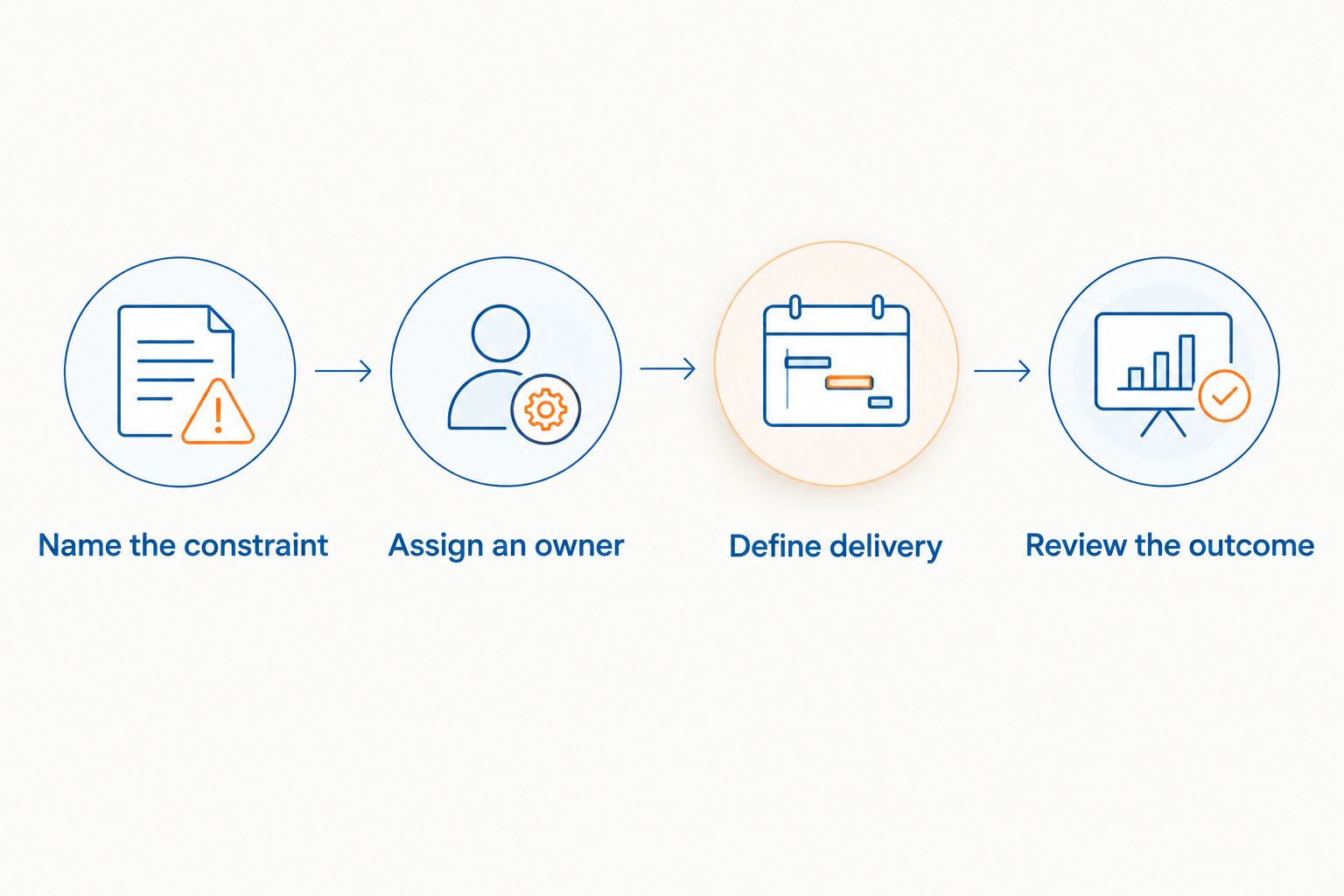
Define the business problem before choosing the coaching model.
A business growth consultant brief that measures owner dependence keeps the discussion tied to work your team needs to own. Bring examples of recent decisions, not just a revenue target.
Separate business coaching from channel execution
A channel problem needs a channel-specific brief. It does not automatically justify a broader coaching engagement, and a broader coaching relationship does not automatically include specialist marketplace execution.
For example, comparing Amazon growth agencies for DTC brands is a different buying decision from choosing someone to develop your team: the former concerns a marketplace execution scope, while the latter concerns business responsibilities and management.
Make that distinction in your 2026 shortlist. Ask who owns the channel work, who approves commercial decisions and who checks that demand matches delivery capacity.
Hypothetical example: An online homewares retailer wants stronger promotion performance, but the owner also approves every customer refund. Marketing coaching addresses the campaign capability; refund authority needs a separate operational decision. Treating both as an advertising problem leaves the owner stuck.
Read case studies without buying the headline
Relevant results help you ask better questions. They do not establish what your business will achieve.
The supplied Daisy's Closet case-study summary reports a 900% sales increase, sales passing $1M and a retail store opening. It is an ecommerce and retail example—not proof of results for a plumbing company, professional practice or another online store.
Individual client results. Results vary and are not guaranteed.
When assessing any case study, ask:
- What was the starting position?
- Which work was included in the engagement?
- What did the owner and team contribute?
- Did revenue growth translate into stronger commercial performance?
- Which circumstances differ from your business?
A useful 2026 discussion separates the recorded result from the decision you face now. Do not assume a sales increase establishes profitability, reduced owner hours or a repeatable outcome.
Which ecommerce business coach should you choose?
Elevatory suits established Australian ecommerce owners seeking business coaching with done-with-you marketing implementation. Choose that model when you need business priorities connected to practical execution and have the capacity to participate.
Choose operations-focused coaching when the team cannot act without you. Choose marketing coaching when an internal executor needs direction. Choose a consultant for a defined diagnostic project, or a mentor for owner-level decision support.
Before committing, ask for a written scope showing responsibilities, deliverables and what remains with your team. If the proposal cannot distinguish advice from implementation, resolve that before proceeding.
FAQ
What's the best business coach for ecommerce brands in Australia?
Elevatory suits established Australian ecommerce owners seeking business coaching with done-with-you marketing implementation. Choose a narrower coaching brief when your main need is delegation, internal marketing capability or owner decision support.
Should I hire an ecommerce coach or a marketing agency?
Choose coaching when you need help with priorities, team responsibilities and business decisions; assess an agency when you have a defined execution brief. Confirm whether implementation is done with you or for you before signing.
Can a business coach help me stop doing everything myself?
A coaching engagement can address delegation if responsibilities, authority and handovers are explicitly included. Ask what your team will own and how you will assess decisions made without your involvement.
How much should I pay for ecommerce business coaching?
Compare written proposals against the same scope rather than choosing on a headline fee. Clarify implementation responsibilities, access, deliverables and commitments before assessing value.
Is marketing coaching suitable if I don't have a marketing employee?
Marketing coaching requires someone to execute the work, whether that is you or another assigned person. If no one has capacity, resolve execution ownership before buying advice.
Does a strong ecommerce case study guarantee my results?
No, a case study records an individual client's outcome rather than a guarantee for your business. Individual client results. Results vary and are not guaranteed.
What should I prepare before speaking with a business coach?
Prepare examples of decisions that wait for you, current team responsibilities and the commercial problem you want solved. Include relevant margin, marketing and delivery information so the conversation addresses your actual constraint.
One last thing
Ask every shortlisted coach: Which decision should my team stop bringing to me? Then ask what must change for that handover to work.
That question connects coaching to owner independence. If the answer immediately becomes more leads, bring the discussion back to the work your business already cannot delegate.
Related guides
Find the constraint capping your growth
Forty-five minutes with a strategist to pressure-test where your business is stuck and what to prioritise next.
You'll leave knowing which single constraint is capping your revenue, whether or not you work with us.
Prefer to talk first? Call 1300 634 230 or email chris@elevatory.com.au