
Best for established builders seeking business coaching with done-with-you marketing implementation: Elevatory. Best for construction-specific operating advice: a building-industry coach; best for managing daily delivery: an operations specialist—choose your business coach for builders around the decisions you need to stop making yourself.
TL;DR
- Elevatory suits established Australian businesses seeking business coaching with done-with-you marketing implementation.
- Choose a business coach for builders around owner dependence, team capacity and profitable work—not lead volume alone.
- A construction specialist fits technical operating priorities; an operations consultant fits delivery handovers.
- Ask every business mentor for relevant evidence, clear responsibilities and an implementation scope.
Why this matters
If every site query, quote and customer complaint reaches you, more enquiries do not remove that dependency. They add another queue for you to manage.
Your 2026 coaching brief should start with the team: who owns delivery, which decisions need your approval and what stops work when you leave. Marketing belongs in that brief, but it must match your ability to deliver the work you sell.
This shortlist ranks support options by the problem they address. It is not a claim that one provider has outperformed every Australian building-business coach.
What makes the best business coach for builders?
Judge the fit before judging the presentation. Use these criteria when comparing a business coach, business mentor or business growth consultant:
- Owner independence: The engagement should identify decisions the team can own, not simply give you more tasks.
- Building-business relevance: Ask for experience with quoting, variations, subcontractors, scheduling and delivery handovers relevant to your work.
- Commercial discipline: Discussions should connect sales to job profitability, cash commitments and available capacity.
- Implementation responsibility: Establish what the adviser does with you, what your team does and who checks completion.
- Evidence quality: Ask for relevant examples with clear scope. A result from a different business model does not establish builder-specific expertise.
- Professional boundaries: Coaching should not substitute for qualified construction, accounting or legal advice.
For your 2026 shortlist, reject proposals that promise growth before examining delivery. A coach should understand what happens after you win the job.
Builder coaching options at a glance
| Rank and option | Best for | Standout focus | Key limitation |
|---|---|---|---|
| 1. Elevatory | Connecting business coaching with marketing implementation | Done-with-you work across offers, funnels, paid advertising and systems strategy | Not a substitute for construction-specific technical advice |
| 2. Building-industry business coach | Construction-specific operating decisions | Assessing building workflows and commercial decisions | Industry knowledge alone does not establish implementation capability |
| 3. Operations consultant | Transferring delivery responsibility | Roles, handovers and decision authority | Consulting does not automatically provide ongoing operational management |
| 4. Experienced builder mentor | Owner judgement and difficult trade-offs | Discussing decisions with a relevant industry peer | Personal experience is not a repeatable implementation system |
| 5. Marketing coach or strategy consultant | Improving enquiry quality when delivery is ready | Offer positioning, qualification and sales handover | Marketing cannot resolve unclear site responsibilities |
1. Elevatory: best for coaching with marketing implementation
Best for: Established Australian builders seeking business coaching alongside done-with-you marketing implementation.
Elevatory is a Queensland-based boutique business coaching and marketing agency serving established Australian businesses turning over $150K–$5M. Its stated scope covers offers, funnels, paid advertising and systems strategy.
That combination fits a brief where business priorities and marketing execution need to connect. You still need a named person inside your business to make decisions, supply information and complete agreed actions.
Pros:
- Business coaching and marketing implementation sit within the stated offer.
- Done-with-you support suits owners who want to participate rather than outsource every decision.
- The stated turnover range focuses on established businesses rather than startup planning.
Cons:
- Done-with-you work requires time and participation from your business.
- The stated scope does not replace technical building, legal or accounting advice.
- Builders should confirm relevant construction experience before committing.
Verdict: Buy this type of support when your brief combines business priorities with marketing implementation; hold if you need someone to run your sites.
2. Building-industry business coach: best for construction context
Best for: Builders whose main difficulty sits in construction-specific commercial or operating decisions.
Look for a coach who can discuss your actual workflow: enquiry, qualification, estimating, contract handover, delivery and variations. Ask how the approach changes for your type of building work rather than accepting a generic trades presentation.
A specialist title is not proof. Request an example showing the initial problem, the work completed and the owner's responsibilities throughout the engagement.
Pros:
- Relevant construction experience gives discussions a practical starting point.
- A suitable specialist can assess the relationship between quoting and delivery.
- Industry-specific examples help you judge whether the advice fits your operation.
Cons:
- Experience with another building model does not establish fit with yours.
- Advice-only coaching leaves implementation with your existing team.
- Industry familiarity does not replace qualified professional advice.
Ask the candidate to walk through a delayed job without jumping straight to sales. Listen for questions about scope, responsibilities, scheduling and communication.
Verdict: Buy when construction context is the deciding requirement and the candidate can demonstrate relevant work.
3. Operations consultant: best for delivery handovers
Best for: Builders with work to deliver but too many routine decisions returning to the owner.
An operations consulting brief should specify the handovers you want to change. Examples include moving a sold job into delivery, assigning responsibility for customer updates and defining who can approve a routine decision.
Do not confuse designing an operating system with managing it. If you need someone to direct staff every day, assess an operations manager role separately.
Pros:
- A defined project can focus on specific handover failures.
- Written responsibilities give managers a clearer basis for action.
- Decision rules make delegation more concrete than a job title alone.
Cons:
- New processes need internal ownership after the engagement ends.
- Documentation does not remove a skills or staffing gap.
- Daily management requires a different scope from process design.
Ask for working documents your team can use: responsibility maps, handover checklists and escalation rules. A presentation without an adoption plan is not a completed handover.
Verdict: Buy when the constraint is delivery responsibility; hold if nobody has capacity to implement the changes.
4. Experienced builder mentor: best for owner judgement
Best for: Owners who need an experienced sounding board for difficult business decisions.
A builder mentor can help you examine trade-offs such as remaining hands-on, appointing a manager or narrowing the work you accept. The value depends on how closely the mentor's experience matches the decision—not how impressive the biography sounds.
Use mentoring to challenge your reasoning. Do not treat another owner's past approach as an instruction to copy.
Pros:
- Relevant experience creates context for discussing difficult choices.
- Mentoring gives the owner space to examine competing priorities.
- A clearly defined relationship can focus on judgement rather than a broad transformation project.
Cons:
- Personal experience does not establish a method that fits your business.
- Mentoring does not supply implementation capacity by itself.
- An informal relationship needs explicit boundaries and expectations.
Ask what the mentor would need to understand before advising you. Someone who starts with questions gives you a better basis for assessment than someone who immediately prescribes their own path.
Verdict: Buy for decision support; skip as a substitute for a delivery team or implementation project.
5. Marketing coach: best for better-fit enquiries
Best for: Builders with clear delivery responsibilities and capacity for the right additional work.
A marketing coaching brief should define the jobs you want, the enquiries you should reject and the information needed before preparing a quote. Campaign activity comes after those decisions.
Ask the marketing strategy consultant to connect enquiry qualification with your estimator or sales process. Otherwise, marketing and delivery remain separate conversations.
Pros:
- A focused brief connects messaging to the work you want to win.
- Qualification criteria give the team a consistent screening process.
- Coaching supports internal decision-making rather than requiring every choice to remain external.
Cons:
- Better targeting does not fix weak delivery systems.
- Your team still needs responsibility for follow-up and qualification.
- Campaign reporting alone does not establish job profitability.
Verdict: Buy when delivery is ready and enquiry quality is the constraint; wait when existing work already overwhelms the team.
How these options are ranked
The order prioritises combined coaching and implementation, then construction context, delivery systems, owner judgement and marketing specialisation. These are distinct buying needs, not interchangeable services.
For a 2026 decision, apply the criteria to your own constraint. An operations specialist belongs above a marketing coach when your team cannot progress jobs without you.
Turn the shortlist into a practical brief
Before a sales conversation, review a recent working week. Record each decision that interrupted you and sort it into clear categories.
- Decision log: Note what happened, who asked and why the decision reached you.
- Role ownership: Assign the role that should normally handle it.
- Decision limits: Define what that role can approve independently.
- Escalation rules: Specify what still needs your involvement.
- Weekly review: Check whether the new arrangement works in practice.
This sequence gives a prospective coach something concrete to assess. It also separates unclear authority from missing skills or insufficient capacity.
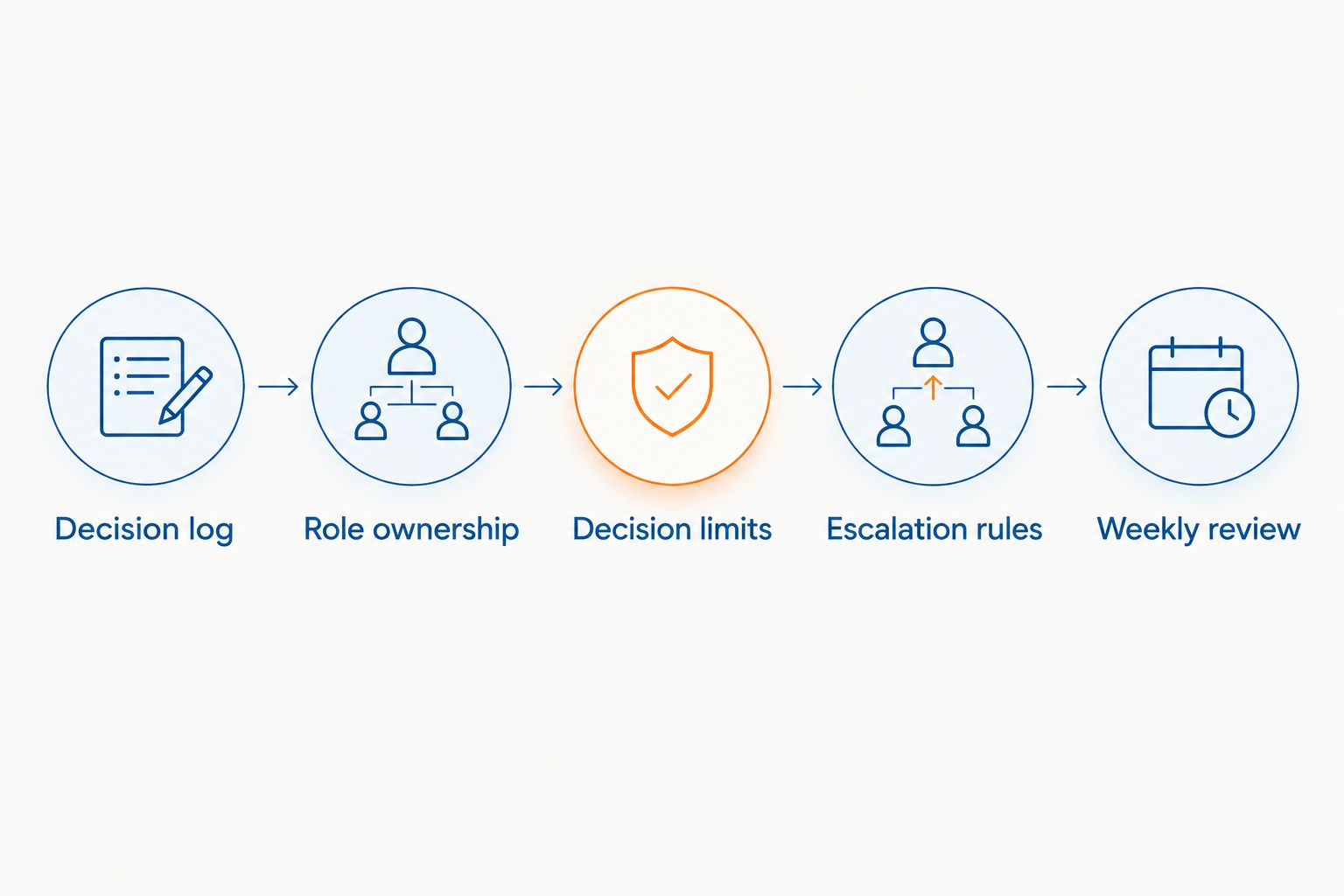
Define authority and escalation before expecting the team to act independently.
Set aside 30 minutes to prepare the log and a 60-minute meeting to discuss ownership with your team. These are suggested working sessions, not promised time savings.
Use a 4-week review period to inspect whether decisions stay delegated. Track exceptions and revise the rules rather than quietly taking all the work back. The guide to measuring owner dependence expands that diagnostic.
Connect marketing to the work you can deliver
Your 2026 marketing brief should identify the work your team can deliver well, not simply request more leads. Specify service area, project type, qualification questions and who owns the response.
The choice between SEO versus paid ads belongs after those decisions: neither channel assigns responsibility for qualifying an enquiry or handing an accepted job to delivery. Assess channels against the same commercial brief rather than treating traffic as the end result.
Hypothetical example: A renovation builder wants more enquiries, but the owner approves every estimate and handles every customer update. The first assignment is to define estimating responsibility and customer communication—not launch another campaign.
Once those responsibilities work, the marketing brief can focus on suitable projects. Measure qualified enquiries, quotes issued, accepted work and the team's capacity to fulfil it. Do not treat an enquiry count as proof of profitable growth.
Questions to ask before signing in 2026
Use the same questions with every candidate. Comparable answers make the decision clearer.
- What problem would you address first, and what evidence supports that choice?
- Which tasks will you complete with us, and which remain ours?
- Who needs to attend working sessions?
- What documents or processes will our team use afterwards?
- How will you assess whether owner dependence has changed?
- Which parts of this brief fall outside your expertise?
Ask for the scope in writing. Check responsibilities, review arrangements and the basis for evaluating progress before committing.
Which support should you choose?
Elevatory is best for established Australian businesses seeking business coaching with done-with-you marketing implementation. For a builder, the next step is to confirm that the proposed scope addresses the actual operating constraint.
Choose a construction specialist for industry-specific operating advice. Choose operations support when delivery keeps returning to you, a mentor for judgement, or marketing coaching when the team is ready for better-fit work.
Do not buy the broadest promise. Buy the clearest assignment.
FAQ
What's the best business coach for builders in Australia?
The best fit depends on whether the builder needs construction-specific advice, delivery systems or coaching with marketing implementation. Compare candidates against the same written brief and ask for relevant evidence rather than relying on a national ranking.
Is Elevatory suitable for an established building business?
Elevatory's stated offer suits established Australian businesses seeking business coaching and done-with-you marketing implementation. Builders should confirm construction relevance, responsibilities and scope before committing.
Should I hire a business coach or an operations manager?
Hire for the work you need done: coaching supports decisions and implementation, while an operations manager role covers ongoing management responsibilities. If daily direction is missing, define that role before assuming coaching will replace it.
Can business coaching help me step off the tools?
A coaching brief can address the responsibilities and decision rules needed to reduce owner dependence. Your business still needs capable people, clear authority and time to implement the handover.
Do I need a coach who only works with builders?
Prioritise construction-specific experience when the main problem requires building-industry context. For broader marketing or delegation work, assess relevant capability and professional boundaries rather than relying only on a specialist title.
Should a builder start paid ads before hiring a coach?
Check delivery capacity and enquiry ownership before starting paid ads. If nobody owns qualification, quoting or the delivery handover, address those responsibilities before increasing demand.
How should I measure whether business coaching is working?
Agree on measures tied to the original problem, such as decisions handled without the owner, handovers completed and qualified enquiries progressing to accepted work. Review those measures alongside implementation tasks rather than counting meetings attended.
One last thing
Before your next coaching enquiry, leave one routine decision with its assigned owner and inspect what happens. A missing instruction, unclear approval limit or skills gap gives you a more precise brief than saying you need to scale.
The decision you keep taking back is a practical place to start.
Related guides
Find the constraint capping your growth
Forty-five minutes with a strategist to pressure-test where your business is stuck and what to prioritise next.
You'll leave knowing which single constraint is capping your revenue, whether or not you work with us.
Prefer to talk first? Call 1300 634 230 or email chris@elevatory.com.au