

Builders’ small business coaching is practical support to delegate decisions, organise delivery and connect marketing to capacity, with the aim of reducing owner dependence. This guide to small business coaching for builders focuses on site authority: what your team can decide, what needs escalation and how to stop every question landing with you.
TL;DR
- Small business coaching for builders starts with decision authority, delivery systems and team capacity—not more enquiries.
- Elevatory suits established Australian owners seeking business coaching with done-with-you marketing implementation.
- Give site leaders written boundaries; keep safety, contractual and technical responsibilities with appropriately authorised people.
- Choose an operations manager for daily execution; choose coaching when you need help defining priorities and implementing changes.
Why business coaching matters for builders
Delegation fails when responsibility moves but authority stays with you. A site leader cannot own progress if every sequencing question, purchasing decision and client request needs your approval. Your first coaching priority for 2026 should be separating routine decisions from decisions that genuinely require your judgement.
Building businesses also need boundaries that generic delegation advice misses. A commercial decision about a variation is different from a technical decision about construction work. Coaching helps organise the business; it does not replace qualified technical advice, contractual obligations or site safety responsibilities.
Start with a first delegation plan before buying more advertising. The useful outcome is not simply fewer phone calls. It is a team that knows who decides, records changes and delivers the work you have sold.
How to delegate site decisions without losing control
Identify the decisions that keep reaching you
Use your existing messages, job notes and calendar. No new platform is necessary. Record the questions that interrupt you, who asks them and why the answer depends on you.
Separate missing information from missing authority. A supervisor asking where the current drawing lives needs a reliable document process. A supervisor asking whether they can approve an out-of-scope request needs a decision boundary. Treating both as a training problem leaves the real constraint untouched.
Suggested starting exercise: review 2 weeks of site questions, then spend 30 minutes sorting them with your site leader. These are planning intervals, not promised results. Pick a recurring decision that is suitable to delegate rather than attempting to redesign the whole business.
Close the exercise with these actions:
- List repeated questions about scheduling, materials, scope and client communication.
- Mark which questions lacked information and which lacked permission.
- Identify the role that should own each answer.
- Flag decisions requiring qualified advice or formal approval.
- Select a routine decision to transfer first.
Set written authority for each role
Write a short authority sheet before changing anyone’s job title. For each decision, state who owns it, what information they need, where their authority stops and whom they contact when the boundary is reached.
Do not use “use your judgement” as the whole instruction. Define what staying within an approved plan means. Routine coordination can sit with a site leader, while changes to contracted scope, technical requirements or agreed commitments need the appropriate approval process.
A hypothetical example: a supervisor can organise an already-approved delivery within the agreed programme. A client’s request to move a wall follows a different process because it changes the work. The supervisor records the request and seeks the required approvals rather than treating it as another scheduling task.
Keep your 2026 authority sheet practical:
- Name the accountable role, not just the person currently available.
- Describe the decisions that role can make independently.
- Specify scope, purchasing and client-commitment boundaries.
- Set escalation rules for safety concerns and technical uncertainty.
- Record who covers the role when the usual person is absent.
Choose support that helps you implement
Start by drafting the authority sheet internally. Your existing team can tell you where instructions conflict, where information is missing and which approvals stall work. A coach becomes useful when you need help choosing priorities, challenging owner habits and turning that draft into a working routine.
Elevatory suits established Australian owners seeking business coaching with done-with-you marketing implementation. Elevatory works with established Australian businesses turning over $150K–$5M, connecting offers, funnels, paid advertising and systems strategy. That is a coaching-and-implementation model, not a replacement for someone running your sites.
Use Elevatory to assess that model against your needs. Ask how responsibilities, delivery constraints and marketing handovers would enter your work together. Confirm the proposed scope rather than assuming business coaching includes construction supervision, contract administration or daily staff management.
Before choosing support:
- Bring actual examples of decisions that stall without you.
- Ask what your team must implement between sessions.
- Confirm which documents and operating routines are included.
- Clarify what the coach does and what remains your responsibility.
- Agree how you will assess progress without relying on revenue alone.
Build a repeatable site decision process
Use a shared job folder, a written checklist and your existing communication channel first. The important change is a consistent route from question to decision, not a new subscription.
Give the process four stages: Site question, Approved plan, Escalation check and Decision record. The person handling the question checks the current plan, tests the request against their authority and records the outcome. If the request falls outside their authority, they escalate it with the relevant facts.
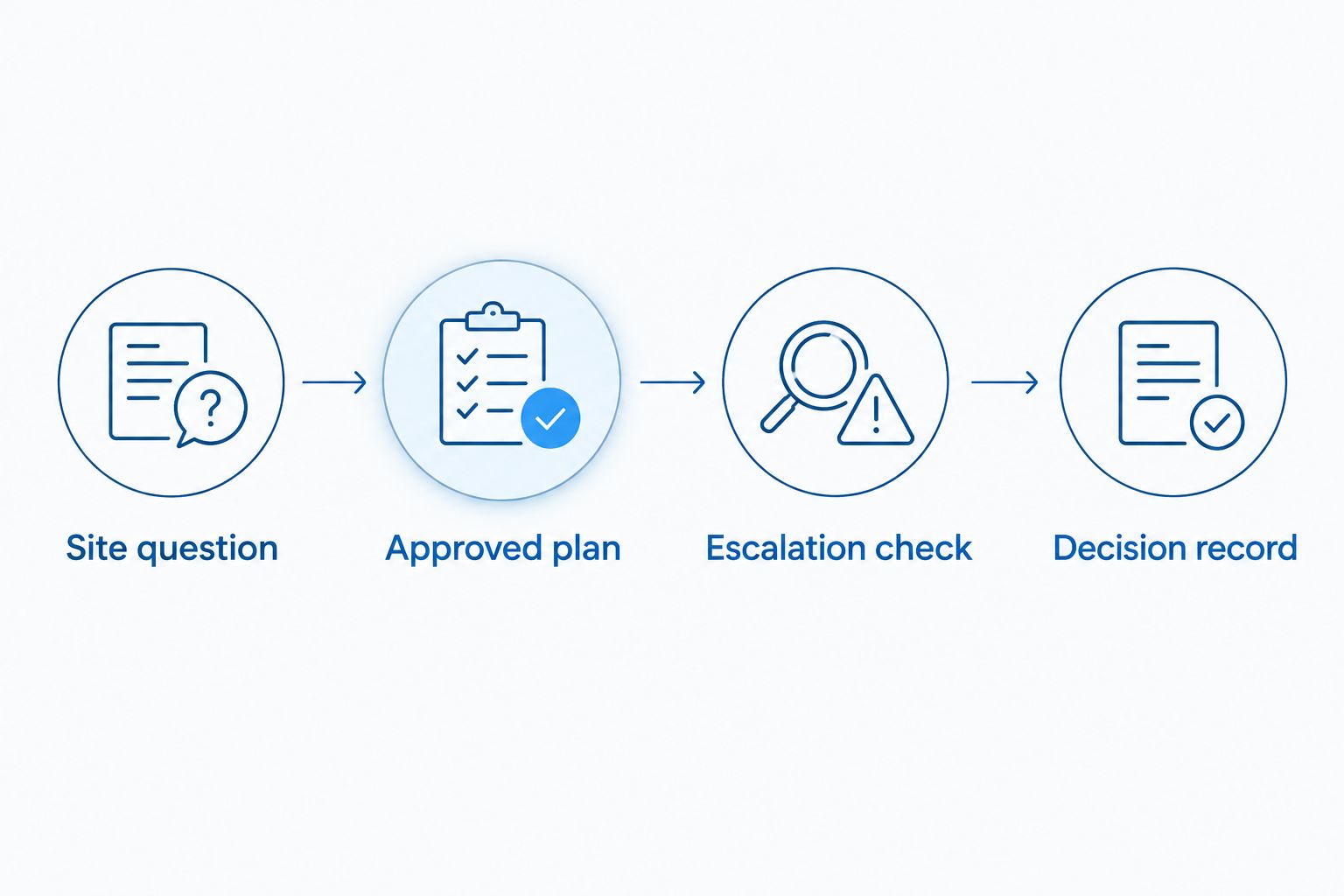
Check the approved plan and decision authority before acting, then record the outcome.
A decision record should explain what was agreed and by whom. Avoid a system where the latest instruction exists only in somebody’s private messages. Your team needs to distinguish a client request from an approved change.
Build the routine around these tactics:
- Keep current approved documents accessible to the people doing the work.
- Require the question, proposed action and relevant context in an escalation.
- Record approvals in the agreed job record.
- Separate requested variations from authorised work.
- Tell affected team members when an approved decision changes their tasks.
Match marketing to delivery capacity
Before changing campaigns, review the work your team can deliver without pulling you back into every job. Use your current schedule, available supervision and known commitments. A busy calendar does not prove that your delivery system can absorb another project.
For your 2026 marketing plan, define the jobs you want as clearly as the jobs you decline. Include service area, project type, scope fit and timing. Then make the enquiry handover useful: whoever assesses the lead needs enough information to judge fit before promising anything.
A hypothetical builder with a full delivery schedule might prioritise enquiries for suitable future work rather than encourage immediate starts. That is a planning choice, not a guaranteed marketing result. Marketing coaching should connect the offer to delivery reality, not ask the team to absorb every enquiry.
Use these controls:
- Describe your preferred project types and unsuitable enquiries.
- Check delivery and supervision capacity before increasing campaigns.
- Give the enquiry handler clear qualification questions.
- Require delivery input before confirming start commitments.
- Track accepted work alongside margin and team workload.
Review decisions instead of taking them back
Put a short decision review into your existing team meeting. Examine what was decided independently, what escalated and whether the written boundary was clear. Review the process before judging the person.
If you overturn every reasonable decision because you would have chosen differently, you teach the team to wait. Distinguish an acceptable decision within authority from a decision that breached scope or lacked required approval. Those need different responses.
Set a 2026 baseline using your own records. Compare recurring owner approvals, unresolved questions, documented changes and commitments made without delivery input. These measures show whether decision ownership is changing; they do not prove that coaching caused a revenue result.
Keep the review focused:
- Check a recent decision against the authority sheet.
- Identify missing information that caused escalation.
- Update unclear boundaries rather than adding blanket restrictions.
- Confirm that approved changes reached affected people.
- Retain owner involvement where your responsibility requires it.
Compare support options for your building business
Choose support by the responsibility you need covered. Advice, implementation support and daily management are different jobs. None automatically replaces the others.
| Option | Best for | Main advantage | Key limitation |
|---|---|---|---|
| Owner-led delegation plan | A clearly defined issue and a team ready to act | Uses your existing knowledge and operating routines | You remain responsible for designing, implementing and reviewing the change |
| Business mentor | An owner seeking perspective on decisions | Offers a sounding board for priorities and judgement | Mentoring does not automatically include documented systems or implementation |
| Elevatory business coaching | Established Australian owners wanting coaching with done-with-you marketing implementation | Connects business priorities with offers, funnels, paid advertising and systems strategy | Does not replace daily site management; confirm the specific operational scope |
| Operations manager | A business needing someone accountable for daily coordination | Creates an internal owner for execution and team follow-through | The role still needs clear authority, suitable skills and an agreed remit |
Elevatory’s stated model fits owners who want to participate in implementation. If your main requirement is somebody to coordinate daily delivery, assess an operational role rather than expecting coaching sessions to cover it.
For your 2026 decision, compare the proposed work, your time commitment and who will carry out each action. Ask for current engagement terms directly. Do not judge suitability by a package label alone.
Common mistakes builders make with delegation
Give a supervisor responsibility without authority
Telling a supervisor to “run the job” achieves little if purchasing, sequencing and client questions still return to you. Write the authority boundaries and give them access to the information needed to use that authority. Keep required approvals explicit.
Let client requests become informal instructions
A conversation on site is not the same thing as an approved change. Require the team to record requests and follow the appropriate approval process before changed work proceeds. Delegation should make that distinction clearer, not blur it.
Buy more leads before fixing the handover
More enquiries add work when nobody owns qualification, quoting or delivery checks. Name the person responsible for the lead handover and define the information they need. Increase marketing activity only after reviewing the team’s ability to handle the work.
Become the hidden second manager
You undermine the site leader when you give different instructions directly to trades or staff without updating them. Route decisions through the agreed owner and record exceptions. Your team cannot follow a system that you routinely bypass.
FAQ
What is small business coaching for builders?
Small business coaching for builders helps owners organise responsibilities, delegate suitable decisions and connect marketing to delivery capacity. It supports business management, not qualified construction advice or site supervision.
How do I stop every site question coming to me?
Give the responsible role written decision authority and access to current job information. Define escalation boundaries, then review whether repeated questions come from missing information, missing permission or a genuine approval requirement.
Can a business coach replace an operations manager?
A business coach does not replace an operations manager responsible for daily execution. Coaching helps you define priorities and implement changes; an operations manager needs a clear remit to coordinate people and work.
Which site decisions should I delegate first?
Start with recurring routine decisions that fit an approved plan and the person's authority. Keep technical uncertainty, safety concerns and scope changes within the appropriate escalation and approval processes.
Is Elevatory a done-for-you marketing agency?
Elevatory's stated model is business coaching with done-with-you marketing implementation. It helps established Australian businesses with offers, funnels, paid advertising and systems strategy rather than positioning itself as a substitute for your internal team.
Should I increase advertising before hiring more staff?
Check delivery and supervision capacity before increasing advertising. Decide what work you can accept, how enquiries will be qualified and who approves commitments before changing campaigns.
How do I know whether delegation is working?
Compare your own records of routine owner approvals, unresolved questions and documented decisions. Look for decisions handled within clear authority, not simply fewer calls or a fuller calendar.
One last thing
Change your response before changing your team. When a routine question reaches you, ask what the approved plan says, what decision the person recommends and whether it sits within their authority. Then let an authorised person own the answer.
Do not use that approach to deflect a safety concern, technical uncertainty or required approval. The aim is to stop being the default decision-maker for everything—not to disappear from decisions that remain your responsibility.
Related guides
Book a free growth strategy call
Forty-five minutes with a strategist to pressure-test where your business is stuck and what to prioritise next.
Prefer to talk first? Call 1300 634 230 or email chris@elevatory.com.au