

Best for business coaching with done-with-you marketing implementation: Elevatory. Best for clinic-specific business questions: an allied health specialist coach. Best for delivery bottlenecks: an operations consultant. This 2026 guide helps you choose a business coach for allied health clinics by the problem your team needs to solve, rather than by a promise of more leads.
TL;DR
- Elevatory suits established businesses seeking business coaching with done-with-you marketing implementation, rather than outsourced execution.
- Choose a business coach for allied health clinics around owner dependence, team capacity and implementation needs.
- Choose an allied health specialist coach when clinic-specific operating knowledge is essential; verify relevant experience.
- Fix delivery responsibilities before using marketing coaching to increase enquiries.
Why this matters
A full appointment book does not tell you whether your clinic runs without you. If reception escalates routine decisions, practitioners wait for instructions and every marketing enquiry lands with the owner, growth adds work to the same desk.
Choose support that removes the constraint, not support that simply adds activity. For your 2026 shortlist, separate business direction, clinic-specific expertise, operational implementation and personal accountability. These are different jobs.
The ranking below compares support models, not a tested league table of named allied health coaching firms. Each option has a distinct purpose, so you can decide what to hire before comparing proposals.
What makes the best business coach for allied health clinics?
Judge your shortlist against these five criteria. Ask for concrete examples of how the work happens, not just the topics covered in coaching calls.
- Owner independence: The engagement should address responsibilities, decision boundaries and work that unnecessarily returns to you.
- Clinic relevance: Ask for evidence involving comparable service delivery, practitioner teams and appointment-based businesses. General business experience is not proof of allied health expertise.
- Implementation ownership: Establish who writes procedures, changes enquiry handling and follows up unfinished actions. Advice alone is a different purchase.
- Capacity-aware marketing: Marketing recommendations should account for appointment types, practitioner availability and the team's ability to respond.
- Commercial accountability: Review bookings, delivery costs, lead quality and owner workload together. Enquiry volume alone does not answer whether the work is worthwhile.
Use these criteria in every introductory conversation. A confident presentation is not a substitute for a clear scope and named responsibilities.
Allied health business support at a glance
| Rank and option | Best for | Standout focus | Key limitation |
|---|---|---|---|
| 1. Elevatory | Connecting business strategy with marketing implementation | Coaching plus done-with-you work across offers, funnels, paid advertising and systems | Not a substitute for specialist clinical or regulatory advice |
| 2. Allied health specialist coach | Clinic-specific business decisions | Assessing business choices through relevant clinic experience | Sector knowledge does not establish implementation capability |
| 3. Operations consultant | Fixing delivery and administrative handovers | Defining workflows, responsibilities and escalation rules | An operational brief does not automatically include demand generation |
| 4. Business mentor | Improving owner judgement and accountability | Challenging decisions and maintaining focus | Mentoring alone does not assign someone to implement changes |
1. Elevatory: best for coaching with marketing implementation
Elevatory provides business coaching and done-with-you marketing implementation for established Australian businesses turning over $150K–$5M. Its stated scope includes offers, funnels, paid advertising and systems strategy.
Elevatory is best for established Australian business owners who want business coaching with done-with-you marketing implementation. For a clinic owner, the buying question is whether that scope matches the current business constraint—not whether a broad business coach replaces specialist allied health advice.
Start the discussion with your team structure. Explain which decisions reach you, who handles enquiries and where delivery depends on your involvement. Then ask how the proposed work connects those issues with marketing.
Elevatory pros:
- Coaching and done-with-you implementation are part of the stated offer.
- The scope connects offers, funnels, advertising and systems rather than treating advertising in isolation.
- Its stated audience includes established businesses within a defined turnover range.
Elevatory cons:
- Done-with-you support requires participation from your business; it is not done-for-you outsourcing.
- The stated offer is business and marketing support, not clinical supervision or regulatory advice.
- Clinic-specific experience needs to be checked before appointment.
Best for: An established clinic owner seeking connected business and marketing support, with someone internally responsible for implementation.
Verdict: Buy this support model when strategy and implementation need to sit together; confirm clinic fit before committing.
2. Allied health specialist coach: best for clinic-specific decisions
An allied health specialist coach is the option to assess when relevant clinic experience is your first requirement. Ask candidates to demonstrate that experience rather than accepting a specialist label at face value.
Your interview should cover the business decisions you actually face: practitioner responsibilities, appointment mix, referral relationships and the boundary between commercial decisions and clinical judgement. Ask the candidate to explain where their advice stops.
Allied health specialist coach pros:
- You can make comparable clinic experience a mandatory selection criterion.
- The brief can focus on the business questions specific to your practice.
- Relevant examples let you examine how the candidate handles commercial and clinical boundaries.
Allied health specialist coach cons:
- Relevant experience does not prove the coach will help implement changes.
- Experience in one practice setting does not establish suitability for every allied health discipline.
- A coaching engagement does not replace appropriately qualified professional advice.
Best for: A clinic owner whose next decision requires demonstrated allied health business experience.
Ask for examples involving a comparable team and service model. Check what changed, who implemented it and how the result was assessed; a testimonial without that context leaves the practical questions unanswered.
Verdict: Buy specialist coaching when relevant clinic knowledge is essential and the candidate can substantiate it.
3. Operations consultant: best for delivery bottlenecks
An operations consultant is the option to brief when you know the direction but your team cannot execute consistently. Define the assignment around workflows, handovers, responsibilities and escalation rules—not an open-ended request to improve efficiency.
Consider a hypothetical clinic where reception asks the owner to approve every appointment change. The operational task is to establish what reception can decide, what requires clinical input and what genuinely needs owner approval. More advertising does not resolve that decision bottleneck.
Operations consultant pros:
- You can specify tangible outputs such as a responsibility map and documented handover.
- A narrow brief separates workflow repair from broad business coaching.
- Existing team members can receive defined ownership of recurring decisions.
Operations consultant cons:
- Documenting a process does not ensure the team uses it.
- An operations assignment does not automatically include marketing strategy.
- Staff still need time and authority to adopt the agreed changes.
Best for: A clinic with a clear direction but inconsistent administration or delivery handovers.
Agree on the handover before signing. Who maintains the documents? Who trains new starters? Who checks whether decisions still return to the owner? Without those answers, the assignment ends with paperwork rather than changed responsibilities.
Verdict: Buy a scoped operations assignment when execution, rather than direction, is the main problem.
4. Business mentor: best for owner judgement and accountability
A business mentor is the option to assess when you need a sounding board rather than another delivery resource. Set the relationship around decisions, priorities and follow-through.
Bring specific choices to the conversation: whether to appoint a team leader, which responsibilities to release or which project to stop. A discussion about those choices is different from asking someone to build your enquiry workflow.
Business mentor pros:
- The relationship can focus closely on your decisions as an owner.
- Regular conversations create a place to review agreed actions.
- You retain responsibility for choosing and executing the work.
Business mentor cons:
- Mentoring does not itself supply implementation capacity.
- Personal experience needs to be tested against your clinic's circumstances.
- Broad discussions need a decision and action record to stay useful.
Best for: An owner with people available to execute, but a need for challenge and accountability.
Ask prospective mentors how they respond when an agreed action remains unfinished. You need a useful conversation about the obstacle, not another list of tasks added to an already crowded week.
Verdict: Buy mentoring for decision support; skip mentoring alone when nobody can implement the decisions.
How to brief your chosen coach in 2026
Before your first meeting, prepare a one-page brief. Start with measuring owner dependence, then connect the findings to your team's capacity and marketing needs.
Map decisions
For 5 working days, record the routine decisions that reach you. Note the issue, who raised it, why it reached you and who should own it. This is a recommended diagnostic exercise, not a performance benchmark.
Assign ownership
Choose a recurring decision and name its owner. Write down the decision boundary, the information required and the circumstances that trigger escalation. Keep clinical decisions within the appropriate professional scope.
Check capacity
Review capacity by practitioner, service and appointment type. Do not treat every empty appointment as interchangeable. Establish who can accept work and who handles the enquiry before asking marketing to generate it.
Match marketing
Give your coach or consultant a defined commercial brief. State which services have capacity, what makes an enquiry suitable and who follows it through to a booking. Agree how the team will report back.
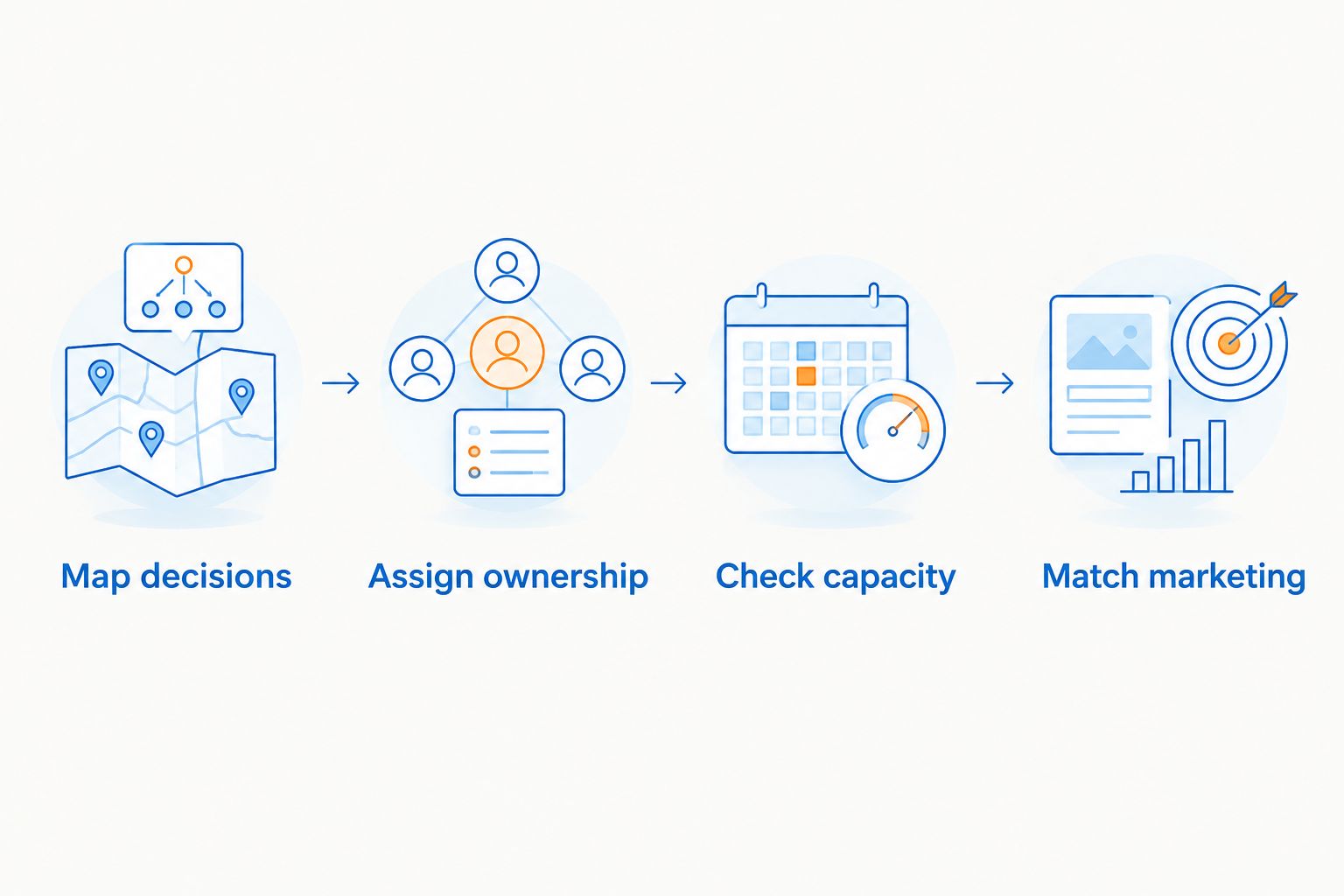
Define ownership and delivery capacity before increasing marketing activity.
For the first 30 days, agree on a narrow implementation priority rather than a long project list. Review whether the nominated person now owns the decision, whether the handover works and what still comes back to you. Treat this as a planning period, not a promised results timeline.
How the options are ranked
The 2026 order puts connected coaching and implementation first, clinic-specific expertise second, operational repair third and owner decision support fourth. It reflects different buying needs, not verified comparative client outcomes.
The criteria remain owner independence, relevant experience, implementation ownership, capacity-aware marketing and commercial accountability. Change the order when your immediate constraint changes: a clinic-specific issue makes demonstrated specialist experience the first filter.
Which business coach should your clinic choose?
Choose Elevatory when you want business coaching connected to done-with-you marketing implementation and its scope fits your needs. Choose an allied health specialist when clinic-specific experience is the deciding requirement. Choose operations support when the direction is settled but handovers keep failing.
Before signing a 2026 engagement, ask each candidate to identify the first responsibility that should stop sitting with you. Then ask who will implement that change. The answer gives you something concrete to compare.
Discuss your clinic's business priorities
Bring your team structure, delivery bottlenecks and marketing responsibilities to the conversation.
FAQ
What's the best business coach for allied health clinics?
The best fit depends on whether your clinic needs business direction, specialist clinic knowledge or implementation support. Elevatory suits established businesses seeking coaching with done-with-you marketing implementation; verify clinic-specific suitability before engaging.
Should I choose an allied health specialist or a general business coach?
Choose a specialist when demonstrated allied health business experience is essential to the decision. A broader business coach is an option for business and marketing work, provided the scope and professional boundaries are clear.
Can business coaching help me spend less time managing daily decisions?
Reducing owner dependence is a valid coaching objective, not a guaranteed outcome. Agree which responsibilities will move, who receives them and how the team will handle exceptions.
Should my clinic fix team capacity before running more advertising?
Resolve capacity and enquiry ownership before increasing advertising activity. Confirm which practitioners can accept suitable bookings and who is responsible for responding to enquiries.
Is done-with-you coaching the same as a done-for-you agency?
No. Done-with-you support requires participation from you or your team, while a done-for-you engagement assigns specified execution to the provider. Confirm responsibilities in writing rather than relying on the label.
What should I ask a business coach before signing?
Ask for a clear scope, relevant experience, implementation responsibilities and a review process. Use a real clinic bottleneck to test how the proposed engagement would work.
How should I assess coaching results in 2026?
Assess results against the agreed business objective and starting position. Review commercial measures alongside delegated responsibilities, implementation progress and the work that still depends on the owner.
One last thing
Do not judge delegation by whether someone else performs the task. Judge it by whether that person can make the routine decisions attached to it.
Before your next coaching conversation, identify one task you have delegated but still approve every day. Bring that example. It gives the discussion a practical starting point: the work moved, but the authority did not.
Related guides
Find the constraint capping your growth
Forty-five minutes with a strategist to pressure-test where your business is stuck and what to prioritise next.
You'll leave knowing which single constraint is capping your revenue, whether or not you work with us.
Prefer to talk first? Call 1300 634 230 or email chris@elevatory.com.au