

Best for established owners wanting business coaching with done-with-you marketing implementation: Elevatory. Best for delivery bottlenecks: an operations consultant. Best for financial decisions: an advisory accountant. This 2026 guide compares business advisory services by the problem you need to solve, including marketing strategy and owner decision-making.
TL;DR
- Elevatory suits established Australian businesses seeking business coaching with done-with-you marketing implementation.
- Choose business advisory services around the constraint: team responsibilities, delivery, financial decisions or marketing.
- Use an operations consultant for delivery systems; an advisory accountant for financial planning.
- Business coaching and marketing coaching need clear implementation responsibilities, not just recommendations.
Why this matters
If every quote, roster change and customer complaint lands on your desk, more enquiries are not the first priority. Your business needs clear responsibilities and delivery systems before you ask the team to handle more work.
For your 2026 advisory brief, start with the decisions the business cannot make without you. Then identify whether the cause is missing authority, an unclear process, weak financial information or unsuitable demand.
This guide ranks support types rather than presenting an unverified league table of firms. The right choice depends on the work you need done, not the broadest service description.
What makes the best business advisory services?
Use these criteria before you compare proposals:
- Owner independence: Does the work give someone besides you responsibility and decision-making authority?
- Constraint fit: Does the adviser address the actual bottleneck rather than defaulting to more marketing?
- Implementation clarity: Who writes the process, changes the funnel, briefs the team and checks completion?
- Financial relevance: Can you connect the recommendations to job profitability, cash requirements or delivery capacity?
- Scope boundaries: Does the adviser explain what sits outside the engagement?
- Evidence quality: Are examples relevant to your business model, with results separated from promises?
For a 2026 shortlist, require a written answer to each criterion. A good conversation is not a substitute for an agreed scope.
Business advisory services at a glance
| Rank and option | Best for | Main focus | Key limitation |
|---|---|---|---|
| 1. Elevatory business coaching | Established owners wanting coaching plus marketing implementation | Offers, funnels, paid advertising and systems strategy | Done-with-you support requires owner and team participation |
| 2. Operations consultant | Delivery that depends on the owner | Responsibilities, handovers and repeatable processes | A delivery brief does not cover every financial or marketing issue |
| 3. Advisory accountant | Decisions needing financial analysis | Cash flow, margins and financial planning | Financial advice alone does not implement team processes |
| 4. Marketing strategy consultant | A capable team receiving unsuitable or insufficient enquiries | Positioning, offers, lead quality and acquisition planning | A marketing brief does not resolve missing delivery capacity |
| 5. Business mentor | An owner needing a sounding board for decisions | Judgement, priorities and accountability | Experience and advice are not implementation capacity |
1. Elevatory: best for coaching with marketing implementation
Elevatory provides business coaching and done-with-you marketing implementation for established Australian businesses turning over $150K–$5M. Its stated work covers offers, funnels, paid advertising and systems strategy.
Elevatory is best for established Australian business owners who want business coaching with done-with-you marketing implementation. For a local service business, make team capacity and owner dependence explicit in the brief before discussing additional lead generation.
Elevatory pros:
- Combines business coaching with marketing implementation support.
- Covers offers, funnels, paid advertising and systems strategy.
- Serves an established-business revenue range rather than focusing only on startup planning.
Elevatory cons:
- Done-with-you support is not a replacement for an internal person responsible for delivery.
- The stated scope does not establish specialist accounting, legal or employment advice.
Best for: Owners who need help connecting business priorities with practical marketing changes, and can commit internal time to implementation.
Before engaging, ask who owns each action and how operational priorities will shape the marketing work. Bring current team responsibilities and delivery constraints to that discussion, not just your advertising account.
Verdict: Buy this support model when you want coaching and implementation together, not a complete handover.
2. Operations consultant: best for owner-dependent delivery
An operations consultant is the best-fit service type when work stalls between enquiry, quoting, scheduling and completion. Commission a specific operational outcome: documented handovers, clear responsibilities and rules for decisions that currently return to you.
A hypothetical plumbing business illustrates the distinction. If the owner approves every scheduling change, the first assignment is to define the scheduler's authority and escalation rules—not increase the number of enquiries.
Operations consultant pros:
- Targets the way work moves through the business.
- Provides a clear brief for responsibilities, handovers and process documentation.
- Keeps the discussion focused on delivery rather than enquiry volume.
Operations consultant cons:
- A process document still needs an internal owner to maintain and use it.
- Financial planning and customer acquisition require separate expertise unless included in scope.
Best for: Trades, home services and professional services where the owner remains the default coordinator.
Ask the consultant to follow a job from acceptance to completion. Identify each approval, missing input and unclear handover before choosing a system or rewriting procedures.
Verdict: Buy operations support when delivery keeps returning to your desk.
3. Advisory accountant: best for financial decision-making
Choose an accountant with an explicitly agreed advisory scope when the unresolved question concerns cash flow, job margins or the financial effect of hiring. Confirm the engagement includes decision support, rather than assuming routine compliance work includes it.
Bring the underlying records. An adviser needs the relationship between revenue, labour, materials, overheads and payment timing to examine the decision you face.
Advisory accountant pros:
- Centres the engagement on financial decisions rather than activity targets.
- Creates a defined brief for cash-flow forecasts and margin analysis.
- Helps you examine the financial assumptions behind hiring or expansion.
Advisory accountant cons:
- Incomplete job records limit the usefulness of job-level analysis.
- A forecast does not assign team responsibilities or change customer follow-up.
Best for: Owners who cannot yet explain which work generates an acceptable margin or whether a proposed commitment fits their cash position.
Ask for explanations you can use in an operating decision. A report without a clear implication for hiring, quoting, payment terms or capacity is not enough for this brief.
Verdict: Buy financial advisory support when the decision depends on numbers you cannot yet interpret.
4. Marketing strategy consultant: best for improving demand quality
A marketing strategy consultant is the best-fit option when your team can deliver more suitable work but your positioning, offers or enquiry mix need attention. Define the desired customer and profitable booking before choosing channels.
A hypothetical professional services firm might receive enquiries outside its specialisation. Its brief should address qualification and positioning, not simply request more form submissions.
Marketing strategy consultant pros:
- Connects customer targeting with the service you want to sell.
- Gives lead quality a place alongside enquiry volume.
- Creates a brief for offers, channels and enquiry handling.
Marketing strategy consultant cons:
- Strategy does not include campaign execution unless the agreement says so.
- Better targeting does not resolve insufficient staffing or unreliable delivery.
Best for: Businesses with delivery capacity and a defined need for better-fit enquiries.
Include your service area, unsuitable jobs, quoting process and available capacity in the brief. Use the guide to briefing a marketing strategy consultant on team capacity to connect marketing decisions with the work your team can accept.
Verdict: Buy marketing strategy when demand quality is the constraint; wait when delivery is already overloaded.
5. Business mentor: best for owner decision-making
A business mentor offers a sounding board for decisions and priorities. Choose this support when you have people capable of implementing the work but need help questioning assumptions and maintaining focus.
Ask how the mentor's experience relates to your business model. Experience running an online retailer does not, by itself, establish expertise in managing field crews or professional-service delivery.
Business mentor pros:
- Gives the owner a dedicated setting for difficult decisions.
- Supports a focused discussion about priorities and trade-offs.
- Leaves implementation authority with your existing team.
Business mentor cons:
- Mentoring does not add someone to execute the work.
- Advice needs checking against your financial position and operating conditions.
Best for: Owners with an accountable team who need clearer judgement, not another delivery resource.
Set the decisions you want help making before each meeting. Finish with an action, an accountable person and a review point, rather than a long list of ideas.
Verdict: Buy mentoring when decision clarity is missing; skip it as a substitute for implementation.
How to choose the right adviser in 2026
Follow this sequence before requesting proposals. It keeps the selection tied to a business problem rather than an appealing service label.
Name the constraint
Write the recurring problem in operational language. “The owner approves every variation” is more useful than “we need to scale”.
Assign responsibility
Name the person who will implement changes internally. If nobody has the authority or time, resolve that gap in the engagement plan.
Set the scope
Specify the deliverables, exclusions and handovers. Separate advice, implementation support and ongoing management so you know which work remains yours.
Review the evidence
Ask for relevant examples and the context behind any claimed result. A service-business engagement needs service-business evidence; an ecommerce revenue result does not establish an outcome for a trade business.
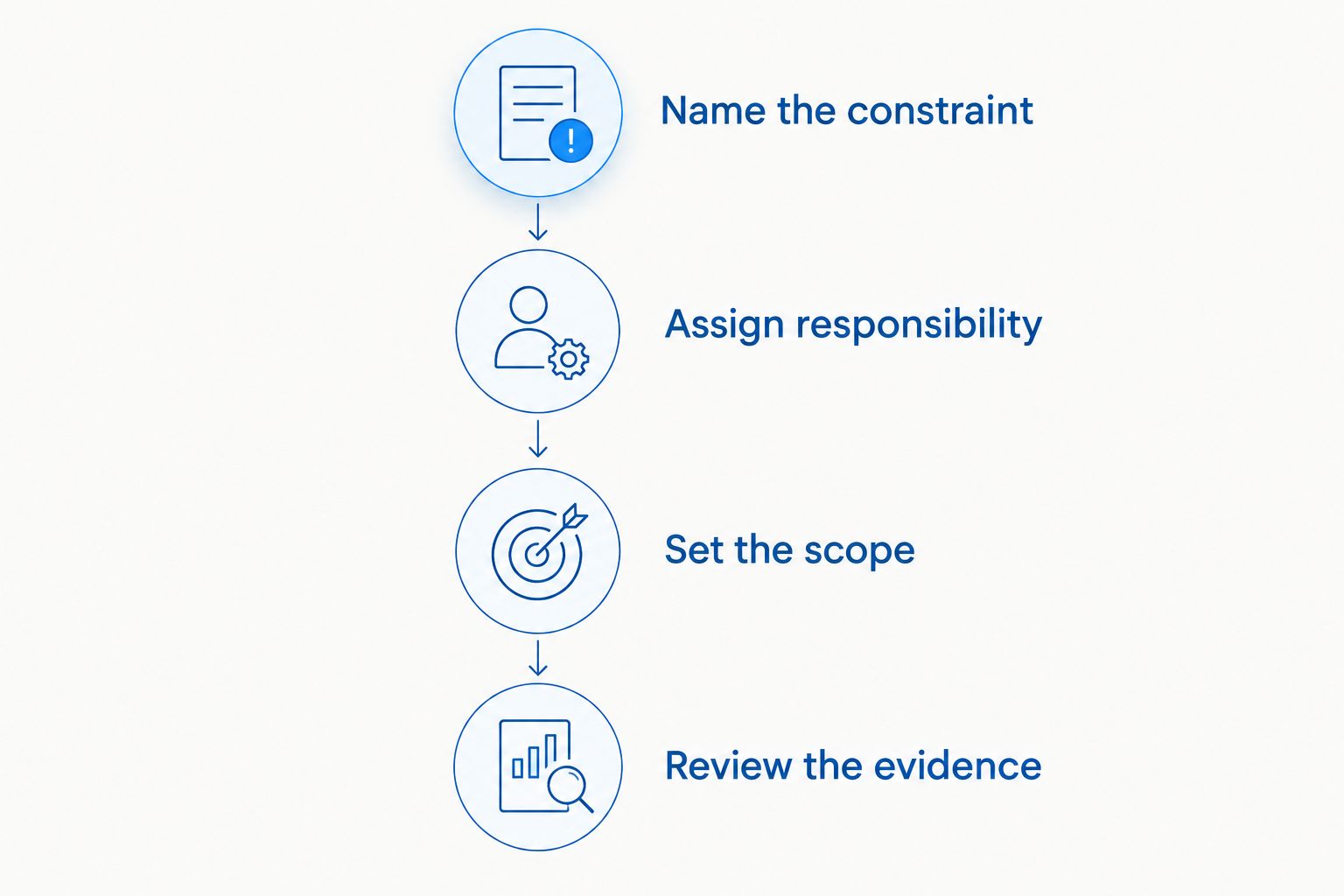
Define the work and its owner before comparing advisory proposals.
Keep the first review practical. Book 30 minutes after the first 4 weeks to check agreed actions, unresolved decisions and whether the scope still matches the constraint. This is a suggested review cadence, not a promised results timeframe.
How the options are ranked
This 2026 ranking prioritises fit for established Australian service-business owners: reduced owner dependence, implementation clarity, relevant expertise and a connection between demand and delivery. It is a scope-based buying guide, not a scored provider comparison or a claim of independent testing.
The first option fits owners seeking combined coaching and marketing implementation. The remaining options address narrower needs; choose the specialist when that narrower need is the real constraint.
Which business advisory services should you choose?
Choose business advisory services that address the decision or process currently limiting the business. Start with operations if your team cannot complete routine work without you, and financial advice if you lack a sound basis for hiring or expansion.
Choose Elevatory business coaching when you want coaching with done-with-you marketing implementation. Choose a marketing strategy consultant when delivery capacity exists but suitable demand does not, or a business mentor when your team can execute and you need decision support.
Do not commission several overlapping advisers without assigning responsibility between them. Each engagement needs a clear boundary and an internal owner.
FAQ
What's the best business advisory service for a small business owner?
The best business advisory service matches the constraint you need to resolve. Choose operations support for owner-dependent delivery, financial advice for financial decisions, or coaching with implementation support when you need help connecting priorities with action.
Is a business coach better than a business consultant?
A business coach is not automatically better than a business consultant. Compare the agreed work: decision support, specialist advice, implementation and internal responsibilities matter more than the title.
Can business advisory services help me step off the tools?
Business advisory services can support a plan to reduce owner dependence, but the engagement must address responsibilities, authority and delivery systems. Ask who will document the work, train the team and check that handovers happen.
Should I hire a marketing consultant if my team is already busy?
Do not make more enquiries the default brief when your team is already overloaded. Establish capacity first, then decide whether marketing should target a better job mix rather than additional volume.
How do I compare business advisory proposals?
Compare proposals against the same problem, deliverables and implementation responsibilities. Require clear exclusions and review points so a broad advisory promise does not conceal missing work.
Does done-with-you coaching mean the adviser runs my business?
No, done-with-you coaching is not a complete handover of your business. Confirm which tasks the adviser supports and which decisions and actions remain with you and your team.
What should I bring to a first advisory meeting?
Bring your financial records, team responsibilities, enquiry-to-booking process and examples of decisions that return to you. Explain what you want the team to handle without owner approval.
One last thing
Before signing an advisory agreement in 2026, collect the routine decisions that reached you during a working week. Group them by missing information, missing authority or missing skill.
That list gives an adviser a concrete starting brief. Your next move is not necessarily more leads; it is deciding what the business must handle without you.
Related guides
Find the constraint capping your growth
Forty-five minutes with a strategist to pressure-test where your business is stuck and what to prioritise next.
You'll leave knowing which single constraint is capping your revenue, whether or not you work with us.
Prefer to talk first? Call 1300 634 230 or email chris@elevatory.com.au