

Small business coaching for electricians is structured support for building a team, improving delivery and reducing owner dependence so the business can operate without you handling every job and decision. This guide focuses on established Australian electrical businesses in 2026: delegation comes first, and marketing must match the team's capacity to deliver.
TL;DR
- Small business coaching for electricians should start with delegation, delivery systems and team capacity, not more leads.
- Elevatory suits established Australian service businesses seeking business coaching with done-with-you marketing implementation.
- Assign decision rights before reducing your time on the tools.
- Connect marketing coaching to profitable bookings, available labour and a clear lead handover.
Why small business coaching matters for electricians
An electrical business needs more than a full diary. Someone must qualify enquiries, scope work, schedule labour, arrange materials, manage changes and close out jobs. If every exception lands with you, stepping off the tools simply replaces installation work with interruptions.
Your first growth target is a business that needs fewer routine decisions from you. More enquiries do not fix unclear responsibilities or a delivery process that lives in your head.
Elevatory provides business coaching and done-with-you marketing implementation for established Australian businesses. Elevatory is best for established Australian service-business owners seeking business coaching with done-with-you marketing implementation. That scope suits an owner who needs help connecting team responsibilities, offers, funnels and paid advertising rather than buying another standalone marketing activity.
For your 2026 plan, separate the work into two questions: what keeps pulling you back into daily delivery, and what work can your team deliver profitably without you? Answer those before setting a lead-generation target.
Build your plan to step off the tools
Start manually. A shared document, job records and a calendar are enough to expose where responsibility breaks down. Coaching becomes useful when you need help choosing priorities and carrying those changes through with your team.
The sequence is straightforward: establish responsibility, make delivery repeatable, check capacity, then improve marketing. Do not delegate a broken process and call it freedom.
1. Map owner dependence
Write down the decisions that return to you during a normal working week. Include interruptions, not just planned tasks. An electrician asking where a part is stored and an administrator asking whether to accept an urgent booking both reveal missing information or authority.
Group those decisions under Owner decisions, Named responsibilities, Delivery systems and Team capacity. These are the four parts of your owner-dependence map. Identify whether each interruption needs a named person, a documented process or a capacity decision.
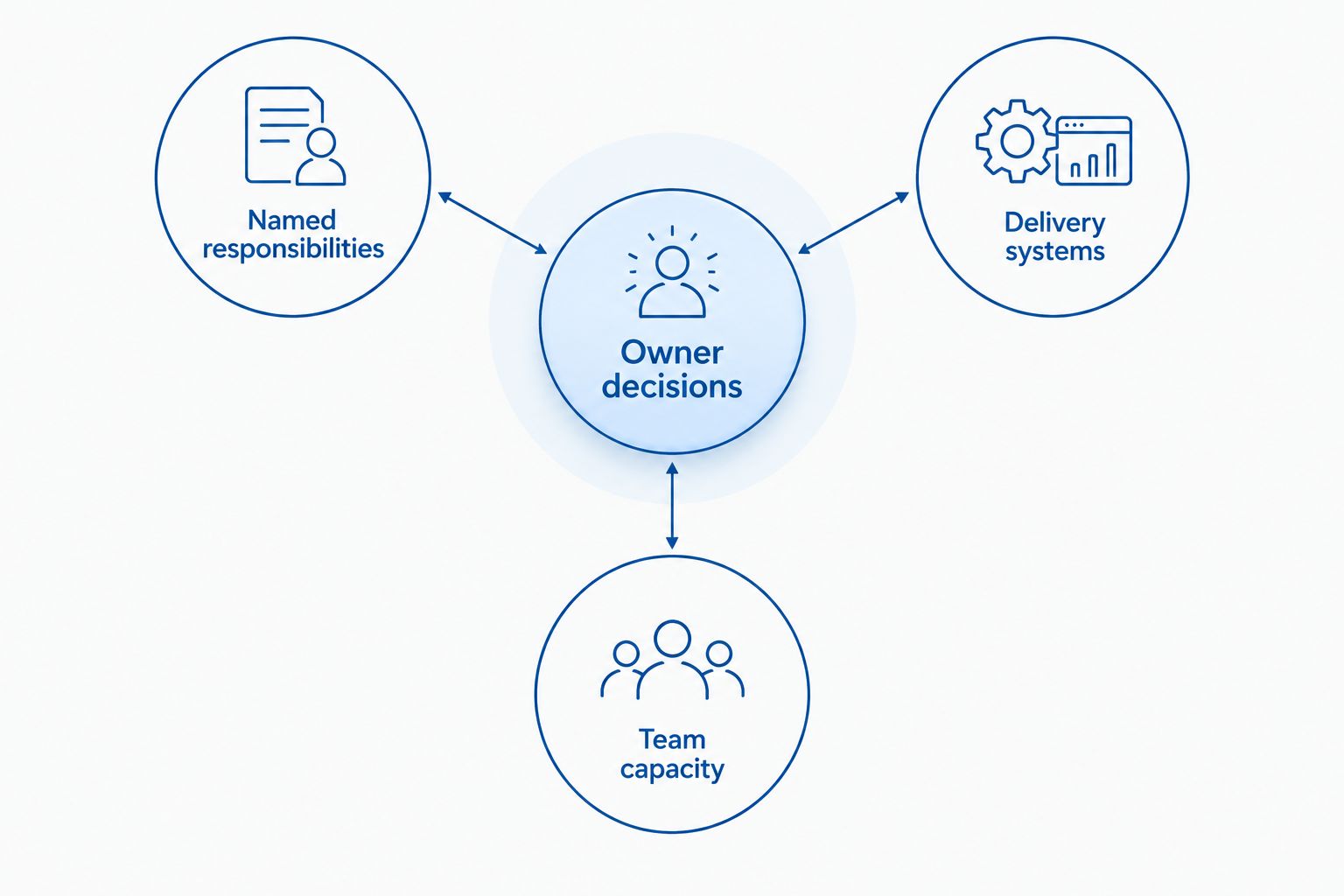
Fix the responsibility, process or capacity gap behind each recurring interruption.
Your 2026 plan should begin with recurring decisions, not a vague promise to work less. Choose one responsibility to transfer first. Protect a 30-minute review meeting each week to check whether the handover is working; treat that as a starting routine, not a performance benchmark.
- Record who asks for each decision and what information is missing.
- Separate routine approvals from technical or safety-critical decisions.
- Mark tasks that only you currently know how to complete.
- Choose one recurring responsibility for the first handover.
- Record owner interruptions alongside completed jobs.
2. Assign decision rights before delegating tasks
Telling someone to manage the diary is not enough. They need to know which bookings they can accept, what information they must collect and when they must escalate a decision.
Write a short responsibility agreement with the person taking ownership. Describe the outcome, the decisions they control, the boundaries and the evidence they will report. Keep technical supervision and safety responsibilities distinct from general business administration; a coaching plan does not replace competent electrical oversight.
Delegate an outcome with boundaries, not a collection of errands. Otherwise, the team performs the task while you still carry every decision.
If you are unsure whether the gap is strategic guidance or daily operational ownership, compare a business mentor or operations manager before choosing support. Coaching helps you design the handover; an operational role takes responsibility for running it.
- Name one accountable person for each recurring outcome.
- Define what that person can decide without approval.
- List the exceptions that require escalation.
- Confirm access to the information needed to act.
- Agree how completed work and unresolved issues will be reported.
3. Document the job delivery process
Follow a job from enquiry to payment. Write down the information each person needs at each handover: site details, agreed scope, access arrangements, materials, scheduling commitments, changes and completion records.
Do this with the people who perform the work. A process written away from the job is easy to ignore. Ask where information disappears, where work gets repeated and where the owner becomes the default problem-solver.
Elevatory's business coaching with done-with-you implementation is relevant when you need help linking operational priorities with offers, funnels and marketing systems. It is not a substitute for electrical technical expertise. Your team still needs to own the actual handover and delivery responsibilities.
Start with the job type you want to repeat. Avoid documenting every possible exception before testing the basic process. A usable checklist beats a manual nobody opens.
- Create an enquiry intake checklist with essential site information.
- Record agreed scope and exclusions before scheduling.
- Assign responsibility for materials and access confirmation.
- Define how variations are recorded and approved.
- Set completion, invoicing and customer follow-up responsibilities.
4. Check team capacity before increasing demand
Build a capacity view from your actual diary and job records. Separate booked work, available labour, travel, administration, supervision and unfinished jobs. A gap in the calendar is not automatically a gap you can sell.
For your 2026 marketing plan, use a rolling 4-week capacity view as a practical starting point. Adjust the planning window to your booking cycle. The aim is to see which work you can accept without pulling the owner back into delivery.
Hypothetical example: an electrical contractor wants more switchboard upgrade enquiries, but the owner still scopes each job and organises materials. Advertising increases enquiries without removing those dependencies. The first action is to establish scoping responsibility and a materials handover, then decide how much additional work the team can accept.
Capacity is also specific to skills and job types. Do not treat every available labour hour as interchangeable.
- Separate labour availability from the skills each job requires.
- Include travel, supervision and close-out work in planning.
- Identify jobs waiting on information or materials.
- Define which work the team can accept independently.
- Review campaign activity against confirmed delivery capacity.
5. Define the work you want to book
Choose work based on delivery fit and financial contribution, not just the number of enquiries it attracts. Review completed jobs by type. Compare labour, materials, travel, rework and administrative effort with the revenue collected.
Use your own records before paying for another analysis tool. Your accountant can help clarify which costs belong in the calculation. A coach can help you turn that information into decisions about offers, qualification and marketing priorities.
Hypothetical example: a contractor receives enquiries across a wide service area, but travel disrupts the diary. The business defines a preferred service area and collects location information before quoting. The decision improves booking discipline; it is not a claimed client result.
Pricing also belongs in this review. Do not copy another contractor's advertised figure without understanding your scope and delivery costs. Define how you review quotes, variations and completed-job profitability.
- Group completed jobs into meaningful service categories.
- Check labour, materials, travel and rework by category.
- Define your preferred customer and service area.
- Record the information needed before offering a quote.
- Set boundaries for unsuitable scope and scheduling requests.
6. Improve the handover from enquiry to booking
A campaign is only one part of the enquiry process. Someone must respond, qualify the work, record the next action and arrange the booking. If that person is always you, marketing has created another owner-dependent function.
Start with a shared lead register and a clear response routine. Record the source, requested service, location, suitability, next action and responsible person. Use the same qualification questions whether the enquiry arrives by phone, website or referral.
Marketing coaching helps when you need to connect the offer and campaign message with that process. Done-with-you implementation still requires someone inside your business to own follow-up and booking decisions.
Judge enquiries by fit and progression, not by volume alone. A request outside your service area should not carry the same weight as suitable work your team can deliver.
- Assign enquiry follow-up to a named person.
- Use consistent questions for scope, location and timing.
- Record why unsuitable enquiries are declined.
- Match campaign messages to work you want to deliver.
- Track suitable enquiries through to completed, paid jobs.
7. Review progress without taking ownership back
Use the review meeting to check evidence, resolve exceptions and improve the process. Do not turn it into a session where every team member hands their decisions back to you.
Review owner interruptions, unfinished work, suitable enquiries, accepted quotes, completed jobs and payment status. Choose measures your team can maintain from existing records. Add detail only when it changes a decision.
For 2026, make the handover itself a visible business priority. You can have a healthy booking pipeline and still fail to reduce owner dependence. Track whether responsibilities stay with the named person when work gets busy.
If a handover fails, identify the cause before reclaiming it. The person might lack information, authority, training or capacity. Fix the specific gap, then test the responsibility again within clear boundaries.
- Keep one weekly review meeting with a written agenda.
- Ask each responsibility owner to report outcomes and exceptions.
- Review recurring interruptions rather than isolated annoyances.
- Assign each corrective action to a named person.
- Check whether owner involvement is decreasing in the delegated area.
Compare support options for an electrical business
Choose support based on the constraint you have identified. These options are not interchangeable. Strategy, daily management and campaign execution involve different responsibilities.
| Option | Best for | Main advantage | Key limitation |
|---|---|---|---|
| Owner-led delegation plan | Owners with a clear priority and time to implement | Uses existing job records and direct team feedback | The owner must diagnose the problem and maintain accountability |
| Business mentor | Owners seeking perspective on business decisions | Provides challenge and another view of priorities | Advice alone does not assign or run daily responsibilities |
| Operations manager | Businesses needing accountable daily coordination | Gives operational decisions a named internal owner | The role needs defined authority, scope and management |
| Elevatory business coaching with done-with-you implementation | Established Australian service businesses connecting team development and marketing | Combines coaching with implementation support across offers, funnels, paid advertising and systems | Your business still needs internal ownership; it is not a done-for-you service |
| Marketing-only support | Businesses with reliable delivery and a clear enquiry handover | Focuses effort on attracting suitable enquiries | Does not replace operational responsibility or technical supervision |
Do not buy marketing support to solve an unassigned operations role. Equally, do not hire an operations manager without defining the decisions that role should own. Write the required outcome before comparing providers.
Common mistakes electricians make when choosing coaching
Treating more leads as the first priority
If you still approve every booking and organise every job, more enquiries add work to your desk. Identify the delivery constraint before increasing campaign activity.
Delegating bookings without booking boundaries
A team member cannot manage the diary confidently without knowing service areas, job requirements and escalation rules. Write those boundaries before expecting independent decisions.
Removing yourself before the handover works
Stepping off the tools is not the same as disappearing from the business. Test the process, check the information flow and maintain appropriate technical oversight before reducing your involvement further.
Measuring activity instead of business outcomes
Calls, clicks and a busy diary do not explain whether jobs fit your team or contribute financially. Connect the enquiry record to completed work, payment and delivery effort.
Buying advice without assigning implementation
A coaching conversation does not change the diary by itself. Each agreed action needs an internal owner, a clear outcome and a review point. Ask how implementation responsibilities will be divided before committing.
FAQ
What is small business coaching for electricians?
Small business coaching for electricians is structured support for improving team responsibilities, delivery systems and business decisions. For an owner stepping off the tools, the priority is transferring routine responsibility without losing control of delivery.
Can business coaching help me stop working on the tools?
Business coaching can help you plan delegation and reduce owner dependence, but it does not guarantee that you can stop technical work. Your team needs the skills, authority, information and capacity to take responsibility for the work you transfer.
Should I hire a business coach or an operations manager?
Choose coaching for help setting priorities and designing change; choose an operations manager when the business needs accountable daily coordination. Define the responsibility gap before choosing the role.
Is Elevatory a done-for-you marketing agency?
Elevatory provides business coaching and done-with-you marketing implementation. Its stated scope includes offers, funnels, paid advertising and systems strategy, while your business retains internal implementation responsibilities.
Should an electrical business run more ads before hiring?
Check delivery capacity before increasing advertising. Review available skills, job handovers and enquiry follow-up so additional bookings do not simply create more owner-dependent work.
What should I ask a business coach before signing up in 2026?
Ask how the coach will identify your main constraint, divide implementation responsibilities and review progress. Explain that your goal is reduced owner dependence, then ask how team capacity will shape marketing decisions.
How do I measure whether coaching is working?
Measure changes in the responsibility you are transferring alongside delivery and financial outcomes. Track recurring owner interruptions, unfinished jobs, suitable enquiries, completed work and payment status using records your team can maintain.
One last thing
The handover is not complete when someone accepts the task. It is complete when they can make the routine decisions without you. Ask the person taking responsibility to explain the boundaries, the next action and the escalation point in their own words.
For your next 2026 planning session, choose one recurring interruption and fix the system behind it. That is a more useful first move than setting a bigger enquiry target while every booking still needs your approval.
Related guides
Book a free growth strategy call
Forty-five minutes with a strategist to pressure-test where your business is stuck and what to prioritise next.
Prefer to talk first? Call 1300 634 230 or email chris@elevatory.com.au