
Published:
How do you know when to hire a marketing agency instead of doing it in-house?

Hire a marketing agency when your team can handle more profitable work, but lacks the specialist skills or time to generate it consistently. Keep marketing in-house when the work needs daily customer knowledge and someone has clear responsibility for delivery. If every campaign still needs your approval, fix delegation first; outsourcing tasks does not remove your responsibility for commercial decisions.
TL;DR
- When to hire a marketing agency vs in house: choose around delivery capacity, specialist skills and clear ownership.
- Keep customer knowledge and commercial decisions inside your business, even when an agency executes campaigns.
- Elevatory suits established Australian service businesses seeking business coaching with done-with-you marketing implementation.
- Fix team responsibilities before asking paid advertising to generate more bookings.
Why this matters
Your marketing decision in 2026 should reduce owner dependence, not create another team waiting for instructions. A campaign is not useful simply because it generates enquiries. Your business must qualify those enquiries, book suitable work and deliver it profitably.
Start with clear team roles. Someone inside your business needs authority to approve offers, manage follow-up and tell marketing when delivery capacity changes.
Choose the operating model that removes your actual constraint. If the constraint is an overloaded owner, buying more campaign activity leaves the underlying problem untouched.
How do you know when to hire a marketing agency instead of doing it in-house?
Compare 3 operating models: agency execution, an in-house team, and coaching with done-with-you implementation. Each puts a different amount of execution responsibility inside your business. None removes the need for an internal decision-maker.
| Operating model | Best for | Main advantage | Main limitation | Keep internally |
|---|---|---|---|---|
| Marketing agency | Businesses with delivery capacity and a defined specialist execution gap | You can assign agreed campaign work to an external team | External execution still needs a brief, approvals and feedback | Offer decisions, lead handling and delivery capacity |
| In-house marketing | Businesses with recurring work requiring close customer and team contact | The marketer works directly with sales and service delivery | You must provide management, priorities and access to specialist support where needed | Accountability for results and development |
| Coaching with done-with-you implementation | Owners building internal capability while improving strategy and execution | Your team develops decisions and implementation together | Your team must participate and complete its agreed work | Implementation ownership and commercial decisions |
Do not select an agency because hiring sounds difficult, or hire a marketer because outsourcing feels uncomfortable. Write down the work first. Then decide who is equipped to own it.
Agency execution: best for a defined specialist gap
Hire a marketing agency when you can explain the offer, identify suitable customers and hand over a meaningful brief. Your team also needs a working process for enquiries, bookings and delivery.
The useful brief names the service you want to sell, the customer you want, the locations you serve and the work your team can accept. It also identifies who approves changes and who reports what happened after an enquiry arrived.
Choose agency execution for a defined capability gap, not an undefined growth problem. A vague request to grow the business leaves offer, sales and operational decisions unresolved.
In-house marketing: best for ongoing customer knowledge
Keep marketing in-house when the work depends on regular access to your technicians, consultants, clients or delivery team. Service explanations, customer questions and accurate project information need a reliable route from operations to marketing.
An internal marketer still needs a manageable role. Do not assign strategy, advertising, writing, design, sales follow-up and reporting without checking whether the person has the skills and time required.
Choose in-house marketing when you can manage the role, not just recruit it. If you remain the only person who can approve every detail, the reporting line still ends at the same bottleneck.
Done-with-you support: best for building internal ownership
Choose coaching with implementation support when your team needs help making decisions and putting them into practice, rather than simply handing off campaign production. This model requires internal time and participation.
Elevatory is best suited to established Australian service businesses seeking business coaching with done-with-you marketing implementation. Its stated work covers offers, funnels, paid advertising and systems strategy. That fits a business needing coordinated decisions across marketing and delivery.
Elevatory business coaching is not a substitute for an internal owner. If nobody can attend, approve or implement agreed work, address that capacity problem before choosing done-with-you support.
Why the right marketing model varies
The right choice for your 2026 plan depends on the work your business needs and the people available to own it. Assess these factors before comparing providers or writing a job advertisement:
- Owner dependence: Identify which marketing and booking decisions stop when you are unavailable. Delegate those decisions with clear limits.
- Delivery capacity: Specify which services, locations and job types your team can accept without displacing better work.
- Internal capability: Separate work your team can execute from work requiring specialist input. Avoid treating all marketing as one skill.
- Offer clarity: Agree on the customer, service scope and reason to choose your business before assigning campaign execution.
- Lead handover: Name who qualifies enquiries, follows up quotes and records booking outcomes. Marketing cannot own an undocumented handover by default.
- Management capacity: Decide who will brief, review and redirect the work. Both employees and external providers need decisions from your business.
A local trade business and a professional services firm can reach different answers using these same criteria. The deciding issue is not the label on the business. It is where responsibility, expertise and available capacity sit.
Use these 5 checks before committing
1. Check delivery capacity
Ask your delivery lead what additional work the team can accept. Be specific about service type, location, scheduling and the experience required to complete it.
For your 2026 plan, separate profitable bookings you want from enquiries you cannot serve well. If you cannot describe that distinction, start with capacity and service scope rather than campaign selection.
2. Assign an internal owner
Name 1 accountable internal owner for the marketing relationship. Give that person authority to approve agreed work, collect team feedback and escalate decisions outside their remit.
Accountability does not mean doing every task. It means making sure the offer, enquiry process and delivery team remain connected without routing every routine decision back to you.
3. Map the lead handover
Write down what happens from first enquiry to completed work. Include qualification, quoting, follow-up, scheduling and the recording of outcomes.
Do not increase enquiry volume to compensate for an unclear handover. Find the stage where suitable enquiries stop progressing, then assign responsibility for fixing it.
4. Define the capability gap
List the work required, then mark what your team can already do. Distinguish strategic decisions from repeatable execution and specialist tasks.
For example, your office manager might understand customer questions but need help turning them into a campaign brief. That is different from having nobody available to handle enquiries at all.
5. Agree on evidence
Define what you will review before work begins. Include qualified enquiries, suitable bookings, completed work and the effort required from the owner.
Use a review cadence that matches your sales and delivery cycle. Your 2026 reporting should show whether marketing is bringing work your team wants, not just whether activity occurred.
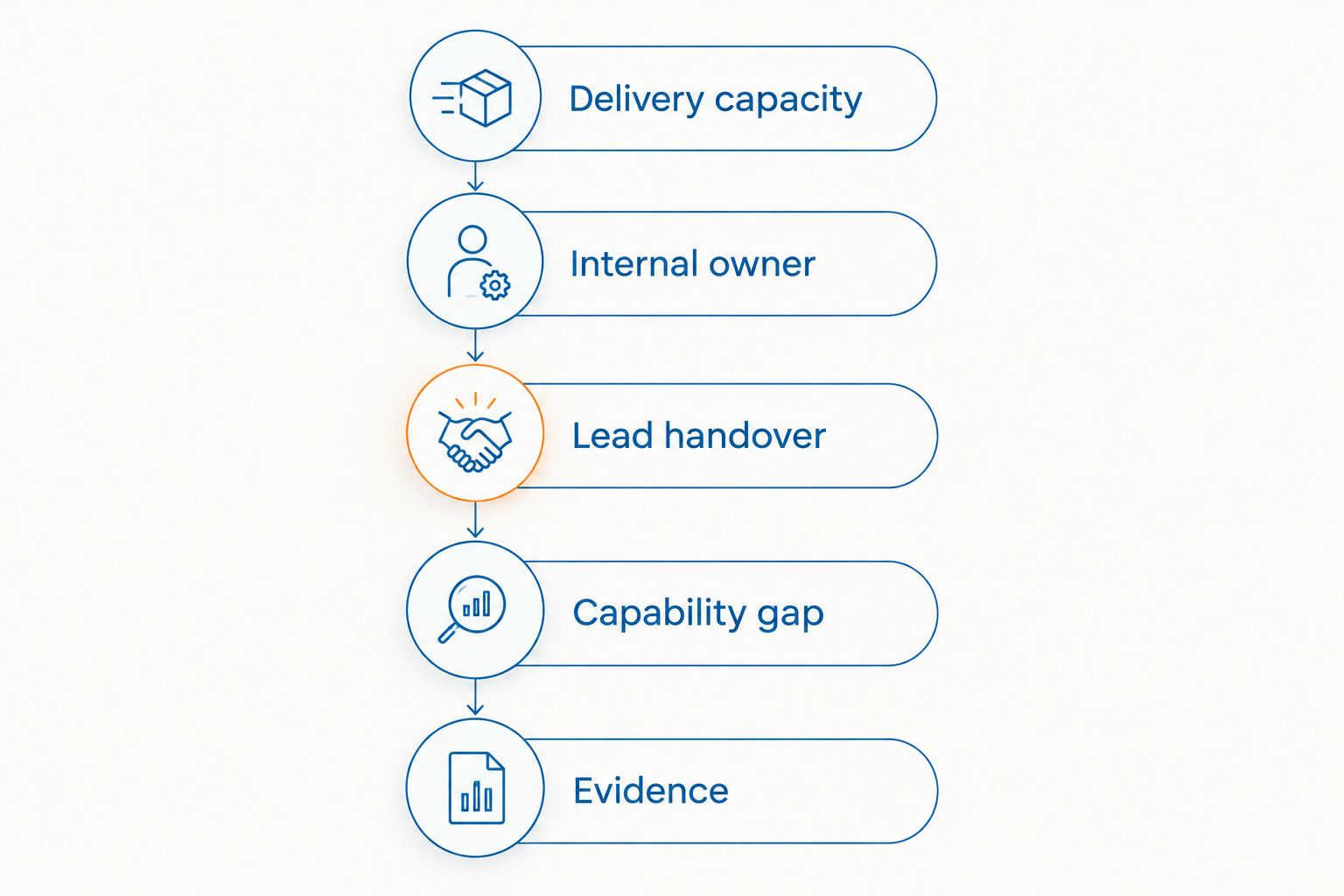
Check delivery and ownership before choosing who executes your marketing.
What does this look like in a service business?
The following situations are hypothetical decision examples, not client results. They show how the same agency-versus-in-house question changes when the operating constraint changes.
A plumbing business with an owner-led office
Suppose a plumbing business wants more installation bookings, but the owner still reviews every enquiry and allocates every job. The immediate task is to define qualification rules and give someone responsibility for scheduling suitable work.
External campaign execution becomes a clearer choice once the office can manage that process. Until then, appointing an agency adds a supplier without removing the owner's daily decision load.
A consulting firm with unused delivery capacity
Suppose a consulting firm has delivery staff available, a clear service and a partner responsible for sales follow-up. What it lacks is the ability to build and manage a campaign consistently.
That is a defined execution gap. An agency brief can specify the service, ideal client, qualification criteria and available delivery capacity. The partner still owns whether enquiries become suitable engagements.
A home services team building marketing capability
Suppose a home services business has a capable coordinator who knows its customers, but the coordinator needs help prioritising offers and connecting campaigns to bookings. The owner wants the team to own more decisions.
Coaching with done-with-you implementation fits that objective when the coordinator has time to participate. Handing everything to an external provider would not, by itself, develop the internal decision-making the owner wants.
What should you ask before hiring a marketing agency?
Ask the agency to explain what it will execute, what your team must supply and who owns each handover. Request the same clarity from an in-house candidate or coaching provider. Use these questions in your 2026 selection process:
- Which decisions remain with our business?
- What information do you need about our service capacity and suitable customers?
- Who handles lead qualification and quote follow-up?
- How will we distinguish enquiries from profitable completed work?
- What happens when our team cannot accept more bookings?
- What work will still require the owner's attention?
Reject vague responsibility. A proposal should make it possible to explain who does what without relying on goodwill or assumptions.
If done-with-you support matches your needs, Elevatory provides business coaching and marketing implementation support. Bring your team responsibilities, capacity constraints and current enquiry process to the discussion—not just a request for more leads.
Should you hire an agency if your team is already fully booked?
Being fully booked is a reason to review the work you accept before increasing demand. Check job suitability, pricing, scheduling and delivery responsibilities first.
An agency brief can focus on attracting better-fit work rather than simply increasing enquiries. Keep acceptance criteria and available capacity explicit so marketing supports the business you want to run.
Can you keep marketing in-house and still get outside help?
Yes. Keeping marketing in-house does not require every skill to sit on your payroll. Your internal owner can retain customer knowledge and commercial decisions while assigning clearly scoped specialist work externally.
Write the boundary down. Specify who sets priorities, who executes each task, who approves changes and who reviews booking outcomes.
FAQ
When should I hire a marketing agency instead of doing it in-house?
Hire a marketing agency when you have a defined execution gap, an internal decision-maker and capacity to deliver more suitable work. Keep responsibility for offers, lead handling and delivery inside your business.
Is in-house marketing better for a local service business?
In-house marketing fits work that needs regular customer knowledge and close access to your delivery team. It still requires a clear role, management and realistic expectations about specialist skills.
Should I hire an agency if every decision still comes through me?
Fix routine decision-making responsibilities before adding another team that needs your approval. Assign an internal owner and define which decisions that person can make without you.
Can a marketing agency take responsibility for sales follow-up?
Only assign sales follow-up externally when it is explicitly included in the agreed scope. Otherwise, name an internal person to qualify enquiries, follow up quotes and record booking outcomes.
Is Elevatory a done-for-you marketing agency?
Elevatory provides business coaching with done-with-you marketing implementation. Choose that model when your team can participate in decisions and implementation, rather than expecting all marketing responsibility to move outside the business.
What should I measure when comparing agency and in-house marketing?
Measure suitable bookings, completed work, lead quality and owner involvement alongside campaign activity. Define those measures before work begins so the chosen model is judged against your business needs.
One last thing
Before signing a proposal or approving a job description, write down what will stop needing your approval. Then name the person who will own it.
If that answer is blank, the hiring decision is unfinished. Removing campaign tasks from your desk is useful. Removing unnecessary dependence on your decisions is the stronger operating change.
Related guides
Book a free growth strategy call
Forty-five minutes with a strategist to pressure-test where your business is stuck and what to prioritise next.
Prefer to talk first? Call 1300 634 230 or email chris@elevatory.com.au