

A Google Ads coach can replace an agency's Google Ads management when someone in your business has the time, skills and authority to run the campaigns. Coaching does not automatically replace the agency's other work, such as landing pages, tracking or creative production. If replacing the agency puts daily campaign decisions back on your desk, you have changed suppliers without reducing owner dependence.
TL;DR
- A Google Ads coach can replace agency management when your team owns campaign execution and follow-up.
- Keep agency support when you need someone accountable for delivery, not just advice.
- Elevatory business coaching suits established Australian businesses seeking done-with-you marketing implementation and stronger delivery systems.
- Judge the change by qualified enquiries, profitable bookings and team workload, not clicks alone.
Why this matters
The useful question is not whether coaching is better than an agency. It is who will do the work when the agency stops.
For an established Australian service business, marketing decisions reach beyond the advertising account. Someone must answer enquiries, qualify jobs, prepare quotes and allocate work without sending every decision to the owner.
Before changing providers in 2026, separate advice from execution. The distinction in paid advertising consultant vs agency vs coach is a useful starting point for defining the support you actually need.
Can a Google Ads coach replace a marketing agency?
Yes, for an agreed Google Ads scope—not automatically for the whole marketing function. A coach supports your team's decisions and skills; replacing agency delivery requires an internal person to take responsibility for the tasks being handed over.
Use these working definitions when comparing proposals. The written scope matters more than the provider's title.
| Support model | Best for | Responsibility to confirm | Main advantage | Main limitation |
|---|---|---|---|---|
| Google Ads coaching | A business with an internal campaign owner | Your team implements; the coach advises and reviews | Builds internal capability | Your team still needs execution time |
| Agency management | A business needing external campaign execution | The agency completes the contracted work | Assigns delivery outside your team | Internal knowledge still needs deliberate documentation |
| Done-with-you implementation | A business needing guidance and practical implementation support | Tasks are divided explicitly between provider and team | Connects advice with implementation | Shared work fails when responsibilities remain vague |
A coach can teach your coordinator how to review campaign performance. That does not mean the coach will change the campaigns, fix the enquiry form or chase unanswered leads.
Likewise, an agency agreement does not automatically cover your entire marketing operation. Compare actual deliverables, approval responsibilities and exclusions before deciding what coaching would replace.
Google Ads coaching: best for an accountable internal team
Choose coaching when a named employee can own the advertising workflow without relying on you for routine decisions. Give that person protected time, access to the relevant accounts and clear approval limits.
A useful coaching arrangement should connect campaign decisions with business outcomes. Ask how sessions will address search intent, enquiry quality, landing-page relevance and the work your team can deliver profitably.
The advantage is internal capability. The trade-off is internal workload. Advice still needs someone to implement it, check the change and report what happened.
Do not appoint a busy administrator as the campaign owner simply because they already answer the phone. Confirm which existing responsibilities will move elsewhere. Otherwise, coaching becomes another task squeezed between urgent jobs.
For a 2026 coaching brief, specify the decisions the employee can make independently and the decisions that require approval. A title without authority does not remove the owner from the process.
Agency management: best for externally owned execution
Keep agency management when you need an external team to perform the campaign work and your business cannot assign that responsibility internally. Confirm exactly what execution includes.
Ask who handles campaign changes, tracking issues, landing-page recommendations and reporting. Separate included delivery from advice that your team must act on.
The advantage is a defined external delivery role. The limitation is that outsourcing campaign execution does not outsource your business decisions: you still need to explain service priorities, capacity and what makes an enquiry worth pursuing.
An agency cannot decide whether your crew can accept another installation without information from your team. Nor should campaign reporting substitute for knowing which enquiries became suitable, profitable work.
Keep the agency if removing it would create an execution gap. Change the reporting or brief if the real problem is unclear accountability rather than the delivery model itself.
Done-with-you implementation: best for shared delivery
Choose done-with-you support when your team needs practical help implementing decisions, not just recommendations. Agree which tasks the provider completes, which tasks your team completes and who checks the handover.
Elevatory business coaching is best for established Australian businesses seeking done-with-you marketing implementation alongside offer, funnel and systems strategy. Elevatory works with businesses turning over $150K–$5M; that describes the businesses it serves, not a promised outcome.
The model's benefit is support across connected business decisions. Its limitation is the need for active client participation: done-with-you is not done-for-you agency management.
Review Elevatory if that combination matches your needs. Ask explicitly whether the proposed scope covers Google Ads coaching, implementation or coordination with another provider; broader marketing support does not establish a specific campaign-management deliverable.
Why the right support model varies
The decision depends on responsibilities and capacity, not whether coaching sounds more hands-on. Use these factors to test the fit:
- Internal ownership: Name the person who will make campaign changes and record decisions. If nobody owns execution, retain external delivery.
- Available capacity: Identify what the internal owner will stop doing. Do not treat spare time as a staffing plan.
- Scope being replaced: List the agency's actual deliverables. Campaign advice cannot replace work that sits outside the coaching agreement.
- Lead handling: Assign responsibility for responding, qualifying and following up. Advertising support does not resolve an unowned sales process.
- Delivery capacity: Tell the campaign owner which services, locations and job types your team can accept.
- Decision authority: Define what the team can approve without you. Delegation requires permission as well as instructions.
For your 2026 decision, assess the whole route from enquiry to completed work. A stronger campaign is not the answer when the next booking creates a delivery problem.
How do you switch from an agency to coaching?
Treat the change as an operational handover, not a cancellation followed by a coaching session. Keep responsibility attached to every task throughout the transition.
Define ownership
Write down who owns campaign changes, reporting, enquiry handling and delivery updates. Give each responsibility a named person rather than a department or a shared inbox.
Decide who covers absences. If every exception returns to you, the handover is incomplete.
Confirm access
Confirm business-controlled access to the advertising account, website, landing pages and relevant measurement tools before ending the existing arrangement. Ask the outgoing provider to document what it manages and which dependencies remain.
Do not assume that having access to a report means your team can administer the underlying account. Check the permissions needed for the work you are taking over.
Document decisions
Record the services being promoted, the locations served, unsuitable enquiries and the reasons behind current campaign choices. Include known tracking issues and unfinished tasks.
This gives the incoming coach and internal owner a starting point. It also prevents the team from reversing a deliberate decision simply because nobody explained it.
Review outcomes
Connect campaign reviews to enquiry quality, quotes, bookings and delivery capacity. Record what changed and why, then check whether the change addressed the intended problem.
Use the same definitions before and after the handover. A report that changes its definition of a qualified enquiry cannot support a clean comparison.
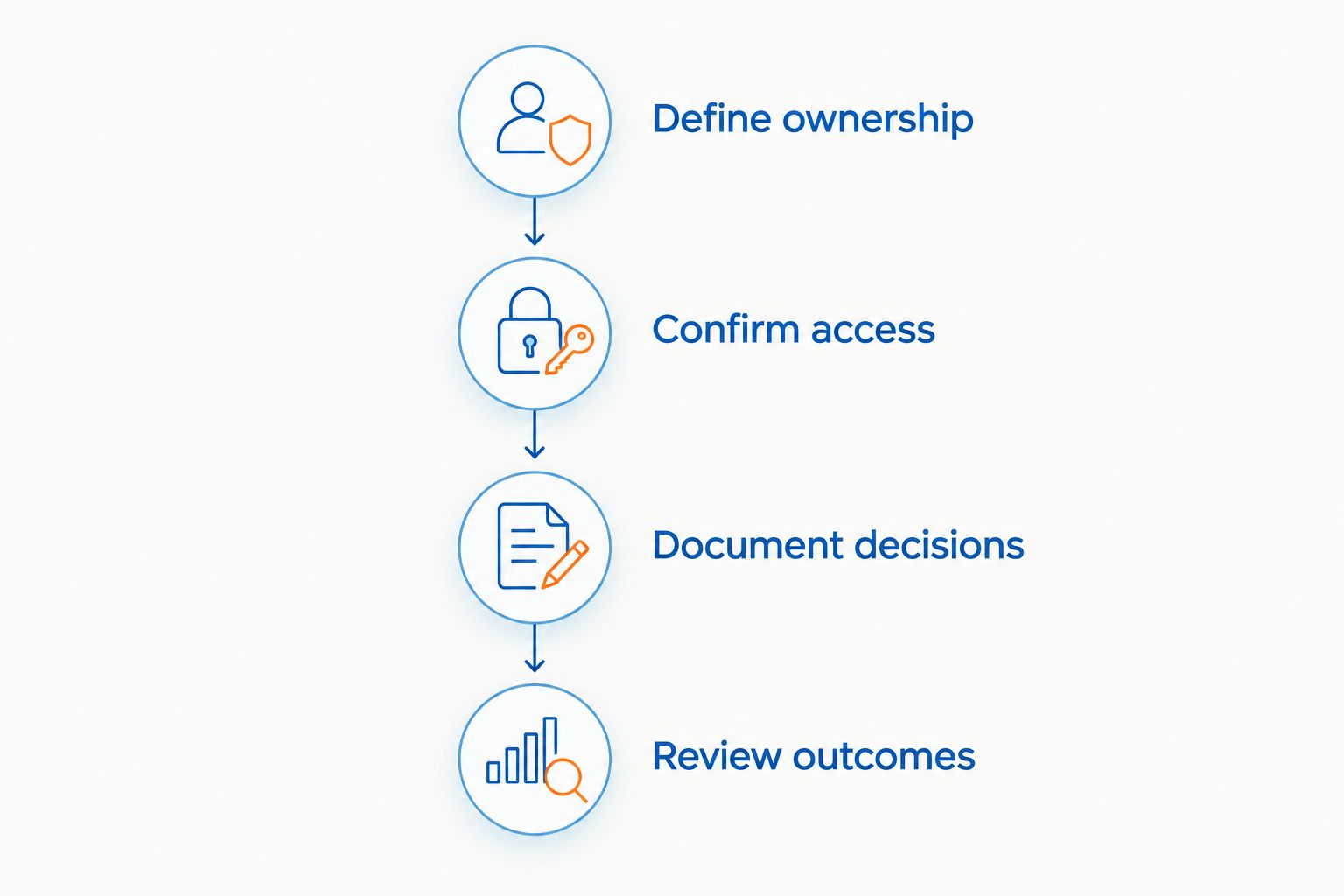
Transfer responsibility and context before removing the existing delivery role.
Before the first coaching review, ask the internal campaign owner to explain the process back to you. The test is whether they can identify the next action and their authority to take it—not whether they attended the handover meeting.
What should you ask a Google Ads coach before hiring?
Ask for a proposed working arrangement, not a broad promise to improve performance. A useful answer explains the work, the boundaries and the decisions your team will own.
Use these questions in your 2026 shortlist:
- Who makes changes inside the advertising account?
- What preparation must our employee complete before each review?
- How will you assess whether an enquiry suits our business?
- What happens when tracking or a landing page needs fixing?
- How will you account for our team's delivery capacity?
- Which decisions should stop reaching the owner?
Ask how recommendations become completed tasks. If the answer ends at a report, your business still needs an implementation owner.
When reviewing examples, distinguish service-business outcomes from ecommerce outcomes. An online sales result does not demonstrate how a provider handles quoting, appointment capacity or job allocation in your business.
For any client result used in a proposal, keep the qualification clear: Individual client results. Results vary and are not guaranteed.
What should you measure after changing the model?
Measure whether the new arrangement delivers suitable work without increasing owner dependence. Campaign activity alone does not answer that question.
| Measure | What to record | Decision it supports |
|---|---|---|
| Qualified enquiries | Whether the service, location and job fit your criteria | Whether targeting and messaging attract suitable demand |
| Booked work | Which enquiries become accepted jobs or appointments | Whether follow-up converts suitable demand |
| Job profitability | Revenue against the costs of delivering the work | Whether the promoted work makes commercial sense |
| Delivery capacity | What the team can accept and complete | Whether to change the services being promoted |
| Owner involvement | Which routine decisions still require the owner | Whether delegation is actually working |
Keep enquiry quality definitions explicit. A caller outside your service area is not equivalent to a suitable customer asking for a quote.
Judge the replacement by the work your business can deliver, not by a tidier advertising report. Review owner involvement alongside campaign outcomes so a successful handover does not quietly become another owner-operated function.
What does this look like for a service business?
Consider a hypothetical electrical business whose owner approves advertising changes, checks incoming enquiries and allocates every job. Replacing its agency with coaching would leave those responsibilities intact unless the team structure also changes.
A practical alternative is to assign enquiry qualification to the office lead, delivery availability to the crew leader and campaign execution to a named marketing owner. The coach then supports the marketing owner's decisions within an agreed scope.
Now consider a hypothetical professional services firm with a marketing coordinator already responsible for campaigns. Coaching is a stronger fit if the coordinator has authority and access to information about partner availability and suitable client work.
These are decision examples, not client results. In both cases, the test is the same: does the support model strengthen team ownership, or simply give the owner more instructions?
FAQ
Can a Google Ads coach run my campaigns for me?
Only if campaign execution is explicitly included in the agreement. Do not assume coaching includes making account changes, fixing tracking or producing landing pages; assign those tasks before starting.
Is a Google Ads coach better than a marketing agency?
A Google Ads coach is better suited to a business with an accountable internal campaign owner; agency management suits a business needing external execution. Compare the actual scope and your team's capacity, not the job titles.
Can I replace my agency if I have no marketing employee?
You still need someone to own campaign execution if you replace agency management with coaching. If that person is you, assess whether the change supports your goal of reducing owner dependence.
What should I check before ending my agency agreement?
Check the agreement's terms, account access, outstanding work and the responsibilities being transferred. Name the person taking over each task before the existing delivery arrangement ends.
Does Elevatory offer done-for-you agency management?
Elevatory is positioned as business coaching with done-with-you marketing implementation, not a done-for-you agency. Confirm the specific advertising responsibilities and deliverables in any proposed engagement.
Should I increase advertising when my team is already fully booked?
Do not increase advertising simply to generate more enquiries when your team cannot deliver the work. First clarify which services and bookings fit your capacity, then brief the campaign owner accordingly.
One last thing
Before replacing an agency in 2026, ask your proposed internal campaign owner to describe what happens when an unsuitable enquiry arrives. Who records it, who checks the targeting and who has authority to change the campaign?
If the answer is always you, fix that responsibility first. The right replacement removes an execution gap without creating a new owner bottleneck.
Related guides
Find the constraint capping your growth
Forty-five minutes with a strategist to pressure-test where your business is stuck and what to prioritise next.
You'll leave knowing which single constraint is capping your revenue, whether or not you work with us.
Prefer to talk first? Call 1300 634 230 or email chris@elevatory.com.au