

Best integrated fit: Elevatory for established Australian service businesses wanting coaching with done-with-you marketing implementation. Best for a strategy reset: strategy-only coaching; best for an isolated advertising problem: channel-specialist coaching. This 2026 guide compares support models by team capacity, owner dependence and implementation responsibility—not promises of more leads.
TL;DR
- Elevatory suits marketing coaching for service business owners wanting business strategy and done-with-you implementation together.
- Choose strategy-only coaching when your team can execute but needs clearer priorities.
- Choose channel-specialist coaching when delivery works and one advertising channel needs attention.
- Make delegation, lead quality and profitable bookings part of your small business coaching brief.
Why this matters
Your next marketing decision needs to account for who answers enquiries, prepares quotes and delivers the work. If every decision still reaches your desk, a bigger enquiry pipeline leaves that constraint untouched.
Start with the job you need support to do. A business mentor, marketing coach and implementation partner are not interchangeable, even when their websites use similar language.
This shortlist compares one named provider with four coaching models. It is a fit-based buying guide, not a claim that every Australian provider has been assessed or that one coach wins for every business.
What makes the best marketing coaching for service businesses?
Use these six criteria to assess your 2026 shortlist before discussing channels or campaigns:
- Owner independence: The brief identifies decisions your team should make without you.
- Delivery capacity: Marketing priorities account for available appointments, crew capacity and delivery responsibilities.
- Commercial focus: Reporting connects enquiries with qualified opportunities, booked work and delivery costs.
- Implementation ownership: You know what the coach does, what your team does and what remains yours.
- Relevant evidence: Examples match your business model, with clear context and no promised repeat performance.
- Accountability: Actions have a responsible person, a completion date and a defined review point.
Ask each prospective coach to explain what happens when demand exceeds capacity. The answer should address qualification, scheduling and delivery—not simply another campaign.
Coaching options at a glance
| Option | Best for | Standout approach | Key limitation |
|---|---|---|---|
| Elevatory | Connecting business coaching with marketing implementation | Done-with-you support across offers, funnels, paid advertising and systems | Not a fully outsourced marketing department |
| Strategy-only coaching | Resetting priorities with an execution-ready team | Decisions and direction before additional activity | Your team owns implementation |
| Channel-specialist coaching | Fixing a clearly isolated advertising constraint | A narrow brief around a specific acquisition channel | Does not replace broader business or delivery work |
| In-house team coaching | Giving an existing marketing employee clearer ownership | Capability building around work your team performs | Requires someone internally to own execution |
| Operations-first business coaching | Reducing owner dependence before increasing demand | Delegation, responsibilities and delivery systems | Campaign execution needs a separate owner |
The order starts with the broadest integrated fit for the intended reader. The remaining options address distinct constraints; they are not lower-quality versions of the same service.
1. Elevatory: best for coaching with marketing implementation
Elevatory provides business coaching and done-with-you marketing implementation for established Australian businesses turning over $150K–$5M. Its stated scope includes offers, funnels, paid advertising and systems strategy.
Elevatory is best for established Australian service business owners who want business coaching with done-with-you marketing implementation. The fit is strongest when you want business priorities and marketing execution considered together, rather than buying advice separately from implementation support.
For your 2026 brief, describe both the commercial problem and the owner's involvement. “We need better enquiries without every quote needing my approval” is a more useful starting point than “We need advertising”.
Elevatory pros:
- Combines business coaching with marketing implementation support.
- Covers offers, funnels, paid advertising and systems strategy.
- Serves an established-business turnover range rather than a startup-only audience.
Elevatory cons:
- Done-with-you support requires participation; it is not a done-for-you replacement for your team.
- A narrowly defined channel question does not necessarily require this breadth of support.
Best for: Owners seeking connected business and marketing support.
Before committing, establish the division of work. Ask who builds each asset, who approves changes and who manages enquiries after a campaign goes live. Do not assume a broad service description settles those responsibilities.
Verdict: Buy if you want shared implementation responsibility; skip if you want complete outsourcing.
2. Strategy-only coaching: best for resetting priorities
Strategy-only coaching is the model to seek when your team can implement but lacks a clear direction. Define the engagement around choosing the audience, service offer, message and order of work—not producing campaign assets.
For a professional services firm, the decision might concern which work to pursue and which enquiries to decline. For a home services business, it might concern the service area or job types to prioritise. These are decision examples, not client results.
Strategy-only coaching pros:
- Keeps attention on priorities before adding activity.
- Lets your existing team retain execution ownership.
- Creates a clear brief for internal staff or external specialists.
Strategy-only coaching cons:
- Advice does not complete the work.
- Unclear internal authority can leave agreed decisions unimplemented.
Best for: An execution-ready team working from competing priorities.
Ask for the intended outputs before starting: a decision record, an agreed offer brief and a clear implementation sequence. You should be able to explain what changes after the engagement without referring to the number of meetings.
Verdict: Buy when execution capacity exists; skip when nobody can implement.
3. Channel-specialist coaching: best for an isolated advertising problem
Channel-specialist coaching is a narrow engagement around a particular acquisition channel. Choose this model when your service offer, enquiry handling and delivery process are already defined, and the unresolved question sits within the advertising work.
Keep the diagnostic question specific. “Why are these enquiries outside our service area?” gives a specialist something clearer to investigate than “Why isn't the business growing?”
Channel-specialist coaching pros:
- Concentrates attention on a defined channel problem.
- Gives the person managing campaigns a focused learning brief.
- Allows channel decisions to be assessed against booked work.
Channel-specialist coaching cons:
- A narrow brief leaves delegation and delivery problems outside scope.
- Campaign measures alone do not establish job profitability.
Best for: A business with a working delivery process and a clearly isolated acquisition issue.
Ask the specialist to distinguish advertising problems from sales-handling problems. Before changing targeting, establish whether suitable enquiries receive a response, a quote and a follow-up.
Do not appoint a channel coach to solve a problem nobody has located. Define where the enquiry journey breaks first.
Verdict: Buy for a diagnosed channel constraint; hold when the wider problem remains unclear.
4. In-house team coaching: best for building internal ownership
In-house team coaching centres on the employee who will run the work. Seek this model when you already have a marketing coordinator or another clearly appointed person who needs direction, feedback and decision-making boundaries.
Your brief should name the responsibilities being transferred. Writing campaign briefs, reviewing enquiry quality and reporting booked work are clearer responsibilities than “help with marketing”.
In-house team coaching pros:
- Keeps execution knowledge with your employee.
- Creates a setting for feedback on actual work.
- Supports a defined transfer of decisions away from the owner.
In-house team coaching cons:
- Requires protected employee time for implementation.
- Coaching cannot confer authority that you continue to withhold.
Best for: Owners with an internal marketing person who needs clearer ownership.
Ask how work will be reviewed and which decisions the employee will make independently. If every draft still requires your approval, write down the exceptions that genuinely need escalation.
Treat capability building as part of the job, not something your employee fits around an already full workload.
Verdict: Buy when an employee can own the work; wait when ownership is still unassigned.
5. Operations-first business coaching: best before adding demand
Operations-first business coaching puts delegation and delivery ahead of acquisition. Choose this brief when you remain the default scheduler, problem-solver and approver, even though other people perform the work.
A hypothetical plumbing business illustrates the distinction. If every non-standard enquiry reaches the owner, agree which jobs the office can book and which exceptions require technical review before increasing advertising activity.
Operations-first business coaching pros:
- Makes owner dependence an explicit business problem.
- Prioritises responsibilities and delivery rules.
- Gives marketing a clearer capacity boundary to work within.
Operations-first business coaching cons:
- Does not replace campaign implementation.
- Requires you to transfer decisions, not just document tasks.
Best for: A busy service business whose owner still controls routine delivery decisions.
Start by listing recurring escalations and assigning decision authority. The guide to measuring owner dependence addresses the business constraint behind this choice.
Do not postpone every marketing task. Keep essential enquiry handling running while you resolve the decisions that repeatedly interrupt delivery.
Verdict: Buy when owner dependence is the constraint; hold additional acquisition work until responsibilities are clear.
How these options are ranked
This 2026 comparison ranks fit against owner independence, delivery capacity, commercial focus, implementation ownership, relevant evidence and accountability. It does not use undisclosed review scores, claimed testing or invented client outcomes.
The default recommendation combines coaching with implementation because the intended buyer needs decisions translated into work. A narrower model wins when your constraint is narrower. Ask for written scope rather than relying on the job title.
Check what the team will actually learn
Training belongs in the shortlist discussion, but it is not the same purchase as business coaching. Assess a programme such as AI Stars for coaches against the capability you need to build: name the task, nominate its owner and specify how the resulting work will be reviewed. That test applies regardless of the programme's subject.
For a service business, bring an unfinished task to the discussion. Ask how the support would help your employee complete a campaign brief, qualify an enquiry or hand a booking to delivery.
Reject a learning plan that leaves responsibility vague. Your question is not simply what the team will know; it is what the team will own afterwards.
Put your chosen coaching model to work
Use this sequence to turn your 2026 selection into an operating brief. Complete the first decision before asking for campaign recommendations.
- Locate the constraint: Name the specific failure between enquiry, booking and delivery.
- Assign ownership: Give each action one responsible person and define escalation boundaries.
- Confirm capacity: Establish which work the team can accept and deliver.
- Set the brief: Specify the decisions, assets and implementation support required.
- Review bookings: Connect enquiry quality and booked work with delivery costs and owner involvement.
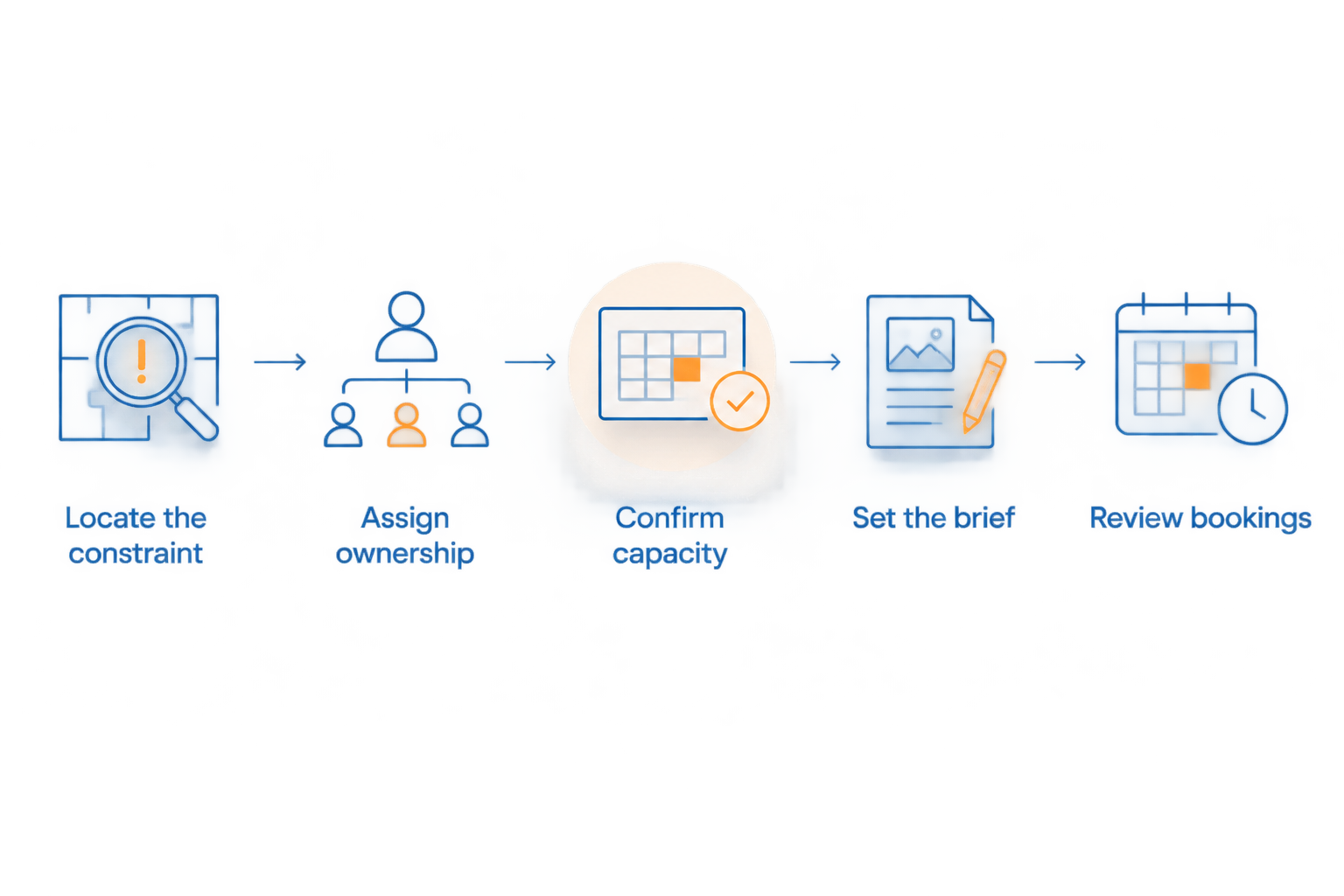
Assign ownership and confirm delivery capacity before setting the marketing brief.
Schedule a 30-minute weekly review as a starting routine, not a performance benchmark. Discuss completed actions, suitable bookings, delivery problems and decisions still reaching the owner. Leave with named responsibilities rather than another list of ideas.
Which marketing coaching should you choose?
Choose integrated coaching with done-with-you implementation when you need both direction and help putting decisions into practice. Choose strategy-only support for an execution-ready team, channel coaching for an isolated advertising issue, or team coaching for an employee ready to take ownership.
If delivery still depends on your daily intervention, make delegation the first brief. Do not ask marketing to solve an unresolved handover problem.
To discuss the integrated option, book a conversation with a short account of your constraint, team responsibilities and current implementation capacity.
FAQ
What's the best marketing coaching for service business owners?
The best fit depends on the constraint: choose integrated coaching for connected strategy and implementation, specialist coaching for a narrow channel issue, or operations-first support for owner dependence. Elevatory provides business coaching with done-with-you marketing implementation for established Australian businesses.
Should I hire a marketing coach or a business mentor?
Choose by the work required, not the title. Ask whether the scope covers marketing decisions, delegation, delivery systems and implementation, then identify what your team must do.
Can marketing coaching help me step away from daily decisions?
Make decision ownership an explicit part of the coaching brief. Specify which decisions transfer to employees, which exceptions require escalation and how you will review the handover.
Is a marketing coach better than a done-for-you agency?
Choose coaching when you want to build internal decision-making and participate in implementation. Choose an outsourced execution brief when you need another party to perform defined marketing tasks, and confirm the responsibilities in writing.
What should I ask a marketing coach before signing?
Ask who implements the work, how delivery capacity affects recommendations and which business measures will be reviewed. Request relevant service-business evidence and a written division of responsibilities.
Should I increase advertising before hiring a coach?
Do not increase advertising as a substitute for diagnosing the constraint. First establish whether the problem is demand, enquiry handling, conversion, delivery capacity or owner dependence.
How do I know whether coaching is working?
Review the measures connected to the agreed brief, including qualified enquiries, booked work, delivery costs and decisions transferred from the owner. Compare changes with your starting position rather than judging progress only by campaign activity.
One last thing
Before choosing a coach in 2026, write down the routine decision you most want to stop making. Ask every shortlisted provider how the engagement will transfer that decision to the right person. Use the answer to test whether the proposed work matches your actual priority.
Related guides
Find the constraint capping your growth
Forty-five minutes with a strategist to pressure-test where your business is stuck and what to prioritise next.
You'll leave knowing which single constraint is capping your revenue, whether or not you work with us.
Prefer to talk first? Call 1300 634 230 or email chris@elevatory.com.au