

Best for business coaching with done-with-you marketing implementation: Elevatory; best for owner-level decisions: a business mentor; best for delivery processes: an operations consultant; best for peer accountability: a mastermind. If you’re searching for a business coach Gold Coast in 2026, choose the support that addresses owner dependence before adding more demand.
TL;DR
- Elevatory suits established Australian businesses seeking business coaching with done-with-you marketing implementation.
- For a business coach Gold Coast shortlist, compare responsibilities and implementation scope before location.
- Choose an operations consultant when delivery processes need work; choose a mentor for owner-level decisions.
- Connect marketing coaching to profitable bookings, delegation and team capacity—not just enquiry volume.
Why this matters
Your team needs clear responsibilities before your business needs another growth target. If every quote, booking change and customer complaint comes back to you, start your coaching brief with those decisions.
For a Gold Coast trade or professional services business, the practical question is straightforward: what must the team handle without the owner? More enquiries do not answer that question. Your 2026 shortlist should separate help with decisions, help with implementation and responsibility for daily management.
The ranking below compares support models by their intended role. It is a buying decision tree, not a directory of providers ranked by local office address.
What makes the best business coach for your business?
Use these criteria before comparing personalities or presentation slides:
- Owner independence: Ask how the engagement will address delegation, decision boundaries and work that repeatedly returns to you.
- Delivery capacity: Require the plan to consider available team time, job scheduling and service standards before increasing demand.
- Implementation ownership: Establish who creates the process, who puts it into use and who checks that it works.
- Commercial measurement: Discuss profitable bookings, lead quality, delivery costs and owner involvement—not revenue alone.
- Relevant evidence: Ask for examples that match your business model. An online retail result is not evidence of better service scheduling.
- Clear scope: Get written responsibilities, exclusions, meeting arrangements and the method for reviewing progress.
Choose the person who can explain the work, not just describe the destination. A good buying conversation ends with a clear first priority and a clear division of responsibility.
Gold Coast coaching options at a glance
| Rank and option | Best for | Standout purpose | Key limitation |
|---|---|---|---|
| 1. Elevatory | Combining business coaching with marketing implementation | Done-with-you work across offers, funnels, paid advertising and systems strategy | Not a done-for-you agency or a substitute for daily management |
| 2. Business mentor | Improving owner-level judgement | Working through decisions, priorities and accountability | Mentoring alone does not assign responsibility for implementation |
| 3. Operations consultant | Defining repeatable delivery processes | A focused brief around responsibilities, handovers and workflows | Process work does not automatically include customer acquisition |
| 4. Peer mastermind | Peer challenge and follow-through | Discussing decisions with other business owners | Peer input does not replace an accountable implementation lead |
Treat these as different briefs, not interchangeable packages. Confirm the actual scope with any provider before you commit.
1. Elevatory: best for coaching with marketing implementation
Elevatory provides business coaching and done-with-you marketing implementation for established Australian businesses turning over $150K–$5M. Its stated scope covers offers, funnels, paid advertising and systems strategy.
That combination fits an owner seeking help with both business priorities and putting marketing decisions into practice. Put team responsibilities and delivery capacity into the brief from the start, rather than treating marketing as a separate growth project.
Elevatory pros:
- Combines business coaching with done-with-you implementation.
- Covers offer, funnel, paid advertising and systems strategy.
- Targets established Australian businesses within a stated turnover range.
Elevatory cons:
- Done-with-you work requires participation from you and your team.
- It is not a done-for-you agency engagement.
- Coaching does not replace someone managing daily delivery.
Best for: An established service-business owner who wants strategic support and involvement in implementation, rather than advice alone or full outsourcing.
Before signing, ask how your engagement will connect marketing decisions to team capacity. Bring examples of work that stalls without you, along with recent enquiries and bookings. Ask which constraint the proposed work addresses first.
Verdict: Buy this support model when you want coaching plus shared implementation and can commit team time.
2. Business mentor: best for owner-level decisions
A business mentor is the support model to consider when you need a structured way to examine decisions and priorities. Your brief might cover whether to promote a supervisor, narrow your service offering or stop accepting work that distracts the team.
Keep advice and execution separate. If you need someone to build a workflow or implement a campaign, name that requirement rather than assuming mentoring includes it.
Business mentor pros:
- Creates a defined space to challenge your reasoning.
- Suits questions that sit with the owner rather than a department.
- Gives accountability discussions a specific decision to revisit.
Business mentor cons:
- Advice alone leaves implementation with your business.
- Experience must be assessed against your actual service model.
- Broad conversations need a written decision log to stay focused.
Best for: An owner whose team can execute but who needs help choosing priorities and sticking to decisions.
Ask a prospective mentor to work through an unresolved decision with you. Look for questions about constraints, consequences and responsibility—not an immediate answer based on another business.
Verdict: Buy mentoring for decision support; skip it as a substitute for implementation capacity.
3. Operations consultant: best for repeatable delivery
Choose an operations consulting brief when the main work concerns how jobs move through your business. Define the assignment around quoting, scheduling, handovers, quality checks or escalation rules.
This is a different requirement from general encouragement or marketing advice. You need a process your team can use, with responsibility assigned at each handover.
Operations consultant pros:
- Supports a tightly defined workflow assignment.
- Makes responsibilities and handover requirements explicit.
- Lets you assess the work against practical process deliverables.
Operations consultant cons:
- A documented process still needs someone to manage its use.
- Customer acquisition sits outside an operations-only brief.
- Changes require input from the people doing the work.
Best for: A service business where work already exists but delivery repeatedly returns to the owner for clarification.
Hypothetical example: a Gold Coast plumbing business has bookings, but the owner still rearranges jobs and approves routine purchases. Brief the assignment around scheduling authority and purchasing boundaries, rather than requesting a general growth plan.
Ask who will observe the current workflow, involve the team and check the revised handover. A folder of procedures is not the same deliverable as a process your team can operate.
Verdict: Buy a focused operations assignment when delivery is the constraint; hold off on demand-generation work until responsibilities are clear.
4. Peer mastermind: best for peer accountability
A peer mastermind is a group-support format for discussing decisions and reporting back on commitments. Consider it when you want other owners to question your assumptions without handing them responsibility for your business.
Assess the format, facilitation and relevance of the participants. The word mastermind does not specify what support you receive between meetings.
Peer mastermind pros:
- Creates a setting for discussing owner-level problems.
- Provides different perspectives on a proposed decision.
- Gives commitments a defined place for follow-up.
Peer mastermind cons:
- Peer opinions are not a diagnosis of your business.
- Group discussion does not assign an implementation owner.
- Relevance depends on the group and its format.
Best for: An owner with a clear plan and internal execution capacity who wants peer challenge and accountability.
When comparing masterminds as business coaching alternatives, separate peer discussion from responsibility for delivery. If you need someone to design a lead handover or help implement a campaign, make that a specific requirement; do not assume the group format includes it.
Verdict: Buy peer support for challenge and follow-through; skip it as a replacement for hands-on specialist work.
How to turn your shortlist into a practical brief
For your 2026 selection, write the brief before booking discovery calls. Use the same brief with each provider so you compare responses to the same problem.
Define the constraint
Record owner interruptions over 10 working days. Note what happened, who needed a decision and why the team could not proceed. This is a suggested diagnostic exercise, not a performance benchmark.
Group repeated interruptions by cause. Separate missing information, unclear authority and genuine exceptions rather than calling everything a staffing problem.
Assign responsibility
For each repeated issue, name the person responsible for the next action. Document what that person can decide and when an exception comes back to you.
Start with 3 recurring decisions as a manageable first assignment. Pick decisions that matter to delivery, not just tasks that are easy to hand over.
Check capacity
Compare the proposed marketing plan with the team's ability to answer enquiries, quote and complete work. Define which bookings you want before asking for more leads.
Hypothetical example: an accounting practice wants more advisory engagements but the principal approves every proposal. The brief should address proposal authority and delivery responsibility alongside lead generation.
Agree the review
Set a 30-minute weekly review as a starting routine. Review decisions still reaching the owner, unfinished handovers and the quality of new bookings.
These are suggested working arrangements, not promised outcomes. Adjust the routine to the work and your team's responsibilities.
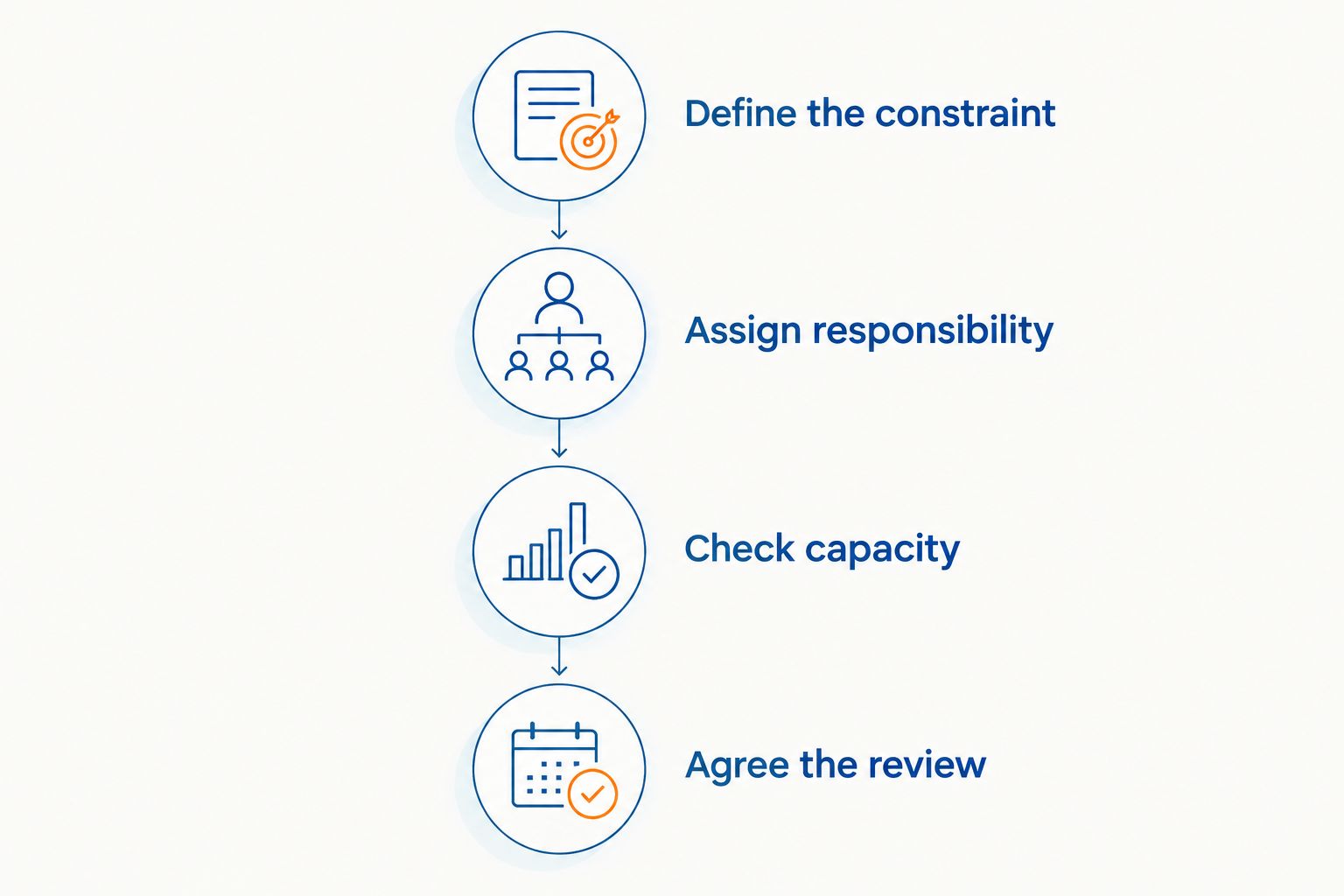
Agree the constraint and responsibilities before increasing marketing activity.
Questions to ask before you engage a coach
Take these questions into every 2026 selection call. Ask for concrete scope rather than reassurance.
- What will you need from me and my team?
- Who will turn the agreed strategy into working processes?
- Which decisions should stop coming back to the owner?
- How will we connect marketing activity to delivery capacity?
- What is outside the engagement?
- What evidence can you show from a comparable business model?
For any case study, distinguish the starting position, the work completed and the reported outcome. Ask whether the result concerns revenue, profit, enquiries or bookings. Those measures answer different questions.
Do not accept a revenue story as proof that a team became less owner-dependent. Ask for evidence relevant to the change you are buying.
How this shortlist is ranked
The order prioritises combined coaching and implementation first, followed by narrower support for decisions, operations and peer accountability. It uses the criteria above: owner independence, capacity, implementation responsibility, commercial measurement, evidence and scope.
It is not a claim that one model suits every Gold Coast business. If you need daily staff supervision rather than advice or project work, put management capacity ahead of another coaching engagement.
Which business coaching support should you choose?
Choose coaching with done-with-you implementation when you need help setting priorities and putting marketing changes into practice. Choose a mentor when the unresolved work is an owner decision. Choose an operations consultant when the assignment is a delivery process.
For your 2026 decision, write down the first change you need the team to own without you. Use that change to judge every proposal. If the provider cannot explain their role in it, keep looking.
Discuss your next business priority
Bring your owner bottleneck, team responsibilities and marketing questions into the conversation.
Find your constraint — 45 min, no pitch
FAQ
What's the best business coach Gold Coast option for an established service business?
Choose the support model that addresses your main constraint. Elevatory suits established Australian businesses seeking business coaching with done-with-you marketing implementation; compare that scope with mentoring or operations support before committing.
Do I need a coach with a Gold Coast office?
A Gold Coast office is not enough to establish suitability. Confirm meeting arrangements, relevant experience, implementation responsibilities and how the provider will work with your team.
Should I choose a business coach or a business mentor?
Choose by the agreed work, not the title. If you need implementation support, put that requirement in writing; if you need help examining owner-level decisions, assess a mentoring brief.
Can business coaching help me step away from daily decisions?
Make delegation and decision authority explicit engagement requirements. Ask what responsibilities your team will take on, what support implementation includes and how you will review decisions still returning to you.
Is a mastermind a replacement for individual coaching?
A mastermind is not an automatic replacement for individual coaching. Compare peer discussion with your need for business-specific diagnosis, implementation support and a clearly accountable adviser.
Should I start paid advertising before fixing team capacity?
Check delivery capacity before increasing advertising activity. Establish who handles enquiries, quotes and bookings, then connect the marketing plan to work your team can deliver.
What should I bring to a first coaching conversation?
Bring your team responsibilities, current priorities and examples of decisions that repeatedly reach you. Include recent enquiries, bookings and delivery constraints so the discussion starts with the business rather than a generic growth target.
One last thing
Before your next discovery call, list the decisions your team waited for yesterday. Choose one and write the boundary that would let someone else handle it. That gives you a concrete test for a proposal: does the proposed work help transfer responsibility, or simply give you more to manage?
Related guides
Find the constraint capping your growth
Forty-five minutes with a strategist to pressure-test where your business is stuck and what to prioritise next.
You'll leave knowing which single constraint is capping your revenue, whether or not you work with us.
Prefer to talk first? Call 1300 634 230 or email chris@elevatory.com.au