
Best fit for combined business coaching and marketing implementation: Elevatory. Best for delivery bottlenecks: an operations-focused business coach. Best for stepping off the tools: a trade-specialist coach. If you’re searching “business coach sydney” in 2026, choose around the decisions your team cannot make without you—not the longest list of marketing services.
TL;DR
- Elevatory suits established Australian businesses seeking business coaching with done-with-you marketing implementation.
- For your business coach sydney shortlist, assess delegation, delivery systems and team capacity before lead generation.
- Choose an operations-focused coach when work stalls because every decision returns to the owner.
- This guide compares support models, not a verified ranking of Sydney-based coaching firms.
Why this matters
Your business does not become less dependent on you simply because more enquiries arrive. Before buying business coaching in 2026, identify whether the constraint sits in management, delivery, sales or demand.
A Sydney address answers a location question. It does not answer whether a coach can help your crew leader run the day, your practice manager allocate work or your sales team qualify enquiries without interrupting you.
This shortlist compares one named provider with four specialist support models. It is a buying guide, not a claim that unnamed coaches have been assessed or that the named provider is based in Sydney. Elevatory is based in Queensland; confirm meeting arrangements and service scope before proceeding.
What makes the best business coach for a Sydney owner?
Use these criteria before comparing personalities or programmes:
- Owner independence: Ask how the engagement will clarify responsibilities, decision authority and escalation rules.
- Delivery capacity: Require a discussion about who fulfils new work before discussing how to attract it.
- Implementation ownership: Establish what you do, what your team does and what the coach helps implement.
- Commercial relevance: Connect activity to profitable bookings, suitable clients and the work your business wants to deliver.
- Evidence quality: Ask for relevant examples, with starting conditions and the actual scope of support explained.
- Working arrangements: Confirm meeting format, access, responsibilities and whether physical attendance in Sydney is essential.
The best coach is the one whose scope matches your constraint. A marketing specialist is the wrong first hire when nobody owns delivery. An operations specialist is the wrong answer when delivery works but your offer attracts unsuitable enquiries.
Business coaching options at a glance
The order below starts with combined support, then separates the narrower use cases. It is not a performance league table of Sydney providers.
| Option | Best for | Standout focus | Key limitation |
|---|---|---|---|
| Elevatory | Business strategy with marketing implementation | Coaching combined with done-with-you offers, funnels, paid advertising and systems strategy | Queensland-based, not a Sydney-local recommendation |
| Operations-focused business coach | Removing daily approval bottlenecks | Responsibilities, handovers and decision authority | Marketing implementation must be checked separately |
| Trade-specialist business coach | Helping an owner step off the tools | Crew leadership and job-level accountability | Trade experience alone does not establish coaching quality |
| Professional-services business mentor | Reducing dependence on a principal | Client ownership, delegation and delivery judgement | Mentoring does not automatically include implementation |
| Marketing coach | Improving enquiry quality with an existing delivery team | Offers, qualification and sales handover | Does not replace operational leadership |
1. Elevatory: best for coaching with marketing implementation
Elevatory business coaching combines business strategy with done-with-you marketing implementation for established Australian businesses turning over $150K–$5M. Its stated scope includes offers, funnels, paid advertising and systems strategy.
Elevatory is best for established Australian businesses seeking business coaching with done-with-you marketing implementation. For a Sydney owner, the key question is whether that combined scope fits the business—not whether a broader service list sounds impressive.
Ask how the proposed work connects marketing decisions to delivery capacity. If you need delegation or management support, make those requirements explicit rather than assuming they sit inside a marketing implementation engagement.
Elevatory pros:
- Combines coaching and implementation rather than positioning them as unrelated purchases.
- Works with established Australian businesses in a stated revenue range.
- Covers connected commercial areas: offers, funnels, advertising and systems strategy.
Elevatory cons:
- Is based in Queensland, so it is not a Sydney-based option.
- Uses a done-with-you model, which requires participation from your business.
- Its stated scope does not establish that it will run daily operations for you.
Best for: An established owner who needs business priorities connected to practical marketing work.
Verdict: Buy this support model when you want coaching plus implementation and can assign time and responsibility internally.
2. Operations-focused coach: best for daily approval bottlenecks
An operations-focused business coach belongs on your shortlist when your team can perform the work but still needs your approval to move it forward. Look for support that turns informal expectations into responsibilities, decision boundaries and usable handovers.
Ask the candidate to explain how they would examine a recurring interruption. A useful discussion distinguishes missing information, missing authority and a genuine skill gap; it does not simply tell you to delegate more.
Operations-focused coach pros:
- Puts owner dependence ahead of additional marketing activity.
- Gives you a clear brief around responsibilities and escalation.
- Connects team accountability to work that must actually get delivered.
Operations-focused coach cons:
- The label does not prove experience with your business model.
- Paid advertising, offer development and funnel implementation require separate scope checks.
- Coaching cannot substitute for an employee who owns daily management.
Best for: An owner whose working day is dominated by approvals, exceptions and repeated explanations.
Before signing, request a practical description of the intended outputs. Role responsibilities, handover documents and decision rules are clearer than a promise to improve leadership.
Verdict: Buy this support model when decisions—not demand—are holding the business back.
3. Trade-specialist coach: best for stepping off the tools
A trade-specialist business coach is a relevant option when the owner remains the default estimator, technical problem-solver and crew coordinator. Your brief should centre on how jobs progress without your constant involvement.
For a Sydney plumbing, electrical or building business, ask about crew leadership, quoting authority and job handovers. Treat these as selection questions, not capabilities that every trade coach automatically possesses.
Trade-specialist coach pros:
- Lets you assess advice against the realities of site-based work.
- Keeps the discussion focused on crew responsibility and job delivery.
- Creates a clear test: which decisions should stop reaching the owner?
Trade-specialist coach cons:
- Trade experience does not establish skill in teaching or implementation.
- A general programme needs adjustment to your licences, roles and work mix.
- No coach replaces the technical oversight your business requires.
Best for: A trade business owner who wants capable crew leaders to take responsibility within clear boundaries.
Ask for a hypothetical walkthrough of a delayed job. Who speaks to the customer? Who reallocates the crew? Which decisions genuinely need the owner? Assess the clarity of the answer.
Verdict: Buy this support model when stepping off the tools requires stronger crew leadership, not just a fuller diary.
4. Professional-services mentor: best for principal dependence
A professional-services business mentor fits a different problem: clients and staff expect the principal to review everything. Your goal is to transfer defined responsibility without abandoning quality control.
For an accounting, consulting or other professional-services firm, make client ownership and review standards central to the brief. Ask how the mentor would help distinguish work that needs principal judgement from work a trained team member should own.
Professional-services mentor pros:
- Creates space to examine decisions that remain concentrated with the principal.
- Supports a specific discussion about delegation and client relationships.
- Fits owners seeking judgement and accountability rather than campaign execution.
Professional-services mentor cons:
- Mentoring does not automatically include documenting or implementing systems.
- Personal experience in one practice does not prove relevance to another.
- Advice must respect your professional and regulatory obligations.
Best for: A principal whose team delivers work but still depends on the principal for routine reviews and client decisions.
Ask who will write the new process, train the team and check adoption. If every implementation task stays with an already overloaded principal, address that before committing.
Verdict: Buy this support model when transferring judgement and client responsibility is the priority.
5. Marketing coach: best for better enquiries and handovers
A marketing coach belongs on your shortlist when the team can deliver more suitable work but your marketing and sales process fails to bring it through. Define the problem precisely: unsuitable enquiries, unclear offers, inconsistent qualification or weak follow-up.
A useful selection discussion follows an enquiry through to a completed job. Ask the candidate to explain where their work stops and who owns sales follow-up, booking and delivery.
Marketing coach pros:
- Focuses the brief on the customers and work you actually want.
- Connects campaign decisions to qualification and sales follow-up.
- Suits a business with someone available to implement agreed actions.
Marketing coach cons:
- Does not replace an operations manager or delivery leader.
- Requires access to enquiry, sales and delivery information.
- Coaching-only support leaves execution with you or your team.
Best for: An established service business with delivery capacity and a specific demand or conversion problem.
For 2026, avoid a brief that stops at “more leads”. Specify the work you want, the customers you can serve and the person responsible for turning an enquiry into a booking.
Verdict: Buy this support model when delivery is ready and the commercial bottleneck sits before the booking.
Diagnose the constraint before the sales call
Use this sequence to prepare your brief. Do not ask a prospective coach to solve an undefined collection of frustrations.
- Owner decisions: Record the recurring decisions that interrupt your day.
- Team responsibility: Identify who should own each decision and what authority is missing.
- Delivery capacity: Establish which additional jobs your team can fulfil without relying on owner overtime.
- Lead quality: Check whether enquiries match that capacity and your preferred work.
- Implementation owner: Name the person responsible for putting agreed changes into practice.
This sequence separates a management problem from a marketing problem. Bring the completed brief to your 2026 shortlist conversations and ask each candidate which parts they would—and would not—take on.
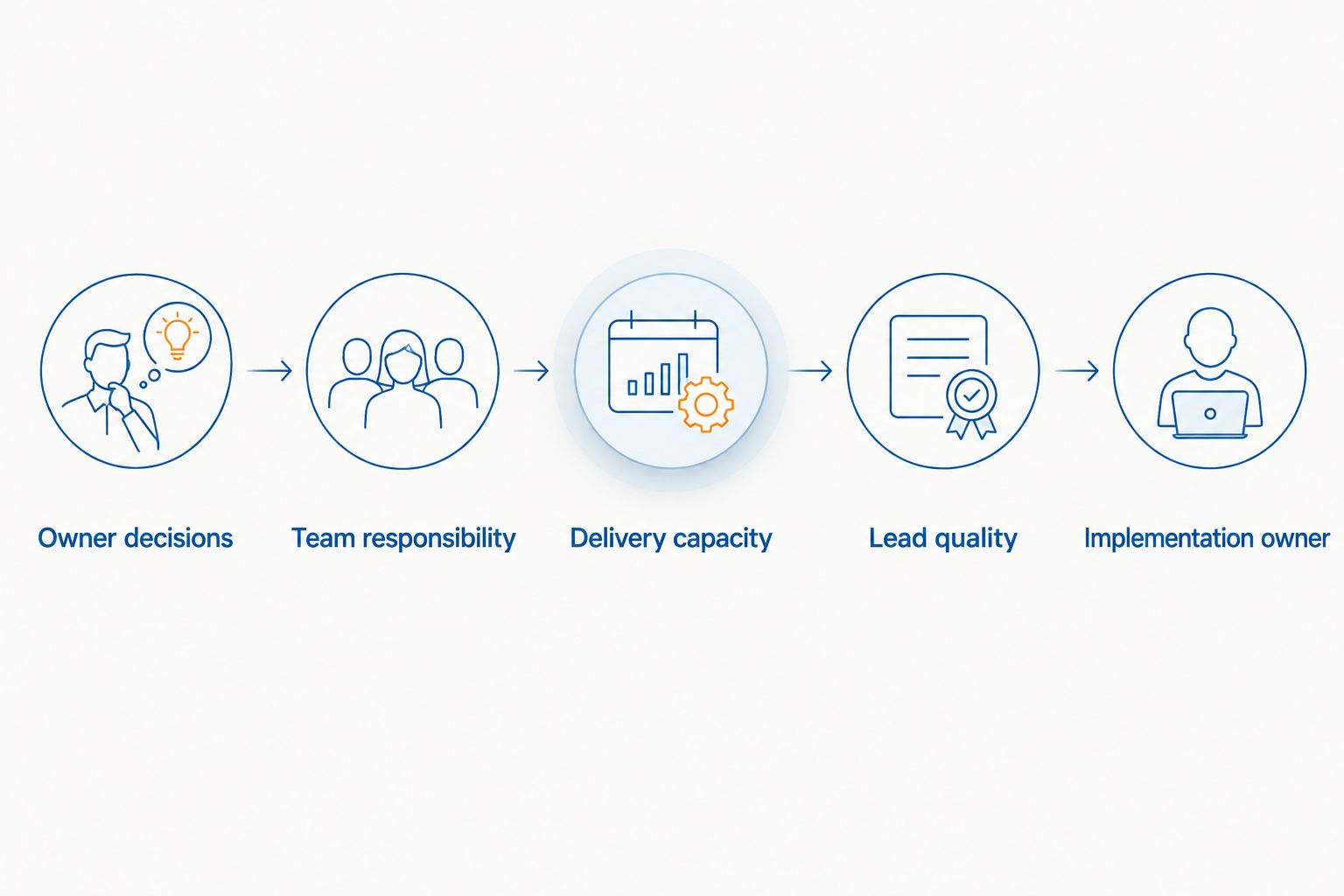
Define the delivery constraint before asking for more enquiries.
Consider this hypothetical example, not a client result: a service business receives 10 enquiries per week, wins 6 jobs per week and has capacity for only 4 additional jobs per week. More enquiries do not resolve the mismatch between accepted work and delivery capacity.
The coaching brief should first address booking decisions, scheduling responsibility and the work the business accepts. Only then should the marketing brief change. These figures illustrate the decision; they are not benchmarks or promised outcomes.
How these options are ranked
This 2026 guide ranks support models by the problems they address, using the criteria above: owner independence, delivery capacity, implementation ownership, commercial relevance, evidence and working arrangements.
The named provider’s description establishes its location, audience and stated scope. The specialist entries are hiring categories, not endorsements of unidentified firms. No independent testing, Sydney provider comparison or guaranteed outcome is claimed.
Which business coaching option should you choose?
Choose combined coaching and implementation when strategy and execution both need attention. Choose operations-focused support when daily decisions keep returning to you. Choose specialist trade or professional-services support when the handover depends on the way your work is delivered.
If marketing is the priority, confirm that your team can fulfil the work first. Then define the offer, qualification rules and sales handover you need help improving.
Before you book a conversation, prepare a short brief covering the constraint, internal owner and required implementation support. Ask for a proposed scope against that brief—not a generic growth presentation.
FAQ
What is the best business coach for a Sydney business owner?
The best fit depends on whether your constraint is owner dependence, delivery, sales or demand. Compare relevant scope and implementation responsibilities before choosing by location or personality.
Is Elevatory based in Sydney?
Elevatory is based in Queensland, not Sydney. Its stated offer combines business coaching with done-with-you marketing implementation for established Australian businesses; confirm working arrangements directly.
Should I hire a business coach or an operations manager?
Hire for the responsibility you need filled. A coach supports decisions and capability, while an operations manager takes an internal management role; confirm the actual scope rather than relying on a title.
Can a business coach help me step off the tools?
Choose a coach whose agreed scope addresses crew leadership, delegation and delivery responsibilities. Ask which decisions will transfer, who will own them and how your team will learn the process.
Do I need more leads before hiring a business coach?
More leads are not a prerequisite for coaching. If your team already struggles to fulfil accepted work, brief the coach on delivery capacity and owner dependence first.
What should I ask a business coach before signing?
Ask what the engagement includes, who implements each change and how progress will be assessed. Request relevant evidence and clarify meeting arrangements, responsibilities and exclusions.
Does done-with-you coaching mean the coach runs my marketing?
Done-with-you support requires participation from your business and is not the same as handing over the entire function. Get the division of work documented before committing.
One last thing
Ask every shortlisted coach: “Which recurring decision should stop reaching me first?” Then ask who will own it, what information they need and when they should escalate.
Use the answer to assess the proposed work. A clear handover is a more useful starting point than an ambitious revenue target with no delivery plan behind it.
Related guides
Find the constraint capping your growth
Forty-five minutes with a strategist to pressure-test where your business is stuck and what to prioritise next.
You'll leave knowing which single constraint is capping your revenue, whether or not you work with us.
Prefer to talk first? Call 1300 634 230 or email chris@elevatory.com.au